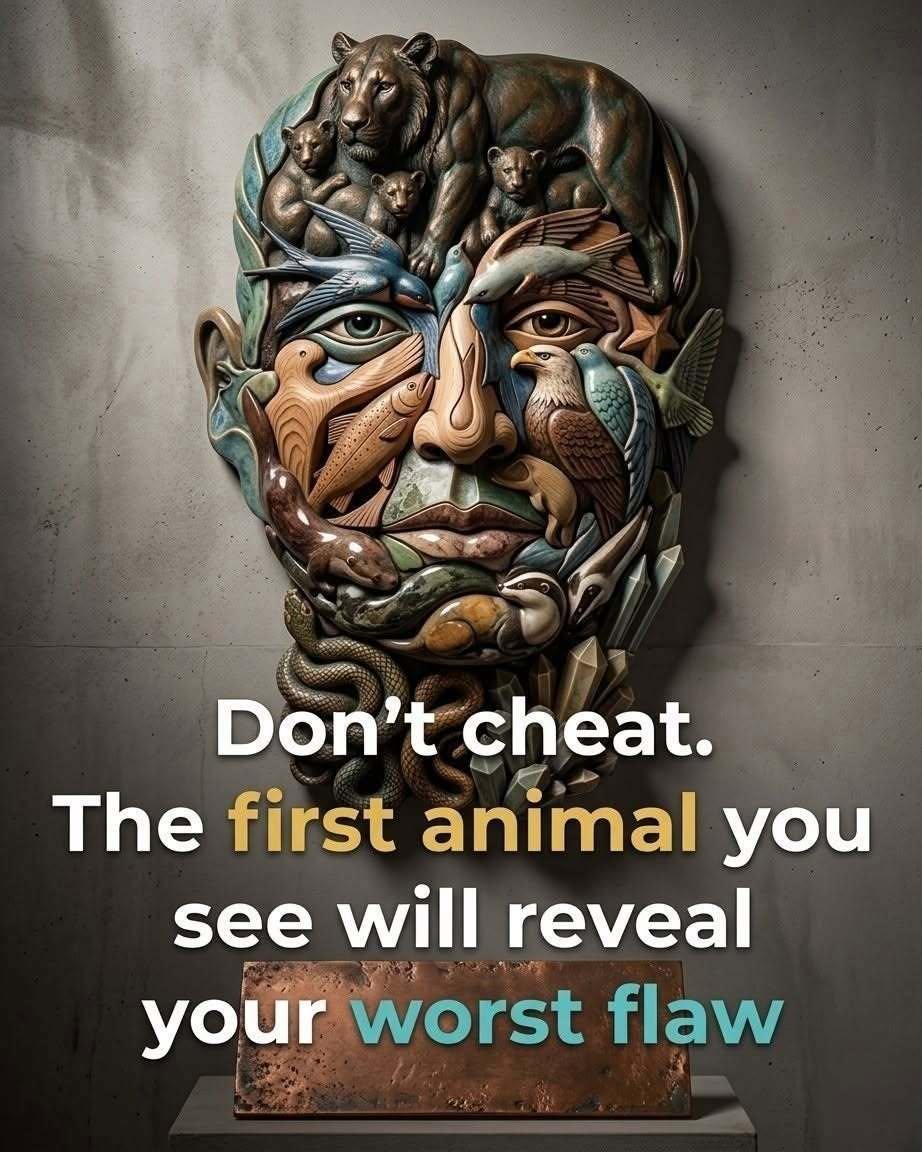
These “first animal you see” challenges have spread widely across social media, often accompanied by dramatic promises about uncovering hidden fears, relationship patterns or subconscious personality traits.
The concept is simple.
You’re shown an illustration containing several animals cleverly hidden within one another.
Instead of carefully studying the entire picture, you’re supposed to notice your immediate reaction.
Which animal appeared first?
Supporters of the game suggest that your instinctive answer reveals something about the way your mind works.
For example, people who immediately notice a lion are sometimes described as strong-willed, confident and naturally dominant.
But the less flattering interpretation suggests that the same personality may struggle with pride or a desire to remain in control.
Spot a rabbit first?
Viral interpretations commonly associate rabbits with sensitivity and emotional awareness.
Such people may be compassionate and highly attentive to the emotions of others, but the same sensitivity could supposedly make them prone to worrying or overthinking.
Those who notice a bird are frequently associated with independence.
They may value freedom, dislike feeling restricted and prefer making decisions for themselves.
A snake, meanwhile, is often given a very different interpretation.
Because snakes have long carried symbolic associations with danger and caution, seeing one first is sometimes said to indicate mistrust, guardedness or a tendency to watch carefully before allowing someone to get close.
Then there’s the elephant.
Elephants are commonly associated with memory, loyalty and strong emotional bonds.
In these viral tests, noticing an elephant first may therefore be interpreted as a sign that someone places enormous importance on family, memories and past experiences.
But before you start reconsidering your entire personality because you spotted a rabbit instead of an elephant, there’s something important to understand.
These interpretations are not established psychological diagnoses.
There isn’t reliable scientific evidence showing that the first animal you notice in a viral optical illusion can accurately uncover your personality, predict your relationships or expose hidden psychological problems.
What these pictures can demonstrate, however, is something genuinely interesting about perception.
When the brain receives complicated or ambiguous visual information, it tries to organize it rapidly.
Certain shapes may attract your attention before others.
Previous experiences, expectations, contrast, positioning and visual salience can all influence what you notice.
That’s why two people can stare at exactly the same picture and immediately see completely different things.
The phenomenon is sometimes loosely compared online with projective psychological techniques such as the famous Rorschach inkblot test.
But a viral animal puzzle shouldn’t be confused with a professionally administered psychological assessment.
So why can the results still feel strangely accurate?
One possible explanation involves something psychologists call the Barnum Effect.
It describes our tendency to accept broad personality descriptions as being uniquely applicable to ourselves, particularly when those descriptions contain characteristics many people recognize in themselves.
Consider a statement such as:
“You care deeply about others, but sometimes you need space for yourself.”
A huge number of people could reasonably identify with that description.
Yet when it appears underneath the animal you personally selected, it can suddenly feel surprisingly specific.
That’s part of what makes personality quizzes so compelling.
We naturally search for connections between the result and our own experiences.
That doesn’t necessarily make these visual challenges useless.
Used as entertainment rather than diagnosis, they can provide an interesting starting point for self-reflection.
If your result says you’re reluctant to trust people, for example, the important question isn’t whether a hidden snake somehow discovered your personality.
A more useful question might be:
Do I actually have difficulty trusting people—and if so, why?
That’s where a simple internet puzzle can become interesting.
Not because it possesses a secret ability to read your subconscious mind, but because it encourages you to think about yourself.
So if you encounter one of these complicated animal illustrations, go ahead and play along.
Notice which creature catches your attention first.
Read the interpretation.
See whether any part of it resonates.
Just don’t treat the result as a psychological verdict.
The most fascinating thing about these illusions may not be what they supposedly reveal about your personality.
It’s that hundreds of people can look at exactly the same image—and somehow see completely different things first.