am sixty-nine years old, and until the afternoon of my granddaughter’s wedding, I believed I had already lived through the worst thing that could happen to a person. I buried my husband Henry eleven years ago. I raised a child who was not mine to raise and loved her more than my own breath. I thought grief had taught me everything it had to teach. I was wrong. There was one more lesson waiting for me, and it came folded inside a printed wedding program, in a reception hall on the edge of a small heartland town, on the day that was supposed to be the happiest of my life.
Let me start at the beginning, because you cannot understand what that program did to me unless you understand what it erased.
My name is Mei. I was born in a village outside Guangzhou, and I came to this country when I was twenty-four with two suitcases, a husband, and forty dollars sewn into the lining of my coat. Henry and I worked. That is the whole story of our early years, told honestly. We worked. He took whatever job would hire a man with an accent and I took in sewing and later cooked in the back of a diner off the county road, the kind of place where the coffee is bottomless and the pie is somebody’s grandmother’s recipe. We saved. We bought a small house with a crooked porch and we raised one daughter in it, and we thought we understood what our lives were going to be.
Then our daughter grew up and had a daughter of her own, and named her June, and then, when June was three years old, our daughter left.
I am not going to spend this story blaming her. She had her own wounds, and some of them were ones Henry and I put there without meaning to, the way immigrant parents sometimes do, loving their child so hard and so anxiously that the child cannot breathe. She left with a man we never met, to a city we could not name, and she did not come back. For a while there were phone calls. Then there were postcards. Then there was nothing, and I stopped waiting by the mailbox and started raising June myself.
June was three. Henry was still alive then. I want you to picture it, because I lived it, every single day. I want you to picture a woman in her fifties who thought she was done with lunchboxes, standing in the school-supply aisle in September with a list in a child’s handwriting, buying the folder with the horses on it because that was the one June wanted. I want you to picture the recliner in our front room where I sat up half the nights June had the croup, the steam from the kettle fogging the window, her small hot body against my chest while I sang her the songs my own mother sang me in a language she would never learn to speak but somehow always understood.
That was my life for sixteen years. From three to nineteen, I was June’s mother in every way that the word means anything. I signed the permission slips. I sat in the folding chairs at the recitals, in the second row so she could find my face, and I clapped until my hands stung whether she hit the notes or not. I learned to braid hair from a library book because Henry’s hands were too big and mine had never done it and June wanted braids like the other girls. When Henry died, when June was eight, it was the two of us in that crooked-porch house, and we held each other up.
I want to tell you about one ordinary morning, because the big moments are not really where a childhood lives. It lives in the ordinary ones. June was maybe ten. It was a school morning, cold, the frost thick on the inside of the kitchen window, and she came down the stairs already crying because she had a spelling test she was sure she would fail. I did not know the words. Some of them I could barely pronounce myself. But I sat her down at the kitchen table with her cereal going soft in the bowl and I had her spell each one out loud to me, over and over, and every time she got one right I made a mark on a napkin with a pencil, a little tally, so she could see the pile of right answers growing in front of her. She got a ninety-two on that test. She ran off the school bus that afternoon waving it over her head. I still have that napkin. I know that sounds foolish, a grown woman keeping a napkin with pencil marks on it for twenty years, but I have it, folded in the drawer with Henry’s watch, and it is one of the most precious things I own.
That is what I mean when I say I raised her. Not the grand gestures. The napkins.
And I paid. This is the part nobody at that wedding wanted printed anywhere. I paid.
I paid for the dentist and the winter coats and the class trip to the state capital that June cried about missing until I found the money for it. I paid for the summer she wanted to go to the science camp two counties over, the one all the smart kids went to, and I did not tell her that I picked up extra shifts at the diner for four months to do it. I paid for the used car when she turned seventeen so she could drive herself to her job at the pharmacy, and I paid for the insurance on it, and I paid, quietly, for the SAT prep books and the application fees when she started talking about college like it was a door she was afraid to knock on.
I paid for college. Not all of it. There were loans, and there were scholarships, because June was clever and worked for everything. But every gap, every semester the numbers did not add up, I closed it. I sold Henry’s truck. I refinanced the crooked-porch house at an age when I should have been paying it off, not borrowing against it. I did these things gladly and I did them silently, because I did not want June to carry the weight of knowing. A child should get to become herself without an invoice attached. That was what I believed. That is still what I believe.
I never once thought of it as a debt she owed me. I want to be clear about that. Love is not a loan. But I did think, God forgive me for the vanity of it, that when the day came, when June stood up in front of her whole life and married the man she loved, there would be a moment. A small one. A moment where I would be allowed to stand up and say, into a microphone, in front of everyone, that this girl was the light of an old woman’s life and that I had been lucky, so lucky, to raise her.
I did not think that was too much to ask. I still do not.
The man June was marrying is named Danny, and I liked him. I want to say that plainly, because what happened was not Danny’s doing, and I do not want you to hate the boy. Danny is kind. He is the sort of young man who stands up when an older person comes into the room and does not know he is doing it. When he asked me, one Sunday over the pot roast I had made because I knew it was his favorite, whether he could marry June, he asked me. Not her absent mother. Not anyone else. Me. He held my hand across the table and his own hand was shaking, and he said, “Mrs. Mei, you’re the one who raised her, so you’re the one I have to ask.” I cried. I told him yes before he even finished.
The trouble did not come from Danny. The trouble came from Danny’s mother, whose name is Bethanne.
Bethanne is a handsome woman in her early fifties, always beautifully put together, the kind of woman whose earrings match her blouse match her handbag, who has an opinion about everything and delivers it with a smile so bright you do not realize until later that it cut you. From the first time we met, at a dinner Danny arranged so the two families could get to know each other, I felt something in her go cool when she looked at me. She was polite. She was always, always polite. But she looked at my sensible shoes and my one good dress and my accent that has never fully left me after forty-five years, and I watched her file me into some drawer in her mind, and the drawer was not a good one.
She took over the wedding almost from the moment it was announced. That was fine with me at first. I am not a woman who needs to control things. I offered to help, and I offered to pay, because I had saved a little back for exactly this, and Bethanne waved both offers away with that bright smile. “Oh, we’ve got it all handled,” she said. “You just enjoy the day.” I told myself that was generosity. I know now it was something else. It was ownership. It was Bethanne deciding, early, whose wedding this was going to be and whose it was not.
There were signs, if I had wanted to read them. The dress fittings I heard about afterward instead of being invited to. The venue chosen and booked before anyone thought to ask what I thought. The seating I was not consulted on. Small things. I let them go, every one, because June was happy, and June loved me, and June called me every few days just to talk, and I thought the love between me and my granddaughter was the only thing that mattered and the rest was just Bethanne being Bethanne.
Then came the day itself.
The reception was held in a hall on the edge of town, a nice place, a former grange with high wooden rafters and long windows that let the late-afternoon light come in gold across the floor. Round tables with white cloths. A head table up front for the wedding party. Flowers everywhere, more flowers than I had ever seen in one room, all of them Bethanne’s doing. It was beautiful. I remember standing in the doorway when I first arrived, in my good blue dress, with my hair done at the salon that morning, holding the little wrapped gift I had made for June, and thinking, this is it, this is the day I have worked toward for sixteen years.
I had written my toast. I had been writing it, honestly, for months, in the margins of grocery lists and on the backs of envelopes, crossing out lines and adding better ones. I had it folded in my handbag, four index cards, worn soft at the corners from how many times I had taken them out to read them over. I knew it by heart by then. It began with the horse folder. It ended with Henry, with how proud he would have been, and how he was there with us anyway, in June’s stubborn chin that was exactly his. I had practiced it in the bathroom mirror until I could say the ending without my voice breaking. I was ready.
I found my name on the seating card table and my name was not at the family table.
I stood there in front of that little easel with the alphabetized cards for a long moment, sure I had misread. I looked again. There was June’s mother’s side of the family, though June’s mother herself was not coming, at the good tables near the front. There was Bethanne’s family, a great sprawl of them, filling three tables in the golden light by the windows. And there was my card, “Mei,” with the table number nine printed under it, and table nine, when I found it, was at the very back of the hall, near the doors to the kitchen, next to a table of Danny’s coworkers I had never met.
I told myself there had been a mistake. I am an old woman and I did not want to make a scene at my granddaughter’s wedding, so I sat down at table nine and I folded my hands and I decided I would sort it out quietly, later, and in the meantime I would simply be grateful to be in the room.
That is where I was sitting when Wendy found me.
Wendy is a cousin of Danny’s, a big warm woman about forty with a laugh you can hear across a room, who had been helping the caterers all afternoon because that is the kind of person she is, the kind who cannot sit still while other people work. She had met me a handful of times and had always been kind. She crouched down next to my chair at table nine with a look on her face I did not understand yet, and she said, “Mei. Honey. Did you know they took your toast off the program?”
I did not know what she meant. I said so.
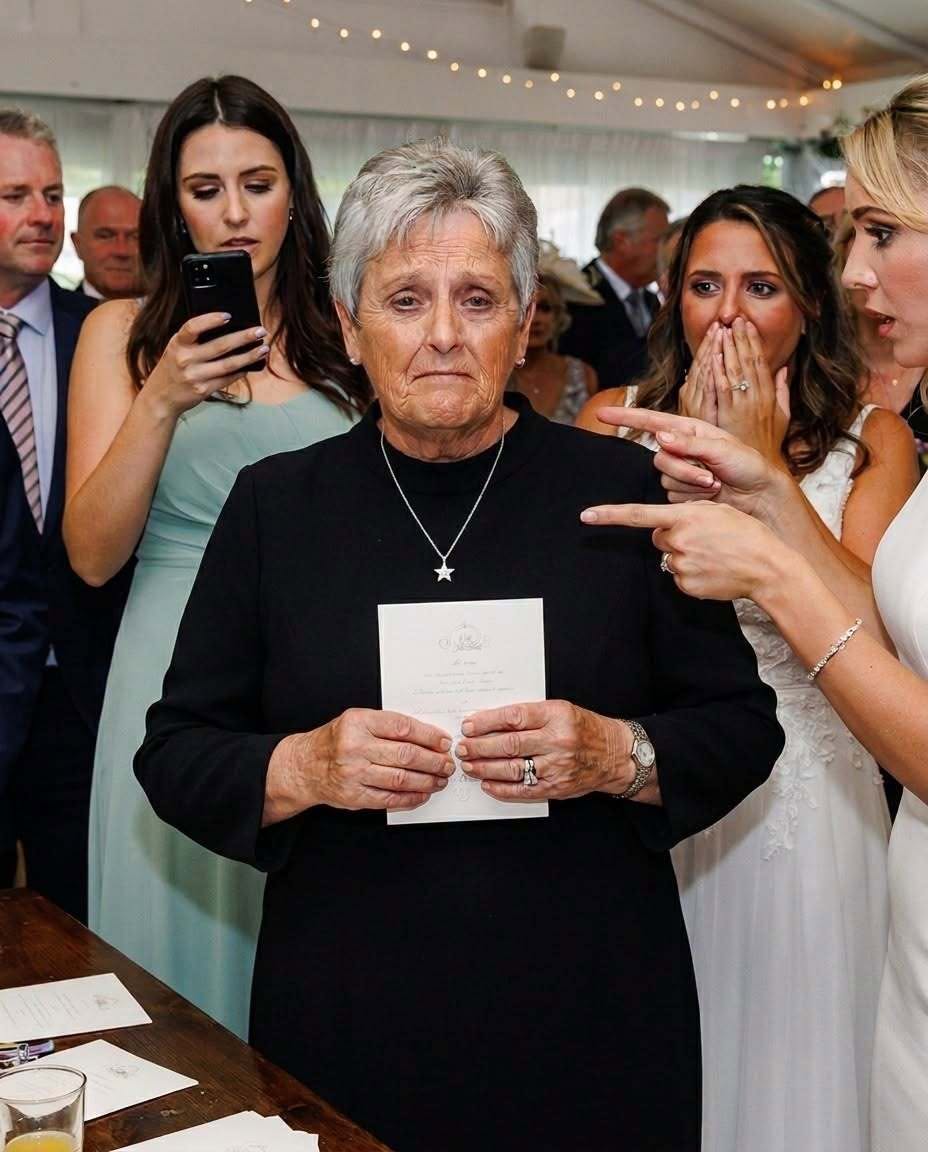
She had a program in her hand, the printed one, cream cardstock with gold lettering, folded in three. She opened it to the inside, where the order of the reception was printed out, the entrances and the first dance and the cake and the toasts. And she pointed. There was a list of who would speak. Bethanne, welcoming everyone. The best man. The maid of honor. Danny’s father. And there, near the bottom, was a line that had my name in it, printed and then struck through, a single line drawn through it in ballpoint pen, done by hand, at the last minute, so that anyone holding the program would see exactly who had been removed.
“Grandmother of the bride, Mei,” it said. And then a line through it. Gone.
I looked at that struck-out line for a long time. I did not cry. I remember being almost calm, the way you go calm when something is too big to feel all at once. Wendy was still crouched beside me, and she looked like she might cry herself, and she said, “I heard her say it. I wasn’t going to tell you, but you deserve to know. I heard Bethanne tell the coordinator to take you out.”
And then Wendy told me the words. She did not want to. I could see she did not want to. But I asked her, and she told me, and I have not been able to unhear them from that day to this.
Bethanne had said, “She’s not really the mother, is she. And honestly, she doesn’t fit the photos. It’ll look strange having her up there. Just cut her from the program and put her somewhere in the back.”
She doesn’t fit the photos.
I want you to sit with that line the way I have had to sit with it. Sixteen years. From three years old to nineteen. Every fever and every folder with horses on it and every extra shift at the diner and Henry’s sold truck and the house I refinanced at sixty-two. Every braid I learned from a library book. Every night in that recliner. All of it, all of that love and all of that labor and all of those quiet sacrifices no one was ever supposed to know about, weighed against a woman’s worry that my face and my sensible shoes and my accent would look strange in the photographs.
She doesn’t fit the photos. So cut her from the program and put her in the back.
I sat at table nine and I held Wendy’s warm hand and I made a decision. I decided I was not going to ruin June’s day. Whatever had been done to me, June had not done it, and June’s wedding was not going to become the day her grandmother made a scene at the back of the hall. I would sit. I would smile. I would clap at the right times. And afterward, someday, I would find a way to make my peace with the fact that I had given everything and been erased with a ballpoint pen.
That was my plan. It lasted about twenty minutes.
Because June came looking for me.
I did not know it at the time, but June had been asking for me. She had gone up to the head table and looked out at the room and could not find me, and she had asked Danny, and Danny did not know, and she had asked her new mother-in-law, and Bethanne had said something smooth about how everyone was seated and it was almost time for the toasts and June should just relax. And June, who is clever, who has always been clever, who I raised to notice things, had felt something wrong in that smooth answer, and had gone looking herself.
She found me at table nine, by the kitchen doors, in my good blue dress, holding a program with my name crossed out of it.
I tried to hide it. I actually tried to slide the program under the tablecloth, as if I were the one who had something to be ashamed of. But June is quick, and she saw it, and she picked it up off my lap before I could stop her, and she read it. I watched my granddaughter’s face as she read the line with her name and my name and the pen struck through mine. I watched her understand it.
She knelt down in front of my chair, in her wedding dress, on that dusty floor by the kitchen, and she took both my hands, and she said, “Popo.” That is the word I taught her for grandmother when she was small, the word from my own childhood, the word I never thought this heartland-raised girl would keep, but she kept it. “Popo. Who did this?”
I did not want to say. I said it did not matter. I said it was fine, that the toasts were only a few minutes and I did not need to be in the program, that I was just happy to be there. I said all the things you say when you are old and you have decided to swallow something to protect someone you love.
June looked at me, and her eyes were full, and she said, “You raised me. You are the only mother I have ever had. And somebody decided you don’t belong in my wedding.”
And then my granddaughter stood up.
I reached for her hand to pull her back. I whispered, “June, no, it’s her mother’s day too, don’t, please, it’s fine.” Because even then, even after everything, my instinct was to make myself small so that no one would be uncomfortable. That is what a lifetime of being the woman who does not quite fit the photos will do to you. It will teach you to apologize for taking up space.
But June did not sit down. She walked to the front of the hall, in her wedding dress, and she went to the little table where the microphone was set up for the toasts, and she picked it up before Bethanne or the coordinator or anyone else could stop her, and she tapped it twice, and the sound cut through the golden room, and everyone went quiet.
I will remember what she said until the day I die.
She said, “Hi, everyone. I know we’re not supposed to start the toasts yet. But I need to say something first, and it can’t wait.” She looked out over all those round white tables, all those faces, Bethanne’s family by the windows and the head table and every seat in the room, and then she looked past all of them, to the very back, to table nine by the kitchen doors, to me.
She said, “When I was three years old, my mother left. And a woman took me in and raised me. She is my grandmother, but that word isn’t big enough, so I’m going to tell you what she actually is. She is the person who sat up with me every night I was sick. She is the person who taught herself to braid my hair out of a library book. She sold her husband’s truck to send me to science camp. She borrowed against her own house, the only thing she had, to help put me through college, and she thought I never found out, but I found out, because I found the papers, and I never said anything because I didn’t know how to thank someone for a thing that big.”
The room was silent. I could hear the caterers stop moving in the kitchen behind me.
“Her name is Mei,” June said. “I call her Popo. And someone decided tonight that she doesn’t fit the photos, and they crossed her name off the program, and they put her at a table in the back by the kitchen. So I’m going to fix that right now.”
And June walked. In her wedding dress, down the length of that whole hall, past every table, past Bethanne, who had gone the color of the tablecloths, all the way to the back, to table nine, to me. And she held out her hand.
“Popo,” she said, in front of all of them. “Come sit with me. And say the toast you wrote. I know you wrote one. Come say it.”
I could not move at first. I have never in my life had a room full of people looking at me, and here was a room full of strangers looking at me, and my granddaughter with her hand out. And then Wendy, beside me, put her arm around my shoulders and lifted me up gently and said in my ear, “Go on, Mei. Go on, now.” And I stood up on my old legs and I took June’s hand and we walked back up the length of that hall together, the grandmother in her good blue dress and the bride in white, and somewhere along the way, from the tables of people who did not even know me, the clapping started.
It started at the back and it moved forward like a wave, table by table, and by the time June and I reached the front the whole room was on its feet, and I do not know all of what they were feeling, but I felt it hold me up. Even some of Bethanne’s family were clapping, I saw later. Even them. Bethanne herself sat very still with her matching earrings and her bright smile finally gone, and I did not look at her long, because I did not need to. I had stopped needing anything from Bethanne the moment my granddaughter said my name into that microphone.
June handed me the microphone. My hands were shaking and I had left my four soft index cards in my handbag at table nine, but it did not matter, because I knew the toast by heart, I had known it for months. I looked at June, in her white dress, my girl, the light of an old woman’s life, and I said the thing I had practiced in the bathroom mirror until I could say it without breaking.
I told them about the horse folder. I told them about the recliner and the kettle and the songs in a language she never learned but always understood. I told them about Henry, and how proud he would have been, and how he was in the room with us anyway, in the stubborn set of June’s chin that was exactly his. I did not say a word about the program, or the back table, or the woman who had put me there. I did not need to. The whole room had watched what happened. My revenge, if you want to call it that, and I do not, was simply to stand at the front of that hall and be exactly who I had always been, out loud, where everyone could see, in the photos and everything.
I got to the end without my voice breaking. I lifted my glass. I said, “To June. Who I raised, and who, it turns out, has been quietly raising me right back into somebody brave, this whole time. I am the luckiest old woman alive.” And the room drank to my granddaughter, and June was crying, and Danny was crying, and I was not, somehow, I was smiling, because there is a kind of joy that comes out too big and too warm for tears.
I did sit at the head table for the rest of the night. June had a chair brought over and put right next to hers, and there I stayed, and when the photographer came around, June pulled me into every single picture. Every one. If Bethanne wanted photos of the family, she got them, and I am in the middle of them, in my good blue dress, next to the bride, exactly where I belonged.
Bethanne and I have not become friends. I will not pretend to you that the day ended with the two of us weeping in each other’s arms, because it did not, and I do not believe in tidy endings that are not true. She avoided me for the rest of the reception. Months later she sent a short note that was almost an apology, and I wrote back something kind, because I am too old to carry a grudge and because June has to share a family with that woman for the rest of her life and I will not make that harder. We are civil. That is enough. I do not need Bethanne to love me. I have June.
Here is what I have carried away from that day, and it is the thing I most want to leave you with.
I spent sixteen years believing that love done quietly did not need to be seen to be real. I still believe that. I would do all of it again, the extra shifts and the sold truck and the refinanced house, without ever telling a soul, and I would want no credit for any of it. But I learned something at table nine that I did not know before. There is a difference between choosing to keep your love quiet and having someone else decide your love does not count. The first is humility. The second is cruelty. And you do not have to accept the second one, even at sixty-nine, even in your good blue dress, even at the back of the hall by the kitchen doors.
Sometimes the people you gave everything to will grow up and become brave enough to give it all back to you, in front of a whole room, in a moment you never asked for and could not have imagined. Sometimes the child you raised in a recliner will walk the length of a wedding hall in her white dress to take your old hand and say, into a microphone, that you are the only mother she has ever had.
I am sixty-nine years old. I have buried a husband and raised a granddaughter and I have been crossed off a program in ballpoint pen for not fitting the photographs. And I am here to tell you that I have never, not once in my whole long life, felt more seen than I did the moment June said my name.
I fit the photos now. I am in every one of them. Ask June. She’ll show you.
This story is a dramatization. Names, characters, and details are invented, and any resemblance to real people or events is coincidental.