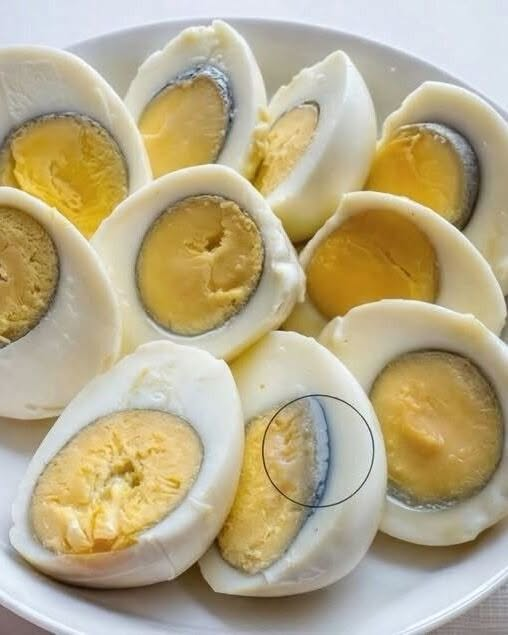
You peel a perfectly ordinary hard-boiled egg, anticipating a vibrant yellow yolk.
Instead, you freeze.
Surrounding the yolk is an unusual greenish-gray ring that suggests something has gone terribly wrong.
Was the egg spoiled?
Did it go bad?
Is it unsafe to consume?
Every year, thousands of individuals pose these questions after noticing the puzzling discoloration. Some discard the eggs immediately, while others believe they’ve made a significant cooking error. A few even fret about the possibility of getting ill.
The reality, however, is far less concerning than most assume.
In fact, that peculiar green ring is among the most common—and misunderstood—culinary enigmas.
The good news is that it poses no danger.
It isn’t mold.
And it doesn’t indicate that your eggs have spoiled.
The explanation lies in a straightforward chemical reaction that occurs during cooking.
For many home chefs, hard-boiled eggs appear to be one of the simplest foods to make.
Place the eggs in water.
Boil them.
Peel them.
Done.
Yet achieving the ideal hard-boiled egg is surprisingly more intricate than many realize.
A change of just a few minutes can significantly alter the final outcome.
The green ring develops when eggs are exposed to heat for too long.
Inside every egg are naturally occurring minerals and compounds.
The yolk contains iron.
The egg white has sulfur.
When eggs are cooked for an excessive duration or exposed to very high temperatures, sulfur from the white reacts with iron from the yolk.
The outcome is a compound known as iron sulfide.
This chemical reaction results in the greenish-gray layer that appears around the yolk’s edge.
Although the appearance may be unappealing, the egg remains entirely safe to eat.
Many people are astonished to discover that the green ring is unrelated to freshness.
Fresh eggs can develop it.
Older eggs can also develop it.
The discoloration merely indicates how the egg was cooked.
Overcooking often leads to another familiar issue as well.
That strong sulfur scent commonly linked to hard-boiled eggs.
The longer eggs are subjected to high heat, the more intense this odor tends to become.
While harmless, both the smell and the green ring can make otherwise tasty eggs less appetizing.
Fortunately, avoiding the issue is surprisingly simple.
The secret starts before the stove is even turned on.
Many professional chefs advise beginning with cold water instead of placing eggs directly into boiling water.
Putting eggs in a pot and covering them with cold water allows them to heat gradually and uniformly.
This reduces stress on the shell and helps prevent cracking.
It also enhances overall cooking consistency.
Once the eggs are submerged in water, the next step is patience.
Bring the water to a gentle boil over medium heat.
Many people err by using maximum heat to hasten the process.
Rapid boiling can cause eggs to bump against each other and crack.
A gentler method typically yields better results.
Once the water reaches a boil, the real secret begins.
Instead of continuing to cook the eggs aggressively, many experts suggest turning off the heat completely.
Cover the pot.
Allow the eggs to stay in the hot water.
The residual heat completes the cooking process more gently.
Timing is crucial.
For slightly creamy yolks, around nine minutes is often adequate.
For fully firm yolks suitable for salads and sandwiches, twelve minutes usually works well.
The most significant error occurs when eggs stay in hot water too long.
Every additional minute raises the likelihood of developing the green ring.
But even perfect timing isn’t sufficient.
The next step may be even more critical.
Immediate cooling.
As soon as the cooking time concludes, transfer the eggs to ice water or very cold water.
This process swiftly halts cooking.
Without this cooling step, eggs continue to cook internally even after leaving the heat source.
That extra heat is often responsible for the discoloration people aim to avoid.
The cold-water bath also provides another significant advantage.
Easier peeling.
Anyone who has struggled to remove tiny shell bits from a hard-boiled egg knows how frustrating this can be.
Cooling helps detach the membrane from the egg white, making it easier to remove the shells.
Some home cooks have additional tricks they swear by.
One popular suggestion is to use slightly older eggs rather than extremely fresh ones.
Fresh eggs tend to stick more firmly to their shells.
Eggs that are a few days old often peel much more effortlessly.
Others add a small amount of salt or vinegar to the cooking water.
While these additions don’t directly prevent the green ring, they can help minimize mess if a shell breaks during cooking.
Storage is important too.
Hard-boiled eggs remain surprisingly convenient because they can be prepared ahead of time.
When left unpeeled, they typically stay fresh in the refrigerator for up to a week.
Once peeled, however, they should be consumed much sooner to maintain freshness and quality.
The intrigue surrounding the green ring continues because it appears far more serious than it truly is.
Humans naturally associate unusual colors in food with danger.
A greenish-gray yolk doesn’t exactly instill confidence.
Yet in this instance, appearances are deceptive.
The discoloration signifies nothing more than chemistry doing what it does best.
No contamination.
No spoilage.
No hidden risks.
Just a reaction between iron and sulfur triggered by excessive heat.
Understanding the science behind it transforms a worrisome mystery into a straightforward kitchen lesson.
And once you grasp the cause, preventing it becomes simple.
Start with cold water.
Avoid overcooking.
Cool the eggs immediately.
That’s really all it requires.
The next time you prepare hard-boiled eggs, you’ll understand exactly why that green ring appears—and more importantly, how to keep your yolks perfectly golden.
Because sometimes the difference between an ordinary egg and a picture-perfect one comes down to just a few minutes and a bowl of ice water.