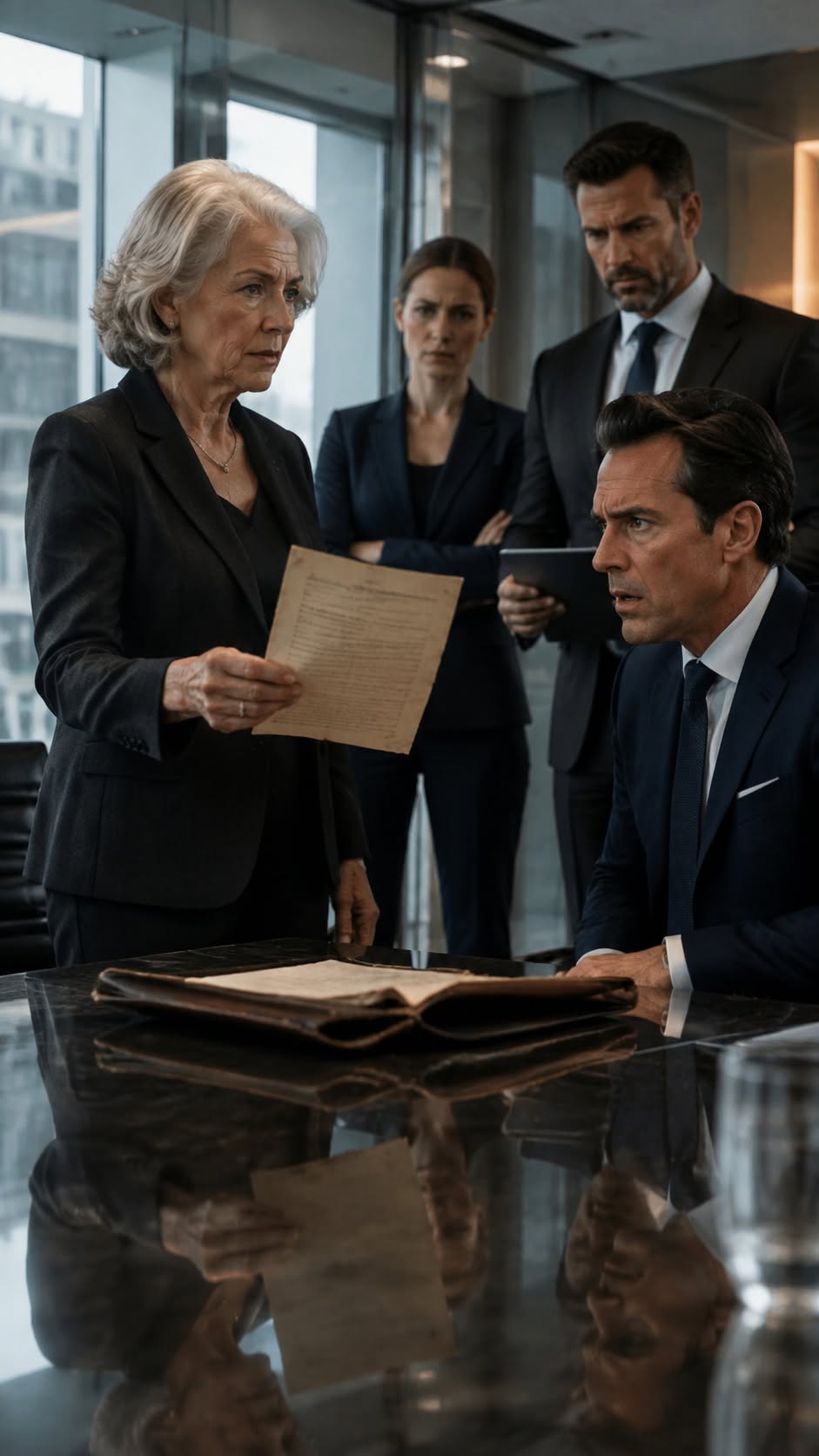
“You’re too old to understand what this business needs.”
Caleb Mercer did not raise his voice. That was what made the sentence land harder.
“Interesting.”
Helen Mercer closed the folder in front of her with one quiet click.
“Why is my name off the meeting agenda?”
“Because you’re not part of operations anymore.”
“Don’t take it personally.”
“You removed me from the company I helped build and called it efficiency.”
“Dad built it.”
“Really? The land came from my mother, not your father.”
“That doesn’t mean you understand today’s market.”
“Today’s market? You fired the oldest employee—the man who carried your father after his heart attack.”
“We had to make hard decisions.”
“Hard for everyone except the people making them.”
“You’re getting emotional.”
“Yes. I get emotional when arrogance wears my husband’s last name.”
Caleb shifted in his chair.
“Now let’s discuss the motel.”
“What about it?”
“The investor meeting is mine.”
“That’s impossible.”
“Because I invited them.”
“Why didn’t Dad tell me?”
“He expected you to ask before taking.”
“Mom—.”
“No. Investors are waiting.”
“What are you going to tell them?”
“The truth about who actually has authority to sell.”
Caleb’s face changed.
It was only a flicker. A tightening around the mouth, a quick glance toward the glass wall of the conference room, as though he expected someone outside to have heard the last sentence. Helen noticed.
She had spent thirty-eight years married to a man who could read a balance sheet from across a room. She had learned to read people the same way. Caleb looked down at the papers in front of him.
“You don’t have authority to derail a transaction because you’re angry.”
“I’m not angry about the transaction.”
“You’re angry because I removed you.”
“No. I’m angry because you think removing my name from a meeting removes my rights.”
He gave a short laugh.
“Rights? Mom, this isn’t about rights. It’s about whether we can survive another quarter.”
Helen looked through the glass wall at the framed photograph hanging in the reception area. Her husband, Richard Mercer, stood in front of the first Mercer Pines sign twenty-two years earlier, one hand resting on the hood of a rust-red pickup. Beside him stood Caleb at nineteen, grinning like a boy who had just been handed the world.
The photograph had been taken three weeks after Helen’s mother died. Everyone remembered Richard’s story. Nobody remembered the deed.
Helen slid her hand beneath the folder and touched the worn leather edge of a document she had carried into the building that morning. She had not looked at it in eleven months. She had not needed to. Until Caleb fired Walter Boone.
Walter had worked at Mercer Pines since the first room opened. He had slept in the maintenance shed during the hurricane that tore half the roof away. He had driven Richard to the hospital during his first heart attack because Caleb had been two states away. When Richard’s hands shook too badly to sign checks, Walter had sat beside him and read every number aloud.
Yesterday, Caleb had handed Walter a cardboard box. Severance. Thirty days. No explanation.
Helen had found Walter in the parking lot afterward, standing beside his old green van with the box on the hood.
“What did he say?” she had asked.
Walter had stared at the motel windows.
“He said the business needed younger blood.”
“And you?”
“I told him blood wasn’t the problem.”
Helen had almost smiled.
Then Walter had reached into the box and taken out a yellowed envelope.
“I found this behind the old office safe,” he said. “Your husband told me never to throw it away.”
Helen had not opened it. Not yet.
Because Richard had spent the last year of his life telling her something she had refused to hear. Caleb isn’t ready. She had thought he meant management. Now she wasn’t so sure. The conference-room door opened.
A young woman in a navy suit stepped inside, followed by a broad-shouldered man carrying a tablet.
“Mrs. Mercer?”
Helen stood.
“Leah Bennett?”
“Yes.”
The woman extended her hand.
“We’re here for the motel acquisition.”
Caleb rose so quickly his chair struck the wall.
“Leah, there has been a misunderstanding.”
“No,” Helen said. “There hasn’t.”
Leah looked from one to the other.
“I was told this meeting would include the controlling ownership.”
“It does,” Helen said.
Caleb’s jaw tightened. Helen pulled out the worn leather folder.
“I believe you were given the wrong person.”
Leah glanced at Caleb.
“Which one of you is authorized to sign?”
Caleb answered first.
“I am.”
Helen opened the folder.
“No.”
The room went still.
She removed a photocopy of a deed and placed it on the table. Caleb stared at it.
“That isn’t the company deed,” he said.
“No.”
Helen turned the page.
“It’s the land deed.”
Leah leaned forward. Helen tapped the signature at the bottom.
“My mother transferred this parcel to me in 1997. Richard built the motel on it with my permission. The corporation has operated here ever since.”
Caleb shook his head.
“Dad owned Mercer Pines.”
“He owned the business.”
“You can’t separate the business from the property.”
“Your father did.”
Caleb looked at the deed again.
“He never told me.”
“He told you to ask.”
“I did ask.”
“When?”
“Before he died.”
Helen’s eyes narrowed.
“And what did he say?”
Caleb hesitated.
“He said the motel was mine to run.”
“Run,” Helen repeated.
“Yes.”
“Not sell?”
He said nothing. Leah slowly set down her tablet.
“Mr. Mercer, our proposal is contingent upon clean authority to transfer both the operating company and the real property.”
“It is clean,” Caleb said.
Helen turned to him.
“Then sign.”
He stared at her.
“Sign what?”
“The authorization you claimed you had.”
His face hardened.
“You know I can’t.”
“Exactly.”
Leah looked at Helen.
“Mrs. Mercer, I think we need to understand something before we proceed.”
“We will.”
Helen opened the yellowed envelope Walter had given her.
The paper inside was folded twice. Richard’s handwriting ran across the top in dark blue ink. Helen recognized it immediately. Her fingers stopped. Caleb noticed.
“What is that?”
Helen looked at her son.
“Something your father left for me.”
“About the motel?”
“About you.”
Caleb stood.
“Mom, don’t do this.”
She unfolded the page. At the bottom was a date from four months before Richard’s death.
And beneath the date was a sentence that made Helen read it twice.
If Caleb tries to sell Mercer Pines without his mother’s written consent, give her the original file in the safe. Helen slowly raised her eyes. Caleb had gone pale.
“Where is the safe?” she asked.
Walter Boone, who had been standing silently outside the open door, answered from the hallway.
“Still where your husband left it.”
Helen looked at him.
“Can you open it?”
Walter nodded.
“I’ve had the key for eleven months.”
Caleb turned toward him.
“You knew?”
Walter met his eyes.
“Your father asked me to.”
The young investor stepped back from the table.
“I’m sorry,” Leah said, “but I think this meeting just changed completely.”
Helen folded Richard’s letter and put it back in the envelope.
“No,” she said.
“It finally became the meeting it was supposed to be.”
Leah closed her tablet.
“I’ll wait in the lobby,” she said. “I don’t want to be part of a family dispute.”
“This isn’t a family dispute,” Helen said.
Caleb gave a bitter laugh.
“Of course it isn’t.”
Leah paused at the door.
“Mrs. Mercer, when you’re ready, have your attorney contact mine. Until then, there will be no signatures and no money transferred.”
“Understood.”
Leah left with her associate. The door swung shut. For several seconds, nobody moved. Then Caleb looked at Walter.
“You should have told me about the safe.”
Walter’s expression did not change.
“Your father told me not to.”
“He’s been dead almost a year.”
“I know.”
“So why keep obeying a dead man?”
Walter looked at Helen.
“Because he was specific.”
Helen picked up her purse.
“Where?”
“The old office.”
Caleb stepped toward the door.
“I’m coming.”
“No.”
“It’s my father’s safe.”
“And this is my land.”
His eyes flashed.
“That’s exactly the attitude that’s going to destroy everything Dad built.”
Helen stopped.
“Then you should be very interested in finding out what he actually built.”
She walked out. Walter followed. Caleb had no choice but to follow them.
The old office sat behind the main reception area, squeezed between the laundry room and a narrow corridor that had once led to six guest rooms. Richard had stopped using it years ago. The door still carried his brass nameplate, its edges darkened with age. Walter unlocked it.
The room smelled of dust, cedar, and the faint metallic scent of the old radiator. Helen stood in the doorway. Nothing had changed.
Richard’s desk remained beneath the window. His old green desk lamp sat beside a stack of motel ledgers. A framed photograph of Helen’s mother occupied the corner, exactly where Helen remembered it. Caleb looked around.
“Why didn’t you clear this out?”
“Your father said he wasn’t finished with it.”
“He died.”
Walter’s gaze moved to him.
“I know.”
Caleb looked away. Walter crossed to the bookcase.
He removed three thick accounting ledgers from the bottom shelf and placed them on the floor. Behind them was a narrow wooden panel. Helen’s breath caught.
“I never knew that was there.”
“Most people didn’t.”
Walter took a small brass key from his pocket. Caleb stared at it.
“You’ve been carrying that all this time?”
“Yes.”
“Why?”
“Because Richard gave it to me.”
Walter inserted the key. There was a click. He pulled the panel open.
Behind it sat a black steel safe, no larger than a suitcase, bolted into the brick wall. Helen stepped closer.
“Why would Dad hide documents here?” Caleb asked.
Walter looked at him.
“Because he knew people would look in the bank.”
“Who?”
“People who thought the bank was the only place he kept important things.”
Walter turned the key twice. The safe door opened.
Inside were four thick folders, a small leather-bound notebook, an envelope marked HELEN, and a second envelope marked CALEB — ONLY IF NECESSARY. Caleb stared at the second envelope.
“What’s that?”
Walter reached for it. Helen stopped him.
“Leave it.”
Caleb looked at her.
“You’re going to read mine.”
“No.”
“Then why did Dad leave it?”
“Because he expected you to become the man who could read it.”
Caleb’s face tightened.
“And if I haven’t?”
Helen looked directly at him.
“Then we’ll find out why.”
She took the folder marked with her name. The first document inside was an original deed. Not a copy. Not a corporate filing. The original.
The paper had been carefully preserved in a clear sleeve, and Helen recognized her mother’s signature before she saw her own. Samuel Ortiz arrived twelve minutes later.
He had been Richard’s attorney for twenty-six years and had represented the company since its incorporation. Helen had called him from the parking lot without explaining more than three words: Richard’s safe. He entered the old office carrying a leather briefcase. He looked at Caleb, then at the open safe.
“I was hoping we wouldn’t need this.”
Caleb folded his arms.
“You knew?”
Samuel took off his glasses.
“I knew your father had documents he wanted kept here.”
“Did you know what they said?”
“Yes.”
“Then you knew I wasn’t the owner.”
Samuel’s eyes held his.
“I knew you were the president of Mercer Pines Hospitality.”
“That isn’t what I asked.”
“No.”
The single word landed heavily. Caleb looked at his mother.
“Everybody knew except me.”
Helen’s voice was quiet.
“That’s not true.”
“You think that makes me feel better?”
“No. I think it makes the next question important.”
She handed Samuel the deed. He examined it without surprise.
“This is the original conveyance from your grandmother to you, Helen. Recorded in 1997.”
Caleb stepped closer.
“Why wasn’t it transferred to Dad?”
Samuel looked at him.
“Because your mother didn’t want it transferred.”
“Dad owned the company.”
“Yes.”
“So why build a motel on land he didn’t own?”
“Because your mother leased the land to the company.”
Caleb stared at him.
“For how long?”
“Thirty years, with renewal options.”
“And who controls renewal?”
Samuel did not answer immediately. Helen did.
“I do.”
Caleb stepped back.
“So Dad spent twenty years building a company that could lose its property if you changed your mind?”
“No.”
Helen opened another folder.
“Your father spent twenty years making sure neither of us could destroy what he built alone.”
Inside was the operating agreement. Samuel laid it flat across Richard’s desk.
“Read section seven.”
Caleb bent over the page. His finger moved down the paragraph. He stopped.
“No.”
“Read it aloud,” Samuel said.
Caleb’s mouth tightened.
“Any sale, transfer, mortgage, assignment, or other encumbrance affecting the motel premises requires written consent of the landowner.”
He looked up.
“That’s Helen.”
“Yes.”
“That’s just the lease.”
“No.”
Samuel opened the next folder.
“These are the corporate bylaws.”
He turned to a marked page.
“The president may conduct ordinary business. He may sign contracts, hire employees, manage operations, negotiate purchases, and execute agreements within the approved budget.”
Caleb nodded.
“Exactly.”
Samuel continued.
“He may not sell substantial company assets, pledge the company’s interest in real property, or enter a transaction involving a related-party transfer without board approval.”
Caleb looked at him.
“I had board approval.”
Helen’s eyes sharpened.
“From whom?”
“Three directors.”
“Names.”
Caleb said nothing. Samuel reached into the folder.
“There are only three directors besides your mother.”
He placed a second page on the desk.
“Your father never amended the board after his illness. Two seats remain vacant.”
Caleb’s face changed.
“You’re saying the vote wasn’t valid.”
“I’m saying there was no quorum.”
Silence filled the office. Helen looked at Walter. He had turned away from them. His eyes were on the old photograph of Richard. Caleb rubbed his forehead.
“Why?”
Nobody answered. He looked at his mother.
“Why would Dad set this up?”
Helen opened the final folder. At the top was a letter dated four months before Richard’s death. This one was longer than the note she had read upstairs. Samuel reached for it. Helen held it back.
“I’ll read it.”
Samuel nodded. Helen unfolded the pages.
“Dear Helen,” she began.
Her voice faltered only once.
“By the time you read this, I will either have explained this to you or failed to find the courage.”
Caleb lowered his eyes. Helen continued.
“I know what you will think. You will think I should have told Caleb years ago that the land is yours and that his authority over Mercer Pines has limits. Perhaps I should have. But I watched our son grow into someone who believes responsibility means having the power to make every decision.”
Caleb looked up.
“Mom.”
Helen kept reading.
“Caleb is capable. He is intelligent. He can make this business grow. But he has begun confusing growth with ownership, and ownership with permission.”
Caleb’s face reddened. Samuel remained silent. Helen turned the page.
“Do not take the land away from him because he makes mistakes. Do not give him the land simply because he is our son. Let the documents decide. That was the agreement between your mother and me, and it is the only way I know to keep Mercer Pines from becoming a prize that the loudest person wins.”
Helen stopped. Her fingers tightened around the paper. Then she read the next paragraph.
“Your mother gave you that land because she trusted you to protect it. I built the motel because you trusted me to build something on it. Caleb inherited the company, not the ground beneath it. I need you to remember that distinction when the day comes that someone asks you to sign something you never agreed to.”
Caleb turned toward the window. For a moment he looked younger. Not the executive who had dismissed Walter.
Not the man who had sat at the head of the conference table.
Just Richard’s son, hearing his father’s voice from a page he could no longer argue with. Helen read on.
“If Caleb ever tries to sell Mercer Pines without your consent, do not argue with him. Do not threaten him. Give him the documents and ask him one question: What exactly did you think you owned?”
Helen lowered the letter. Caleb stared at the floor. Walter broke the silence.
“He asked me to remember that line.”
Caleb looked at him.
“Why?”
“Because your father knew you wouldn’t listen to him when he was alive.”
Caleb’s eyes flashed.
“You think you knew him better than I did?”
“No.”
Walter’s voice stayed level.
“I think he knew you better than either of us did.”
Caleb moved toward him. Helen stepped between them.
“Enough.”
Caleb stopped. Samuel lifted the last sheet from the folder.
“There is one more provision.”
Caleb looked over. Samuel tapped the page.
“Your father’s succession clause.”
Helen frowned.
“I’ve never seen that.”
“Neither had I until he amended the agreement privately.”
Caleb’s voice was low.
“What does it say?”
Samuel read it.
“If the president attempts to encumber the motel premises without the landowner’s written consent, his authority as president is suspended immediately upon written notice from the landowner, pending review by the board.”
Caleb stared at him.
“Suspended?”
“Yes.”
“Immediately?”
“Yes.”
“And Dad signed that?”
“Your father signed it.”
Helen looked at the date. Four months before Richard’s death. The same month as the letter.
The same month Richard had started asking her strange questions about Caleb’s spending.
She remembered him at the kitchen table one night, pushing a stack of receipts toward her. Not accusing. Not angry. Just tired.
“Do you know what he bought?” Richard had asked.
She had said no. He had folded the receipts back into the envelope.
“Then don’t ask him yet.”
At the time, she had thought he was protecting their son. Now she understood he had been buying time. Caleb reached for the document. Samuel let him take it. He read the clause again. Then he looked at his mother.
“So you can suspend me.”
“I can give written notice.”
“And then the board decides.”
“Yes.”
Caleb laughed once, but there was no humor in it.
“You’ve been waiting for this.”
“No.”
“You knew this existed.”
“I didn’t know the details.”
“But you knew Dad had something.”
“I knew he was afraid.”
“Of me?”
Helen held his gaze.
“Of what you might do if you believed nobody could stop you.”
Caleb looked down at the papers spread across his father’s desk. The deed. The operating agreement. The bylaws. The succession clause.
Every road he had thought belonged to him now ended at Helen’s signature. He picked up the final envelope from the safe. The one marked with his name. He turned it over. There was no seal. No lock. Just Richard’s handwriting. Caleb looked at Helen.
“Can I open this?”
Helen nodded.
“Yes.”
He tore the envelope carefully. Inside was a single sheet. Caleb read the first line. His expression changed. He read the second. Then he sat down hard in his father’s chair.
“What?” Helen asked.
He did not answer. Samuel stepped closer. Caleb folded the page in half.
“What does it say?” Helen asked again.
Caleb looked at his mother. For the first time that day, he seemed genuinely frightened.
“It says Dad knew I was going to need money.”
Helen’s hand went still on the desk. Samuel held out his hand.
“Let me see it.”
Caleb didn’t move. Walter watched him from across the room. Then Caleb whispered,
“He says I wasn’t supposed to borrow against the motel.”
Walter did not move immediately. He looked at Helen, then at Caleb, as though waiting for the decision that mattered. Helen picked up her handbag.
“Show me.”
They left the conference room together, with Leah and her associate following a few paces behind. Caleb remained where he was for a moment, staring at the closed folder on the table. Then he snatched up his phone and followed.
The old office was at the back of Mercer Pines, past the laundry room and a narrow corridor that smelled faintly of detergent and cedar. Richard had used it long after the company moved its administrative offices into the renovated building. The brass nameplate was still on the door.
R. MERCER Walter unlocked it. Helen stepped inside. Nothing had changed enough to make her comfortable.
Richard’s desk was still beneath the window. His old calculator sat beside a mug filled with pens. A wall calendar showed the month he had died, its pages never turned. On the shelf were three binders, a brass clock, and a photograph of Helen and Richard standing beside the first motel cabin while rain streamed off the roof.
Caleb stopped in the doorway.
“He kept all this?”
Walter glanced back.
“Your father didn’t throw much away.”
“That isn’t what I asked.”
“I know.”
Helen crossed to the desk.
“Where is it?”
Walter pointed toward a tall oak cabinet in the corner.
“Behind the bottom drawer.”
Caleb gave a disbelieving laugh.
“You’re telling me Dad hid a safe behind a filing cabinet?”
“No.”
Walter pulled the bottom drawer open.
“He hid the filing cabinet in front of the safe.”
For the first time since leaving the conference room, Helen almost smiled.
Walter removed the drawer completely and set it on the floor. Behind it was a black steel door, barely visible against the dark wood. Caleb stared at it.
“That’s been here the whole time?”
“Since before you were born.”
Walter took a small key from his pocket. Caleb stepped closer.
“Where did you get that?”
“Your father gave it to me.”
“You said eleven months.”
“I said I’ve had it for eleven months.”
Walter inserted the key.
“He gave it to me the week before he went into the hospital for the last time.”
The lock turned. Helen’s hand tightened around Richard’s letter.
“Why didn’t you tell me?”
Walter looked at her.
“Because he made me promise I wouldn’t unless Caleb tried to sell the property.”
Caleb’s eyes narrowed.
“So this whole thing was planned.”
“No,” Helen said. “Your father planned for the possibility.”
Walter pulled the safe door open.
Inside were four thick document boxes, a sealed envelope, and a small leather-bound notebook. Helen’s breath caught. She knew the blue box.
Richard had kept the original property records in it from the day her mother signed the transfer. Caleb saw the box too.
“That’s the deed?”
“Yes.”
He reached for it. Helen caught his wrist.
“Don’t.”
He looked at her hand, then slowly looked up.
“I’m your son.”
“And that is my mother’s property.”
Silence settled over the room.
Leah stood just outside the doorway, making no attempt to hide that she was listening. Helen lifted the first box onto Richard’s desk.
“Walter, call Samuel.”
Caleb’s expression changed again.
“Why do we need a lawyer?”
“Because I don’t intend to argue about what these papers mean.”
“They’re family papers.”
“No. They’re business records.”
She looked at him.
“And that is exactly why we’re going to have a lawyer read them.”
Walter stepped into the hall with his phone. Caleb remained beside the desk.
“You’re humiliating me.”
Helen opened the blue box.
“I haven’t said anything to anyone.”
“You brought an investor into a meeting and told her I don’t have authority to sell my own company.”
“Your company?”
He flinched.
“You know what I mean.”
“I do.”
Helen removed a heavy cream-colored document.
The original deed was older than Caleb, older than Mercer Pines, and written in the formal language her mother had insisted on when she transferred the land. Helen read the first page. Then she turned it over. There it was. Her mother’s signature. Her own.
And the legal description of the parcel on which every cabin, every office, every parking space and every pine tree now stood. Caleb leaned over her shoulder.
“So the land is yours.”
“It always was.”
“Dad built everything on it.”
“Yes.”
“Then why didn’t he put it in the company?”
Helen looked at the deed for several seconds before answering.
“Because I asked him not to.”
Caleb stared at her.
“Why?”
“Because my mother gave me that land after your father and I had been married for twelve years. She told me she wanted one thing in my name that nobody could take from me if the business failed.”
Caleb’s voice softened.
“Did you think Dad would fail?”
“No.”
She placed the deed on the desk.
“I thought businesses could.”
Walter returned.
“Samuel’s on his way.”
Helen nodded. Caleb looked again at the document.
“Dad could have told me.”
“He should have.”
“Then why didn’t he?”
Helen’s eyes moved to the sealed envelope inside the safe.
“I think we’re about to find out.”
Samuel Ortiz arrived twenty minutes later carrying a battered leather briefcase and wearing the expression of a man who had been summoned away from lunch to discover a disaster. He stopped when he saw Caleb.
“Is this the disaster?”
Helen shook her head.
“Not yet.”
Samuel looked at the boxes.
“Then I assume that’s the disaster.”
Walter closed the office door.
Samuel took off his glasses and examined the deed first. He read every page without speaking, then opened the second box. The operating agreement was there. So were the corporate bylaws. Samuel laid them side by side. Caleb folded his arms.
“Tell me something I don’t already know.”
Samuel did not look up.
“You’re the chief executive officer of Mercer Pines Hospitality, Inc.”
“I know.”
“You can operate the business.”
“I know.”
“You can enter ordinary contracts.”
“I know.”
“You can hire and fire employees.”
Caleb’s eyes flicked toward Walter.
“Yes.”
Samuel turned one page.
“But you cannot sell, mortgage, lease for more than ten years, or otherwise encumber the real property beneath Mercer Pines without the written consent of Helen Mercer.”
Caleb’s face hardened.
“That clause is old.”
“It’s current.”
“Dad could change it.”
“He didn’t.”
“Maybe he intended to.”
Samuel tapped the signature block.
“He amended the agreement twice.”
Caleb leaned forward.
“And?”
“And he left this clause untouched both times.”
Helen watched her son read the page. His finger stopped over a paragraph near the bottom.
“What does this mean?”
Samuel adjusted his glasses.
“It means your father’s shares gave you control over the company only so long as the company operated the motel under the existing land arrangement.”
Caleb looked up.
“That makes no sense.”
“It makes perfect legal sense.”
“Why would Dad do that?”
Samuel looked at Helen.
“Because he wanted the business and the land to remain separate.”
Caleb’s voice sharpened.
“Why?”
Nobody answered. Samuel opened the third box.
Inside was a bundle of old meeting minutes tied with faded red string. On top was a document dated six months before Richard’s death. Samuel read it. Then he read it again. Helen saw the color leave his face.
“What?” she asked.
Samuel handed her the page.
“Your husband documented his reasons.”
She read the first line. Richard’s handwriting appeared beneath the formal minutes, squeezed into the margin. I am not changing the land arrangement. Helen swallowed. Below it, another sentence.
The company can recover. The land must not be put at risk while I am alive, and it must not be put at risk after I am gone. Caleb stepped closer.
“That’s it?”
“No,” Samuel said.
He reached for the sealed envelope.
“This is.”
Helen’s fingers were suddenly cold. The envelope had her name written across the front. Not Mrs. Richard Mercer. Not Helen Mercer, wife of Richard. Simply: Helen. She broke the seal. Inside was a letter three pages long.
Richard had written it in the uneven handwriting that appeared during the last months of his illness. Helen read silently at first. Then her eyes stopped on the second paragraph. She began again from the top.
“Read it,” Caleb said.
Helen looked at him.
“It’s private.”
“About me?”
“Yes.”
“Then I have a right to hear it.”
Samuel spoke quietly.
“Whether you have a legal right is one question. Whether your mother wants to read her husband’s final letter aloud is another.”
Caleb stepped back. Helen looked down at the page. Richard’s first words were simple. Helen, If you’re reading this, then something happened that I hoped never would. She stopped. Walter looked away. Helen continued.
I know Caleb believes Mercer Pines belongs to him because I have allowed him to believe it. I did that deliberately, and I am sorry. Caleb’s breathing changed.
“Keep going,” he said.
Helen’s thumb pressed into the paper.
I wanted my son to believe that leadership was something he could inherit. I wanted him to discover that authority is something he must earn. She lowered the page. Caleb gave a bitter laugh.
“So Dad was testing me.”
Samuel said nothing. Helen continued.
He has talent. He understands numbers better than I did at his age. But he has begun to confuse ownership with permission. Twice he has asked me to borrow against the property. Twice I refused. He thinks I am afraid of debt. I am not. I am afraid of what he will risk when he believes the thing he is risking belongs entirely to him.
Caleb’s face went rigid. Helen looked at him.
“You asked him to borrow against Mercer Pines?”
“I asked about expansion financing.”
“That isn’t what he wrote.”
“I don’t know what he thought I asked.”
Helen read the next paragraph.
I have not told Caleb that his authority is conditional because I need to know whether he will respect a boundary he cannot see. If I tell him, he may simply learn how to work around it. If he respects it without being told, then I will know I raised the man I hoped to raise.
Caleb shook his head.
“That is cruel.”
Helen’s voice was barely above a whisper.
“He was dying.”
“That doesn’t make it less cruel.”
She looked at the page again. The final paragraph was written more shakily than the rest.
If he ever tries to sell the land, do not save him from the consequences. Give him the opportunity to tell you the truth. If he does, listen. If he lies, let the documents speak for me. Beneath it was Richard’s signature. Richard Mercer. Helen lowered the letter.
Nobody spoke. Then Caleb said, “He knew.” Samuel looked at him.
“Knew what?”
Caleb’s eyes remained on the letter.
“That I was going to sell.”
Helen stood very still.
“Were you?”
Caleb did not answer. Helen waited.
“Caleb.”
He rubbed both hands over his face.
“I had an offer.”
Walter’s head lifted.
“What offer?”
Caleb looked toward the window.
“Nothing was final.”
Leah, still waiting in the hallway, heard him.
“Mr. Mercer,” she said from the doorway, “your email to my office says the property was available for immediate acquisition.”
Caleb turned. Helen’s eyes stayed on him.
“What else did you tell them?”
He said nothing. Samuel reached into the document box and removed another sheet.
“This,” he said, “might answer that.”
Caleb stared at the page. It was a copy of an authorization request dated three weeks earlier. The signature line at the bottom bore Caleb’s name. Helen stepped closer.
“That’s my signature.”
“No,” Samuel said.
“It is.”
“Mrs. Mercer, look at the date.”
She did. Her stomach tightened. She had been in the hospital that day with her sister.
“I never signed this.”
Caleb’s face went blank. Samuel placed the document beside the original operating agreement.
“And that,” he said quietly, “is why your husband kept the original file in the safe.”