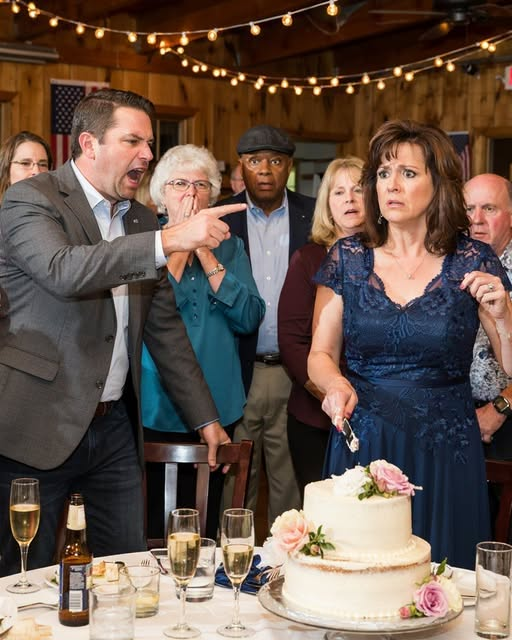
At 6:42 that Saturday evening, twenty two months after my brother’s last failed drug test and eleven days after I had paid four hundred dollars I did not especially have for a sheet cake shaped like a stethoscope, I was standing at the head table of the Comstock County VFW hall with a cake knife still in my hand and buttercream drying on my thumb when my brother Rodney tapped his beer glass with a fork and said the sentence that ended eighteen years of both of us pretending we were fine.
“Everybody keep clapping for Merrilee like she’s the one who should be standing up here,” he said, glass raised, wearing the same easy grin that used to talk our mother out of grounding him. “Just remember what actually happened. She didn’t raise my daughter. She stole one from a man who was already down, and she never once let me have her back.”
Sixty two people went quiet in about a second and a half. I know it was sixty two because I had counted the place settings myself that morning at the caterer’s request. I know it was 6:42 because the wall clock behind the folding table of paper plates was the last ordinary thing my eyes landed on before I made myself look at my brother instead, and some stubborn, useless part of my brain filed the time away the way I used to file a patient’s vitals, automatic, unwanted, exact.
My niece Junia was sitting three feet from her father in her good navy dress, her brand new BSN pin fastened a little crooked to her collar because I had pinned it on her myself forty minutes earlier with hands that were shaking from pride, not nerves. She had been a licensed nurse for two hours and eleven minutes. I watched the color drain out of her face and land somewhere around her collarbone, and I understood, in the way you understand weather changing in your knees before you see the clouds, that this was not going to be a small thing we laughed about by Thanksgiving.
I wish I could tell you I said something dignified into that silence. I did not say anything at all. I stood there holding a cake knife at a party I had paid for, in a hall my property taxes help keep the lights on in, and let my brother’s sentence sit over sixty two of our neighbors and half my church, because for about four full seconds I could not make my mouth remember how words worked. It was Junia who broke the silence first, not me, and I will get to what she said, because it is the reason I am able to write any of this down without my hands shaking. But first I have to tell you what actually happened, because Rodney was right about exactly one thing that evening, and wrong about everything else, and the difference matters more than I can say.
My name is Merrilee Holcomb. I am forty seven years old. I live seven miles outside a small town called Comstock, Nebraska, cattle and wheat country, the kind of place where the Sunday church bulletin still runs a prayer list by first name only because everyone already knows the last names. For eighteen years, since Junia was six years old, I raised my brother’s daughter as my own, and until 6:42 that Saturday evening, I would have told you, without a flicker of hesitation, that whatever else had gone wrong between Rodney and me, we had both made a kind of peace with what those eighteen years had cost each of us. I was wrong about that. But I want you to understand what those eighteen years actually held, because a toast at a party is four sentences long, and a childhood is not.
Rodney is two years younger than me. We grew up on our parents’ place outside Comstock, and he was the kind of little brother who could talk a rattlesnake out of its own skin, funny and quick and better looking than any of it should have made a person, and our whole family loved him the specific, worried way you love someone you can already tell is going to need extra watching. He married young, to a woman named Renae who left town for good when Junia was four and has not, to my knowledge, called her daughter more than a handful of times since. Rodney worked construction and did fine for a few years, and then he did not, and by the time Junia was six, the fine had been gone for a long while and none of us had wanted to say so out loud.
The call came on a Tuesday in March, nineteen years ago this coming spring. I was twenty nine years old, six weeks away from starting an eighteen month critical care fellowship at Prairie View Regional Medical Center in Omaha, a job I had wanted since nursing school, the kind of opportunity a hospital that size does not offer twice. I had already signed the lease on an apartment near the medical campus. My things were half packed in boxes in my parents’ garage. The call was from a Comstock County deputy I had gone to high school with, telling me Rodney had been arrested for burglary and possession with intent, that he had been stealing copper wire off a construction site to sell for meth money for longer than any of us had realized, and that Junia, six years old, had been found alone in his apartment at eleven at night by a neighbor who heard her crying through the wall.
I drove to that apartment before I drove anywhere else, before the jail, before my parents’ house. Junia was sitting on a stripped mattress in a t shirt with no pants on, eating dry cereal out of the box because there was nothing else in the kitchen, and when I picked her up she did not cry or ask questions. She just put her face into my neck and stayed there, and I remember standing in that apartment with a six year old’s whole weight against my chest, doing math I did not want to do. Prairie View held the fellowship spot for eleven days while I made calls I already knew the answer to. Our parents were sixty eight and seventy one, in fragile health themselves, in no shape to take on a six year old full time. Renae was already three states away and unreachable. There was no one else. I called the fellowship director, a woman named Adalyn Reyes who had championed my application personally, and told her I could not come. She was kind about it in a way that still makes my chest hurt to remember, and she told me the door would not stay open, and it did not, and it should not have. I made my choice with my eyes open. I do not regret it. I want that on the record before anything else in this story, because Rodney’s sentence at that party tried to make my eighteen years sound like theft, and a woman does not steal a child she spent a career to keep.
I moved back to Comstock that April with two suitcases and a car full of boxes I never fully unpacked for years, took over the lease on a little three bedroom rental a half mile from my parents, and petitioned for temporary guardianship of Junia while Rodney’s case worked through the county court. He pled to a reduced charge and was sentenced to forty months at the state correctional facility in Tecumseh, of which he served twenty seven before parole. Twenty seven months does not sound like a long time until you are the one filling every single day of it for a child who wakes up screaming some nights and cannot tell you why.
I took a lesser job than the fellowship would have paid, three shifts a week at the Comstock County clinic instead of a trauma floor in Omaha, so I could be home for a six year old’s bus and a six year old’s nightmares and a six year old’s sudden, furious grief that showed up sideways, in tantrums over shoes and bedtime and the wrong color cup. I learned to braid hair from a video on my phone at midnight because Junia’s kindergarten teacher had gently mentioned that the other little girls noticed. I learned that a child who has been left alone in a dark apartment does not sleep through a thunderstorm for almost two years, and I learned to keep a cot made up in my own room without either of us ever having to discuss why.
The hardest year, if I am honest, was the year Junia was seven, when the state finally approved supervised visitation and I drove her ninety minutes each way to the correctional facility in Tecumseh once a month so she could see her father through a wall of scratched plexiglass and a black telephone receiver that smelled like every other frightened family who had held it before us. She would press her small hand flat against the glass and Rodney would press his against it from the other side, and neither hand ever actually touched the other, and I would stand behind her in that visiting room with my own hands balled into fists at my sides, furious at my brother and heartbroken for him in the same breath, because both of those things can be true about someone you love at once. I never once told Junia not to go. I never once made those drives feel like a burden to her, even on the months I had to trade a Saturday shift at the clinic to make the trip, because a father, even a flawed and absent one, was still something worth driving ninety minutes for if your daughter needed to know he existed.
When Junia was eleven, she spiked a fever of a hundred and four on a Tuesday night in January during an ice storm bad enough that the county had closed the highway. Our own little clinic did not have overnight pediatric coverage. I put chains on my tires myself in the dark, kneeling in the driveway with a flashlight clenched between my teeth because my hands were shaking too hard to hold both the light and the tensioner at once, and I remember the specific sound the chains made clicking into place, a sound I still hear sometimes on bad-weather nights even now. I strapped her into the back seat wrapped in every blanket in the house, her lips gone the color of the inside of a plum, and drove forty one miles at eleven miles an hour to the emergency room in North Platte, the wipers barely keeping up with the sleet, the highway a single set of taillights ahead of me and nothing else. I talked to her the whole way so she would not fall asleep, made her name every animal on her farm puzzle from memory, made her count backward from a hundred by sevens even though she was only eleven and hated math, because somewhere in my nursing brain a small cold voice kept saying meningitis, kept running the checklist, nuchal rigidity, photophobia, the soft spot that was not soft anymore because she was eleven and long past having one, until a doctor finally told me, four hours later, standing in a hallway that smelled like burnt coffee and hand sanitizer, that it was a severe ear infection and she was going to be fine. I have never told anyone how close I came to sliding off that overpass twice, how I felt the back tires go loose under me both times and just kept my hands steady and my foot off the brake the way you are trained to do and never actually believe you will be able to do until the moment arrives. I have also never told anyone that I sat in the hospital parking lot afterward, engine still running, and cried harder over a fixed ear infection than I had over almost anything else in my life, because it was the first time since I had taken her in that I understood, all the way down, that I would drive through worse than ice for this child without ever once stopping to ask myself if I had to. I have also never told anyone that I would drive it again tomorrow without a second thought.
The summer Junia turned sixteen, she needed four years of orthodontic work fixed in eighteen months so she would not be self conscious in the yearbook photos that mattered to a sixteen year old more than I was able to convince her they should not. I sold my own car, a decent little Honda I had owned free and clear for six years, and drove a borrowed truck with a bad transmission for eight months so I could pay the orthodontist in full instead of on a payment plan Junia would have noticed and worried over. She did not find out about the car for four more years. When she finally did, from my mother, of all people, at a Christmas dinner, she left the table and did not come back for twenty minutes, and when she did come back her eyes were red and she would not let me apologize for not telling her.
When Junia applied to nursing school, she wrote her scholarship essay about growing up with a father in prison and asked me, the night before the deadline, to help her find the right words for the parts that still hurt too much to write clean. We sat at my kitchen table until one in the morning, and I watched my niece turn the worst year of both our lives into four hundred words a scholarship committee in Lincoln read and decided was worth eleven thousand dollars. She won two more scholarships after that on her own, without my help, and told me once, offhand, in the car, that she had decided to become a nurse the year I drove her through an ice storm, because she wanted to be the kind of calm in a crisis that I had been for her. I did not tell her that night in the car that I had once been eleven days from becoming exactly that kind of nurse myself, in a hospital three hours from where we were sitting, in a life that got quietly folded up and put away the week she needed me instead. I am telling her now, in this article, because some things are easier to say to strangers than to the one person whose face you would have to watch while you said them.
Rodney was released from Tecumseh when Junia was eight and a half, thin and gray and twenty pounds lighter than the brother I remembered, and spent ninety days at a halfway house in Kearney before he was allowed supervised visits, then unsupervised ones, then, slowly, over years, real ones. I want to be fair to him here, because fairness matters more to me than winning an argument about a toast. Rodney worked. He went to meetings four nights a week for the first two years and has not, to my knowledge, missed one in the last eleven. He built a small HVAC repair business from nothing, the kind of business that takes a man’s own two hands and a truck and a reputation you rebuild one satisfied customer at a time in a county where everybody remembers everything. He married a steady, kind woman named Larkin nine years ago, and Larkin has, more than once, quietly helped smooth things between Rodney and me in ways I do not think he ever fully knew about. I was proud of him. I told him so, more than once, meaning every word.
There was a phone call before any of that, one I have thought about more in the last three months than I had in the ten years before it. Junia had just turned eight, and Rodney had been at Tecumseh long enough to earn a single non-monitored call, the kind the facility allows once a prisoner has kept a clean record for a set stretch of time, and he used it to call me instead of our mother, which surprised me enough that I almost let it go to the answering machine on the kitchen wall. He did not ask about Junia first, which surprised me more. He asked how I was sleeping. I told him the truth, badly, some nights not at all, and he was quiet on the line for long enough that I thought the call had dropped, and then he said, in a voice I had not heard him use since we were kids sharing a bedroom wall, that he lay awake most nights doing math too, working out exactly how many of Junia’s birthdays he was going to miss if his appeal did not go through, and that the number scared him more than anything the state could still do to him. He asked me to tell her, if anything ever happened to him in there, that he had asked about her every single day, even the days he did not deserve to. I told him nothing was going to happen to him in there. He asked me to promise to tell her anyway, and I did, and then the line clicked off before either of us had to find a way to end the call ourselves, because Tecumseh cuts you off at exactly the allotted minute whether you are finished or not. I did not sleep that night either, but for a different reason. I sat at the kitchen table until almost three in the morning turning that conversation over, understanding for the first time that my brother’s silence about wanting to be a father was not indifference, it was a man too ashamed of what he had already cost his daughter to ask for more of her than he felt he had earned.
The first time Rodney and Junia spent a full unsupervised Saturday together, she was eleven, and he taught her to change a bicycle tire in the gravel driveway outside the halfway house’s transitional apartment, the two of them crouched over an upside down bike for two hours while he explained tire levers and valve stems in the slow, careful voice of a man who wanted very badly to get something right in front of his daughter. She came home that evening with grease on her jeans and a grin I had not seen on her in months, and I stood at my kitchen sink washing dishes I did not need to wash just so I would have something to do with my hands while I cried a little, grateful and grieving at once, glad my brother was becoming someone worth knowing again and aware, in some small unspoken corner of myself, that I was watching him earn back a kind of afternoon I had spent five years building by myself, one gravel driveway lesson at a time.
Here is the part Rodney’s toast left out, the part that I think, if I am honest, has been sitting under his ribs for years without either of us naming it out loud. When Junia was fourteen, after Rodney had been clean for six years and stable for four, he asked me, carefully, at my own kitchen table, whether Junia might want to come live with him and Larkin full time. I told him the truth, which was that the decision was not mine to make. I sat both of them down together and told Junia, in front of her father, that she was old enough to choose where she wanted to live, that I would support whatever she decided, and that nothing about my love for her would change either way. Junia thought about it for three days. Then she told her father, gently, holding his hand while she said it, that she loved him and was proud of him and wanted him fully in her life, but that home, the actual word home, meant my kitchen and my porch and my truck in the driveway, and she was not ready to trade that for anything, even for him. I have never told Rodney how much that conversation cost me to sit through without saying a single word in my own favor. I let a fourteen year old choose freely, with her father’s hand in hers, and she chose me, and I think some small, wounded part of my brother has been carrying that choice like an accusation for ten years, waiting for a place to set it down.
That is what was sitting behind Rodney’s sentence at 6:42 that Saturday evening, though it took me weeks and one very honest conversation to understand it fully. In the moment, all I understood was sixty two faces turned toward me, my mother’s hand flying to her mouth two tables back, Larkin’s face gone white with something that looked like real shock, and my brother still standing there with his glass raised like he was waiting for applause that was never going to come.
It was Junia who moved first. She stood up so fast her chair scraped hard against the linoleum, loud enough that the sound alone silenced the two or three people in the back who had started to whisper, and she walked around the table and stood between her father and me with her crooked little BSN pin catching the fluorescent light.
“Dad, I love you,” she said, and her voice shook but did not break. “I have loved you my whole life, even the years I only got to see you through a plexiglass window at Tecumseh. But you do not get to stand up at my pinning ceremony and call the last eighteen years theft. I was there for every single one of them, and you were not, and that is not Aunt Merrilee’s fault, and it is not mine either.”
She told the room about the ice storm, about a forty one mile drive at eleven miles an hour with chains on the tires that she still remembered in flashes, headlights and her aunt’s voice never once stopping. She told them about a Honda Civic she did not find out had been sold for her braces until she was twenty, and how she had cried in her grandmother’s driveway not because of the car but because she had spent four years thinking the money had simply appeared, the way children assume things simply appear, and had never once said thank you for it because she had not known there was anything to thank anyone for. She told them about a scholarship essay written at a kitchen table until one in the morning, and about the exact moment, at nine years old, standing in a school gymnasium during a Muffins with Mom event her class had quietly renamed for her sake, that she had first called Merrilee Mom, out loud, in front of a room of other people’s mothers, because there was no other true word left in her mouth for the woman standing next to her.
“You didn’t lose me to her,” Junia said, turning finally to face her father fully. “You lost the years you were in Tecumseh, and the two years after that when you were still finding your feet, and none of that is a thing Aunt Merrilee did to you. She didn’t take your daughter. She kept your daughter alive and fed and loved while you found your way back to being able to do it yourself, and then she let me choose you anyway, over and over, every single time you asked, and I did choose you, Dad. I’m choosing you right now, standing here defending you to a room instead of just walking out. Don’t make me regret it.”
Rodney’s face did something I had not seen it do since he was nine years old and got caught lying to our mother about a broken window, a kind of collapse from the inside that has nothing to do with the muscles of the face and everything to do with whatever sits behind them. He set his glass down on the table so carefully it barely made a sound, and for a long moment he did not say anything at all, and the sixty two people in that hall, God bless every one of them, had the decency to look at their plates instead of at him.
“You’re right,” he finally said, to Junia, not to me, his voice gone rough. “You’re right, and I’m sorry, and I picked the worst possible night in the world to say something I’ve been carrying wrong for years.” He looked at me then, and I want to be honest and tell you I did not soften immediately, because eighteen years is a long time to be called a thief in a single sentence in front of everyone you know, and four more sentences of apology, however sincere, do not erase that in real time. But I nodded, once, because a room full of neighbors did not need to watch us finish this, and the caterer, bless her, chose that exact moment to announce the cake was ready to cut, and sixty two people let themselves exhale into the sound of forks against plates.
The real conversation happened two hours later, in my mother’s kitchen, after the hall had emptied and Larkin had driven Junia’s grandparents home and it was just Rodney and me standing on either side of a counter I had leaned against as a teenager a thousand times. He told me the truth, finally, the thing he had apparently been sitting on since Junia was fourteen. Watching his daughter choose to keep calling my house home, over and over, year after year, even after he got clean, even after he built something real to offer her, had convinced him, quietly and wrongly, that he had been erased, that whatever he built would never be enough to compete with eighteen years of my ordinary, daily presence in her life. He said the word stole out loud at that party because some ugly, scared part of him had needed, for one terrible minute, to make his own failure into someone else’s theft, because that hurt less than admitting the truth, which was that addiction had cost him years nobody could give back, and no apology tour, however sincere, changes math like that.
I told him I understood the fear underneath it, the way you can understand a wound without excusing what someone does while it is bleeding. I told him I had never once, not for one single day of eighteen years, tried to make Junia love him less, that I had sat her down myself at fourteen and told her to choose freely, that I had driven her to Tecumseh for visits he never had to ask me twice for, that I had defended his sobriety to relatives who doubted it long after he had earned their trust. And then I told him the part that mattered most, the part I needed him to actually hear instead of just apologize past. I told him that I loved him, that I was proud of the man he had become, and that I would never again stand quietly through a public accusation meant to make my sacrifice sound like a crime, not at a party, not at Christmas, not anywhere, and that if he needed to say something like that again, he needed to say it to my face at my kitchen table, the way a grown man settles something with his sister, not into a microphone in front of sixty two witnesses at his own daughter’s proudest night.
He has kept that agreement in the three months since. He called me the following Tuesday and apologized again, fully, without qualifications this time, and asked if he could take Junia and me both to dinner, just the three of us, no audience, so he could say the rest of it properly.
That dinner happened on a Thursday at the steakhouse out on Highway 40, the kind of place with a salad bar under a heat lamp and a corkboard by the register covered in photos of 4-H steers, and Rodney had written things down on an index card beforehand, which was so unlike him that Junia laughed before he even opened his mouth, and he laughed too, and read it anyway, holding the card at arm’s length like the print was smaller than he remembered. There were four lines on it, and I know because he set it down on the tablecloth between the bread basket and his water glass when he was finished, and I read it upside down while the waitress cleared our plates. The first line just said years, underlined twice. He told her, in front of both of us, that he was never going to be able to hand her back the years Tecumseh took, and that he had spent a long time being angry at the wrong person for that loss instead of grieving it honestly, and that watching her become a nurse, becoming the kind of person who runs toward emergencies instead of away from them, was the proudest he had ever been of anything in his life, prouder than getting sober, prouder than the business, prouder than any single day since. He got through the third line, about wanting to earn a Sunday phone call instead of assuming he was owed one, and had to stop and press the back of his hand against his mouth for a second before he could finish the fourth. Junia cried into her mashed potatoes and told him it was the first time he had ever said any of that out loud, and he said he knew, and that he was done waiting for the right moment, because the toast had taught him there was no such thing as a safe time to finally tell the truth. Larkin reached over at some point and took the index card off the table, folded it once, and put it in her purse without either of them noticing, and later, walking us out to the parking lot, she told me quietly that she was going to frame it, because she had been married to my brother for nine years and had never once heard him say most of those sentences out loud before, not even to her.
He has started calling Junia every Sunday afternoon instead of every few weeks, has driven up twice already to sit with her during a rough overnight shift on the medical floor at the hospital in Kearney where she works now, and quietly paid off the last four hundred dollars I had put on a credit card for that sheet cake shaped like a stethoscope, sliding the receipt across my kitchen table without a word, which from my brother is its own kind of apology.
People sometimes ask me, gently, whether I regret the fellowship I gave up nineteen years ago, the trauma floor in Omaha, the career I might have built if a six year old had not needed me more than a hospital did. I have thought about that question honestly more times than I can count, usually late at night, usually after a hard shift at the little county clinic that has been my whole working life instead. The answer has never once changed. I did not lose a career that spring. I traded one kind of nursing for another, the kind that does not come with a fellowship or a title, the kind where the patient calls you Mom at nine years old in a school gymnasium and means it with her whole chest.
Junia works nights on a medical surgical floor in Kearney now, forty minutes from my porch, close enough that she still shows up on Sunday mornings some weeks smelling like hospital coffee, still calls me at two in the morning on the hard shifts the way I used to want someone to call me on mine. Rodney and Larkin came to dinner two Sundays ago, and my brother sat at my table and told a story about a customer’s cranky furnace that had the whole room laughing, and for about an hour, watching him laugh with his own daughter across a table I have set a thousand times, none of it felt like theft. It felt like exactly what it was. A family that broke once, badly, and spent eighteen years and one terrible toast learning the slow, unglamorous difference between losing someone and simply, finally, being ready to let them all the way back in.
This story is a dramatization. Names, characters, and details are invented, and any resemblance to real people or events is coincidental.