At 2:13 on Easter Sunday, while families across the country were sitting at tables filled with glazed ham and polite laughter, my phone rang with a sound that didn’t belong to holidays.
It wasn’t church bells.
It wasn’t celebration.
It was my daughter trying not to fall apart.
I stood at the kitchen sink, dish soap sliding slowly down my fingers, a cold cup of coffee forgotten beside me. The house was quiet in that particular way grief teaches you to tolerate—where silence is no longer peace, just habit.
Then I heard her voice.
“Dad… please come get me.”
Something in her tone stopped me completely.
Before I could even answer properly, she added in a broken whisper:
“He hit me again.”
And then I heard it.
A sharp impact.
A heavy thud.
Silence.
In the background, life continued where she was—soft music, distant laughter, someone asking about dessert—as if my daughter’s world hadn’t just cracked open.
I was out the door before I fully registered grabbing my keys.
The Estate That Looked Like Perfection
Richard Whitmore’s property sat behind black iron gates in the richest part of town.
On Easter, it looked almost beautiful—white tents on the lawn, pastel decorations, champagne glasses catching the sun, children running with painted eggs.
Everything looked perfect.
And that’s always how you know something is wrong.
I didn’t knock. I didn’t wait.
I walked straight up the marble steps.
The door opened before I could touch it.
Margaret Whitmore stood there holding a mimosa like nothing in the world could touch her.
Her eyes scanned me like I didn’t belong in her air.
“Go back to your lonely little house, Arthur,” she said flatly. “Lily is resting. Don’t make a scene.”
“I’m here for my daughter.”
“She’s not going anywhere. She’s just having one of her episodes.”
Then she pushed me.
Not hard enough to matter physically.
But enough to tell me exactly how little she respected me.
I stepped past her anyway.

What I Saw Inside
The moment I entered, the room changed.
Silence dropped like a weight.
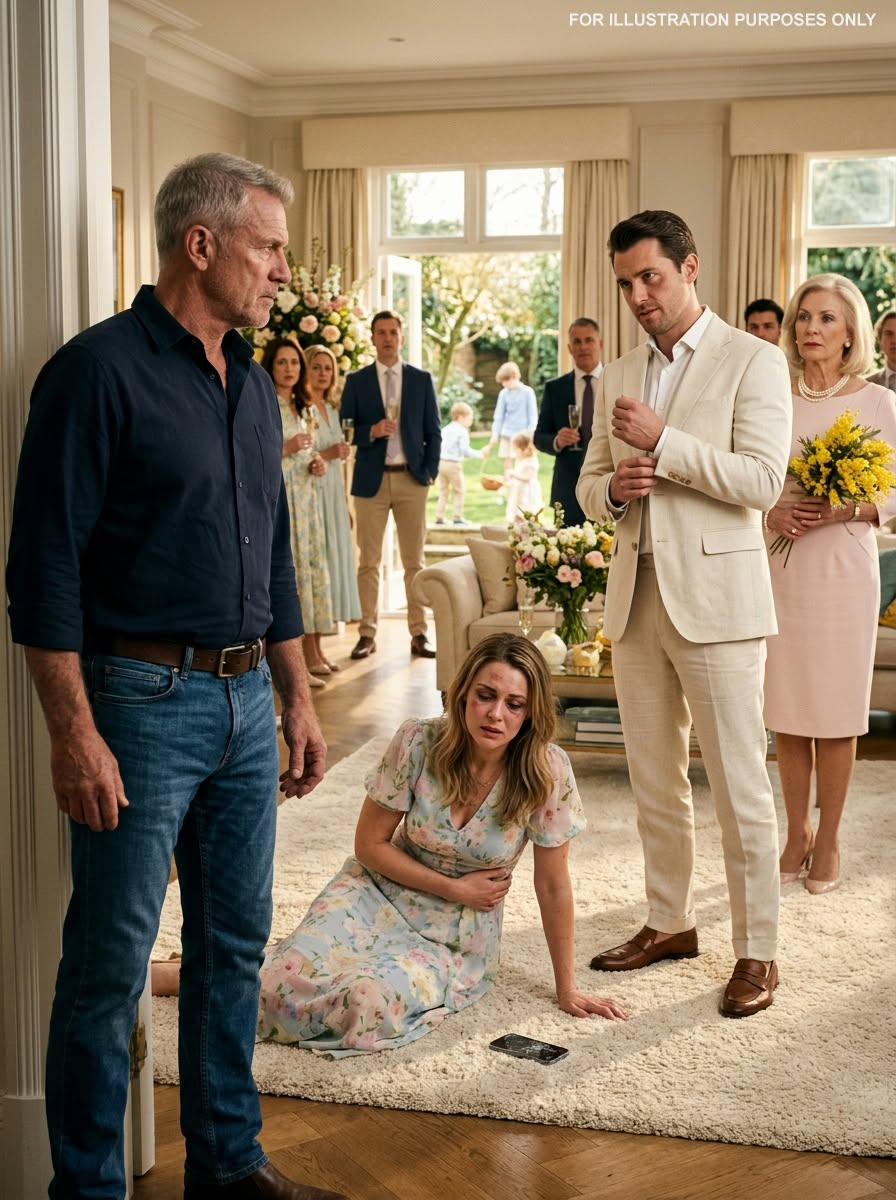
Guests froze mid-conversation. A fork stopped halfway to a plate. A glass hung in the air.
And then I saw her.
Lily.
My daughter.
On the floor.
Her face was swollen. One eye already darkening. Her lip split. Her arms wrapped around herself like she was trying to hold her body together.
Blood marked the white rug beneath her.
Standing above her, calm and composed, was Richard Whitmore.
My son-in-law.
He didn’t look guilty.
He looked inconvenienced.
He adjusted his cufflinks like I had interrupted his day.
“Arthur,” he said, almost casually. “You’re making a scene.”
I looked at my daughter.
Four distinct finger marks on her neck.
Richard spoke before I could.
“She fell,” he said smoothly. “She gets clumsy when she drinks.”
“She doesn’t drink.”
A flicker of irritation crossed his face.
Behind me, Margaret stepped in again.
“Arthur, don’t be dramatic. This is a family matter.”
A family matter.
My daughter was bleeding on the floor.
And they called it a matter of manners.
The Phone That Changed Everything
Then I saw it.
Half-hidden under the sofa.
Lily’s phone.
Still recording.
Still active.
Richard noticed my glance and smiled.
“Go ahead,” he said quietly. “Call the police.”
Then louder, for everyone to hear:
“Let me save you the trouble. My family owns this town. The Chief is outside eating food I paid for. Judges attend my dinners. Half the council owes us favors.”
He leaned closer.
“So tell me, Arthur… who exactly are you going to call?”
I didn’t answer.
Men like him mistake silence for fear.
It isn’t fear.
It’s calculation.
The Escape
I walked to Lily.
She flinched when she saw me—then realized it was me.
That hurt more than anything else.
“Don’t let him make me stay,” she whispered.
“I won’t,” I said quietly. “Not one more minute.”
Richard laughed behind me.
“You carry her out of here and I’ll have you arrested for kidnapping my wife.”
I lifted her carefully.
She weighed almost nothing.
As I turned, the room didn’t stop me.
It simply moved aside.
Not out of respect.
Out of fear of consequences.

The Truck and the Past
Outside, I laid her gently in the truck seat.
Her fingers gripped my sleeve.
“He’ll come after us,” she whispered.
I didn’t answer immediately.
Because I was no longer just Arthur Miller—the quiet widower who fixed gutters and paid bills.
That life had been a mask.
Inside my truck was a locked case I hadn’t opened in years.
I opened it.
Inside:
A satellite phone.
An emergency authorization card.
A contact list tied to a life I had buried.
I hesitated only once.
Then I activated the line.
“This is Code Black,” I said. “Burn everything.”
Silence.
Then a voice I had not heard in years:
“How badly did they hurt her?”
I closed my eyes.
“Badly.”
And then—
A second voice.
A voice that shouldn’t exist.
A voice I had buried in grief.
Claire.
My wife.
Lily’s mother.
The woman I was told was dead.
The Return of the Dead
Thirty seconds later, engines appeared at the end of the street.
Then more.
Black SUVs filled the road like a wave swallowing the neighborhood.
Doors opened.
Silent agents stepped out.
No chaos.
No hesitation.
Just precision.
Inside the mansion, panic began.
The Chief of Police dropped his plate.
Guests screamed.
Richard turned, suddenly unsure.
“This is private property!” Margaret shouted.
A woman in a black suit walked past her without slowing.
“Not anymore.”
Then
Claire arrived.
Time stopped.
She stepped out of a sedan like the past itself had returned to collect a debt.
Older.
Stronger.
Alive.
Lily saw her and broke completely.
“Mom?”
Claire crossed the distance in seconds.
“I’m here,” she said, holding her daughter like she had never left.
And for the first time, Lily cried like a child who had been found.
The Truth Comes Out
Richard backed away slowly.
“This is impossible,” he whispered.
Claire turned toward him.
“I was never dead,” she said. “I was evidence.”
Then she opened a folder.
Inside were years of documentation:
Money laundering.
Corruption.
Disappeared witnesses.
Names tied directly to the Whitmore family.
Richard’s smile collapsed.
For the first time, he looked like what he was.
A man without protection.
Just guilt.
The Collapse of Power
Agents moved through the estate.
Hidden cameras were discovered.
Files were pulled from safes behind paintings.
Everything Richard thought was hidden… wasn’t.
He turned toward me.
“You did this.”
I shook my head.
“No,” I said. “She did.”
I looked at Lily.
“She made sure someone finally listened.”
Then Claire said something that broke the final illusion:
“They were planning to make her disappear next.”
Silence.
Even Richard stopped breathing for a moment.
The End of Control
Richard was restrained.
The Chief was arrested.
Margaret collapsed onto the steps, watching her world collapse without understanding how.
And for the first time, Richard Whitmore had nothing:
No influence.
No witnesses protecting him.
No control.
Just truth.

After Everything
Hours later, the Easter decorations were gone.
So were the guests.
So was the illusion.
Only silence remained.
Lily sat between us in the truck.
Alive.
Breathing.
Safe.
Claire held one of her hands.
I held the other.
For fifteen years, I had lived as a man hiding from a life I thought I lost.
But I hadn’t lost it.
I had protected it.
Poorly.
Quietly.
But enough.
And standing there, I finally understood something simple:
Power was never his.
It was ours.
Because power is not money.
Not fear.
Not influence.
Power is the moment truth finally decides to arrive.
And stay.