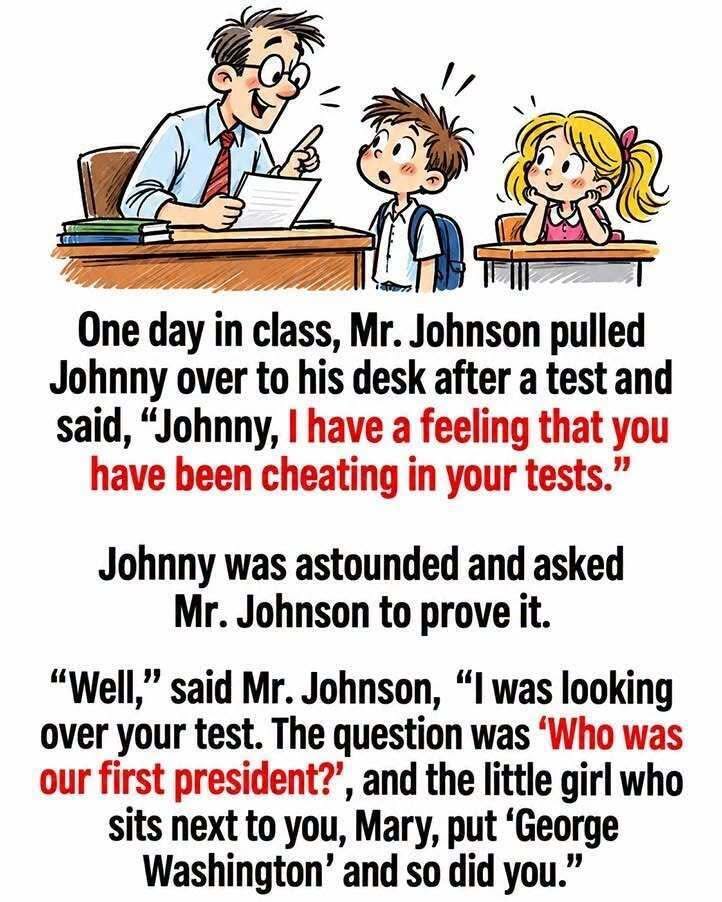
Johnny had always been good at talking his way out of trouble.
Forgot his homework?
He had an explanation.
Arrived late?
There was always a perfectly reasonable story.
Caught whispering during class?
According to Johnny, he had merely been “helping a classmate understand the lesson.”
So when his history teacher, Mr. Johnson, called him to the desk after a test, Johnny wasn’t particularly worried“Johnny,” Mr. Johnson said seriously, “I believe you copied your answers from Mary’s paper.”
Johnny immediately looked offended.
“Copied?”
“Yes.”
“That’s a pretty serious accusation, Mr. Johnson.”
His teacher nodded.
“I know.”
Johnny crossed his arms.
“Well, if you’re going to accuse me of cheating, you’d better have proof.”
Mr. Johnson looked surprisingly calm.
“I thought you might say that.”
He placed Mary’s test on the desk beside Johnny’s.
“Let’s look at the answers together.”
Johnny smiled confidently.
“Sure.”
Mr. Johnson pointed to the first question.
“Who was the first president of the United States?”
Mary had written:
George Washington.
Mr. Johnson pointed to Johnny’s answer.
George Washington.
Johnny shrugged.
“So?”
“So your answers are identical.”
Johnny almost laughed.
“Mr. Johnson, everybody knows George Washington was the first president. You can’t accuse me of cheating because I know basic history.”
A couple of students nearby started listening.
Mr. Johnson nodded.
“Fair enough.”
Johnny smiled.
Exactly.
This was going to be easy.
The teacher moved to the second question.
“Who freed the slaves in America?”
Mary had written:
Abraham Lincoln.
Johnny had written:
Abraham Lincoln.
Mr. Johnson looked at him.
Johnny raised his eyebrows.
“Seriously?”
“What?”
“You think that proves something?”
Johnny pointed toward the test.
“I studied last night. Abraham Lincoln is one of the most famous presidents in history.”
Mr. Johnson said nothing.
Johnny continued.
“If Mary studied too, obviously we might have some of the same answers.”
A few students giggled.
Johnny’s confidence grew.
He leaned slightly against the desk.
“Anything else?”
Mr. Johnson looked at him for a moment.
“Yes.”
He turned both papers over.
“There is one more answer I’d like to discuss.”
Johnny’s smile weakened slightly.
Mr. Johnson pointed to the final question.
“Who was president during the Louisiana Purchase?”
Johnny stared at him.
“Okay.”
Mr. Johnson picked up Mary’s test.
“Mary apparently wasn’t sure.”
Under the question, Mary had written:
I don’t know.
Johnny stared at the words.
His confidence began disappearing.
Mr. Johnson slowly picked up Johnny’s paper.
“And you…”
Johnny swallowed.
“…wrote this.”
He turned the test around.
Johnny looked down.
Under the exact same question, in his own handwriting, were two words:
Me neither.
The classroom went silent.
Then somebody in the back started laughing.
Another student joined in.
Johnny’s face turned bright red.
Mr. Johnson raised one eyebrow.
“Would you like to explain how you knew that Mary didn’t know the answer?”
Johnny opened his mouth.
Nothing came out.
For perhaps the first time in his school career, Johnny had absolutely no explanation.
Mr. Johnson waited patiently.
“Well?”
Johnny stared at the floor.
Finally, he muttered:
“I guess that one looks a little suspicious.”
Mr. Johnson nodded.
“A little.”
Johnny had spent the entire conversation arguing that identical correct answers proved nothing.
And technically, he had a point.
Two students could both know that George Washington was the first president.
Two students could both write Abraham Lincoln.
But only Johnny could copy “I don’t know” and somehow turn it into “Me neither.”
His teacher didn’t need witnesses.
He didn’t need another accusation.
Johnny had supplied all the evidence himself.
Sometimes getting caught cheating isn’t about copying the wrong answer.
It’s about copying an answer so perfectly that you accidentally prove you were looking at someone else’s paper.