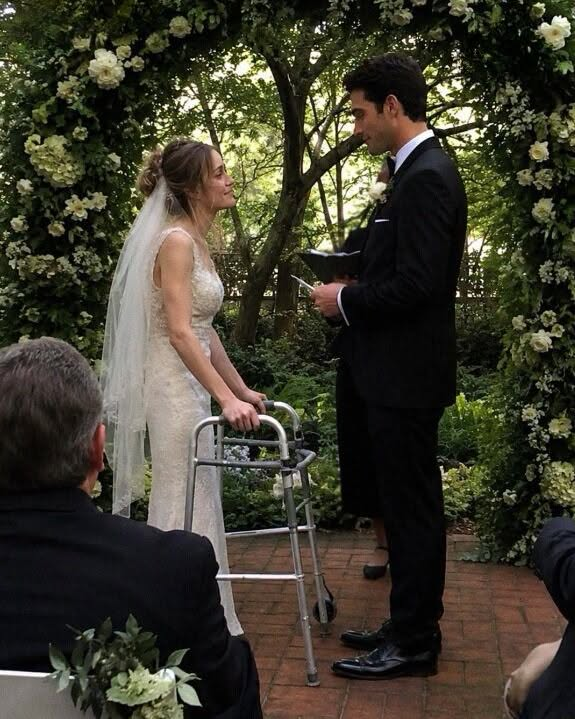
Her fiancé remained during the cake tastings, the dress fittings, and nearly a whole year of wedding preparations — right up until the doctors informed her that her illness was terminal. Then he departed, leaving a heartbroken bride with a fully paid wedding to do something unexpected.
“I can’t do this.”
Initially, I thought Daniel was referring to the diagnosis.
Not to me or us.
Just the cancer, timelines, and the harsh, clinical language doctors use when they attempt to be compassionate while delivering devastating news.
I was 29, seated at our kitchen table in leggings and one of his old college sweatshirts, still trying to digest the terms “advanced” and “terminal” from two days prior. My tea had turned cold. My head had been ringing since the appointment.
Daniel stood by the door with red eyes and a packed overnight bag.
I remember first focusing on the bag.
Because some foolish part of me thought, No, that can’t be right. He must be going to his brother’s for the night. He must just need some space.
Then he repeated it, quieter.
“I can’t do this, Serah.”
And that was when I realized.
He didn’t mean he couldn’t cope with the news.
He meant he couldn’t cope with me.
“You said we would get through anything,” I whispered.
He looked shattered. I want to be fair to him, even now. He looked shattered, embarrassed, and frightened in a way that made him appear younger, smaller, and not at all like the man I had spent 11 months planning a wedding with.
“I know,” he replied. “I know what I said.”
I stood up so suddenly my chair scraped against the floor.
“So that’s it?” My voice quivered. “You leave before I get worse? Before I lose my hair? Before I stop resembling the version of me you were comfortable loving?”
He recoiled. “Please don’t say that.”
I laughed then. A terrible little laugh.
“Do what? Say it out loud for you?”
He covered his face for a moment. “I’m sorry.”
“You already said that.”
Then he grabbed the bag and exited our apartment while I stood there in his sweatshirt with my entire life crumbling in real-time.
The wedding was just 12 days away.
My father had already paid for everything. The venue, the flowers, my dress, the string quartet my mother insisted on, the food for 120 guests, and the hotel rooms for relatives traveling from two states away.
My mother’s friends had already begun asking what shade of lipstick I intended to wear. My father had rehearsed his speech three separate times and cried during one of those attempts, though he denied it each time.
I spent three days in bed. I wept until my face hurt and then lay still because crying consumes energy you no longer have.
On the fourth night, I opened the closet and gazed at my wedding dress.
Then I sat on the floor in front of it and contemplated something so absurd I actually said “no” out loud to myself.
Then I thought it again.
The wedding didn’t have to be called off.
I just needed another groom.
Perhaps that makes me seem unhinged. Maybe I was. But here’s the thing nobody mentions about being told you’re dying: Embarrassment loses a lot of its power.
I had dreamed of a wedding since I was little. Not specifically a husband, although hopefully one of those, too. I wanted the dress, the music, the flowers, my father escorting me down the aisle, my mother crying in the front row, and the photographs that would prove I had been the center of something beautiful once.
I wasn’t ready to abandon that dream just because the man who promised it turned out to be weak.
So, in the morning, I opened my laptop and began searching for acting agencies.
I found one that managed commercials, local theater, private events, corporate hosts, and “special request performance bookings.”
I selected the least expensive man available on my wedding date. His headshot displayed dark hair, kind eyes, and a gentle-looking face.
His name was Peter.
I sent the most humiliating email of my life.
I told him I was supposed to be getting married in a few days, but that my fiancé had left after my diagnosis. I clarified that I was not seeking a real marriage or anything inappropriate or strange.
Just a day, a ceremony, some photos, and a dance.
A kind man in a suit, willing to stand beside me so my family wouldn’t have to witness me losing this, too.
I concluded by saying I understood if it was too odd.
The next morning, I awoke to a response.
“I will only do it under one condition.”
My entire body froze.
I opened it.
“I won’t deceive your family. That’s it. That’s the condition.”
“If I do this, they will know exactly who I am and exactly why I’m there. No tricking your family. No humiliating anyone in public. If they still want the day, I will show up and do it properly.”
“Peter.”
I stared at the screen for a long time.
Then I cried again, but differently.
Because that one line revealed more about him than any headshot could convey.
He wasn’t going to help me deceive my family.
He was only willing to help me achieve my goal honestly.
My father reacted better than I had anticipated and worse than I had hoped.
At first, he simply blinked at me across the dining room table as if his brain had slipped a gear.
“You want to hire a man,” he said cautiously, “to marry you.”
“Not really marry me. Just to be the man waiting at the end of the aisle.”
“At the ceremony.”
“Yes.”
My mother burst into tears.
I grasped her hand. “Mom, please don’t cry like that. It makes it sound crazier.”
“It is crazy,” she sobbed.
“I am dying. What do I care about being seen as crazy?”
My father looked weary.
“Serah,” he said quietly, “you don’t have to perform happiness for us.”
I swallowed hard. “I’m not performing it. I want one good day. I want one day when I am not the sick girl everyone pities. I want to wear the dress you paid for, eat the cake, dance with you, and let Mom fuss over my veil. I want the wedding. I still want it.”
He gazed at me for a long time.
Then he asked, “And this actor? He suggested we be informed?”
“Yes.”
Something in my father’s expression softened then.
“All right,” he said.
My mother ceased crying just long enough to gasp, “Frank.”
He turned to her. “What exactly are we afraid of now? The worst could happen any day, and we could lose our daughter.”
Then he looked back at me.
“If this is what you want, we will do it with our heads held high.”
I will love him forever for that.
Peter arrived the next evening.
He came in a plain navy shirt with a folder in his hand. Up close, he looked older than his headshot.
My mother made tea. My father asked him questions with the terrifying politeness fathers use when trying not to intimidate a man in their house.
Peter answered everything.
Yes, he had done event work before. No, nothing exactly like this.
Yes, he understood how peculiar it was. No, he would not take the full payment if I changed my mind. Yes, he could dance. No, he would not kiss me unless I asked him to for the photographs, and even then, only if I was comfortable.
My mother actually appeared relieved at that.
Then my father asked, “Why did you agree?”
Peter was silent for a moment.
Then he said, “Because I understood her request. I would want someone to grant what could be my last wish.”
That landed in the room like a prayer.
After my parents went upstairs, Peter and I stayed in the living room to discuss details.
He asked practical questions first. Favorite flowers, first dance song, and whether I wanted him to memorize a story about how we met in case I wanted it included in the vows.
Then he looked at me and said, “You don’t have to entertain me. If this feels too difficult, I can just show up on the day and do my job.”
That should have made things simpler.
Instead, I found myself asking, “Do you think this is pathetic?”
He shook his head immediately. “No.”
“Not even a little?”
“Not even a little.”
I laughed weakly. “You must be a very good actor.”
He held my gaze. “I’m not acting right now.”
That was the first crack in something I had been holding together with force.
Over the next week, he visited three times.
Once for a menu tasting because my mother insisted “the groom” should share his opinions. Once for a dance lesson because apparently I had forgotten how feet worked while undergoing treatment.
Once, just to sit on the back porch with me while I admitted I was terrified that no one would ever look at me again without pity.
He didn’t rush to contradict me.
He simply said, “Pity from a place of love is not such a bad thing.”
It turns out he didn’t begin his career as an actor.
Two nights before the wedding, I asked what role he had played that prepared him for this.
He smiled for the first time in a way that reached his eyes.
“I should probably tell you before your aunt asks where I’ve performed.”
I waited.
“I used to work in a hospice.”
That explained why he looked older.
“I left six months ago,” he said. “Too many losses too close together.”
Something inside me went still.
“So when you got my email…”
“I knew what terminal sounds like between the lines.”
I looked at him for a long moment. “Why the agency, then?”
“My cousin owns it. She puts me on the books sometimes when she needs a man who can speak clearly in a suit.”
I laughed. “So I accidentally hired a grieving hospice nurse pretending to be an actor.”
“Basically.”
Then he looked embarrassed. “You can back out if that feels manipulative.”
“It doesn’t.”
It felt like fate, trying not to appear obvious.
On the morning of the wedding, I woke up convinced that Daniel would somehow ruin it.
Text me, show up, apologize, or plead. Men like him always want back in once they feel guilty for abandoning someone.
He did worse. He arrived at the venue 15 minutes before the ceremony.
I was in the bridal suite with my mother, pinning my veil, when my cousin rushed in and said, “There’s a man downstairs demanding to speak to Serah.”
My stomach dropped.
Peter was already downstairs. So was my father.
By the time I reached the hall outside the chapel doors, Daniel was arguing with both of them.
“I’m trying to fix this,” he was saying.
Peter stood between him and the corridor, calm as stone.
My father looked poised to commit a felony.
Daniel saw me, and his expression crumbled.
“Serah,” he said. “I made a mistake.”
The audacity of weak men is one of life’s ugliest miracles.
“You think?” I replied.
He stepped toward me. Peter moved without touching him, just enough to block the path.
Daniel looked at Peter as if he had only just realized I had actually replaced him.
“This is insane,” he said.
“No,” I said. “What’s insane is abandoning a dying woman and then appearing because you cannot suddenly live with your choice.”
He went pale.
“I panicked.”
“Yes.”
“I loved you.”
“Not enough.”
That silenced him.
Then Peter did something I will never forget.
He reached back without looking and found my hand.
Not possessively or theatrically but steadily.
Like he was lending me balance until I found my own.
Daniel and my father witnessed it. I felt it most clearly.
“Please leave,” I said.
Daniel looked at me, then at the chapel doors, and then at the guests gathering inside. Perhaps he finally understood that there was no noble version of himself left to save.
He departed.
I married a stranger 40 minutes later. Well, not legally, but in every way that mattered to my heart that day.
The chapel was full. My dress fit perfectly. My father walked me down the aisle with tears in his eyes and his shoulders squared. My mother cried before the music even began.
Peter stood at the front in a black suit, his hands clasped, wearing the same steady expression he had when I first saw him.
When I reached him, he whispered, “You are the kind of woman someone runs towards, not away from.”
I balanced tears in my eyes.
The vows were intended to be generic, safe, and symbolic.
But when the officiant asked whether we wished to share personal words, Peter said yes before I could respond.
Then he looked at me and said, “I met Serah because someone else walked away when life got hard. I agreed to stand here because I thought she deserved a dream wedding. But somewhere between meeting her, the dance lesson, and watching her walk down the aisle, she stopped being a job.”
The room went completely still.
My pulse raced.
He took a breath.
“I don’t know what tomorrow holds for either of us,” he said. “But I know that standing beside you has been the easiest and loveliest thing I’ve done and experienced in a long time.”
I was openly crying by then. So were my mother and my aunts.
Afterward, there was music, dinner, toasts, photographs, and one truly excellent cake. Peter danced with me gently, as if I were breakable but not fragile. My father laughed more than he had in weeks. My mother kept touching my cheek as if ensuring I was still there.
It was my dream wedding.
Not because it looked the way I envisioned as a girl.
But because for one day, all the people I loved were in one room, joyful and laughing.
I am writing this from hospice care, and guess who my caregiver is. Peter.
He stayed.
After the wedding, he did not vanish when the day was over. He remained through the treatments, the waiting rooms, the laughter, the fear, and all the ugly moments I thought would drive anyone away.
Somewhere in between, we became friends.
Then we became more than friends.
A few weeks ago, the doctors informed me I likely only have a few weeks left.
I am very ill now. There is no miraculous ending awaiting me.
But these have been the best weeks of my life.
Not because I am dying. There is nothing beautiful about that. But because I am spending these last days with a man who loves me in the most genuine and gentle way I have ever known.
He cares for me, sits with me, makes me laugh when I feel too weary to smile, and holds my hand when I am frightened. He stayed after someone else walked away.
I truly believed I would die feeling betrayed and alone, never knowing what it was like to be loved by the right person.
Instead, I found Peter.
And somehow, in the midst of all this pain, that brings me peace.
I do not know how much time I have left.
I just know that in my final days, I am loved.
And after everything, that is enough.