Part 1: The Fork at the Harbor Club
The fork was not heavy, but in my left hand it felt like an anchor. It was just polished silver from the Halcyon Harbor Club, the kind of place where even the water glasses looked expensive. Still, my fingers tightened around it, then loosened without permission. A faint tremor ran from my wrist into my knuckles.
My mother noticed immediately.
“Keep your hand lower, Elise,” she whispered, never looking away from the white roses in the center of the table.
I lowered my hand into my lap.
Not because she was right.
Because I was tired.
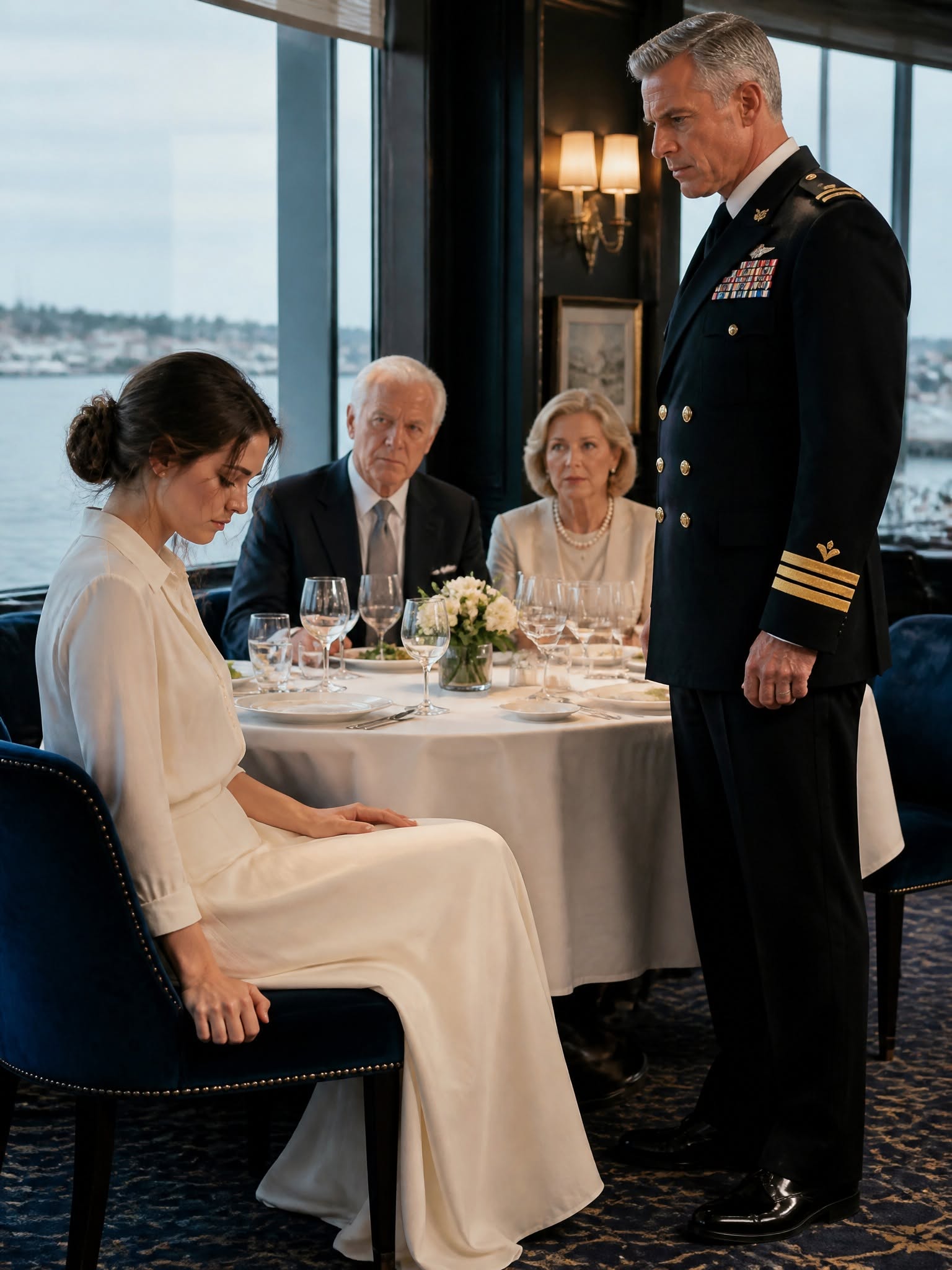
The private dining room smelled of polished oak, lemon wax, seared butter, and expensive perfume. Sunlight poured through tall windows overlooking the harbor, turning every glass and knife into something sharp.
My father, Victor Hartwell, sat at the head of the table because of course he did. He had built Hartwell Maritime from borrowed trucks and a rented warehouse into a shipping company with contracts from Boston to Savannah.
He checked his watch again, glanced at the entrance, then at the leather folder beside his plate.
“Elise,” he said quietly.
I knew that voice. It was the tone he used to correct employees without raising his blood pressure.
“Yes?”
“Try not to fidget.”
“I’m not.”
His eyes dropped toward my lap, where my damaged left hand still moved slightly against the cream skirt my mother had chosen for me.
“Then try not to look like you are.”
Across from me, my younger sister, Camille, hid a smile behind her wineglass.
My mother, Helena, leaned closer. “You could have worn the ivory jacket.”
“It’s eighty degrees outside.”
“It would have looked nicer.”
“It would have covered my arm.”
Her face tightened. “That is not what I meant.”
It was exactly what she meant.
The scar began above my left wrist and twisted almost to my elbow. The tremor came from nerve damage after a shipboard fire during my Navy service. It did not stop me from living, driving, typing, or running my company.
It only made forks tap plates.
And my family uncomfortable.
My father lowered his voice. “Admiral Pierce will be here any minute. This dinner could change the company.”
There it was.
The reason I had been summoned.
Not invited.
Summoned.
He wanted a retired Navy woman at the table to make his company look connected to service.
He just did not want that woman looking damaged.

Part 2: The Daughter They Wanted Hidden
Hartwell Maritime was competing for a long-term support contract connected to Navy sealift and port logistics. One dinner would not decide federal procurement, but my father believed relationships mattered.
He was not entirely wrong.
Admiral Marcus Pierce commanded one of the Navy organizations whose operational requirements could shape future maritime-support work. If he thought Hartwell Maritime was competent and ethical, doors might open. If not, no steak dinner would save them.
Dad had spent six weeks preparing. He hired a consultant, revised the company presentation, had Camille redesign the website, bought Mom a new dress, and called me two days earlier.
“I need you there.”
I had laughed. “You haven’t needed me at a family dinner in three years.”
“This is different.”
“Why?”
“Pierce is Navy.”
“So?”
“You were Navy.”
Past tense.
Always past tense.
As if sixteen years before medical retirement had been a phase that ended when the scars appeared.
When I arrived that afternoon in a sleeveless navy dress I had bought myself, Dad looked at my arm first.
Then he said, “Don’t embarrass us tonight.”
Not hello.
Not thank you for coming.
“Don’t embarrass us.”
“What exactly would embarrass you?”
He nodded toward my arm. “The whole wounded-veteran thing.”
“The whole what?”
“You know what I mean. Pierce is coming for business. I don’t want him feeling obligated to turn the evening into some emotional conversation about your service.”
“My arm isn’t a conversation.”
“It becomes one. People stare.”
I almost smiled. “You stare.”
He looked angry. “Just keep it discreet.”
Mom appeared then with the ivory jacket.
I did not put it on.
That was why she was still annoyed.
Now, sitting beneath the harbor windows, I wondered why I had come at all. The answer was embarrassing.
I still wanted my father to be proud of me.
Forty years old. Medically retired. Homeowner. Business owner. Sixteen years of service. And somewhere inside me still lived the girl who once held a second-place ribbon while Dad said, “Good job, sweetheart,” without looking up from his phone.
Some hungers age badly.
They do not disappear.

Part 3: Harborline
Camille looked at my hand. “Does it always do that now?”
Mom shot her a warning glance. “Camille.”
“What? I’m asking.”
“Yes,” I said.
“Can doctors fix it?”
“No.”
“Botox?”
I stared at her.
She shrugged. “They use it for muscle stuff.”
“Thank you, Doctor.”
Dad looked toward the entrance again. “Can we all focus?”
Then he turned to me. “If Admiral Pierce asks what you do now, keep it simple.”
“Simple.”
“Yes.”
“What would you like me to say?”
“That you consult.”
“I do.”
“Maritime safety.”
“I do.”
“Perfect.”
He smiled as if we had solved something.
What he did not want me to say was that my company, Harborline Response Group, trained commercial crews, ports, and maritime operators in shipboard fire response, casualty evacuation, and emergency continuity.
What he especially did not want me to say was that Hartwell Maritime had already hired Harborline twice.
Indirectly.
Dad did not know. His safety director, Patrice Monroe, did.
After two insurers raised concerns about emergency readiness at Hartwell terminals, Patrice hired Harborline through a third-party training vendor. My team wrote new fire-response procedures for three Hartwell facilities, trained supervisors, ran drills, and reduced deficiencies.
Dad praised the improvements at a board meeting.
He never asked who designed them.
I never told him.
Silence had become easier.
At 4:27, the private dining-room doors opened.
My father stood so quickly his chair nearly struck the wall.
Admiral Marcus Pierce entered with a civilian aide and a Navy captain. He was sixty-one, broad-shouldered, iron-gray, and composed in the way only decades of command can teach.
Four stars gleamed on his shoulder boards.
My family reacted instantly.
Dad became charming.
Mom became gracious.
Camille became interested.
I became very still.
Because I knew him.
Not well.
Not socially.
But enough.
The last time I had seen Marcus Pierce, neither of us had been dressed for dinner.
He had been covered in soot.
I had been lying on the deck of a burning ship while someone cut my sleeve away.
Part 4: The Admiral Recognized My Scar
My father stepped forward. “Admiral Pierce. Victor Hartwell. It is an honor.”
“Mr. Hartwell.”
“This is my wife, Helena.”
“Ma’am.”
“My daughter Camille, vice president of communications.”
“Nice to meet you.”
Then Dad turned toward me.
The pause was tiny.
Still there.
“And my older daughter, Elise.”
Not Chief Hartwell.
Not retired Navy.
Just Elise.
I stood.
Admiral Pierce looked at my face. For a second, I thought he had forgotten. That would have been reasonable. It had been nearly seven years.
Then his eyes dropped to my left arm.
He went completely still.
He stared at the scar near my wrist, then at the tremor in my hand, then back at my face.
“Elise?”
His voice changed.
My father smiled quickly. “Yes, my daughter. She used to be Navy.”
Pierce did not look at him.
“Chief Hartwell?”
My mother’s eyes widened.
Camille stopped breathing.
I said quietly, “Admiral.”
He stepped toward me.
“My God.”
His voice lowered. “I thought you were in Norfolk.”
“I was. Not anymore.”
“They told me you retired.”
“Medical.”
His eyes returned to the scar. “I didn’t know.”
That sentence carried more weight than anyone at the table understood.
Dad tried to rescue the moment. “Elise doesn’t talk much about her service.”
Pierce finally turned to him. “You’re her father?”
“Yes.”
The admiral looked almost confused.
Then he turned back to me. “You never said your family owned Hartwell Maritime.”
“It never came up.”
Camille laughed nervously. “What exactly didn’t come up?”
No one answered.
Pierce gestured toward my arm. “May I?”
I knew what he meant.
I turned it slightly so the scar showed fully in the light.
His jaw tightened.
“That happened on Peregrine.”
Not a question.
“Yes.”
My father frowned. “What is Peregrine?”
Pierce looked at him. “The MV Peregrine.”
The name meant nothing to my father.
That should not have surprised me.
It still hurt.
The admiral sat. Everyone followed.
For a full minute, the table had no conversation.
Part 5: The Work He Never Asked About
Dad forced a soft laugh. “I’m afraid I’m missing some history.”
Pierce looked at me.
I shook my head slightly.
Not here.
Not tonight.
He understood. “Another time.”
Dad hated being outside information, but dinner began.
For ten minutes, he kept the conversation where he wanted it: port capacity, civilian shipping partnerships, maintenance, labor shortages, surge readiness.
I stayed quiet.
Dad relaxed.
Then the Navy captain beside Pierce asked about emergency-response certification at civilian terminals.
Dad answered confidently. “We’ve invested heavily there. Our safety program is one of the strongest on the coast. We recently implemented a comprehensive casualty-response framework.”
I looked down at my plate.
Pierce noticed.
“What framework?”
Camille opened the leather folder. “Integrated terminal casualty and fire readiness.”
That was not the title we had used.
Marketing had apparently improved it.
Pierce skimmed the summary, then looked at me.
“This terminology is familiar.”
Dad smiled. “We believe in learning from the best.”
I bit the inside of my cheek.
“Elise,” Pierce said.
Dad’s smile faded.
The captain turned toward me. “You wrote this?”
“Parts of the original protocol.”
My father laughed once, not because it was funny, but because disbelief was his first defense.
“Elise?”
I set my fork down carefully. “My company provided the underlying emergency-response package through your third-party training contractor.”
Silence.
Dad’s eyes narrowed. “Your company?”
“Harborline Response Group.”
His face changed.
He knew the name.
Of course he did. Patrice had recommended renewing our contract the previous quarter, and Dad had approved the budget.
“You own Harborline?”
“Yes.”
Camille stared. “Wait. The Harborline?”
“How many are there?”
“You trained Eastport.”
“Yes.”
“Savannah.”
“Yes.”
“Norfolk.”
“Part of the team.”
Dad’s expression hardened. “Why didn’t you tell me?”
The question was so absurd I almost admired it.
“You never asked.”
“I knew you consulted.”
“You told me to keep it simple.”
Pierce lowered his eyes, trying not to smile.
Dad cleared his throat. “Well. That’s good.”
Good.
Sixteen years in the Navy.
A medical retirement.
A business respected enough that his own company used it.
Good.
But the room had shifted.
Now Pierce asked me questions.
Not about the scars.
About port resilience, civilian crew preparedness, maintenance culture, and the difference between written procedures and real readiness.
I answered carefully, never undermining Dad and never revealing confidential client details.
The tremor in my hand gradually became less noticeable.
Not because it stopped.
Because everyone stopped watching it.
Part 6: The Letters in the Attic
Dessert arrived: bourbon pecan cake, chosen because Pierce’s staff had said he liked pecans.
The admiral took one bite, set his fork down, and turned to me.
“Did you ever receive the letter?”
My chest tightened. “What letter?”
“From the Peregrine families.”
I looked at him. “No.”
His face changed. “They told me it was sent.”
“Where?”
“Your home address after you left Portsmouth.”
At the time, I had been in rehabilitation, then temporarily living with my parents. Mail piled up in the study because I could not drive for months. Mom sorted most of it. Dad handled insurance papers.
I looked at my mother.
She had gone pale.
“Mom?”
Her fingers tightened around her napkin.
“What letter?” I asked.
“There were many letters,” she whispered.
“What happened to them?”
“I gave you some.”
“Some?”
Dad cut in. “Helena, what is this?”
She closed her eyes. “I didn’t think it was healthy.”
Everything inside me stopped.
“What did you do with my mail?”
“I put some away.”
“Where?”
“In the attic.”
For seven years, I had believed almost nobody from Peregrine remembered me. I told myself that was normal. People survived. People moved on. Families grieved.
You do not rescue people to receive Christmas cards.
Still, the silence had hurt.
Pierce’s face went cold. “What letters did you put away?”
Mom began crying. “People kept writing about the fire. I was trying to help you move on.”
“You hid them.”
“I thought reading those stories would keep you trapped.”
“They were mine.”
“I know.”
“No. You don’t.”
The table went silent.
Dad looked furious, but not at her.
At the situation.
“Can we discuss this privately?” he asked.
Pierce looked at him. “Perhaps you should.”
Dad heard the warning and stopped.
Then Camille asked the question everyone had been avoiding.
“What happened on Peregrine?”
Pierce looked at me.
This time, I did not stop him.
Part 7: Peregrine
Admiral Pierce folded his hands on the table.
“Seven years ago, the MV Peregrine was operating under Navy charter during a multinational logistics exercise in the Mediterranean. The vessel suffered a major machinery-space fire after a fuel-line failure. Initial suppression did not contain it.”
I could smell it again.
Burned insulation.
Diesel.
Hot steel.
Extinguishing agent.
Pierce continued. “I was aboard as a rear admiral overseeing part of the exercise. The fire spread faster than expected. Smoke filled two passageways. Electrical systems failed. Several crewmen became trapped aft.”
His eyes moved toward my arm.
“Chief Hartwell was attached to the joint damage-control evaluation team.”
Camille whispered, “Chief?”
“I was a chief petty officer then,” I said.
Dad stared.
I had told him about that promotion. He missed the ceremony because Camille had a charity brunch.
Pierce continued. “When evacuation routes became confused, Chief Hartwell led a team back into an area already ordered cleared. Three civilian mariners were trapped behind a jammed watertight door. Another sailor had collapsed from smoke exposure.”
He looked at my family.
“She got them out.”
My father’s face lost color. “You went back into a fire?”
That was his first real question about that day in seven years.
“Yes.”
Pierce’s voice remained calm. “Then a damaged fuel manifold reignited. Chief Hartwell stayed behind long enough to isolate the remaining fuel feed manually.”
My left hand trembled harder.
I placed it on the table.
For once, I did not hide it.
Dad whispered, “Why?”
“Because if the fire reached adjacent storage and electrical spaces,” Pierce said, “we risked losing control of the vessel.”
He looked at me.
“She suffered severe burns and nerve damage while closing the isolation assembly. What she did bought enough time for the remaining casualties to evacuate and for fire teams to regain control.”
Dad asked, “How many people?”
“Twenty-three remained in the affected section when the secondary fire began.”
No one spoke.
Then Pierce added quietly, “I was one of them.”
My father’s eyes snapped to him.
The admiral continued. “I was assisting with casualty movement when smoke conditions worsened. Chief Hartwell directed us through an alternate route she had checked earlier. Without that route, several of us would have been trapped.”
He looked at my scar again.
“That is why I recognized her arm.”
Dad swallowed. “You recognized the scar?”
“I helped hold the dressing while we waited for the helicopter.”
The room went absolutely still.
There it was.
The scar my parents wanted covered.
The scar my father thought would embarrass a Navy admiral.
That scar was the reason the admiral remembered my name.
Part 8: The Truth at the Table
For nearly a minute, Dad said nothing.
Then he looked at me.
“Why didn’t you tell us?”
I could not believe the question.
“I did.”
“No.”
“Yes.”
“You said there was a shipboard fire.”
“Yes.”
“You said you were injured.”
“Yes.”
“You never said this.”
“I spent months trying.”
His expression changed.
“You came to the hospital once while I was conscious,” I said. “You took three business calls.”
His jaw tightened. “Camille was getting married.”
“No. She was getting engaged.”
Camille looked away.
Mom whispered my name.
“I told you there were casualties,” I said to my father. “You told me not to dwell on it.”
“I didn’t know.”
“You didn’t ask.”
I turned to my mother. “I told you people had been trapped. You told me survivor guilt was unhealthy.”
Her shoulders shook. “I thought I was helping.”
“You hid letters.”
“I was scared.”
“Of what?”
“That you would never come back.”
The anger in me softened.
Not disappeared.
Changed.
She looked at my scar. “When I saw your arm, I thought the Navy had taken my daughter.”
“So you decided I should pretend it never happened?”
“No.”
“That is exactly what you did.”
She had no answer.
Pierce turned to Dad.
“Mr. Hartwell, I came here expecting to discuss maritime readiness. I still intend to discuss it. But since your company is pursuing greater work supporting naval operations, I suggest you understand what readiness actually means.”
Dad straightened slightly.
Business.
Something he understood.
“It is not a presentation folder,” Pierce said, tapping the binder. “It is not a dinner. It is what people do when systems fail. When no camera is present.”
Then he asked real questions about Hartwell Maritime’s safety culture, whistleblower procedures, maintenance deferrals, crew training, and how leadership responded when employees reported uncomfortable truths.
Dad answered.
Sometimes well.
Sometimes not.
I stayed quiet unless asked.
At one point, Pierce turned to me.
“Would you contract with Hartwell Maritime again?”
My father froze.
It was a brutal question.
“Yes,” I said.
Dad blinked.
“Why?” Pierce asked.
“Because their safety director listens. Their crews take drills seriously. Their supervisors improved after the first assessment. Companies can have leadership problems without every employee being the problem.”
The words landed.
“What would you change?” Pierce asked.
“Executive accountability. Less focus on whether a problem looks embarrassing. More focus on whether it is real.”
Nobody misunderstood.
Pierce smiled faintly. “That sounds expensive.”
“It usually saves money.”
“Good answer.”
Part 9: Forty-Seven Letters
No contract was promised that night. No rules were bent. Pierce shook my father’s hand and told him the proper review process would continue.
Then he came to me.
“Harborline still working East Coast?”
“Yes.”
“We may need your training team for an exercise next spring.”
“Have your staff call.”
He smiled. “You always make everything sound ordinary.”
“It usually is.”
He looked at my arm. “No. Not always.”
Then he left.
The moment the doors closed, Dad turned to me.
“You could have told me Pierce knew you.”
“I didn’t know he remembered.”
“He obviously remembered.”