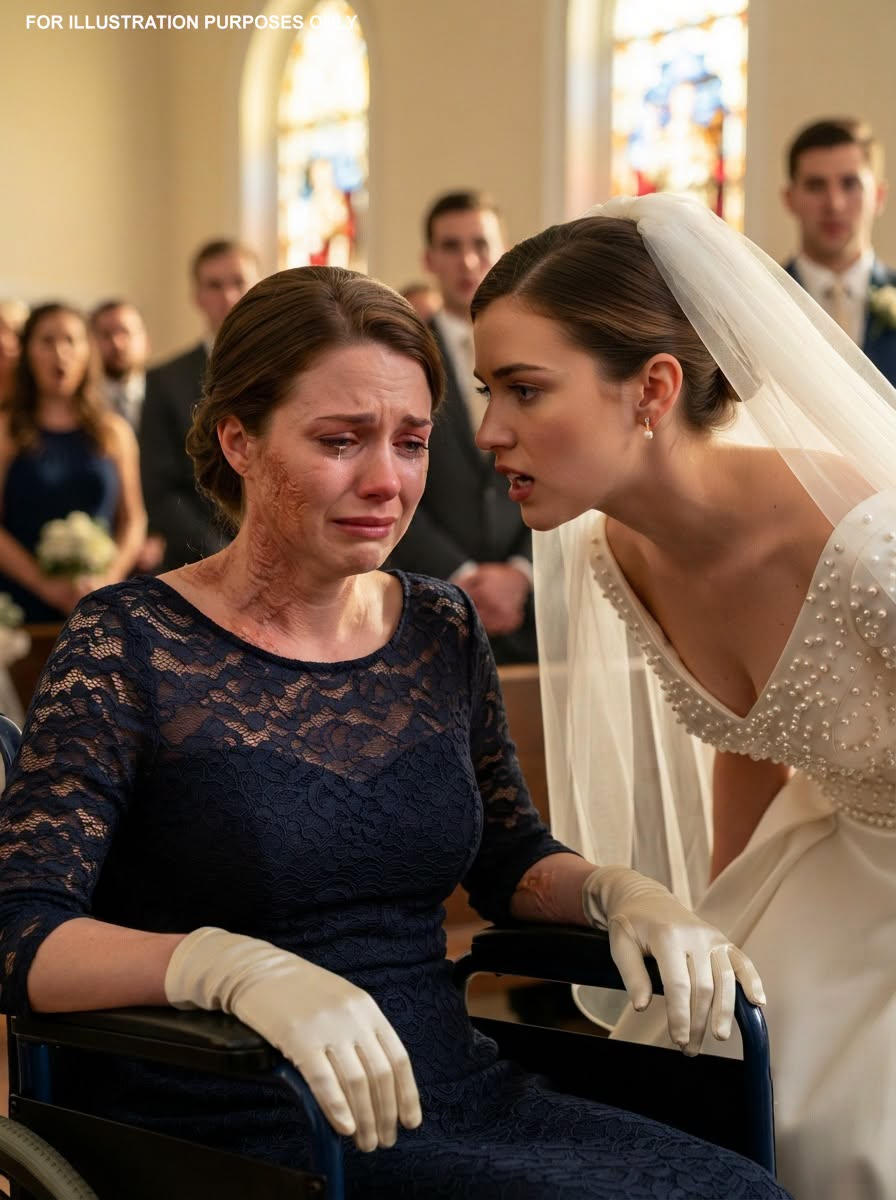
The church in Charleston, South Carolina, carried the scent of white roses, polished timber, and expensive perfume. I sat at the edge of the second pew, positioning my wheelchair carefully so it wouldn’t obstruct the aisle. Thin ivory gloves covered my hands where they rested in my lap. Beneath the lace sleeves of my navy dress, burn scars curled along my arms like melted ribbon, stretching across my neck, my back, my legs, and half my face. Most people tried not to stare. Not everyone succeeded.
My sister, Emily Whitmore, waited at the altar in a fitted pearl-white gown, radiant beneath the colored light spilling through the stained-glass windows. At twenty-two, she looked flawless from every possible camera angle. The ten-year-old girl I had once carried through smoke and falling beams was now a bride. I was twenty-nine.
The fire remained painfully clear in my memory even now — Emily screaming from an upstairs bedroom, our parents trapped outside by panic, firefighters still several agonizing minutes away. I went back into the house anyway. I found her beneath a fallen curtain, coughing and terrified, still gripping a stuffed rabbit in one small fist. I wrapped my body around hers and crawled through the flames together with her. Emily escaped with only a small scar near one shoulder. I escaped as something strangers whispered about for years afterward.
Before the ceremony began, Emily walked down the aisle smiling toward the photographer, practicing her entrance. When she reached me, the smile stayed fixed in place, but her eyes turned cold. She leaned close as though she meant to kiss my cheek. “Go sit in the back,” she whispered instead. I stared at her, certain I’d misheard. “You’re ruining the atmosphere and the perfect image of my wedding.” My throat tightened around nothing. “You’re being too much,” she added, and straightened back up like nothing had happened at all.
Behind Emily, our mother, Linda, suddenly found the flower arrangements deeply fascinating. Our father, Mark, kept his gaze fixed forward, jaw clenched tight. Neither of them said a single word. I looked at the sister I had saved — the sister who could still breathe because my own lungs had filled with smoke first, all those years ago. I wanted to ask when exactly my presence had become something shameful. I wanted to know whether perfect photographs mattered more to any of them than the body that had carried her out of that fire. Instead, I stayed silent. I placed both hands against the wheels of my chair, ready to disappear the way I’d been trained to.
That’s when Margaret Callahan, the groom’s mother, rose from the first row. Tall, silver-haired, dressed in deep green silk, she carried herself like a woman whose silence alone could unsettle an entire room. The organist stopped mid-note. Emily turned toward her in surprise. Daniel, the groom, looked openly confused. Margaret glanced at my sister, then at my parents, and finally at me, her expression firm and unwavering.
Then she spoke five words that stopped the ceremony cold.
“She saved your life, Emily.”
The church went completely, utterly silent.
Emily’s expression shifted so suddenly that even the photographer lowered his camera. For one brief moment she looked ten years old again — frightened, exposed, caught doing something she already knew was wrong. Then the bride’s composure snapped back into place. Her chin rose, her smile returned, though noticeably thinner than before.
Margaret stepped fully into the aisle. “I heard what you said to her,” she continued. A whisper moved through the congregation like air slipping beneath a closed door. Daniel looked at Emily. “What is she talking about?” Emily produced one sharp, brittle laugh. “Nothing. Your mother misunderstood.” “No,” Margaret replied evenly. “I did not.”
My mother finally lifted her gaze toward me. Our eyes met for less than a second before she looked away again. That hurt worse than anything Emily had said. My father gripped the pew so tightly his knuckles turned white, but he still didn’t speak.
Margaret addressed the gathered guests directly. “Twenty years ago, I was an emergency room nurse at St. Anne’s,” she said. “I was working the night Claire Whitmore was brought in after the Laurel Street fire.” Hearing my own name spoken by her sounded strange. Stronger than I actually felt in that moment. “She was seventeen,” Margaret continued. “Burned over most of her body. Barely conscious. And every single time she opened her eyes, she asked one question.” Daniel’s expression shifted. “What question?” Margaret turned toward Emily. “She asked, ‘Is my sister alive?’”

No one in that church moved. Heat gathered behind my eyes, but I refused to let it fall. Not there. Not while everyone finally looked at me like they’d only just realized I wasn’t furniture, wasn’t a flaw in the room’s careful staging, wasn’t something meant to be tucked away in the final row.
Emily parted her lips, but no sound came out at all. Margaret kept going, steady as ever. “I have never forgotten that girl. I never knew what happened to her after surgery. When Daniel showed me the guest list and I saw the name Claire Whitmore, I wondered. When I saw her today, I knew for certain.” Daniel stepped backward from the altar. “Emily,” he said quietly, “did you tell Claire to move?” Emily’s eyes flashed. “This is my wedding.” “That is not an answer.” “She was sitting too close to the aisle,” Emily snapped. “People were staring.” “At Claire?” Daniel asked. “At us,” Emily shot back. “At everything. At her chair. At her scars. This day is supposed to be beautiful.” The words struck harder now that the whole room could hear them clearly. I lowered my face toward the floor.
Then Daniel spoke again, and the gentleness had drained entirely out of his voice. “Beauty is not what I thought you meant.” Emily reached toward him. “Daniel, please. You’re letting them turn this into something ugly.” Margaret stepped smoothly between them. “No, dear,” she said. “You did that yourself.”
The minister cleared his throat nervously. The bridesmaids stood frozen in place. From somewhere near the back, a guest whispered, “Oh my God.” I touched the wheels of my chair again, not because I meant to leave, but because I needed something solid beneath my hands to hold onto.
For years, my relatives had mistaken my silence for consent. That day, someone had finally heard the words I’d always been expected to keep buried.
I didn’t answer right away. I think that surprised all of them. Perhaps they’d expected rage, or tears, or some dramatic speech that would make the whole scene easier to categorize and move past. But genuine pain doesn’t always turn itself into a speech on command. Sometimes it just settles inside your chest like a room with no key.
Daniel turned toward me directly. “Claire,” he said, “is it true?” His voice was careful rather than cruel. He wasn’t asking whether I’d rescued Emily — everyone understood that part now. He wanted to know if she’d truly said those things to me. The entire church waited on my answer.
My sister met my eyes. For the first time all day, the perfect bride disappeared entirely from her face. Only fear remained. Not fear for me. Fear of being exposed for what she actually was underneath the dress and the flowers.
I could have protected her again. That was the role my family had trained me to perform for years — protect Emily from guilt, protect my mother from shame, protect my father from having to choose a side, protect everyone from a truth that made dinners uncomfortable and holidays tense and family photographs slightly imperfect. But I had grown tired of playing that particular part.
“Yes,” I said. My voice came out quiet, but the microphone near the minister caught it anyway. The single word traveled through the speakers and filled the entire sanctuary.
Emily’s shoulders sank. My mother covered her mouth with one hand. My father shut his eyes. Daniel stared at Emily like she’d become a total stranger to him in the space of a few seconds. “Why?” he asked her. Her reply came too quickly to be anything but reflexive. “I was stressed.” “No,” Daniel said. “I had pressure on me all morning. The planner was late, the flowers were wrong, and the photographer kept saying the front rows needed to look balanced.” “Emily.” “What do you want me to say?” she cried out. “That I wanted one single day where people looked at me instead of her?”
The silence that followed was heavier than anything before it. More truthful, too. I had always sensed some version of that sentence living inside her somewhere, even if not those exact words. I had felt it every time she cropped me out of birthday posts, every time she introduced me only as “my older sister,” every time she steered us away from brightly lit restaurants because people stared a beat too long.
At twelve, Emily had been grateful. At thirteen, guilty. At fifteen, resentful. By eighteen, she had started behaving as though my scars were something I’d personally done to her, rather than something I’d taken on to save her life.
Daniel’s face lost its color entirely. “Instead of her?” he repeated. Tears filled Emily’s eyes. “You don’t understand what it was like growing up. Everything was about Claire. Her surgeries. Her pain. Her appointments. Her recovery. Her special needs. Her trauma. I was the little girl from the fire, but she became the hero. I became the reason everyone whispered when we walked into a room.”
I looked over at my mother. Linda Whitmore was silently crying, mascara gathering beneath her lashes in dark streaks. My father still hadn’t said a word. Margaret remained beside me like a wall, steady and unmoving.
Daniel dragged one hand across his mouth. “Did you ever tell me any of that?” “I tried,” Emily said. “No. You told me Claire was private. You told me she preferred not to be in pictures. You told me she didn’t like attention.” Emily’s mouth trembled. Daniel kept going. “You told me she might not even come today because crowds were difficult for her.”
A breath escaped me that almost sounded like laughter. Crowds were never what I found difficult. What was difficult was when people pretended not to see me at all. What was difficult was when relatives publicly abandoned me and acted like nothing unusual had happened. What was difficult was sitting in a room full of people who all remembered the fire but none of whom wanted to know what came after it.
Daniel looked at me again. “Claire, did you want to sit in the back?” “No,” I answered. The second truth came easier than the first.
My father finally stood up. “Enough,” he said. Every face in the church turned toward him. For one foolish moment, I actually thought he might defend me. Even after all those years, hope apparently still kept small, irrational roots alive somewhere inside me. But his attention stayed fixed on Margaret and Daniel instead. “This is a private family matter,” he said. “It should not be handled like a courtroom.” Something inside me went cold at that.
Margaret raised her eyebrows sharply. “A private family matter? Your daughter was publicly humiliated at your other daughter’s wedding.” “She has always been sensitive,” my father said. The word struck me like an open-handed slap. Sensitive. That was what they’d always called me when I cried after children pointed at my face in public. Sensitive when I asked Emily to stop joking about my “Halloween hands.” Sensitive when I stopped joining family beach trips because my mother said wearing long sleeves in summer made other people uncomfortable to look at. Sensitive whenever my father said, “You know how your sister is. Don’t make it bigger than it is.”
I pressed the brakes on my wheelchair. The quiet click gave me a strange kind of courage. “I was not sensitive when I went into that house,” I said. My father stared at me in genuine surprise. “I was not sensitive when my skin was burning. I was not sensitive during the grafts, or the infections, or the months when nurses had to turn me in bed because I couldn’t move myself. I was not sensitive when Emily screamed every night after the fire and I let her sleep in my hospital bed because she was afraid of the smell of smoke.”
Emily covered her face with both hands. I didn’t stop. “But I became sensitive the moment I asked this family to treat me like a person instead of a reminder of something they’d rather forget.” No one interrupted me. Not even my father.
I turned to face Emily directly. “I never asked you to worship me. I never asked you to spend your whole life thanking me. I never wanted your wedding to become about me.” My voice trembled, but it held steady enough. “I came because you are my sister. I bought this dress because Mom said navy matched your wedding colors. I wore these gloves because you once told me my hands made people uncomfortable in photographs. I sat exactly where the usher placed me. I smiled when your friends stared too long. I stayed quiet when you leaned in and whispered to me.”
Emily lowered her hands, tears covering her entire face now. “And still,” I said, “I was too much.”
Daniel moved completely away from the altar. The movement was slow, but there was something final in it already. Emily grabbed for his sleeve. “Please don’t do this.” He didn’t jerk his arm away from her. He simply removed her hand, gently but firmly. “I need a minute,” he said. “Daniel, we’re in the middle of our wedding.” “No,” he answered. “We’re in the middle of learning who we actually are.” He walked down the side aisle and disappeared into the small room near the front where the groomsmen had waited earlier that morning. The door closed behind him. Whispers spread rapidly through the guests. Emily stood alone beneath the floral arch, the roses suddenly looking too white, too carefully arranged, too fragile for the damage sitting just beneath them.
My mother approached me. “Claire,” she whispered, “maybe we should go outside.” I studied her face carefully. For years I had mistaken her avoidance for simple weakness. That day I finally understood it had always been a choice. Every time she looked away, she was choosing comfort. Every time she redirected a conversation, she was choosing Emily’s version of peace. Every time she warned me not to upset my sister, she was choosing the child whose face was easier to love out loud, in public. “No,” I said. She flinched visibly. “I’m not leaving because everyone finally heard the truth.” My mother opened her mouth, but no apology followed it.
Margaret rested one hand gently on the back of my wheelchair. She didn’t push me anywhere. She simply reminded me, through touch, that she was still there.

Several minutes passed. Maybe five. Maybe ten. Then Daniel came back. His boutonniere was gone. Emily noticed instantly. “No,” she whispered. Daniel stopped several feet away from her, looking broken rather than angry, which somehow made the whole moment worse. Anger could fade with time. Devastation settled in deeper and stayed. “I love you,” he said. “But I don’t know if I know you.” Emily shook her head hard. “One mistake. You’re ending everything over one mistake?” Margaret answered before Daniel could open his mouth. “A mistake is spilling wine on a dress. What you did was reveal a pattern.” Emily stared at her with open hatred. “You don’t know me.” “I know enough,” Margaret said simply.
Daniel faced the minister. “I can’t continue today.” A low eruption passed through the church — not shouting exactly, but shocked breaths and whispered voices and shoes scraping against the wooden floor. Emily looked at him like he’d struck her physically. “You’re humiliating me,” she said. Daniel’s reply came quiet and even. “Claire was humiliated. You are simply being held responsible.” That sentence ended the wedding more completely than any formal declaration ever could have.
The minister closed his book. The string musicians stopped pretending the ceremony might somehow continue. The photographer lowered his camera again, this time wearing the guilty expression of someone who understood certain moments simply shouldn’t be documented for posterity.
Emily looked over at me. For one second, I genuinely thought she might apologize right there. Instead she asked, “Are you happy now?” The person I used to be would have accepted the blame instantly. I would have said no, cried, apologized for being too visible, begged Daniel not to hold Emily responsible for any of it. I would have tried to gather up the broken pieces of her wedding in my own scarred hands and hand them back to the person who had shattered them in the first place. But I was no longer that particular version of Claire. “No,” I said. “I’m free.”
A faint smile touched Margaret’s face. My father collapsed onto the pew like his legs could no longer hold him up. My mother began sobbing openly, though she still didn’t move any closer to me. I released the brakes on my chair and moved into the aisle. People made room for me as I passed — not out of pity, but out of something closer to respect. Some looked ashamed. Some simply nodded at me. An elderly woman pressed one hand flat against her chest. I didn’t need any of their gestures, but I noticed each one anyway.
Daniel caught up with me near the church doors. “Claire,” he called out. I stopped. “I’m sorry,” he said. “For not asking more questions over the years. For believing whatever version was easiest to believe.” “You didn’t know,” I replied honestly. “I should have wanted to know.” It was the first genuinely honest apology I’d heard all day.
Margaret joined us beneath the church entrance. The afternoon sunlight was bright, almost cruel in its beauty. Cars lined the road outside, white ribbons stirring gently from their door handles in the breeze. Behind us, an entire wedding was quietly collapsing beneath everything it had spent months trying to conceal.
Margaret bent slightly until our eyes met at the same level. “I have thought about you for twelve years,” she said. I swallowed hard. “You remembered me?” “I remembered a burned seventeen-year-old girl asking about her sister before she ever thought to ask about herself.” My chest tightened painfully. For years, people had told the story of that fire as Emily’s survival story. Later, once it became uncomfortable, no one told it at all anymore. Hearing someone remember my part in it without disgust, without pity, without trying to smooth it over into something easier to hear, felt like being handed back a piece of myself I’d assumed was permanently lost. “Thank you,” I said.
The church doors opened behind us. Emily came outside alone. Her veil had been removed, strands of hair falling loose around her face. Without the carefully arranged lighting and the practiced smile, she looked younger. Not innocent. Just young. Our parents followed several steps behind her.
“Claire,” Emily said. I waited. Her gaze moved from me to Daniel, then to Margaret, then back to me again. I could see everything competing inside her at once — pride, fear, shame, anger, panic over losing the entire future she’d carefully constructed. “I shouldn’t have said that,” she said finally. It wasn’t enough. But it wasn’t nothing, either. “No,” I answered. “You shouldn’t have.” She wiped the tears from her face with the back of one hand. “I was overwhelmed.” I stayed silent. Her expression tightened when I didn’t rush in to rescue her from the discomfort of the silence. “I’m sorry,” she said at last, the words sounding stiff and unfamiliar in her mouth. I examined her face carefully. I genuinely couldn’t tell whether she meant it, or simply wanted Daniel standing nearby to hear it. Perhaps both were true at once — people are rarely motivated by only one thing at a time. “I hear you,” I said. Emily frowned. “That’s it?” “That’s all I have for today.”
She opened her mouth, then closed it again without speaking. My mother stepped forward. “Claire, please. This has gone far enough.” I turned to face her fully. “No, Mom. It went far enough when she told me to hide at her own wedding. It went far enough when Dad called me sensitive. It went far enough every single time both of you taught her that my pain was simply inconvenient to deal with.” My father’s face reddened. “We did our best.” “Maybe,” I said. “But your best left me alone.” He had no reply to that at all.
That moment marked the beginning of the end of the family I had always known.
In the weeks that followed, Daniel postponed the wedding without ever selecting a new date. Eventually he canceled it outright. He and Emily attended counseling briefly together, but he later told me, with real kindness in his voice, that love without respect had started to resemble a beautiful house wired dangerously beneath the surface.
Emily left their shared apartment and moved back in with our parents. For several months, she only contacted me through brief messages that sounded like exercises assigned by a therapist. I acknowledge that I hurt you. I am working on accountability. I hope someday we can rebuild trust. I didn’t mock them. I also didn’t respond to most of them. My healing didn’t require me to answer immediately every single time someone else started experiencing guilt on their own timeline.

Margaret continued being part of my life after that. First she invited me to lunch. Later she asked me to attend a charity event for burn survivors. Then she invited me to speak at a nursing school, where she introduced me not as a victim, not as some inspiration, but as “someone whose experience deserves to be heard accurately.” That word stayed with me long afterward. Accurately. Not beautifully. Not comfortably. Accurately.
The first time I addressed those nursing students, my hands shook so badly I nearly dropped the pages I’d prepared. But when I finally lifted my eyes to the room, no one turned away from me. So I described the smoke. The pain. The strange isolation of surviving something everyone else preferred to flatten into a simple story about heroism. Afterward, a young man with burn scars running along his jaw came up to speak with me. “My family doesn’t talk about it either,” he said. I nodded. “Mine didn’t either, for a long time.” “Did that change?” he asked. I thought of Emily standing in her wedding gown, my mother avoiding my eyes, my father’s stubborn silence, Daniel removing his boutonniere, Margaret speaking those five words that started it all. “Yes,” I said. “But not because they suddenly became brave. Because someone finally refused to keep pretending.”
One year later, Emily invited me to meet her at a quiet café in Columbia. I nearly said no. Then I agreed, not because she’d earned it exactly, but because I needed to find out whether hearing her voice still held any power over me at all.
She arrived without makeup, dressed simply in jeans and a gray sweater. No audience this time. No camera. No perfect image left to protect. “I’m not here to ask you to forgive me,” she said. I hadn’t expected that opening line at all. “I’m here because my therapist asked me what I lost in the fire,” she continued. “I said childhood. Safety. A normal life. Then she asked me what you lost.” Her eyes filled with tears. “I couldn’t answer that question for a while.”
I looked down at the coffee sitting untouched in front of me. Emily’s voice broke as she kept going. “You lost your body as you knew it. Your independence. Your privacy. Your future plans. And then I helped take your family from you too, on top of everything else.” I didn’t try to comfort her through it. She sat with the silence and breathed through it on her own. “I was jealous of someone I should have spent my whole life grieving for instead. I turned your sacrifice into my personal burden because it was easier than admitting I only survived because you suffered in my place.”
Rain traveled down the café window in thin, uneven paths while we sat there. “I don’t expect us to be sisters the way we used to be,” she said. “I don’t even know if we ever really were, not after the fire changed everything. But I am sorry, Claire. Not for one sentence at a wedding. For all of it, going back years.” This particular apology didn’t demand that I repair her feelings for her. So I accepted it, quietly. Not with an embrace. Not through matching tears. Not with instant forgiveness tied neatly around the moment like a bow. “I believe you’re sorry,” I said. Emily nodded while tears moved silently down her face. “That’s where we start,” I added. And that’s exactly what it became. A beginning. Nothing more, nothing less than that.
Not every injury turns into something beautiful in the end. Not every damaged family finds its way back to wholeness. My parents remained difficult and complicated in their own ways. My mother apologized in quiet fragments over time but continued struggling to fully confront what she had allowed to happen under her own roof. My father sent me a three-page letter filled mostly with explanations, before finally arriving at the one sentence that actually mattered: I failed you when silence felt easier than the truth. I kept that letter. I didn’t put it in a frame.
I moved into a smaller apartment with wider doorways and brighter natural light pouring through the windows. I began advising hospitals on preserving patient dignity in their care. I stopped wearing gloves unless I personally wanted to wear them. I let people see my hands. I allowed myself to take up space in restaurants, in theaters, on sidewalks, in photographs that used to make me shrink back automatically.
One photograph eventually became my favorite of all of them. It was taken at Margaret’s retirement dinner. She sat beside me laughing, one hand resting easily over mine. Daniel stood behind us both, smiling gently. No one placed me in the back that night. No one concealed my scars from the frame. No one asked me to make the room easier for anyone else to look at.
For years, I believed the fire had stolen my place in the world for good. But the truth turned out to be quieter and far more difficult than that. The fire changed my body. Other people, afterward, tried to take my place from me on top of it. And on my sister’s wedding day, when five words finally brought an entire ceremony to a complete stop, I began, at last, to take it back.