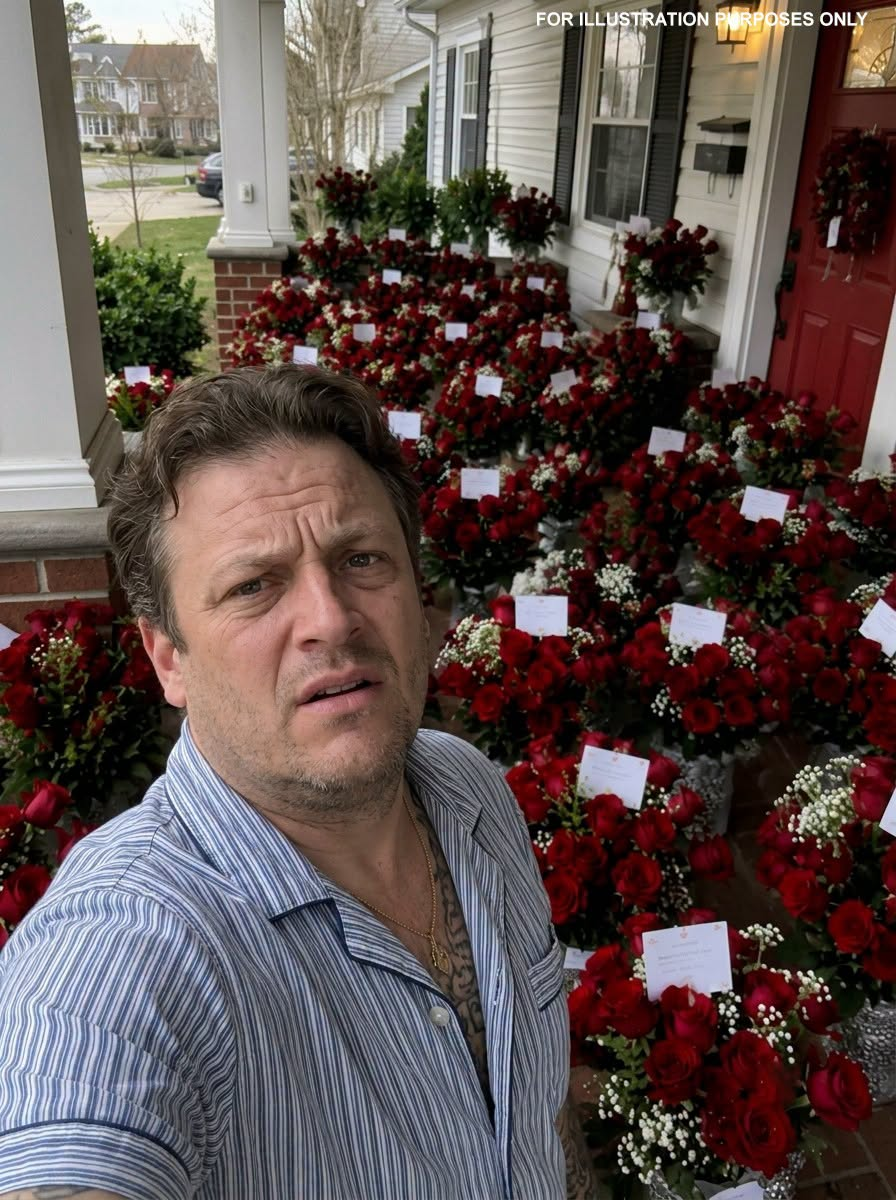
I knew something was wrong before I even cut the engine.
For seven years, every time I came home from a work trip, my wife Jane was already on the porch before I finished pulling into the driveway. Sometimes she waved with both arms like I’d been gone for months instead of five days. Sometimes she stood there barefoot in one of my old sweaters, smiling like the whole house had finally remembered how to breathe again now that I was back.
This time, the porch was empty.
“Jane?” I muttered, leaning forward over the steering wheel, scanning the front of the house for some sign of her.
Then I saw the flowers.
At first, from a distance, I thought there might be five or six bouquets scattered near the front door — strange enough on its own, but not alarming. As my car crept closer up the driveway, though, I realized the entire porch was covered. Red roses, pink ones, yellow, white, all of them wrapped in paper and ribbon and clear plastic that caught the afternoon light and threw it back at me in flashes.
There had to be a hundred of them.
I parked crooked, grabbed my suitcase off the passenger seat, and stepped out slowly, my pulse already climbing for reasons I couldn’t fully explain yet.
“What the hell?” I said under my breath.
The smell reached me before I even made it to the steps — thick, sweet, almost suffocating, the kind of fragrance that should have felt romantic and instead made my stomach clench into a fist. Bouquets were stacked against the railing, lined up along the welcome mat, tucked into the porch swing where Jane usually sat with her coffee before school.
I was still standing there, frozen, when the front door opened.

The Question Neither of Us Wanted to Ask
Jane appeared in the doorway in jeans and a faded cardigan, wearing the same tired expression she’d been carrying around for months now, one I’d learned to recognize even from across a room. The second she saw me, her face lit up — but before she could take a single step toward me, her eyes dropped to the porch, and she froze solid.
“Mark,” she breathed. “What did you do?”
Her voice was half wonder, half confusion, and it caught me completely off guard.
“What did I do?” I said.
She stepped outside carefully, looking around at the sea of roses like they might somehow explain themselves if she stared long enough. “You didn’t send these?”
“No,” I said, sharper than I meant it. “I just got home.”
She blinked, looking from me to the flowers and back again. “Then who sent them?”
That question landed between us harder than either of us expected it to.
I tried to laugh it off, but it came out thin and unconvincing. “I was hoping you could tell me.”
Her mouth opened, then closed without a sound. I watched her face closely, searching for something I very much did not want to find. All I saw was shock slowly curdling into panic.
“Mark, I have no idea,” she said. “Maybe there was some kind of delivery mix-up?”
“A hundred roses is a pretty specific mix-up.”
She wrapped her arms tightly around herself. “Don’t say it like that.”
“Like what?”
“Like you think I know something I’m not telling you.”
I looked away first, because the truth was that suspicion had already slipped quietly into my chest and settled there like a stone dropped into still water. Jane noticed the look. Of course she noticed — she noticed everything, it was part of what made her who she was.
Her eyes filled with hurt. “You really think someone sent me all of this while you were gone, and I just conveniently forgot to mention him?”
“I don’t know what to think,” I admitted.
She stepped back like my words had physically touched her, and for a moment, neither of us moved. The roses sat between us, fragrant and enormous and completely unexplained, and the silence stretched longer than either of us wanted it to.
The Envelope
That’s when I saw it — a small white envelope tucked into one of the bouquets near the porch swing. I bent down before Jane could say anything and pulled it free, turning it over in my hand. No name on the front. Just a crooked little heart, drawn in blue marker, uneven in a way that struck me as strange even before I opened it.
“Mark,” Jane whispered.
I opened the envelope. Inside was a note, folded twice, written in handwriting that didn’t match anything I expected.
The first line made my throat tighten without warning. The second made Jane’s hand fly to her mouth. By the time I reached the third, my hands were shaking badly enough that the paper rattled against the envelope, and for a few seconds I genuinely couldn’t understand why I was reacting this way.
Then I looked closer at the letters themselves.
The handwriting wasn’t elegant. It wasn’t romantic. It wasn’t the careful cursive of some secret admirer trying to impress a married woman. The letters were oversized, uneven, some floating high above the lines while others dipped below them, the way a child’s handwriting does before their hand has fully learned to control the pen.
I cleared my throat and read it out loud.
“Please don’t quit.”
Jane’s hand shot to her mouth.
The words were simple, almost plain, but the reaction they triggered in her was immediate and unmistakable. Her shoulders went stiff, her eyes widened with recognition, like she already knew exactly what this was before I even continued.
I kept reading. “We love you so much.”
My voice cracked partway through, and Jane started blinking rapidly, tears already gathering. By the time I reached the last line, they were sliding freely down her cheeks.
“We are so sorry.”
The porch went completely silent. I looked up, and Jane wasn’t looking at the flowers anymore. She was staring at the note in my hand like it might vanish if she blinked.
“No,” she whispered. Then she shook her head slowly. “No. They didn’t.”
“Jane?” I said.
Her hand trembled as she reached out and took the note from me, reading it again herself, more slowly this time. Then she started crying — not quietly, not politely, but the deep, shaking kind of crying that only comes from somewhere far below the surface, from a person who has spent months holding herself together by sheer will.
I dropped my suitcase right there on the porch and wrapped my arms around her.
“Hey,” I said softly against her hair. “Talk to me.”
For a moment, she couldn’t. She just pressed her face into my chest and cried among a hundred bouquets of roses while I held her and waited. When she finally pulled back, she wiped her eyes with the sleeve of her cardigan and looked around the porch again, this time like she was seeing it for the very first time.
“Oh my God,” she whispered.

What the Cards Said
I followed her gaze and realized, for the first time, that every single bouquet had a small card attached to it. Some held handwritten notes. Others simply listed names — children’s names, parents’ names, entire families signed together.
My stomach tightened again, but for a completely different reason this time.
“Jane,” I said quietly. “These are from your students.”
She nodded, and a fresh wave of tears rolled down her face.
I understood in that instant, all at once, what I was looking at. For months, I had watched my wife slowly losing pieces of herself, one exhausted evening at a time. Jane loved teaching more than anyone I had ever met in my life. She never treated it like a job. She treated it like a calling, the kind of work that asks something of you beyond your paycheck and your contracted hours.
She graded papers long after dinner had gone cold. She bought classroom supplies out of her own pocket without a second thought. She remembered every student’s birthday, their favorite books, their quiet strengths, even the ones the kids themselves couldn’t see yet.
But this year had been different. The stress had followed her home every single day, seeping into every corner of our life together. I remembered finding her at the kitchen table after midnight, a stack of ungraded assignments in front of her and tears sliding silently down her face.
“I don’t know if I can keep doing this,” she’d admitted to me once, not looking up from the papers.
Another night, I came downstairs around two in the morning and found her staring blankly at her laptop screen, the glow lighting up her exhausted face.
“Why aren’t you sleeping?” I’d asked.
“Because tomorrow I have to walk into that classroom,” she’d said, “and pretend I’m not failing.”
That memory still hurts to think about, even now.
“You are not failing,” I’d told her.
She’d laughed bitterly. “You didn’t see what happened today.”
Then she’d told me about the disruptions, the constant arguments, the daily battle just to get anyone in that room to listen to her for five uninterrupted minutes. But the worst part, she said, wasn’t even the students themselves. It was feeling invisible. Feeling like no matter how much of herself she poured into that job, it was never quite enough to matter to anyone watching.
The Message She Regretted Sending
A few weeks before my trip, she’d hit some kind of breaking point. I remembered standing in our kitchen while she typed out a message to the parents’ group chat, her fingers hovering motionless over the keyboard for almost ten full minutes before she finally pressed send.
“What did you write?” I’d asked her.
She’d stared at the screen without answering right away. “The truth.”
When she showed me the message afterward, it broke something in me too. She’d told them, plainly, that she loved teaching but that she was exhausted. That she was struggling. That if things kept going the way they had been, she wasn’t sure she could keep showing up.
Almost immediately, she’d regretted it. “I shouldn’t have done that,” she’d said.
“Why not?”
“Because teachers aren’t supposed to admit they’re drowning.”
Now, standing on our porch surrounded by a hundred bouquets, I finally understood. Those parents had read her message. And instead of complaining, instead of filing it away as a problem to manage, they had listened.
Jane knelt beside one of the bouquets and picked up another card, her voice shaking as she read it aloud. “Thank you for helping Ethan believe in himself.”
She reached for another. “Thank you for never giving up on Sophia.”
Then another, and another. Every note carried a slightly different message, but every single one told the same underlying story. The people she had convinced herself she’d failed had actually been paying close attention the whole time.
Soon we were both sitting together on the porch steps, opening cards side by side. Some were written by parents in careful adult handwriting. Others were clearly written by the kids themselves.
One simply read: “You’re my favorite teacher.”
Another said: “School is better when you’re there.”
Then Jane opened a small card covered in crooked stickers and a little too much glitter, the handwriting barely legible in places. She laughed through her tears as she read it aloud.
“Dear Mrs. Jane, please don’t quit because you make math less scary and because your jokes are funny even when nobody laughs.”
I laughed. Jane laughed too. Then, almost in the same breath, she started crying again.
Proof She Had Mattered
The deeper we dug into that pile of flowers, the more notes we uncovered, and with every single one, I watched something slowly return to my wife’s face that I hadn’t seen in a long time.
Hope. The same hope I had honestly believed she’d lost months earlier, somewhere between the midnight grading sessions and the two a.m. laptop glow.
By this point, the porch wasn’t just covered in roses anymore. It was covered in evidence — proof that she had mattered far more, to far more people, than she had ever let herself believe.
For the next hour, neither of us went back inside the house. The groceries I’d meant to unpack stayed forgotten in the car. My suitcase sat abandoned by the front door. Dinner became the last thing on either of our minds. We just stayed there on the porch, surrounded by roses and handwritten notes, opening card after card like we’d stumbled onto a treasure chest hidden in plain sight the whole time.
With every message Jane read out loud, another piece of the weight she’d been quietly carrying seemed to lift off her shoulders. At one point, she unfolded a card from the parent of a boy named Tyler — a student she had mentioned to me countless times over the past few years.
Her eyes went wide as she read it.
“What is it?” I asked.
She handed the card to me without a word.
“Mrs. Carter, Tyler used to cry every morning before school. You’re the reason he loves learning now. We can never thank you enough.”
I looked up and found tears streaming down Jane’s face again.
“I didn’t even know they noticed,” she whispered.
The sadness in her voice wasn’t really sadness by that point. It was disbelief. After months of feeling completely unseen, she was suddenly confronted with dozens of quiet reminders that people had, in fact, been paying attention the entire time.
I reached over and took her hand. “They noticed.”
Jane looked around at the mountains of flowers still covering the porch, and the evidence was impossible to argue with. One hundred bouquets. One hundred families. One hundred separate decisions, made by one hundred different people, all pointing to the same conclusion — that she mattered, and that they needed her to know it.

Carrying the Roses Inside
As the afternoon faded slowly into evening, we started carrying the bouquets inside in small armfuls. Roses filled the kitchen counters. They covered the dining room table. They lined the living room shelves and every flat surface we could find room for. By the time we finished, the entire house smelled like a flower garden in full bloom.
Jane stood in the middle of the living room, turning in a slow circle to take it all in. I couldn’t remember the last time I had seen her smile the way she was smiling right then. Not the polite smile she wore for strangers at the grocery store. Not the tired, worn-thin smile she gave me after a hard day.
This was different. This was the smile of someone realizing, all at once, that she hadn’t been fighting alone the whole time after all.
Then she noticed one final envelope, tucked beneath a bouquet near the fireplace.
“There’s another one,” she said quietly.
She opened it carefully. Inside was a large card, signed by dozens of names — parents, students, entire families crowding the margins. At the very bottom, someone had added one final message.
Jane’s voice trembled as she read it aloud.
“The world needs teachers like you. Please don’t give up on us, because we haven’t given up on you.”
The room went completely still. Then Jane pressed the card against her chest and started crying again.
I wrapped my arms around her, and this time the tears felt different from before. They weren’t tears of exhaustion anymore. They weren’t tears of defeat. They were tears of relief, plain and simple.
What I Finally Understood
For months, I had watched my wife come home feeling defeated, day after day. I had watched her question herself, question her entire career, question whether the endless hours and quiet sacrifices were even worth it anymore.
Standing there in that flower-filled living room, I finally understood something I hadn’t fully grasped before. Teachers rarely get to witness the impact they’re making while they’re actually making it. They plant seeds without ever knowing which ones will take root and grow. They show up, day after ordinary day, without realizing how many lives they’re quietly reshaping in the process.
Jane buried her face in my shoulder. “I really was going to quit,” she admitted.
“I know.”
“I had already started looking at other jobs.”
I pulled back just far enough to look her in the eye. “And now?”
She glanced around the room — at the roses, at the cards, at the sheer physical evidence of hundreds of people who believed in her more than she’d ever let herself believe in herself.
Then she smiled. A real smile, the kind that reaches all the way up into someone’s eyes.
“I think I need to show up on Monday.”
I laughed. “You think?”
She laughed too, and the sound filled the room in a way it hadn’t in longer than I wanted to admit.
Later That Night
Later, after the flowers had all been arranged and the notes carefully stacked on the dining table, we sat together on the couch, surrounded on every side by roses. I found myself thinking back to that first moment in the driveway, seeing all those bouquets scattered across the porch and feeling my stomach drop, wondering for a few terrible minutes if I was looking at proof of betrayal.
Instead, it had become something far more powerful than that fear ever could have been. It was proof that kindness travels further than we usually give it credit for. Proof that appreciation has a way of arriving exactly when someone needs it most, even if it takes months longer than it should. And proof that while my wife had spent every single day teaching her students, she had unknowingly been teaching them something even more important than long division or spelling words.
She had taught them how to show up for someone who desperately needed to be reminded that she was loved.