The clock on the living room wall ticked with a heavy, rhythmic monotony that always seemed to amplify whenever the house was empty. It was just after noon on a Tuesday, that specific slice of the day where the rest of the world was bustling with life, yet my suburban home felt completely insulated in silence. I stood at the kitchen sink, letting the warm water run over my favorite ceramic coffee mug, watching the dark remnants of caffeine swirl down the drain.
Outside, the bright mid-summer sun beat down on the manicured lawn, casting long, sharp shadows through the window. It was a beautiful day, objectively speaking, but inside, the quietness was almost physical.
Daniel was gone again.
That part of my life was as predictable as the changing of the seasons. After eighteen years of marriage, I had long since adapted to the choreography of his departures. I knew the exact sound of his heavy nylon suitcase zipping shut at five in the morning. I knew the precise, hurried way he kissed the crown of my head before slipping out the front door to catch an early flight. I knew the hollow, too-neat feeling of his side of the bed when night fell, the sheets stretched taut and undisturbed.
His corporate consultancy work took him out of town constantly. Sometimes it was just a quick two-night sprint to a neighboring state; other times, like this week, it was a grueling, five-day trip to Chicago. I had never learned to love the emptiness it left behind, but we had built a comfortable, affluent, and entirely stable life around the predictable rhythm of his absence.
There were absolutely no red flags in our relationship. We didn’t have those icy, prolonged silences that plague collapsing marriages. We didn’t have explosive, irrational arguments over trivial things, nor did he possess a second phone or a sudden habit of tilting his screen away from me when a text came through. We were steady. We were a team.
At forty-four years old, I had long surrendered the naive fantasy that marriage was supposed to be a non-stop display of emotional fireworks. To me, mature love had evolved into something much more grounded. It was a brief, mid-day text message that read, “Landed safely. Heading into the boardroom.” It was the way Daniel quietly remembered to order my specific brand of almond creamer on the grocery app the night before he left, knowing with absolute certainty that I would forget to restock it myself. It was the simple comfort of sharing a dinner table without the desperate need to fill every passing silence with meaningless chatter.
So, when the sudden, sharp chime of the front doorbell shattered the domestic stillness, my first reaction wasn’t fear or suspicion. It was a mild curiosity.
I dried my hands on a tea towel, tossed it onto the marble countertop, and walked down the long, hardwood hallway toward the front entrance. Through the frosted glass panels of the door, I could see a massive, blurred shape of vibrant color.
When I swung the heavy oak door open, I was greeted by a deliveryman who looked thoroughly exhausted, his face completely obscured by an absolute wall of floral brilliance.
“Amber?” a muffled voice called out from somewhere behind the dense foliage.
“Yes, that’s me,” I said, my lips instantly curving into a wide, surprised smile.
“These are for you. Sign right here, please.”

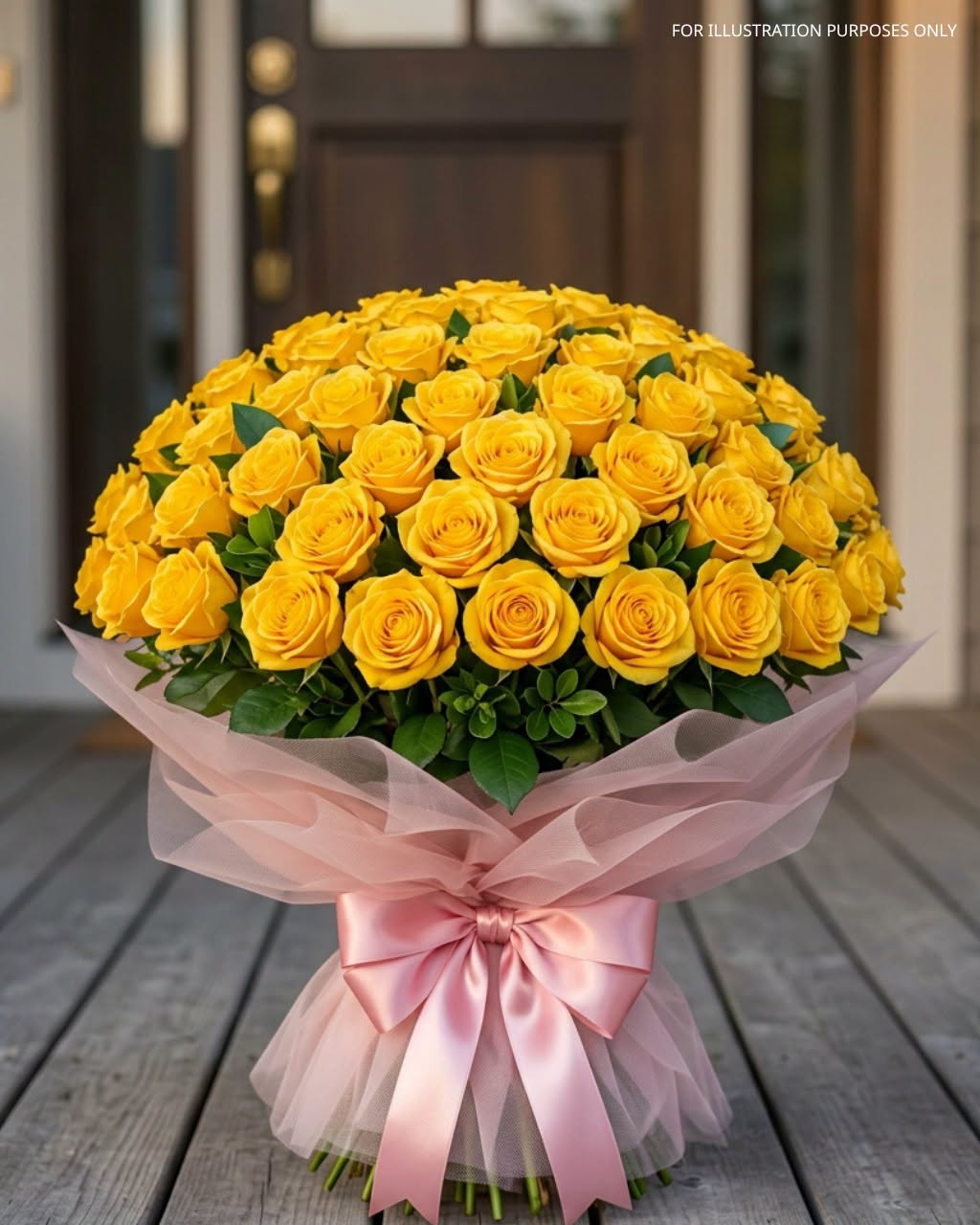
He carefully shifted the massive weight of the bouquet into my outstretched arms, and I let out a genuine, breathless laugh. The sheer volume of the arrangement was staggering. My hands could barely loop around the thick, heavy green stems, which were bound together tightly by layers of premium, textured brown paper. The roses were breathtaking—a sea of deep, golden yellow, their petals perfectly formed and heavy with moisture, catching the natural sunlight streaming onto the front porch. There were so many individual blooms packed into the bundle that I had to crane my neck sideways just to see the deliveryman over the top of them.
“Wow,” I murmured, adjusting my grip as the sweet, slightly intoxicating scent of fresh-cut roses washed over me. “Someone went absolutely all out. Thank you so much.”
The deliveryman offered a polite, professional smile, tipped his cap, and turned back down the concrete walkway. “Enjoy them, ma’am. Have a great day.”
I kicked the front door shut with the heel of my slipper, balancing the massive weight of the flowers against my hip. My eyes instinctively began scanning the dense canopy of yellow petals, searching for the small, familiar white card that typically accompanied an expensive floral delivery. I expected a little plastic pitchfork tucked into the greenery, holding a note that read something sweet and predictable.
But there was nothing.
I turned the massive bundle around in my arms, shifting the paper wrapping, thinking perhaps the card had slipped down toward the base of the stems during transit. There was no envelope. No printed receipt. No handwritten message.
Puzzled, I quickly reopened the door and called out to the delivery driver just as he was climbing back into his van. “Excuse me! Wait! There’s no card. Do you know who sent these?”
The man paused, looking back over his shoulder. He reached into his pocket, pulled out a digital handheld scanner, and squinted at the delivery manifest. “Let me check the system log… No, ma’am. No card text was submitted with the order. No sender signature requested anonymity either—the billing field is completely blanked out by the corporate office. Just your name and address on the routing label. Just Amber.”
“Just my name?” I repeated, a faint frown creasing my forehead.
“Yes, ma’am. Sorry about that.” He waved and pulled away from the curb.
I shut the door for a second time and carried the massive bouquet into the dining room, setting it down carefully onto the polished mahogany table. I stepped back, dusting off a few stray green leaves from my shirt, and stared at the golden display. They truly were magnificent. The bright yellow hues seemed to inject an artificial warmth into the quiet room, reflecting beautifully against the dark wood of the table.
Initially, the lack of a signature didn’t truly alarm me. Daniel had a history of being incredibly private, almost understated, about his romantic gestures. He was fundamentally not the type of man to write long, emotionally transparent, poetic notes in greeting cards. He found it performative.

I vividly remembered our twelfth anniversary, when a delicate diamond necklace had arrived via courier with absolutely no message attached. I had spent six anxious hours wondering if it was a delivery error until he called me during his dinner break, laughing softly when I questioned him. I remember his exact words: “I thought the gift said enough.”
I had teased him relentlessly for weeks about his mysterious, secret-agent approach to gift-giving. So, standing alone in my quiet dining room, looking at this massive display of golden roses, I naturally deduced that he had arranged a grand, spontaneous surprise for me from his hotel room in Chicago, deliberately leaving his name off the order just to make me smile and think of him.
But as the minutes began to tick by, the initial rush of pleasant surprise began to curdle into a strange, localized unease. It started as a tiny, persistent pinch right behind my ribs—a quiet, instinctual tug that I couldn’t logically justify, but couldn’t seem to shake either.
I leaned forward, resting my knuckles on the edge of the table, studying the bouquet with a critical eye.
The first detail that felt fundamentally wrong was the color.
Daniel knew, with absolute and unyielding certainty, that I preferred white roses. It wasn’t a casual preference or a detail he could easily misplace in his memory. It was an established truth embedded in the very fabric of our shared history. White roses were the exact flowers I had carried down the aisle at our wedding eighteen years ago. White roses were the specific, comforting blooms he had placed on the kitchen counter when my mother passed away, knowing they were the only things that brought a shred of peace to my eyes. White roses were always the centerpiece whenever we celebrated a major milestone.
Yellow roses were undeniably beautiful, but they held no personal currency in our marriage. They weren’t mine.
I folded my arms tightly across my chest, the warmth of the afternoon suddenly feeling a bit more distant. “Daniel,” I murmured under my breath, my voice sounding small in the empty room, “what on earth were you thinking with this color?”
And then, there was the sheer scale of the number.
Exactly one hundred.
I reached down and picked up the small plastic shipping tag attached to the waterproof wrapping. Printed clearly in sterile, automated font under the quantity field was the number: 100.
Not ninety-nine. Not a standard florist’s premium arrangement of two or three dozen. Exactly one hundred.
A round, massive number like that should have felt incredibly romantic. It was the kind of extravagant statement people made for landmark anniversaries, public proposals, or deep, grand apologies. But my birthday was months away in the winter. Our anniversary had passed peacefully three months prior. And Daniel, for all his wonderful, provider-oriented qualities, was simply not a “one hundred roses for absolutely no reason” kind of man. He was calculated, practical, and highly intentional with his finances. He was thoughtful, yes, but he was never extravagant without a clear, logical purpose.
I stood completely still, staring at the golden wall of petals.
Yellow roses have never carried a singular, universally accepted meaning in the lexicon of flowers. In casual modern culture, people often associate them with bright friendship, celebration, or new beginnings. But if you dig just a fraction deeper into older traditions and European lore, yellow roses carry a much darker connotation. They symbolize deep-seated jealousy. Infidelity.
And in certain traditional cultures, they symbolize a farewell. A final, definitive goodbye.
The thought materialized in my mind with such sudden, crystalline clarity that I instinctively took a full step backward, away from the dining table. My heart gave a strange, erratic thud against my ribs.
“Stop it,” I whispered firmly to myself, shaking my head to clear the irrational fog. “You are being completely ridiculous. It’s just a delivery mistake.”
But the seed of unease had already taken deep root in the room, and the air suddenly felt suffocatingly heavy.

Desperate to ground myself in reality, I reached for my phone on the kitchen counter and dialed my husband’s mobile number. I held the device to my ear, listening to the long, rhythmic rings.
One. Two. Three. Four.
It cut abruptly to his standard, professional voicemail greeting. “You’ve reached Daniel Wright. Please leave a message and I will return your call as soon as possible.”
I clicked off the call, a small line forming between my brows. Daniel was always incredibly busy during these consulting trips, packed into back-to-back corporate strategy meetings, but after nearly two decades of marriage, he had developed a reliable habit of answering my calls if his phone was within reach. If he couldn’t talk, he would at least press the quick-decline option and immediately send a templated text stating he was occupied. Leaving it to ring out entirely was uncharacteristic.
I quickly tapped out a text message, my thumbs moving rapidly across the glass screen. Did you send me flowers? They just arrived. They are beautiful, but let me know when you can talk.
I hit send, keeping my eyes locked on the digital screen, waiting for the small bubbles to appear, waiting for the instant reassurance that everything was perfectly normal.
One minute passed in total silence.
Then five minutes.
Then ten.
The text remained marked as delivered, but there was no read receipt, no typing indicator, no response whatsoever.
I swallowed hard, the cold sensation in my fingers spreading up my arms. I pressed the call button a second time. Again, the phone rang through the empty air, echoing into the voicemail box.
By that point, the roses on my dining table had completely lost their aesthetic appeal. They no longer looked like a beautiful, romantic gesture. They looked oppressive. Too bright. Too meticulously arranged. Too intensely present in my quiet home.
Driven by a restless, nervous energy, I began to walk slowly around the perimeter of the dining table, studying the massive bouquet from different angles. I tried to convince myself that I was overreacting, that I was letting a harmless florist error trigger a ridiculous, paranoid episode. Maybe Daniel’s flight had been delayed. Maybe he was trapped in a dead zone inside a massive corporate skyscraper. Maybe the florist ran out of white roses and substituted yellow at a steep discount, offering a hundred stems as a promotional package deal.
But as I leaned over the bouquet, my eyes caught a subtle, structural anomaly in the arrangement.
The flowers hadn’t been gathered together in a loose, casual bundle. The outer perimeter of the bouquet was composed of fully opened, lush yellow roses, all angled outward in a flawless, symmetrical circle. But near the dead center of the arrangement, a cluster of stems sat noticeably lower than the rest. Their heavy golden heads were tilted slightly inward, creating a subtle, intentional depression in the design. It wasn’t an accident of shipping; it was far too precise. It was a deliberate, geometric variance that most casual observers would completely miss. But I had spent my life around an incredibly analytical father; I noticed patterns.
Curious, and with my heart hammering a frantic rhythm against my chest, I began to count them methodically. I used the tip of my index finger, lightly brushing the velvet petals of each individual bloom as I moved my way inward.
Ten rows. Each row contained exactly ten perfectly placed roses.
Ten by ten. One hundred.
I counted a second time, my breathing growing shallower as the numbers lined up with terrifying precision. It was an absolute grid of flowers.
But as my finger reached the inner, recessed cluster of the ninth row, I froze.
One of the roses near the geometric center was not entirely yellow. Hidden deep beneath the curve of a heavy outer petal, right near the base where the bloom met the green stem, was a tiny, vivid red mark.
At first glance, I tried to tell myself it was a natural flaw—a common bruise on the vegetation, or perhaps a stray drop of red dye from a neighboring workstation at a busy floral shop. I gently extended my index finger, carefully lifting the heavy yellow petal to get a clearer look.
The red mark was not a bruise. It was a clean, distinct, circular dot of permanent ink, applied deliberately to the hidden underside of the flower.
My breath caught sharply in my throat, a sudden wave of ice pouring down my spine.
I moved to the next flower in the recessed cluster, lifting the petal with a trembling hand. There it was. A second identical red mark, perfectly concealed from view unless you actively dismantled the arrangement.
My hands began to shake so violently that I accidentally snapped the leaf off a nearby stem. I searched the remaining center flowers, my vision tunneling, the room around me seemingly fading into a dull, distant roar.
Deep in the absolute center of the final row, I found the third one.
Exactly three. Three marked yellow roses, buried inside a flawless grid of one hundred.
My stomach completely dropped, a heavy, visceral sensation of pure terror taking hold of my core. I completely forgot about my husband’s unanswered text messages. I forgot about the warm afternoon sun pouring through the windows, and I forgot about the half-cleaned coffee mug sitting in the kitchen sink. In that terrifyingly quiet moment, the only sound that existed in the universe was the frantic, ragged sound of my own breathing.
Three marked roses.
I had seen this specific, horrifying pattern before.
A memory stirred deep within my mind—an old, long-buried, and entirely unwelcome memory that I had spent decades trying to suppress. It was like a monstrous entity hidden beneath the floorboards of my childhood, suddenly scratching violently at the wood to be let out into the light.
“No,” I whispered aloud, the word catching in my throat, completely stripped of any real strength. “No, it’s not possible. It’s a coincidence.”
But my instincts knew better. My body was already responding to a danger my mind was terrified to articulate. I grabbed my phone from the table, my slick, sweaty palms nearly dropping the device. This time, I didn’t waste time dialing Daniel.
I dialed 911.
The line connected almost instantly, the calm, clinical voice of the emergency dispatcher cutting through my panic. “911, what is the address of your emergency?”
I gripped the edge of the mahogany dining table so hard my knuckles turned a stark, bloodless white. I tried with everything I had to articulate the situation without sounding like a woman losing her mind. “My name is Amber Wright. I need an officer sent to my home immediately. A bouquet was just delivered to my house… one hundred yellow roses. There is no card. There is no sender signature. Just my name on the routing slip.”
There was a brief, palpable pause on the other end of the line, the sound of keyboard keys clicking softly. “Ma’am, I understand this is unusual, but are you currently in any immediate physical danger? Is there someone outside your property?”
“I don’t know,” I admitted, my voice cracking under the immense weight of the suspense. “But you don’t understand… three of the roses in the center are deliberately marked. Exactly three. There are tiny red ink marks hidden directly beneath the petals.”
Saying the words out loud to a stranger made the reality of the situation crash down upon me with a suffocating force.
Another prolonged pause stretched over the line, the dispatcher’s tone shifting from standard customer-service processing to a sharper, more focused register. “Marked how, Ms. Wright? Can you describe the marks?”
“They are small, distinct red dots,” I said, my eyes locked onto the golden arrangement that now felt like a ticking bomb sitting in the middle of my home. “They are hidden. Exactly three of them. Please… you need to send someone.”
“Alright, Amber, listen to me carefully,” the dispatcher instructed, her voice steady and firm. “I am dispatching a unit to your location right now. I want you to step away from the delivery. Do not touch the flowers, the wrapping, or the tag any further. Go to your front door, ensure it is locked, check your back entrances, and stay away from the windows until the officers arrive. Do you understand?”
“Yes,” I choked out. “Yes, I’m locking everything right now.”
I disconnected the call and moved through the house like a ghost, driven by pure survival adrenaline. I checked the heavy deadbolt on the front door, turning it until it clicked into place with a heavy, metallic finality. I ran through the kitchen, sliding the security bar into the track of the glass patio doors. I pulled the heavy curtains shut across the living room windows, plunging the space into a tense, artificial twilight.
Then, I retreated back to the center of the dining room, standing a safe distance away from the table, my eyes glued to the one hundred yellow roses. I stood there completely isolated, waiting for the sound of sirens, waiting for any sign of life from my husband’s phone, and praying that the shadow of the past wasn’t finally crossing over my threshold.
But Daniel’s phone remained completely silent.
The worst part of the ordeal didn’t arrive with the initial discovery. It came a grueling hour later.
By that time, two uniformed patrol officers had arrived at the scene. They were currently standing in my dining room, clipboard in hand, looking at the massive bouquet with that carefully practiced, patronizing politeness that law enforcement professionals use when they believe they are dealing with a wealthy, paranoid suburban housewife frightened over an administrative error.
The senior officer, a burly man named Officer Voss, shifted his heavy utility belt and looked down at me. “So, let me make sure I have the details correct, Ms. Wright. You stated that your husband typically sends you white roses for special occasions?”
“Yes,” I replied, my voice tight, my arms wrapped securely around my torso as if trying to hold myself together. “Always white. In eighteen years, he has never bought me a single yellow flower. He knows what they mean to me.”
“And he is currently away in Chicago for a corporate consulting contract?” Voss asked, scribbling a note on his pad.
“That’s what he told me on Monday morning when he left for the airport.”
The younger patrol officer, a rookie who kept glancing nervously around the upscale room, offered a placating smile. “Ms. Wright, I completely understand how an anonymous delivery can feel deeply unsettling when you’re home alone, but florists are notorious for making order substitutions during high-volume weeks. It’s entirely possible your husband placed a standard order online, and the local shop simply ran out of white inventory.”
I wanted to believe him. With every fiber of my being, I wanted to nod, apologize for wasting city resources, and laugh off my terror. I wanted this to be a stupid mistake.
But before I could formulate a response, the low, heavy hum of a vehicle pulling into my driveway cut through the conversation. Through the gaps in the dining room curtains, I watched a dark, unmarked sedan come to a halt at the curb.
A moments later, the front doorbell rang. Officer Voss stepped into the foyer to answer it, and a man walked into my home who looked like he had been pulled straight from a film noir. He was in his late sixties, with a thick mane of silver hair, deeply set, tired eyes, and a weathered face that carried the distinct, heavy lines of someone who had spent too many decades carrying horrific secrets in the dark.
He stepped into the dining room, flashing a gold shield to the patrol officers before his gaze settled heavily onto me.
“I’m Detective Kellan,” he said, his voice deep and gravelly.
The sound of that name hit me like a physical blow. A strange, electric shock ran through my system, and a name from my childhood instantly surfaced.
“My father… my father used to know a Kellan,” I whispered, my voice trembling.
The older detective paused, his tired eyes softening with a profound, sudden sorrow as he looked at me. “Your father was Detective Ron Vance. He was my mentor, Amber.”
I nodded slowly, a familiar, sharp pain catching in my chest. My dad had been a legendary homicide detective in the city for over thirty years. He had been a larger-than-life figure, a man of intense code and deep, quiet intensity. Before he passed away five years ago from cancer, he would occasionally sit with me on the porch, rolling a cold cup of coffee between his calloused hands, sharing vague, heavily redacted fragments of his old investigations. He never gave me the gruesome details, but he gave me enough to know that there were certain cases—certain unresolved horrors—that had permanently stained his soul.
Detective Kellan bypassed the patrol officers and walked directly up to the dining table. He stopped inches from the bouquet, leaning down to inspect the arrangement.
Initially, his expression was completely neutral, the stoic mask of a seasoned investigator. But then, he reached out with a gloved hand and gently parted the yellow petals of the ninth row, exposing the three hidden red ink marks.
The moment his eyes locked onto those dots, every single drop of color completely drained from Detective Kellan’s face. His jaw went completely slack, leaving him looking suddenly frail, old, and terrified.
He whipped his head around to face me, his voice dropping into a low, urgent hiss. “Where exactly did this delivery come from, Amber? Who handed this to you?”
“I already told the officers,” I stammered, my panic returning with a vengeance. “A standard floral delivery van. It arrived just after noon. No card. No sender information. Just my name scrawled on the manifest.”
Kellan didn’t hesitate for a single second. He turned to the two uniformed officers, his voice cutting through the room like a gunshot. “Secure the perimeter of this property immediately. Call the forensic unit and the tech squad. Get a tape on this room right now.”
Officer Voss straightened up, looking thoroughly confused by the sudden escalation. “Sir? It’s just a floral delivery—”
“Do it now, Voss! Move!” Kellan roared.
My legs suddenly felt like water, and I had to grab the sturdy back of a dining chair just to keep from collapsing onto the hardwood floor. “You recognize this,” I breathed, the horror of confirmation setting in. “Oh my god… you know what this means.”
Detective Kellan walked over to me, placing his heavy, steady hands on my shoulders, looking directly into my eyes with an absolute seriousness that chilled me to the bone. “Twenty-two years ago, Amber… before you and Daniel even bought this house, this city was plagued by a phantom. Three young women vanished without a single trace over a span of eighteen months. Each one of those victims received an anonymous bouquet of exactly one hundred yellow roses on her doorstep less than forty-eight hours before she disappeared.”
My throat completely closed up, a suffocating weight pressing down on my chest. “One hundred,” I repeated, the number sounding like a death sentence.
Kellan nodded slowly. “Not ninety-nine. Not one hundred and one. Always exactly one hundred. Your father spent two years of his life living inside that case file. He believed the number held a deeply personal, ritualistic meaning to the killer. A complete cycle. A century of life cut short. A final, beautiful goodbye.”
I gripped the fabric of the chair, the room around me seemingly tilting on its axis.
“And the red dots?” I whispered, almost terrified to hear the answer.
“Three marked flowers,” Kellan confirmed, his voice heavy with grim finality. “Every single time. The killer used a permanent red marker to dot the hidden underside of three specific petals near the center. Your father discovered it during the processing of the third victim’s apartment. He always said it was the killer’s way of signing his work without leaving a fingerprint. A secret code between him and the universe.”
A horrific shiver raced through my entire body. I remembered sitting on that old porch with Dad all those years ago. I could still hear his gravelly voice echoing in my ears: “Some monsters don’t leave fingerprints, Amber. They leave symbols. They want you to know they were there, but they want to dare you to prove it.”
I had thought he was just a tired, aging cop waxing poetic about the frustrations of his career. I had never known—never in my wildest nightmares imagined—that his words were a blueprint for a horror story that would eventually land on my own dining table.
“We need to get a hold of Daniel immediately,” Kellan said, pulling out his own tactical phone. “If someone is targeting you because of your father’s legacy, your husband needs to be pulled out of Chicago under executive protective custody right now.”
“I’ve tried calling him,” I sobbed, the tears finally breaking through my defenses. “He won’t answer. He isn’t responding to any of my texts.”
Kellan frown deepened. He dialed a direct line, bypassing standard channels, and contacted the corporate headquarters of the consultancy firm where Daniel worked. I stood in the center of the room, watching the detective’s face like a hawk as he listened to the voice on the other end of the line.
I watched as his brow furrowed, then saw his expression stiffen into a mask of pure, unadulterated shock.
“Are you absolutely certain?” Kellan asked into the receiver, his voice dropping an octave. “Check the payroll routing. Check the travel logs… Understood.”
He hung up the phone slowly, refusing to meet my eyes for several agonizing seconds.

“What is it, Detective?” I demanded, stepping forward, my voice shrill with hysteria. “What did they say? Is Daniel okay? Did they reach him at his hotel?”
Kellan swallowed hard, a look of deep, agonizing pity in his eyes. “Amber… Daniel was never on a business trip to Chicago.”
My mouth went completely dry, the words failing to process in my brain. “What? That’s… that’s not possible. He left on Monday morning. I watched him pack his suitcase. He told me he had a major presentation with a manufacturing client—”
“According to his company’s HR department and his direct supervisor, Daniel took a mandatory personal leave of absence starting last Thursday,” Kellan said gently, though the words felt like knives. “The hotel reservation confirmation he gave you was completely fabricated. The corporate flight profile was never booked. Nobody at his firm has physically seen or spoken to your husband in over four days.”
Four days.
The revelation felt like a physical explosion inside my mind, completely shattering the foundation of my reality. The man I had slept beside for eighteen years, the man who had kissed my forehead just twenty-four hours ago and told me he loved me, had systematically lied to my face. He had packed a suitcase full of clothes, constructed a elaborate corporate narrative, and walked out of our lives into complete anonymity.
I didn’t know where he was. I didn’t know who he was with.
And for the first time in my life, I realized I didn’t truly know who my husband actually was.
By nightfall, my peaceful suburban home had been entirely transformed into a frantic, brightly lit crime scene. Forensics technicians in white Tyvek suits crawled through my rooms, dusting every surface for latent prints. I sat huddled on the living room sofa, wrapped in a heavy wool blanket despite the summer heat, staring blankly ahead as the sound of drawers opening and closing echoed from Daniel’s home office upstairs.
The thoughts in my head were a chaotic, terrifying loop. Had I been living with a monster? Was the steady, predictable man I loved actually a dormant killer whose past was finally catching up to him? Had he abandoned me because he knew the police were closing in?
Suddenly, Detective Kellan descended the stairs, carrying a small, heavy metal lockbox that I recognized instantly. Daniel kept it on the top shelf of his office closet, always claiming it held old tax documents and mortgage deeds from our first apartment.
“Amber,” Kellan said carefully, sitting down on the coffee table directly opposite me. “Do you have the key to this box?”
I shook my head, my jaw trembling. “No. He always kept the key on his personal ring.”
Kellan signaled a technician, who stepped forward with a heavy set of bolt cutters. With a sharp, metallic snap, the lock gave way, and the lid was lifted.
I braced myself, fully expecting to see horrific trophies—hair trimmings, driver’s licenses of missing women, pieces of clothing.
Instead, Kellan reached in and began pulling out stacks of old, yellowed newspaper clippings.
Dozens of them. Hundreds of pages.
I leaned forward, my heart skipping a beat as my eyes scanned the bold, historical headlines: “Third Ward Victim Vanishes.” “Police Baffled by Golden Rose Killer.” “Detective Vance Vows Justice for Missing Women.”
They were all articles about the exact cold case from twenty-two years ago. Mixed between the clippings were high-resolution photocopies of the original crime scene photos—the empty apartments, the neat, circular arrangements of yellow roses left behind on tables. And scrawled heavily along the margins of every single document was Daniel’s unmistakable, precise handwriting. There were complex timelines, arrows connecting dates, and frantic, analytical notes questioning timelines and police statements.
Officer Voss looked grimly over Kellan’s shoulder. “Sir, this is extensive. He’s been tracking this case for years in absolute secret. We need to issue an immediate nationwide felony warrant for his arrest.”
I stared at the clippings until the ink blurred into a dark, meaningless smudge. My hands flew to my mouth to stifle a scream. My Daniel. The man who deliberately made terrible, lumpy pancakes every Sunday morning just because he insisted mine were “too beautiful to eat.” The man who held me in the dark for three straight weeks when my father passed away, absorbing my grief.
Had he been hiding a dark, psychotic obsession right under my nose? Had I spent nearly two decades loving a ghost? A predator?
By midnight, the local news channels had picked up the leak. Daniel’s face was splashed across every digital screen in the tristate area, named as the prime suspect in a sudden, dramatic reopening of a decades-old serial disappearance case.
By morning, I felt entirely hollowed out, a shell of a woman sitting in a house that no longer felt like home.
Then, just after breakfast, the entire trajectory of the nightmare shifted once again.
Detective Kellan walked through my front door, his jaw tightly set, a strange, intense energy radiating from his posture. He didn’t look at the patrol officers; he walked straight to the kitchen table where I was sitting with an untouched cup of tea.
“The forensic priority report on the bouquet just came back from the state lab,” Kellan said, his voice taut.
I braced myself, closing my eyes, waiting for the final nail in the coffin of my marriage. “Did they find Daniel’s prints on the wrapping paper?”
“No,” Kellan answered flatly. “They didn’t find a single trace of Daniel’s DNA on the order form, the tag, or the paper wrap.”
I opened my eyes, blinking through the exhaustion. “Then whose prints were they? Did the killer use gloves?”
Kellan took a deep breath, his face looking suddenly older, carrying the immense weight of an incredible revelation. “The partial latent prints recovered from the adhesive on the florist tag belong to a man named Amos Albright.”
The name floated in the quiet kitchen, meaning absolutely nothing to my ears. I frowned, searching my memory. “Amos? I don’t know an Amos. Who is he?”
Kellan swallowed hard, his eyes shining with a mixture of dawning fury and profound regret. “Amos was a highly decorated, retired homicide detective, Amber. He was your father’s original partner. They worked side-by-side on the task force twenty-two years ago.”
My father’s old partner. The man who used to come to our family barbecues when I was a teenager, bringing a box of donuts and laughing loudly with my dad in the backyard.
A profound, violent shiver ripped through my core. “Why… why would my father’s partner send a bouquet of death to my house?”
“He didn’t send them to threaten you,” Kellan answered softly, leaning over the table. “We don’t think you were ever the target, Amber. The bouquet wasn’t meant to frighten you into submission. It was bait.”
“I don’t understand,” I stammered, my mind spinning out of control. “Bait for who?”
“For Daniel,” Kellan explained, his fingers tapping the table with urgency. “We just executed a deeper digital audit of your father’s old personal effects. Before your dad passed away, he began to privately suspect Amos. He noticed timeline inconsistencies in Amos’s alibis during the weeks of the disappearances, but he never managed to compile enough hard, physical evidence to secure a warrant before his illness took him. Your dad hid his private investigation journals in an old locker.”
Kellan took my trembling hands in his. “Daniel must have discovered your father’s old storage locker recently while sorting through the family estate documents. He found the journals. He realized what your dad suspected. And instead of putting you in danger or bringing a wild theory to a police department that worshipped Amos as a hero, Daniel decided to finish your father’s work himself. He used his personal leave to track Amos’s movements. But Amos is a brilliant, trained investigator. He realized Daniel was getting dangerously close to uncovering the truth.”
My heart gave a massive, structural stumble against my ribs. “Daniel knew? He was trying to find the killer?”
“He wasn’t running away from you, Amber,” Kellan said, his voice cracking with emotion. “He was trying to eliminate a monster before that monster ever realized you existed. The bouquet was Amos’s message to Daniel. It was his way of saying: ‘I know exactly where your wife lives. I know her schedule. Drop the investigation, or she becomes victim number four.’“
That completely broke me.
A massive, sobbing wave of pure emotional release washed over me. I collapsed onto the table, weeping for the husband I had spent the last twenty-four hours demonizing. He wasn’t a predator. He wasn’t a monster hiding in my bed. He was a brave, terrified man who had walked into the mouth of hell completely alone, carrying a heavy burden just to keep me safe from the sins of the past.
Within minutes, a multi-agency task force tracked a burner phone signal linked to Amos Albright to an isolated, abandoned hunting cabin deep in the dense woods outside the city line. I begged Kellan to let me go with them, to ride in the back of the cruiser, but he firmly refused, citing safety protocols.
The next six hours felt like an eternity, each passing second a brutal exercise in psychological torture. I sat alone in a quiet room at the police precinct, holding Daniel’s heavy platinum wedding ring tightly between my fingers—the ring he had intentionally left behind on his dresser before his “trip,” a detail I now understood was his way of ensuring it wouldn’t be lost if things went horribly wrong.
The sun dipped below the horizon, casting the precinct into shadow. Finally, the heavy glass doors of the briefing room swung open, and Detective Kellan walked in. His uniform shirt was wrinkled, his face streaked with dirt, but his eyes were wet with absolute triumph.
“He’s alive, Amber,” he said simply.
I stood up so fast my chair flipped backward onto the floor. “Daniel?”
“Yes. We breached the cabin just in time. He’s dehydrated, he’s bruised, but he is completely alive.”
An incredibly raw, visceral sound escaped my throat—a mix of a broken sob and a desperate prayer of thanksgiving.
Daniel came home to me two days later.
When the police escort pulled into our driveway, I didn’t wait for him to reach the porch. I sprinted down the concrete walk, my bare feet hitting the pavement, and threw my arms around his neck before he could even close the car door. He looked exhausted—there were deep purple bruises lining his cheekbone, a heavy white medical bandage wrapped securely around his left wrist, and a profound, lingering guilt shining in his eyes.
“I’m so sorry, Amber,” he choked out, wrapping his good arm around my waist, pulling me so tightly against his chest that I could barely draw breath. “I found your dad’s old case box in the attic locker… I saw what Amos did. I thought I could handle it. I thought I could figure out where the bodies were hidden before anyone got hurt. I didn’t want to drag you into the horror.”
“You should have told me, you idiot,” I wept into his shoulder, kissing his bruised face. “You should have never walked into that darkness alone.”
“I know,” he whispered, his voice cracking as he buried his face in my hair. “But I was so terrified. I was so scared for you.”
Amos Albright was formally arraigned the following week. A thorough forensic search of his isolated hunting cabin uncovered definitive, undeniable physical evidence that linked him directly to the three original missing women from twenty-two years prior. After more than two decades of agonizing silence, three grieving families finally received the definitive answers they had almost entirely stopped hoping for.
The massive bouquet of one hundred yellow roses remained locked away inside the dark metal lockers of the police evidence room. I never wanted to see, smell, or think of a yellow rose for the rest of my days on this earth.
A month later, the chaos had finally settled into a quiet, tentative peace. Daniel and I sat together on the front porch steps, the cool evening air brushing against our faces as we watched the stars begin to pinprick the darkening sky above our neighborhood.
“The flowers were never actually meant for me, were they?” I said softly, staring out at the empty street.
Daniel reached over, lacing his fingers through mine, his grip firm, warm, and real. “No, sweetie. They weren’t.”
“They were a weapon meant for you.”
He offered a slow, solemn nod, his eyes filled with a quiet, reflective regret.
For the very first time since the doorbell had rung on that fateful Tuesday afternoon, I understood the absolute, unassailable truth of what had occurred. The bouquet had never been a romantic mistake, a random delivery glitch, or a simple act of domestic confusion. It had been a calculated, chilling strike meant to paralyze the one person the killer truly feared—the husband who was carrying the legacy of the detective who almost caught him.
And somehow, through the tangled web of time, through a dusty old lockbox and a daughter’s sharp memory, my father had still managed to guide us both back home to safety.
But as I sit here on this quiet porch, looking out into the darkness of the suburban night, I am left with one final, haunting question that I want you to truly consider: If a strange, anonymous package arrived at your front door tomorrow while the person you trusted most in this world was far away, would you have the courage to ignore the rising fear in your gut and brush it off as a mistake? Or would you risk calling the authorities, knowing that pulling at that single loose thread might unravel a dark truth that will change the fabric of your entire existence forever?