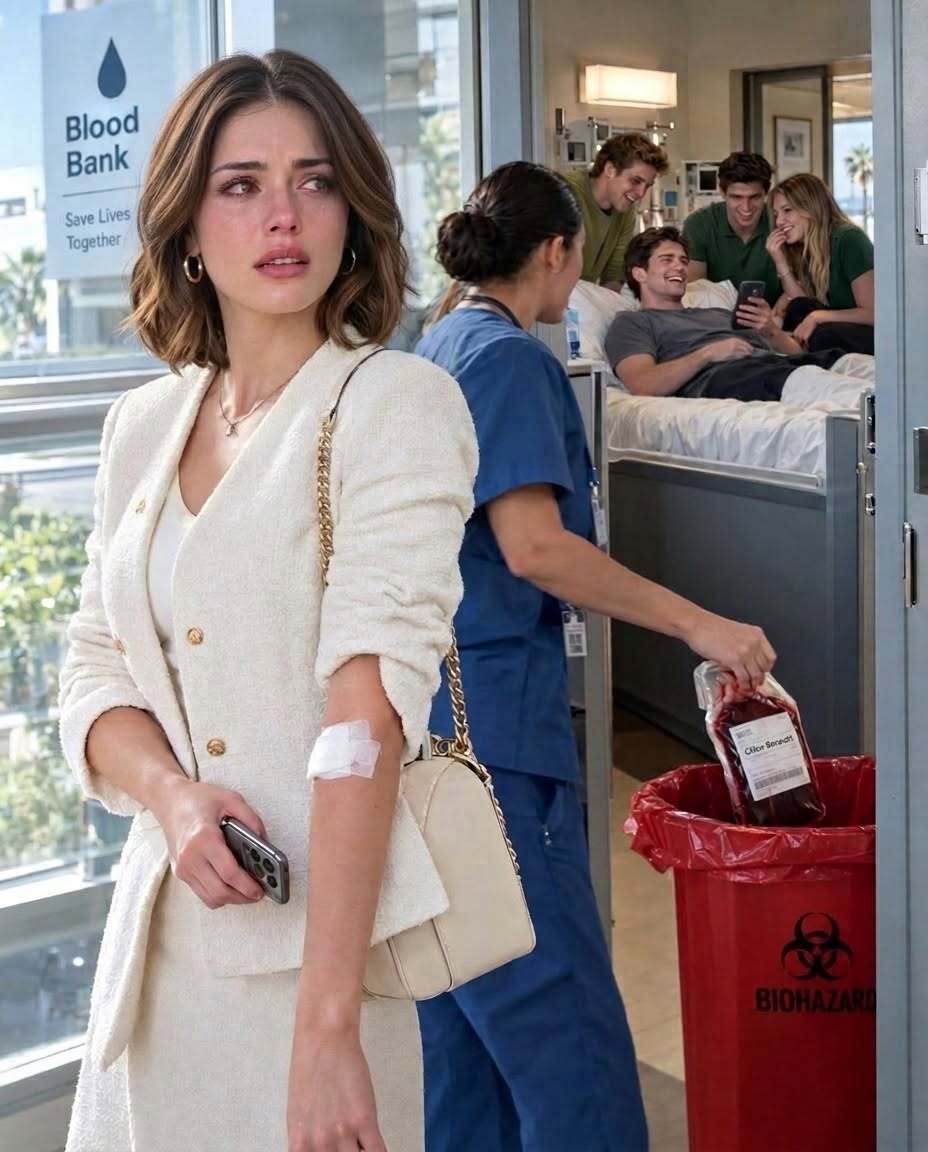
I Donated Blood to Save My Boyfriend. Then I Discovered I Was His Ninety-Sixth Prank.
I donated blood because I believed my boyfriend was dying.
Forty minutes later, I discovered he hadn’t been in an accident at all.
He was laughing with his friends in a private hospital room.
And I was the jokeBrendan’s friends had called me in the middle of the night.
There had been a terrible car crash, they said.
He urgently needed blood.
I rushed to the clinic without questioning them.
We had been together for three years.
Of course I wanted to help him.
After donating, I was walking toward the elevator when I noticed a cooler labeled with my name.
A member of staff carried it into another room.
To my confusion, I saw the blood bag being discarded.
Then laughter came from a nearby suite.
“I can’t believe Chloe fell for it again.”
I stopped.
Through the partially open door, I saw Brendan lying comfortably on a bed.
No injuries.
No medical equipment.
Just his friends gathered around him.
“That’s ninety-six,” someone said.
They began recalling other occasions.
The night they’d invented a missing anniversary gift and sent me searching through heavy rain.
The time they convinced me Brendan was in a coma.
The false accusation that made me miss my university graduation.
Things I had spent years believing were unfortunate coincidences.
Each one had been planned.
Then a friend said:
“Only three more until we reach ninety-nine.”
Brendan laughed.
After the final prank, he planned to leave me and return to Scarlett, his former girlfriend.
I recognized the name.
Four years earlier, Scarlett and I had competed in a regional dance championship.
I won.
Apparently, Brendan had never forgiven me for it.
He had started dating me partly to punish me for defeating her.
I stepped away before anyone saw me.
Outside, I sat on a bench, staring at the bruise on my arm.
For three years, I had believed love meant being patient with his moods, forgiving his jokes, and proving I would always be there.
He had turned that trust into entertainment.
My mother called while I was still outside.
She and Dad were moving to Tucson.
They had asked me to come with them before, but I always refused because of Brendan.
This time, I whispered:
“Please save a room for me.”
That night, I packed my belongings.
At two in the morning, Brendan appeared at my apartment.
“Open the door.”
I kept it locked.
“I heard what happened at the clinic.”
He went quiet.
Then asked:
“Who told you?”
Not whether I was all right.
Not whether I had been frightened.
Only who had exposed him.
“It was a joke,” he said.
“You told me you were dying.”
“Nobody forced you to donate.”
I looked at the door between us.
He was right about one thing.
I had chosen to help.
What I had not chosen was to be deceived.
“We’re finished, Brendan.”
He became angry.
I did not open the door.
Eventually, he left.
The following evening, Scarlett called.
She admitted knowing Brendan had played cruel tricks on me.
But she said she hadn’t known how far things had gone.
Then she told me something I hadn’t expected.
“I moved on from that competition years ago. Brendan didn’t.”
She explained that he had been offended by the idea that someone from my background could defeat a dancer with expensive training and influential connections.
His obsession had never really been about protecting Scarlett.
It had been about punishing me for succeeding.
Then she sent me screenshots.
Brendan and his friends had maintained a private record of their pranks.
Dates.
Photographs.
Videos.
Messages.
Revenge 96: Fake car crash and blood donation.
I read the entry twice.
Below it, Brendan had written:
Chloe would do anything if she thinks I’m dying.
I felt physically sick.
My mother found me crying on the bathroom floor.
“Three years,” I said. “How could I not see it?”
She sat beside me.
“You were looking for reasons to trust someone you loved.”
For the first time, I stopped treating my willingness to love as the shameful part of what had happened.
The shame belonged to those who had deliberately abused it.
We moved to Tucson the following week.
I preserved the screenshots and contacted the clinic to report what had happened with the false emergency and blood collection.
Those were serious matters that deserved proper review, not another private confrontation.
I also sought advice about the secretly recorded videos and false accusations.
Then I focused on the part of my life I could rebuild.
I found work at a bakery.
Made a few friends.
Started sleeping better.
But recovery was not straightforward.
Some mornings, I still missed Brendan.
I remembered the moments when he had seemed gentle.
The birthdays when he gave me thoughtful gifts.
The ordinary conversations that had felt real.
I had to learn that missing those memories did not mean I should return.
One afternoon, I passed a small dance studio.
Music drifted through the open door.
I stopped to watch.
The instructor smiled.
“Want to try a class?”
“I haven’t danced in years.”
“Then start slowly.”
My first lesson was difficult.
My muscles were stiff.
I struggled with movements that had once felt effortless.
And every mirror reminded me of the competition that had somehow become an excuse for years of cruelty.
But I returned.
Again.
And again.
Gradually, dance began to feel like mine.
Not something I needed to defend.
Not something that made other people angry.
Simply something I loved.
Six months later, I performed a short solo at a community theater.
My father filmed it with his phone tilted at a terrible angle.
My mother cried in the audience.
I laughed when I watched the recording.
For the first time in years, I could look at myself dancing without remembering Brendan first.
A year after leaving California, I returned to speak at a university event about emotional manipulation and recovery.
I didn’t use the occasion to name or publicly shame the people involved.
I spoke about how easily affection can be used to excuse behavior that repeatedly hurts us.
And how difficult it can be to recognize manipulation when someone alternates cruelty with tenderness.
Afterward, Brendan approached me.
He looked uncomfortable.
“I was cruel to you,” he said.
“Yes.”
“I thought I was making things right after the competition.”
“You were punishing me for winning fairly.”
He lowered his eyes.
“I know that now.”
Then he told me he had lost friends and damaged his reputation after the prank records became known.
I listened.
But his losses were not what I had come to discuss.
“I’m sorry,” he finally said. “For all of it.”
I believed he might regret what he had done.
Perhaps losing people had finally made him examine himself.
But I could not know how much he had changed from one conversation.
And I didn’t owe him another relationship to find out.
“Can you forgive me?” he asked.
“I don’t know.”
He looked disappointed.
I continued.
“But I don’t need to hate you to stay away from you.”
That was the truth.
I no longer spent my days imagining how to make Brendan understand the pain he had caused.
I had accepted that he might never understand it fully.
I was going to live anyway.
Before returning to Tucson, I bought a new pair of dance shoes.
Black.
Simple.
Nothing like the silver pair I’d worn when I won that championship.
I called Mom from the airport.
“How was it?” she asked.
“Better than I expected.”
“Seeing him?”
“No,” I said.
“Seeing that I could.”
Brendan and his friends had planned ninety-nine humiliations.
Their plan ended at ninety-six.
For a long time, that number represented everything they had taken from me.
My confidence.
My graduation.
Years of trust.
But I was learning not to measure my future by the harm they had caused.
I had loved someone who did not treat my love with care.
I had believed lies because I trusted him.
Those things had hurt me deeply.
They did not make me foolish or unworthy.
And Brendan’s cruelty did not get to become the defining fact of my life.
I kept the evidence somewhere safe.
Then I closed the folder.
The next morning, I went to dance class.
Not to prove anything.
Not to win.
And not because somebody finally gave me permission.
Just because I wanted to dance.