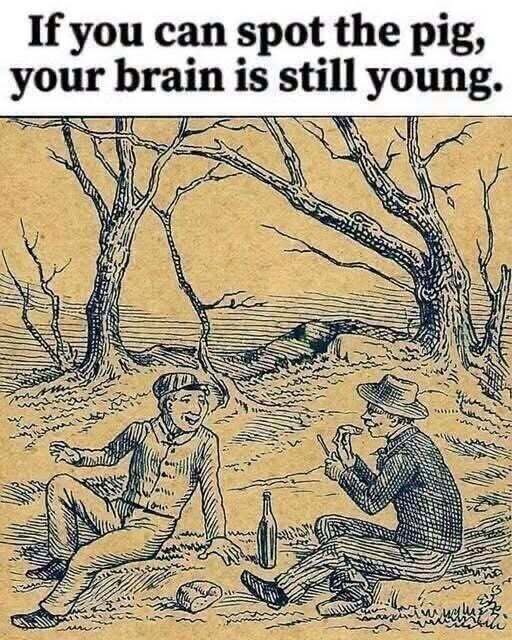
The challenge sounds incredibly simple: find the hidden pig.
Yet vintage visual puzzles like this were deliberately designed to trick the eye. Instead of placing the animal somewhere obvious, the artist cleverly incorporated its shape into other parts of the illustration.
That means staring directly at the picnic scene may not help.
Your brain naturally tries to identify familiar objects first.
You see people.
You see trees.
You see the picnic.
You see branches and empty spaces.
Once your brain decides what those shapes represent, it can become surprisingly difficult to interpret the exact same lines in another way.
That is what makes the hidden pig so tricky.
Before searching for the answer, give yourself a little time.
Look carefully at every part of the drawing rather than concentrating only on the two people.
Examine the trees.
Follow the branches with your eyes.
Pay attention to strangely curved lines and shapes that seem slightly out of place.
And most importantly, look at the empty spaces between objects.
That last clue can make all the difference.
In many classic hidden-image puzzles, the secret object is not drawn as an obvious standalone figure. Instead, parts of surrounding objects combine to create its outline.
A tree branch might become part of an animal’s face.
An empty patch of background might suddenly resemble a body.
Two unrelated lines may form ears, legs or a snout when viewed together.
This technique relies heavily on what artists call negative space — the apparently empty areas surrounding the main subjects.
Your brain normally treats those spaces as background and largely ignores them.
But the moment you begin examining the background as carefully as the foreground, an entirely different picture can emerge.
Still can’t see the pig?
Try stepping slightly farther away from the image.
Sometimes concentrating too intensely on individual lines makes the hidden figure even harder to recognize.
You can also briefly look away and then return to the picture.
Another useful trick is to change your viewing angle or mentally separate the trees from the picnic scene.
Instead of asking yourself, “Where did the artist draw a pig?” ask a different question:
“Which shapes could become a pig?”
That subtle change in thinking may be exactly what you need.
Puzzles like this are entertaining because they demonstrate how strongly perception depends on expectation.
Your eyes may receive all the visual information necessary to recognize the hidden animal, but your brain initially organizes that information into something completely different.
Then comes the satisfying moment when everything suddenly clicks.
The random lines stop looking random.
The background changes.
And there it is.
Once your brain recognizes the pig, it becomes remarkably difficult to stop seeing it.
That is part of what makes optical puzzles so addictive.
They encourage attention to detail, pattern recognition and flexible thinking while turning an ordinary illustration into a miniature mystery.
Different people can also have completely different experiences with the same image.
One person might discover the pig almost immediately.
Another may stare at exactly the same picture for several minutes and see absolutely nothing.
Then, after receiving one tiny clue, the hidden animal suddenly becomes obvious.
That makes this puzzle perfect for challenging friends and family.
Show them the illustration without giving away the answer and see who notices the secret first.
Give everyone 10 seconds.
If nobody finds it, allow another 20.
Still nothing?
Tell them to stop looking directly at the people and start examining the shapes created around the trees and surrounding objects.
But don’t reveal too much.
Finding it yourself is far more satisfying.
So take one more careful look at the picture.
Forget what you thought you saw when you first glanced at it.
Study the branches.
Examine the outlines.
Pay attention to the negative space.
Somewhere inside that peaceful picnic scene, a pig has been hiding in plain sight the entire time.
Can you spot it before someone points it out?
Because once you finally see the hidden animal, there’s a good chance you’ll have the same reaction as everyone else:
“How did I not see that before?”