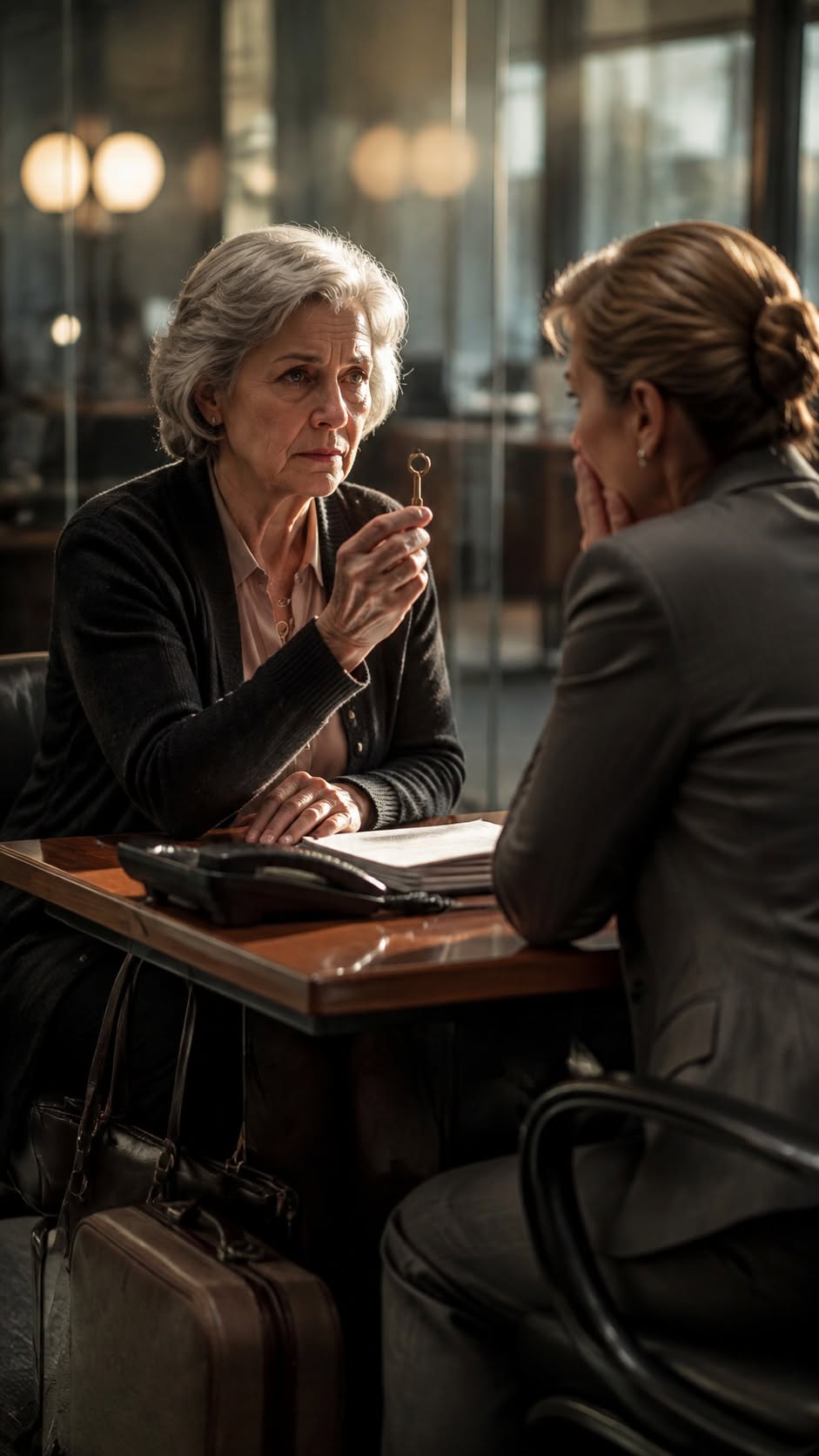
I did not know my husband had left me a key to a life my son was already trying to take.
By the time we returned from the cemetery, the white lilies in the living room had begun to droop. Their sweet, heavy smell mixed with reheated casseroles and the faint trace of Thomas’s aftershave, and for one strange moment I stood in the doorway of the house on Maple Avenue expecting to hear him cough upstairs.
Then Victoria walked past me carrying a stack of legal folders.
She did not lower her voice. She did not offer me a chair.
“Mom, we need to talk about the house.”
I looked at my son. Daniel stood beside the fireplace with his hands in his coat pockets, staring at the floor.
“Today?”
“It has to be today,” Victoria said.
I had been married to Thomas for forty years. I had polished those floors until they shone, sewn the curtains in the dining room, raised our only son beneath that roof, and stood at the kitchen counter at 4:30 every morning while coffee brewed before my shifts at Saint Vincent’s Hospital.
But grief had apparently given me no ownership rights in my own home. Victoria placed the folders on the dining table.
“The mortgage, utilities, taxes, everything connected to this place has to be reorganized. Daniel and I can’t keep carrying the uncertainty.”
“Uncertainty?”
She gave me a tired smile.
“You know what I mean.”
“No,” I said. “I don’t.”
Daniel finally looked up.
“Mom, don’t make this harder.”
I watched his face. He was thirty-eight, the same boy who had once slept against my shoulder during thunderstorms. His father had taught him to shave in the upstairs bathroom. I had kept his first school drawing in a kitchen drawer for thirty years. Now he could barely meet my eyes.
Victoria opened the top folder.
“The transfer is already prepared.”
I stared at the papers. My name appeared beneath the words VOLUNTARY TRANSFER OF REAL PROPERTY. The room seemed to shrink.
“You want me to sign my house over to you?”
“No,” Victoria said quickly. “We want to put the property where it belongs.”
“Where it belongs?”
“With Daniel.”
I looked at my son.
“Is that what you want?”
His mouth opened. Closed. Then he whispered, “It’s complicated.” That was when something inside me stopped pleading.
I had spent the last three weeks believing Thomas would eventually explain himself. He had been sick, frightened, heavily medicated. On the last morning I saw him awake, he had taken my hand and pressed something cold into my palm. A small brass key.
“Keep this safe,” he had whispered.
“What does it open?”
His eyes had moved toward the hospital door.
“Don’t tell anyone.”
I had thought the medication was confusing him.
Now, in the house he and I had built together, I slipped my hand into my coat pocket and closed my fingers around that key.
“Okay,” I said.
Victoria blinked. Daniel looked at me.
“Okay?”
I nodded.
“I’ll sign nothing today.”
Victoria’s expression hardened.
“That isn’t what we agreed.”
“We didn’t agree to anything.”
I picked up the folders, closed them, and pushed them back across the table. Then I walked upstairs. No one followed me.
In our bedroom, Thomas’s side of the bed was still untouched. His blue cardigan hung over the chair. His reading glasses sat on the nightstand beside a bottle of water he would never finish. I opened the bottom drawer of his desk.
There, beneath old tax returns and receipts, was the business card I had found months earlier in his coat pocket. Bennett & Cole Estate Law. 47th Street, Manhattan. I had asked him about it. He had smiled and said, “Nothing you need to worry about.” I took the card downstairs, along with the brass key.
The papers Victoria had prepared were still on the dining table. There was a sentence near the bottom that I read three times: Transfer to Daniel Mercer, subject to existing encumbrances and recorded interests. Recorded interests. The phrase made the back of my neck prickle.
At 5:18 that afternoon, while Daniel and Victoria were arguing quietly in the kitchen about whether I would “cooperate,” I called the number on Bennett’s card. A man answered on the second ring.
“Bennett & Cole.”
“My name is Margaret Mercer. My husband was Thomas Mercer.”
Silence. Then the man’s voice changed.
“Mrs. Mercer, where are you?”
“At home.”
“Are you alone?”
I looked toward the kitchen.
“No.”
“Do not sign anything.”
My fingers tightened around the receiver.
“Why?”
“Because your husband left instructions that if you ever called this number after his death, you were to come to our office immediately.”
I sat down.
“What instructions?”
“I can’t discuss them over the phone.”
“Then tell me what this is about.”
Another silence. Finally he said, “Bring the brass key.” I stared at the key lying beside the telephone.
“How did you know about that?”
He exhaled slowly.
“Because I gave it to your husband.”
The next morning, before sunrise, I packed one suitcase. Not because I had decided to leave my home forever.
Because for the first time in forty years, I no longer knew whose side of the truth I was standing on.
At exactly 9:07, I entered a quiet bank on 47th Street carrying the suitcase in one hand and my worn purse in the other. A woman in a gray suit met me at the reception desk.
“Mrs. Mercer?”
“Yes.”
“I’m Evelyn Shaw. Mr. Bennett asked us to expect you.”
She led me into a glass-walled office. I placed the brass key on her desk. She picked it up. The number stamped into the metal was tiny: M-417. Evelyn’s face changed. She looked at the key. Then at me. Then she locked the office door.
“Mrs. Mercer,” she said quietly, “how did you get this?”
“My husband gave it to me three weeks before he died.”
She lowered her voice.
“That means the instruction was activated.”
“What instruction?”
She reached for the telephone. I heard the click of the receiver being lifted.
Then she said four words that made the employees outside the glass office turn toward us.
“Daniel Mercer was here.”
My stomach dropped. Evelyn covered the mouthpiece and stared directly at me.
“Mrs. Mercer,” she whispered, “your husband did not leave this key for you to open a box.”
She turned the key over. There was a second number engraved beneath the first. A number I had never seen before.
“Someone,” she said, “has already tried to use it.”
I stared at the second number until the little black marks seemed to swim before my eyes.
“Why would Daniel know anything about this?”
Evelyn did not answer immediately. She set the key down with great care, as though even the sound of brass touching glass might matter.
“Because he was here yesterday morning.”
“Yesterday?”
“At 8:42.”
The answer came too quickly to be a guess.
Evelyn turned her computer toward me. A security photograph appeared on the screen. Daniel stood beneath the bank’s brass entrance sign wearing the dark suit he had worn to Thomas’s funeral. He was holding a folder against his chest. My son looked tired. He also looked determined.
I leaned closer to the screen.
“What did he want?”
Evelyn folded her hands.
“He asked for access to a restricted trust holding belonging to Thomas Mercer.”
My throat tightened.
“What did he tell you?”
“That your husband had died. That he was the designated successor. And that he needed to secure the property before another family member could interfere.”
I looked at her.
“Another family member?”
Evelyn’s eyes softened.
“He meant you.”
For several seconds, neither of us spoke.
Outside the glass wall, a teller laughed quietly with a customer. A printer hummed. Somewhere near the entrance, a door opened and closed. The ordinary sounds of a weekday morning seemed almost insulting. I reached for the key.
“Did you give him anything?”
“No.”
“Did he get into the vault?”
“No.”
“Then why did you say he tried to use this?”
Evelyn tapped the second number engraved beneath M-417.
“Because he knew the identification number.”
“How?”
“That is one of the things Mr. Bennett wants to explain to you himself.”
As if summoned by his name, someone knocked twice on the glass door. Evelyn stood.
“Come in.”
The door opened, and a tall man in a charcoal suit stepped inside carrying a thin leather briefcase. He had silver hair, narrow glasses, and the expression of someone who had spent many years learning how to deliver unpleasant facts without making them sound like accusations.
“Mrs. Mercer,” he said.
“Mr. Bennett.”
“Arthur is fine.”
He glanced at the key on the desk.
For the first time since I had entered the bank, someone looked relieved to see it. He closed the door behind him.
“Thomas was very specific about what was supposed to happen when you brought that key here.”
“What did he say?”
Arthur placed his briefcase on the table but did not open it.
“He said you would probably be frightened.”
I almost laughed.
“Your client knew me well.”
“He also said you might be angry.”
“I am.”
“And he said you would want answers immediately.”
“I do.”
Arthur nodded once.
“Then let’s begin.”
He opened the briefcase and removed a cream-colored envelope sealed with dark red wax. My husband’s initials had been written across the front in his unmistakable handwriting. T.M. My hand moved toward it. Arthur stopped me gently.
“Not yet.”
I stared at him.
“Why?”
“Because the letter inside was written to be read after you had seen the documents.”
“What documents?”
“Mrs. Mercer, the second number identifies a private vault beneath this branch. The vault contains the original documents Thomas placed under restricted custody.”
“Why didn’t you tell me this on the phone?”
“Because until I saw the key, I had no authority to discuss the contents.”
“And now?”
“Now you are the person Thomas designated.”
Those words landed harder than they should have. I looked from Evelyn to Arthur.
“You keep saying designated. Designated for what?”
Arthur reached into his briefcase again.
“For protection.”
He slid a document across the desk.
At the top was Thomas’s full name, followed by the words MERCER FAMILY PROPERTY TRUST. I recognized the date. Three years earlier. I looked up sharply.
“Thomas never told me about this.”
“No,” Arthur said. “He didn’t.”
“Why?”
“That question is answered in the letter.”
He stood.
“First, you need to see what he protected.”
Evelyn led us through a secured door at the back of the bank.
The corridor beyond was colder than the public area. Our footsteps sounded strangely loud against the polished floor. At the end stood a heavy steel door with a keypad and a camera mounted above it. Evelyn entered a code. A green light appeared. Then she held out her hand.
“The key.”
I placed it in her palm.
She inserted it into a narrow slot beneath the keypad and turned it once. There was a deep metallic click. The door opened. I had expected shelves of boxes.
Instead, there was a small private room with a single steel cabinet bolted to the floor. Evelyn walked to it and entered M-417 on a second keypad. The cabinet unlocked. She pulled out a flat black case. A white label was attached to its lid. THOMAS MERCER — RELEASE ONLY TO MARGARET MERCER UPON DEATH OF GRANTOR.
My fingers went cold.
“That’s me.”
“Yes.”
“Why did Thomas do this?”
Arthur’s voice came quietly from behind me.
“Because he knew that once he was gone, people might tell you things that were not true.”
I looked at him.
“People like my son?”
Arthur did not answer. He didn’t have to. Evelyn carried the case to a table and opened it.
The first document was a certified copy of the deed to the Maple Avenue property.
I recognized the legal description immediately. The lot number. The boundaries. The address where I had lived for forty years. But beneath the property description was something I had never seen. The ownership had been transferred into the Mercer Family Property Trust. I read the first paragraph.
Then the second. Then the third. My eyes stopped at a sentence in the middle of the page. I read it again.
“Read it aloud,” Arthur said.
I swallowed.
“Upon the death of the grantor, the residential property known as 18 Maple Avenue shall remain held for the exclusive benefit and occupancy of Margaret Elaine Mercer during her lifetime.”
My voice faltered. Arthur pointed to the next line. I continued.
“No beneficiary, successor, heir, spouse, creditor, or representative of the grantor shall compel, demand, or execute a transfer of said property without the written consent of Margaret Elaine Mercer.”
I lowered the paper.
For the first time that morning, I felt the ground beneath me settle. Arthur watched my face.
“The house is not Daniel’s.”
I shook my head slowly.
“No.”
“The house cannot be transferred to Daniel because he wants it.”
“No.”
“And the papers waiting on your dining table have no authority to override this trust.”
My hand tightened around the edge of the deed.
“Then what are those papers?”
“We’ll come to that.”
Arthur turned to the next document. It was a trust schedule listing financial assets.
There were several smaller accounts, but one figure made me stop breathing for a moment. $412,000. I looked at Arthur.
“What is that?”
“An investment account Thomas placed inside the trust.”
“Four hundred and twelve thousand dollars?”
“Yes.”
“That can’t be right.”
“It is.”
“I knew we had savings.”
“You knew about some savings.”
He tapped the page.
“This account was separate.”
“Why?”
“Because Thomas intended it to remain protected for you.”
I sat down. The steel chair was cold beneath my coat.
I thought of all the times Thomas had told me we were doing fine. All the times I had worried about hospital bills, property taxes, repairs to the roof, and whether we could afford to replace my old car.
I remembered one evening two years earlier when I had asked him why he was still working with an investment adviser. He had kissed my forehead.
“Just tying up loose ends.”
I had believed him. Arthur placed the account statement beside the deed. The balance was exact. $412,083.17.
“Did Daniel know about this?” I asked.
“We don’t know everything Daniel knew.”
“But he came here.”
“Yes.”
“And he knew the trust number.”
“Yes.”
I looked toward Evelyn.
“Show me the log.”
She hesitated. Arthur nodded. Evelyn opened a folder she had brought with her. Inside was a printed visitor-access record. The first line showed the date. The second showed the time. 8:42 a.m. Daniel Mercer. Reason for visit: Estate access. Requested file: Mercer Family Property Trust, M-417.
Supporting documentation: Death certificate, identification, photocopy of handwritten authorization. Status: Denied. I read the last line twice.
“Photocopy of handwritten authorization?”
Evelyn nodded.
“He presented it to the branch manager.”
“What did it say?”
“That he was authorized to obtain the trust contents upon Thomas’s death.”
“By Thomas?”
“Yes.”
“Did Thomas sign it?”
Evelyn looked at Arthur. Arthur answered.
“It appeared to bear his signature.”
The room became very still. I stared at the log.
“Then why was Daniel refused?”
“Because the document was insufficient,” Evelyn said. “And because the trust instructions were explicit.”
She pointed to a notation at the bottom.
Release only to Margaret Elaine Mercer after verification of identity and presentation of key M-417. I touched the paper with one finger.
“Daniel knew he couldn’t get it.”
“Yes.”
“So he came anyway.”
“Yes.”
“What happened when you refused him?”
Evelyn’s expression tightened.
“He became angry.”
“What did he say?”
“He said the bank was withholding his father’s property from the rightful heir.”
My jaw clenched.
“Did he threaten anyone?”
“No.”
She paused.
“But he asked who had authority to access the trust.”
I looked up.
“And what did you tell him?”
“That I could not disclose that information.”
Arthur added quietly, “But he already knew.” I turned toward him.
“How?”
Arthur picked up the trust agreement.
“That is where things become more complicated.”
He opened it to the final pages.
Thomas’s signature appeared at the bottom of the final page, witnessed and notarized. Beneath it was Arthur’s signature. I looked at him.
“You witnessed this?”
“I drafted it.”
“Thomas came to your office?”
“Yes.”
“Alone?”
“Yes.”
“Three years ago?”
“Yes.”
“And he told you to keep it secret from me?”
Arthur was quiet for a moment.
“He told me that you would be safer if you did not know every detail.”
My chest tightened.
“Safer from what?”
Arthur closed the trust agreement.
“That is what Thomas wanted you to learn from his letter.”
He finally reached for the sealed envelope. He broke the wax with his thumb. The paper inside was folded twice. I knew Thomas’s handwriting before I saw the first word. Margaret. Just my name. I reached for it. Arthur let go. I unfolded the page. The first line read:
If you are holding this letter, then I am no longer there to explain why I did what I did. My vision blurred. I blinked hard and continued.
I have spent too much of our life telling you that everything was fine because I believed that was what a husband was supposed to do. I know now that silence can look like protection while doing the opposite. I stopped. My thumb rested against the edge of the page.
Arthur said nothing. Evelyn quietly stepped away from the table. I kept reading.
The trust was created for one reason: to make certain that the home we built together could never be taken from you by pressure, debt, or a promise made on my behalf after I was gone. My breathing became shallow. I read the next paragraph.
Daniel must not be told about the full extent of the trust until after my death. If he asks you for the house, do not sign. If anyone tells you that I wanted you to give it to him, do not believe them without verification through Arthur.
My hand began to shake. There was more.
The money in the trust is yours to use for your care and your choices. You earned more than you ever admitted. You spent forty years believing you were helping me build our life. You were. I wanted to make certain that after I was gone, no one could rewrite that life as though it belonged to someone else.
A tear fell onto the paper. I wiped it away before it could reach the ink. Then I saw the final paragraph.
I am sorry I did not tell you sooner. I was trying to prevent a fight I was no longer certain I could control. If Daniel comes to the bank before you, Arthur will know. If anyone attempts to transfer the house before you have read this letter, the bank is instructed to freeze the trust and preserve every document connected to the attempt.
I looked up so quickly the chair scraped against the floor.
“Freeze the trust?”
Arthur nodded.
“Automatically, if an unauthorized transfer is attempted.”
“And Daniel already attempted one.”
“Yes.”
“Then why isn’t it frozen?”
“Because he was denied before he gained access to anything.”
I looked back at the letter. There was one final sentence. It was shorter than the others. But it was the one that made my fingers go numb.
If Daniel comes asking for what is yours, Margaret, remember that he is not the boy you raised in that house. He is a man who has been taught to believe that what I leave behind belongs to him. I stared at the words. Arthur watched me carefully.
“Mrs. Mercer?”
I folded the letter once.
“Did Thomas know Daniel would do this?”
Arthur did not answer immediately. Then he said, “Thomas was afraid he might.”
I looked at the deed, the trust agreement, the account statement, and the bank log spread across the steel table.
Everything I had thought was missing from my husband’s final weeks seemed suddenly to be sitting in front of me. Not everything.
But enough to understand that the papers waiting on my dining table had not been the beginning of this. They were the next move. And Thomas had prepared for it. I folded his letter carefully and held it against my chest.
“Arthur,” I said, “I want to know exactly what Daniel tried to do yesterday.”
Arthur closed the briefcase.
“You will.”
“Everything.”
“Everything.”
“And I want to know why my husband thought I needed protecting from my own son.”
Arthur’s expression changed. This time, he did not tell me to wait.
He picked up the obsolete transfer document I had brought from home, laid it beside the trust agreement, and tapped the date printed at the top.
“Then we need to go back three years,” he said. “Because that document is not what Daniel thinks it is.”
Arthur slid the old document closer to me.
“This was prepared three years ago,” he said. “Thomas considered transferring the house directly to Daniel.”
I looked at the signature near the bottom. It was my husband’s. My stomach tightened.
“He signed it?”
“Yes.”
“Then why isn’t the house Daniel’s?”
“Because Thomas changed his mind before the transfer was recorded.”
Arthur turned the page and pointed to a handwritten notation in the margin. Thomas’s handwriting again. Three words had been written in blue ink. VOID — DO NOT RECORD. I stared at them.
“When did he write that?”
“The same week he came to my office.”
“Why?”
Arthur sat across from me.
“Because he discovered something about Daniel’s finances.”
I felt my shoulders stiffen.
“What did he discover?”
“Debt.”
“That isn’t an answer.”
“No. It isn’t.”
Arthur opened another file.
“There was a construction company Daniel had invested in with two friends. The company failed. Daniel’s personal guarantee left him responsible for approximately one hundred and eighty-six thousand dollars.”
I shook my head.
“He told us that business had closed cleanly.”
“It had not.”
“Thomas knew?”
“He learned after a creditor contacted him.”
I remembered the phone call.
Three years earlier, Thomas had stood beside the kitchen window while I washed dishes. He had answered the telephone, listened without speaking, then gone upstairs and shut the bedroom door. When he came back down, he had looked twenty years older. I had asked what was wrong.
He had said, “Nothing we can’t handle.” I had believed him. Arthur placed another sheet on the table.
“This is a notice of judgment against Daniel.”
I read the amount. $186,742.19. Below it was a list of creditors. I looked up.
“Why didn’t Thomas tell me?”
“He was embarrassed.”
“Embarrassed about Daniel?”
“About the possibility that you would learn what Daniel had done and blame yourself.”
I frowned.
“Why would I blame myself?”
“Because Thomas told me you had spent your life believing that if you worked hard enough and loved your son enough, you could protect him from every bad decision.”
I looked away. That sounded exactly like something Thomas would say. Arthur continued.
“Daniel’s creditors were not immediately interested in your house because it was jointly held at the time. But Thomas became concerned that if he transferred his interest to Daniel, the property could eventually become exposed.”
“So he canceled the transfer.”
“Yes.”
“And created the trust.”
“Yes.”
I touched the old document.
“Then why did Daniel have a copy of this?”
Arthur’s expression hardened.
“That is the question we need to answer.”
I looked at him.
“Do you know?”
“I have a strong suspicion.”
“What?”
“Someone in your family knew Thomas had once intended to give Daniel the property. Someone also knew he changed his mind.”
I thought of Victoria immediately. Arthur saw it in my face.
“You suspect her.”
“I don’t know what I suspect.”
“You will soon.”
He took the obsolete transfer document and turned it over.
There, on the back, was a date three years and two months earlier.
“Thomas signed this before he knew the full extent of Daniel’s debt. Once he understood the risk, he came to me. We revoked the document, executed the trust, and recorded the new deed.”
“Recorded where?”
“Westchester County Clerk’s Office.”
“And that deed is the one you showed me?”
“Yes.”
“Then how could anyone think this old paper still mattered?”
“Because it looks convincing.”
I stared at him.
“It has Thomas’s signature.”
“Yes.”
“It has a legal description of the property.”
“Yes.”
“And it says Daniel receives the house.”
“Yes.”
Arthur leaned forward.
“But it has one fatal problem.”
“What?”
“Thomas himself canceled it.”
He placed the trust agreement beside it.
“The later document controls.”
I looked between the two papers.
“Then the papers Victoria left on my table were deliberately chosen.”
Arthur did not contradict me.
“They were designed to make you believe your husband’s final wishes were different from what they actually were.”
My mouth went dry.
“Daniel said it was complicated.”
Arthur’s gaze remained on me.
“It may be more complicated than he admitted.”
He opened the certified deed again.
“Mrs. Mercer, I want you to understand one thing before you go home.”
He turned the document toward me and placed his finger beneath the critical clause.
“Thomas didn’t merely put the house into the trust. He specifically restricted its disposition after his death.”
I read the sentence again.
“Exclusive benefit and occupancy.”
“Yes.”
“During my lifetime.”
“Yes.”
“So I can live there as long as I want.”
“As long as you want.”
“And Daniel can’t force me out.”
“No.”
“Victoria can’t force me out.”
“No.”
“And nobody can sell it without my consent.”
“Not lawfully.”
The distinction caught my attention.
“Not lawfully?”
Arthur’s face became serious.
“People can attempt many things. That doesn’t make them legal.”
I thought of the folders waiting on my dining table.
“Then why did Thomas put so much money into the trust too?”
Arthur opened the account schedule.
“Because he wanted you to have choices.”
“Choices?”
“You could remain in the house. Sell it if you ever wanted. Pay for care. Travel. Give money away. Leave something to Daniel. The trust gives you control.”
I looked at the $412,083.17 balance.
“He never told me we had this.”
“He wanted to surprise you.”
I gave him a look.
“Thomas was terrible at surprises.”
Arthur smiled faintly.
“He was better at them than you thought.”
For a moment, the tension eased. Then Evelyn entered the room carrying another folder.
“Arthur.”
He looked up.
“What is it?”
She placed the folder on the table.
“This was attached to Daniel’s visitor record.”
Arthur opened it.
Inside was a photocopy of the authorization Daniel had presented to the bank. I saw Thomas’s signature. Then I saw the date. My heart stopped.
“That date is wrong.”
Arthur looked at me.
“How do you know?”
“Because Thomas was in the hospital that day.”
I pointed at the paper.
“He couldn’t have signed this at the house.”
Arthur examined the document closely.
“Where was he?”
“Saint Vincent’s.”
“Was he conscious?”
“Barely.”
Arthur’s jaw tightened.
“Then this changes things.”
I looked at the photocopy again. The signature was almost perfect. Almost.
Thomas always signed his first name with a long, sweeping T. On this document, the T was shorter. I remembered something else.
“Thomas didn’t use black ink.”
Arthur looked at me.
“What?”
“He always used blue ink for legal papers. He said black ink looked like a photocopy.”
Evelyn leaned closer.
“This is black.”
Arthur took a magnifying glass from his briefcase. He examined the signature. Then the date. Then the paper itself.
“Interesting.”
“What?”
“The signature was copied from another document.”
My hands went cold.
“You’re certain?”
“I need a forensic comparison before I say that conclusively. But yes, the pressure pattern is wrong.”
Arthur looked at Evelyn.
“Pull the original authorization request and the access-camera footage.”
“I already requested both.”
“And the visitor log?”
“Printed.”
“Good.”
He gathered the papers. I stood.
“I want to go home.”
Arthur looked surprised.
“Now?”
“Yes.”
“You understand that Daniel may still be there.”
“I know.”
“Then please don’t confront him alone.”
I looked at the photograph of my son on the bank’s screen.
“I am not going home to fight with him.”
“What are you going home to do?”
I picked up Thomas’s letter and folded it carefully into my purse.
“I am going home to ask my son one question.”
Arthur waited. I looked down at the old transfer document.
“Who told him my husband wanted to give him the house?”
Arthur’s expression told me he understood the question was no longer about property.
It was about who had been standing beside Thomas while he was dying. He closed the case.
“I’ll come with you.”
“No.”
“Mrs. Mercer—”
“I appreciate it, Arthur. But if Daniel is still in my living room, I want to hear what he says before he has time to prepare another answer.”
Evelyn handed me the brass key. I closed my fingers around it. Arthur held the door open.
“Then take the documents with you.”
I looked back at him.
“All of them?”
“No.”
He kept the original deed and trust agreement in his briefcase.
“You take the copies. The originals stay here.”
“Why?”
“Because if Daniel knows exactly what Thomas left behind, he may try to destroy evidence.”
I stopped.
“Do you really think he would do that?”
Arthur met my eyes.
“I think you should stop asking what your son is capable of and start asking what the evidence says he has already done.”
I said nothing. At the elevator, I looked once more at the photocopied authorization. The signature stared back at me. Thomas’s name.
Someone had taken his name and tried to make it speak after he was gone.
This time, I was not going to let them decide what it said.
By the time I reached Maple Avenue, the March wind had picked up. I sat in the car for a moment with both hands on the steering wheel, looking at the house through the windshield. The curtains in the living room were open. Someone was waiting for me.
I took the copies from my purse and slid them beneath the lining of my coat. The brass key went into the inside pocket, against my ribs. Then I walked to the front door. Before I could put the key in the lock, it opened. Daniel stood there.
His face changed when he saw me.
“Mom.”
I stepped inside.
Victoria was sitting on the sofa with a cup of coffee in her hands. The transfer papers were still spread across the dining table. Beside them sat a second stack I had not seen before. She looked at me without getting up.
“You were gone a long time.”
“I had somewhere to be.”
Daniel closed the door.
“Where?”
I took off my coat.
“The city.”
He looked at Victoria. She set down her cup.
“Did you go to the lawyer?”
I watched her carefully.
“Why would you ask that?”
Her eyes flickered.
“I assumed.”
“No,” I said. “You didn’t assume.”
Daniel moved toward the dining table.
“Mom, can we please sit down?”
“No.”
He stopped.
“I want to ask you something.”
He swallowed.
“What?”
“Did you go to a bank on 47th Street yesterday morning?”
Daniel’s face went blank. Victoria looked at him. He looked back at her. Then he said, “Yes.”
The answer came so quietly that for a second I wondered whether I had heard him correctly.
“Why?”
“I wanted information.”
“About what?”
“The estate.”
“Which estate?”
“You know which one.”
I walked toward the table.
“Then why did you tell the bank you were the rightful successor to my husband’s property?”
Daniel’s eyes widened.
“I didn’t say that.”
“They have a record.”
“I said I was his son.”
“That isn’t what I asked.”
He rubbed his forehead.
“Mom, I was trying to understand what Dad had done.”
“You were trying to access a trust.”
He went silent. Victoria stood.
“This is getting ridiculous.”
I turned toward her.
“No. It is getting clear.”
She folded her arms.
“You’ve been grieving for three weeks. You’re exhausted. Arthur Bennett has filled your head with legal language, and now you’re treating your own son like a criminal.”
“Did you know about the trust?”
Victoria did not answer. Daniel did.
“No.”
I looked at him.
“Are you sure?”
“Yes.”
Victoria’s voice cut across the room.
“Daniel didn’t know about any trust.”
I turned toward her.
“Then how did you know there were papers Thomas had signed?”
Her mouth tightened.
“Because your husband told us.”
“Us?”
“Yes.”
“When?”
“Before he went into the hospital.”
Daniel stared at her.
“Victoria.”
She ignored him.
“He told us he wanted Daniel to have the house.”
The room went still. I felt the brass key against my ribs.
“Thomas told you that?”
“Yes.”
“Exactly what did he say?”
“He said the house should stay in the family.”
“What does that mean?”
“It means Daniel should have it.”
I looked at my son.
“Did your father tell you that?”
Daniel hesitated.
“Yes.”
“When?”
“A few weeks before he died.”
“Where?”
“At the hospital.”
I stared at him.
“He was barely conscious toward the end.”
“He wasn’t barely conscious then.”
“What day?”
Daniel looked down.
“I don’t remember.”
“You don’t remember the day your dying father told you he wanted to give you his house?”
“Mom, it was an emotional time.”
“Was it before or after he gave me the key?”
Daniel looked up sharply. Victoria’s cup slipped from her fingers and struck the table. Coffee spilled across the wood. Neither of them moved.
I reached into my coat pocket and placed the brass key on the table. Daniel stared at it. Victoria’s face had gone pale.
“What’s that?” Daniel asked.
“You know what it is.”
“No, I don’t.”
“Your father gave it to me three weeks before he died.”
Daniel took one step backward. Victoria whispered, “Thomas never mentioned a key.” I looked directly at her.
“You just said he told you everything.”
“I said he told us about the house.”
“You said he wanted Daniel to have it.”
“He did.”
“Then why did he put the house into a trust for me?”
Victoria’s eyes moved toward Daniel. He did not look at her.
“What trust?” he asked.
I almost laughed.
“You tell me.”
Daniel’s jaw tightened.
“I don’t know.”
“Then why did you go to the bank?”
“I told you. I wanted information.”
“About a trust you didn’t know existed?”
He had no answer. Victoria stepped forward.
“Your husband made promises.”
I looked at her.
“Then show me one.”
She pointed at the papers on the table.
“That transfer.”
“That isn’t a promise. It’s a document.”
“Thomas signed it.”
“Yes.”
“So did you.”
I looked at the signature line. My name was written there. But I had never signed it.
“I didn’t sign this.”
Victoria’s voice softened.
“You were going to.”
“No.”
“You just hadn’t accepted it yet.”
“I never agreed to give Daniel my house.”
She took a breath.
“Then perhaps you should ask yourself why your husband prepared the paperwork.”
“I did.”
Her expression changed.
“What did he tell you?”
“Nothing.”
“Then you don’t know.”
“I know enough.”
Daniel suddenly spoke.
“Victoria, stop.”
She turned on him.
“What?”
“Just stop.”
“You said this was going to be simple.”
The words escaped before she could catch them. I looked at Daniel. He looked at Victoria. Neither spoke.
“What was supposed to be simple?” I asked.
Victoria shook her head.
“Nothing.”
“No.”
I stepped closer.
“You said this was going to be simple. What was supposed to be simple?”
Daniel closed his eyes.
“Mom, please.”
“Tell me.”
He opened them.
“We’re in debt.”
I waited.
“How much?”
He looked at the floor.
“Daniel.”
“How much?”
“About two hundred thousand.”
Victoria interrupted.
“It isn’t just Daniel.”
He turned toward her.
“Don’t.”
“We have obligations.”
“What obligations?” I asked.
Victoria’s voice became defensive.
“The business.”
“What business?”
Daniel answered this time.
“The construction company.”
My heart sank.
“The company you told us was finished?”
“It was.”
“You told your father?”
“Yes.”
“Did you tell him you still owed money?”
Daniel said nothing. Victoria stepped in.
“Thomas knew Daniel was under pressure.”
“Pressure doesn’t explain this.”
“You don’t understand what creditors can do.”
“No,” I said. “I understand exactly what they can do. I worked in a hospital for forty years. I watched people lose everything because they were too ashamed to ask for help.”
Daniel looked at me.
“I wasn’t asking for help.”
“You were asking for my house.”
His face tightened.
“I was trying to save my family.”
“By taking mine?”
He flinched. Victoria’s voice rose.
“Thomas promised Daniel that property!”
“Then why did Thomas create a trust that says the opposite?”
“Because he changed his mind.”
The words hung between us. I stared at her.
“You knew.”
She did not answer.
“You knew he changed his mind.”
“No.”
“You just said he did.”
“I meant—”
“You knew.”
Daniel looked at Victoria.
“What did you know?”
She turned toward him.
“I knew your father was confused.”
“You told me he promised me the house.”
“He did.”
“You told me Mom was going to sign.”
“She should have.”
Daniel’s face changed.
“You said the papers were ready.”
“They were.”
“You said Dad had arranged everything.”
“He had.”
I watched the two of them argue across my dining room.
For the first time, I understood that they had not been united by certainty. They had been united by a story. And now the story was beginning to break apart. Daniel turned toward me.
“Mom, I swear I didn’t know about the trust.”
“I believe you didn’t know everything.”
He stared at me.
“But you knew enough to come to that bank.”
“I knew Dad had documents.”
“Who told you?”
Daniel hesitated. Victoria stepped between us.
“I did.”
I looked at her.
“What documents did you tell him about?”
“The transfer.”
“Only the transfer?”
“Yes.”
“Where did you get it?”
She looked toward the papers.
“Thomas gave it to us.”
“Before he went into the hospital?”
“Yes.”
“Show me the original.”
Her face tightened.
“This is the original.”
“No.”
I pointed at the document.
“This is a copy.”
Silence. Daniel looked at Victoria.
“You told me it was the original.”
She said nothing. I felt the small folded packet beneath my coat. Arthur’s warning echoed in my mind. Do not let them know exactly what Thomas left behind. I did not tell them about the recorded deed. I did not tell them about the $412,000.
I did not tell them that the trust contained a clause specifically protecting me from them. Instead, I asked the only question that mattered now.
“Victoria, where did you get this copy?”
She looked at Daniel. Then at me. Finally, she whispered, “From Thomas’s things.”
“Which things?”
“The papers from the hospital.”
My breath caught.
“You had access to his hospital papers?”
“He was my father-in-law.”
“That isn’t an answer.”
“I was helping.”
“Who gave them to you?”
She looked down.
“No one.”
I took a step closer.
“Victoria.”
Her voice dropped.
“I took them.”
Daniel stared at her.
“You what?”
“I took a folder from his room.”
“When?”
“After he died.”
“Why?” Daniel asked.
She looked at him as if the question offended her.
“Because someone had to protect us.”
I felt the key against my ribs again.
“What else did you take?”
Victoria’s eyes met mine.
For the first time since I had walked into the house, she looked afraid.
“I don’t remember.”
I knew then that the conversation was over. Not because I had all the answers. Because I finally knew where to find them. I picked up my coat. Daniel stepped toward me.
“Mom, where are you going?”
I looked at him.
“To speak to the man who knew your father better than either of you did.”
“Arthur?”
“Yes.”
Daniel’s face drained of color. Victoria grabbed his arm.
“Daniel.”
He pulled free.
“What did you do?”
She stared at him.
“I did what I had to do.”
I opened the door. Behind me, Daniel’s voice broke.
“Mom, wait.”
I stopped without turning around.
“Did Dad really leave the house to you?”
I looked down at the brass key in my hand. Then I turned.
“Yes.”
Daniel’s shoulders dropped.
“But that’s not the question you should be asking anymore.”
I stepped outside. The door closed behind me.
And through the glass, I saw Daniel turn toward Victoria with an expression I had never seen on my son’s face before. It was not anger. It was fear.
Arthur answered on the first ring.
“Margaret?”
“I need you to come back to the house.”
There was a pause.
“Are you safe?”
“Yes.”
“Is Daniel there?”
“No. I left him with Victoria.”
Arthur exhaled.
“What happened?”
“She admitted she took papers from Thomas’s hospital room after he died.”
The silence on the line was immediate.
“Did she say which papers?”
“The transfer document.”
“Anything else?”
“She said she didn’t remember.”
Arthur’s voice became very quiet.
“She remembers.”
I stopped walking.
“You’re sure?”
“I’ve practiced estate law for thirty-two years. People don’t forget documents when those documents are worth a house.”
I looked back at Maple Avenue. The living-room curtains were still open.
“Then what do we do?”
“Come back to the bank.”
“Now?”
“Now.”
I turned toward the street.
“And Daniel?”
“Do not accuse him of forgery yet.”
“I wasn’t planning to.”
“Good. Because we need to know exactly what he signed.”
I tightened my grip on the phone.
“Why?”
“Because if Victoria took the papers and Daniel used them to obtain access to the trust, there may be more than one false document.”
I thought of Daniel’s face when I told him the house belonged to me.
“Then I want everything.”
“You’ll have it.”
When I arrived back at the bank, Evelyn was waiting near the secured entrance. She took one look at my face and said nothing, only opened the door.
Arthur was standing at the same table where we had examined Thomas’s trust documents earlier. Three new folders had been added to the surface. One was marked BANK RECORDS. One was marked HOSPITAL. The third had no label at all. Arthur waited until I sat down.
“Before we begin, I need to ask you something.”
I nodded.
“Did Victoria admit that she removed documents from Thomas’s hospital room?”
“Yes.”
“Did Daniel know she had them?”
“I don’t know.”
“Did he know about the transfer document?”
“Yes.”
“Did he believe you had signed it?”
“She told him I would.”
Arthur opened the unlabeled folder.
“Then we have our second problem.”
He slid a sheet toward me. It was a signature page.
My name was printed beneath a declaration that said I had voluntarily agreed to transfer the Maple Avenue property to Daniel Mercer. Underneath my name was a signature. Mine, apparently. I stared at it.
“That isn’t my signature.”
“I know.”
“Then whose is it?”
“We don’t know yet.”
Arthur placed a second sheet beside it. This one had Daniel’s signature. My eyes moved over the language.
Daniel Mercer, as intended recipient and beneficiary of the property, acknowledges that the grantor has voluntarily executed the foregoing transfer. I looked up.
“He signed this?”
“Yes.”
“When?”
“Yesterday afternoon.”
“After he went to the bank?”
“Yes.”
I touched the paper.
“Why would he sign something saying I agreed to this when I hadn’t?”
Arthur’s expression was grave.
“Because he was trying to make the transfer appear complete.”
I leaned back.
“So he knew.”
“He knew you had not signed.”
My throat tightened.
“Then he lied to the bank.”
“Yes.”
For several seconds, I could hear only the faint mechanical hum of the bank’s ventilation system. I looked at Daniel’s signature. I had taught him how to write his name.
I had watched that hand hold a crayon, a baseball bat, a graduation diploma, and eventually his father’s hand when Thomas could no longer walk without assistance.
Now that same hand was beneath a sentence claiming I had surrendered my home.
“How did you get this?”
Arthur tapped the page.
“The bank received it electronically from the title company Daniel contacted.”
“Title company?”
“Yes.”
“He was already trying to transfer the house?”
“Before the funeral flowers had wilted.”
I closed my eyes. Arthur continued.
“The title company rejected the submission because the recorded trust created a conflict. They requested confirmation from the bank. That’s how we became aware of the attempt.”
“And Daniel went to the bank afterward.”
“No. He went to the bank first.”
Arthur turned another page.
“The timing matters.”
He pointed to the printed timestamps.
“8:42 a.m. Daniel enters the bank. At 9:03, he presents the handwritten authorization. At 9:17, the bank refuses access. At 9:26, he leaves.”
He moved his finger down the page.
“At 10:11, the title company receives the transfer package.”
I stared at the times.
“He went there knowing the bank would probably refuse him.”
“Yes.”
“Then he submitted the papers anyway.”
“Yes.”
“Why?”
Arthur looked at me.
“Because someone told him the bank’s records were the last obstacle.”
“Victoria.”
“I believe so.”
I looked at the hospital folder.
“What does that have to do with it?”
Arthur opened it.
Inside was a hospital visitor record and a photocopy of a patient’s property-release form. Thomas’s name appeared at the top.
The date was two days after he had been admitted to Saint Vincent’s. I remembered that day.
Thomas had been too weak to sit upright for more than a few minutes. I looked at the visitor section. Victoria Mercer. 9:14 p.m. Daniel Mercer. 9:37 p.m. I looked up.
“They were there together.”
Arthur nodded.
“According to the hospital record, Victoria was given temporary access to Thomas’s personal belongings because you had gone home to sleep.”
My stomach dropped.
“I was exhausted.”
“I know.”
“She told me she would sit with him.”
Arthur’s eyes stayed on the paperwork.
“She did more than sit with him.”
He showed me the property-release form.
A nurse had recorded the removal of a leather folder, two watches, several insurance documents, and miscellaneous papers. The receiving signature belonged to Victoria. I touched the page.
“She took his things.”
“Some of them.”
“Why wasn’t I told?”
“The hospital assumed she was acting as family.”
I stared at the signature.
“Did Thomas authorize it?”
“No record shows that he did.”
“Then how did she get the folder?”
Arthur turned another page.
“This is where the evidence becomes more useful.”
He showed me a copy of a nursing note. The handwriting was cramped and hurried.
At approximately 9:50 p.m., patient became agitated when daughter-in-law removed papers from bedside table. Patient repeatedly stated, “Those are for Margaret.” My breath caught. I read the sentence again.
“Thomas said they were for me.”
“Yes.”
“Did anyone hear him?”
“The nurse documented it.”
I pressed my fingertips against my lips. All those months, I had thought Thomas’s silence meant confusion. Perhaps some of it had been fear.
“What happened after he said that?”
“Victoria told the nurse he was disoriented.”
“And the nurse believed her?”
“She didn’t say that. She simply documented the exchange.”
Arthur placed another page on the table.
It was a photocopy of the transfer document Victoria had brought to my house. Beside it was the version Thomas had signed three years earlier. I saw immediately that they were not identical. The original had a blank section beneath the transfer terms. The newer copy contained an added paragraph.
Arthur pointed to it.
“This language wasn’t in Thomas’s document.”
“What does it say?”
“That the transfer remains valid upon death and that the grantor acknowledges Daniel as the intended successor.”
I looked at him.
“Thomas never wrote that.”
“No.”
“Who added it?”
“We’re still tracing that.”
I felt anger rise into my throat.
“Victoria?”
“We have not proved it yet.”
“And the signature?”
“We have enough evidence to send it for forensic comparison.”
I looked at the papers.
“Do it.”
Arthur nodded.
“I already have.”
“Then what happens now?”
“That depends on whether you want to handle this privately.”
I looked at him.
“Privately?”
“We could demand that Daniel and Victoria withdraw the transfer attempt, return every document, and sign an acknowledgment that they have no claim against the property.”
I thought of Victoria sitting on my sofa.
I thought of Daniel asking whether Thomas really left the house to me.
I thought of his signature beneath the lie that I had voluntarily surrendered it.
“What would happen if I agreed?”
“They would probably walk away.”
“And Daniel?”
“He would remain your son.”
I looked at the bank log.
“Would the false documents disappear?”
“No.”
“Would the bank keep them?”
“Yes.”
“Would the title company keep its records?”
“Yes.”
“Then no.”
Arthur waited.
“I don’t want them to walk away.”
“I understand.”
“No.” I pushed the papers away. “I don’t mean that I want revenge. I mean I want the truth recorded.”
Arthur nodded slowly.
“That is a different matter.”
“I spent forty years believing that if something terrible happened in my family, we sat down and talked about it.”
My voice shook, but I did not lower it.
“I thought we protected each other. I thought we told the truth when it mattered.”
I looked at Daniel’s signature again.
“My son didn’t merely ask for my house. He signed a paper saying I had given it to him.”
Arthur closed the folder.
“Then we preserve everything.”
I nodded.
“Everything.”
Evelyn stepped into the room.
“Arthur.”
He looked up.
“The security footage is ready.”
She placed a tablet on the table. Arthur pressed play. The image showed the bank entrance from above. Daniel walked through the doors at 8:42. He carried a black folder. At 8:45, he approached the reception desk. At 8:51, a bank employee escorted him toward the private office.
At 9:02, he removed a sheet of paper from the folder. Arthur paused the video.
“Zoom in.”
Evelyn enlarged the image. The paper was visible in Daniel’s hand. At the bottom was a signature. Thomas’s. But something else was visible. A second sheet underneath it. Arthur stared at the screen.
“That’s the original transfer document.”
I looked closer. The corner of a blue line showed beneath the forged authorization.
“Why would he have both?”
Arthur’s expression tightened.
“Because someone gave him the old document as proof that Thomas once intended the transfer.”
“Victoria.”
“Most likely.”
The video continued. Daniel handed the paper to the bank manager. The manager read it. Daniel spoke. The audio was faint, but the microphone caught enough.
“My father signed this. He wanted me to have the property.”
The manager asked something. Daniel leaned forward.
“My mother knows about it.”
I closed my eyes. There it was. Not a misunderstanding. Not confusion. A lie. Arthur stopped the recording.
“I think we have enough to proceed.”
I opened my eyes.
“What does proceed mean?”
“Formal review. Preservation of the documents. Notification to the title company. And, if the forensic examination confirms what we suspect, a report concerning the forged authorization.”
I stared at the screen.
“Will Daniel be arrested?”
“Not because of what we know today.”
“And Victoria?”
“We don’t know yet who created the signature or altered the document.”
I nodded.
“Then find out.”
Arthur gathered the papers.
“There is one more thing.”
“What?”
“The bank’s security system recorded a second person waiting outside while Daniel was inside.”
“Victoria?”
“No.”
He turned the tablet toward me.
The image showed a woman standing across the street from the bank entrance. Her face was partly hidden by a scarf. But I recognized the coat. I had seen it at Thomas’s hospital room. I looked at Arthur.
“That is Victoria.”
“Yes.”
“You’re certain?”
“Evelyn compared the image with the hospital footage.”
I stared at the screen. Victoria had not merely known about Daniel’s visit. She had been waiting outside. Arthur closed the tablet.
“We’ll call them in for a formal meeting.”
I stood.
“When?”
“Tomorrow morning.”
“Both of them?”
“Both.”
“And the bank?”
“Yes.”
“And the title company?”
“If necessary.”
I picked up my purse.
“Then tomorrow, I want the entire truth in one room.”
Arthur nodded.
“It will be.”
I slipped the brass key back into my coat pocket.
For the first time since Thomas died, it no longer felt like a strange object he had left behind. It felt like a promise.
And tomorrow, someone was finally going to have to answer for breaking it.