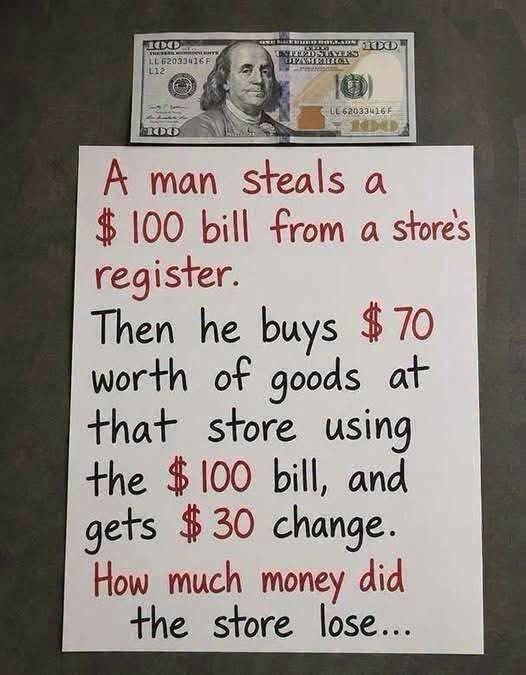
A straightforward question regarding a stolen $100 bill has perplexed more individuals than anticipated. Initially, it appears simple. A man takes $100 from a store’s cash register, then returns to that same store and purchases $70 worth of items with that same $100 bill. The cashier gives him $30 in change, leading to the question: how much did the store truly lose?
Many people quickly assert that the store lost $200 because the thief first stole $100, then took $70 in items and $30 in change. Others contend that the store only lost $100 since the stolen bill returned to the register. This is where the trick lies. The same $100 bill cannot be counted twice as a distinct loss once it is back in the store.
The clear way to grasp it is straightforward. The store initially loses $100 from the register. Later, the thief returns that same $100 while purchasing items. At that point, the cash aspect is balanced again, but the store still dispenses $70 worth of products and $30 in change.
Thus, the actual loss totals $100. This loss consists of $70 in merchandise and $30 in cash. The return of the stolen bill to the register offsets the original cash loss but does not negate the goods and change the thief took with him.
This is why the answer surprises many. The store did not lose $200, $170, or $130. It lost precisely $100, even though the situation seems more intricate than it is.
One method to verify the calculation is to document the two cash movements separately. During the first visit, the register decreases by one hundred dollars. During the second visit, it increases by one hundred dollars when the bill returns. Those entries cancel each other out. The cashier then pays out thirty dollars, resulting in the register ending with thirty dollars less than it had before either visit.
The shelf illustrates the rest of the situation. The shopper departs with items priced at seventy dollars, and the store receives no money that the shopper brought from outside. The same bill serves two purposes in the narrative of the puzzle: it is first taken and then returned. A ledger logs those as opposite movements. Counting the initial withdrawal again after crediting the return would double-count the same money.
Another way to perceive the answer is to examine the shopper’s final situation. The individual begins without the store’s bill and concludes without it, as it has returned to the register. What the shopper retains is thirty dollars in change and the goods. Based on the puzzle’s stated valuation, that totals one hundred dollars.
The merchandise is valued at its seventy-dollar selling price in the riddle. If the question instead inquires about how much cash and inventory cost the store on its own records, the cost of that inventory would need to be provided separately. The puzzle presents a selling price and seeks the loss using that figure. Under those conditions, the thirty dollars and seventy dollars are the two amounts remaining after accounting for the original bill.