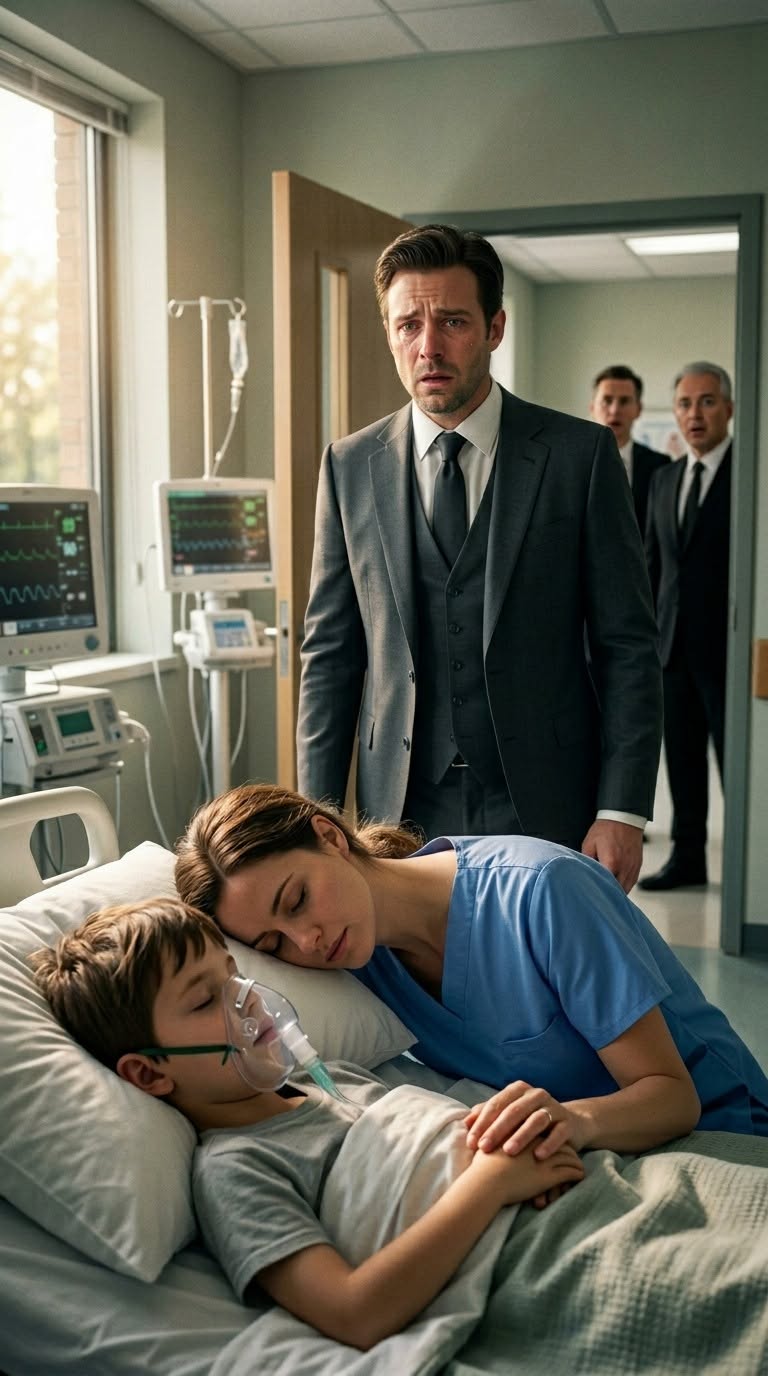
This is the chronicle of my resurrection. It did not begin in a quiet church, or a pristine therapist’s office, or even a sterile courtroom where men in heavy robes decide the trajectory of ruined lives. It began on the scuffed, bleach-stained linoleum floor of the pediatric intensive care unit at Mercy General Hospital, where I stood clutching a heavy wooden mop handle like a broadsword, placing my own trembling body between a billionaire’s sedated heir and a needle full of death.
“He was targeted once. He will be targeted again,” Vance Sterling said. His voice was a low, vibrating hum that seemed to chill the ambient air of the sterile room. He didn’t yell. Men who owned half the city’s commercial real estate and controlled the dark, unspoken shadows of the other half never needed to raise their voices. They simply altered the gravity around them.
“This is a locked ICU floor,” I shot back, gripping the plastic frame of the child’s bed so hard my knuckles turned white. “It’s compromised, yes, but you cannot simply carry a sedated five-year-old child out of a hospital because you don’t like the wallpaper.”
Vance glanced back at me. His tailored charcoal suit was immaculate, save for the stark, violent smear of dark blood on his left French cuff. He possessed the kind of sharp, brutal handsomeness that felt less like a genetic gift and more like a physical warning.
“Miss Lawson,” he said, stepping closer. The scent of ozone, rain, and expensive cedar washed over me, masking the hospital smell. “Someone bypassed the military-grade security grid at my estate. They triggered a calculated medical emergency, followed the ambulance route, drugged an armed hospital guard, infiltrated this secure floor wearing stolen scrubs, and nearly injected my son with something untraceable. Jack does not spend another minute in a building I do not personally control.”
“He needs constant cardiac monitoring!” I protested, gesturing wildly to the glowing telemetry screens. “His heart rate is unstable!”
“I have a private trauma unit.”
“You have a what?”
“A private trauma unit.”
I stared at him, my grip on the bed rail faltering. “Of course you do.”
Despite the utter chaos, despite the unconscious assassin I had just bludgeoned with my mop handle lying zip-tied in the corner, something that was almost humor flickered across the stoic face of Vance’s right-hand man. Hayes was a tall, broad-shouldered enforcer who looked like a man perfectly comfortable with a body count.
I struggled to catch my breath, my ribs throbbing with a dull ache where the fake doctor had shoved me against the supply cart. “Then he doesn’t move without portable oxygen, active telemetry leads, and someone who actually knows pediatric emergency care.”
Vance’s dark, fathomless eyes locked onto mine. He studied the faded blue scrubs I wore, the cheap rubber clogs on my feet, the heavy janitorial keyring clipped to my belt. “You are a cleaner.”
The bitterness in those four words tasted like ash in my dry mouth. “Tonight, yes.”
“What were you before tonight?”
I looked down at my hands. They were trembling, encased in bloody latex. “Pediatric trauma nurse. Johns Hopkins. Six years.”
Hayes gave a low, appreciative whistle from the doorway.
“What happened?” Vance asked. He didn’t ask it with pity. He asked it like an engineer assessing the structural integrity of a bridge he was about to cross.
My mouth went completely flat. “My daughter, Emily, got bone cancer. The insurance company stalled. The medical bills buried me alive. After she died, the quiet in my apartment was so loud it broke my mind. I made a lot of terrible decisions, and one criminal one. I stole heavy pain medication from a locked surgical cart. I didn’t sell it. I just wanted to sleep. I lost my license. I lost my home. I lost everything else in pieces.”
I braced myself, pulling my shoulders up to my ears, waiting for the familiar judgment.
Vance offered none of it. He simply nodded once, a slow, deliberate motion. He looked at the way my hands hovered over Jack’s IV, the way my eyes constantly tracked the monitor.
“Hayes,” Vance commanded without looking away from me. “Call Cole. Bring the armored unit to the loading dock. You have exactly five minutes.”
“Armored unit?” I blinked, the reality of the situation crashing back over me.
“And get Dr. Harrison out of bed,” Vance continued. “Have him meet us at the shipyard clinic.”
I grabbed Vance’s cashmere sleeve. “Listen to me. If Jack crashes in transit, and I am right about him being poisoned, he could bottom out in seconds.”
“Then come with us.”
“No. I am not getting dragged into organized crime.”
Vance closed the distance between us. “The second you saw that assassin’s face, you crossed a line. He knows you. If you go home tonight to whatever walk-up you live in, you die before sunrise.”
Footsteps thundered down the hall outside. A heavy voice shouted, “Police! Drop your weapons!”
Hayes materialized back in the doorway, completely unbothered. “Boss, uniforms are coming up the stairwell.”
“Buy me three minutes,” Vance said, moving toward the bed. “Unhook what you need to keep him alive, Sarah.”
Survival instinct snapped me into motion. I silenced the alarms, disconnected the wall oxygen, and stabilized the child’s mask. “He’s bradycardic,” I muttered. “Something is actively suppressing his heart.”
Vance lifted Jack into his arms, his large hands astonishingly careful. “Grab the tank.”
I slung the portable monitor over my shoulder, grabbed the heavy green oxygen cylinder, and followed him into the corridor. We bypassed the police standoff, slipping toward the service elevators.
The heavy metal doors groaned open.
A man wearing fresh janitor whites stood inside. He wasn’t holding a mop. He was holding a suppressed machine pistol, and it was already rising toward Vance’s chest.
For one fractured, impossible instant, the air sucked out of the hallway. Vance shifted his body violently to the left, twisting his torso to physically shield Jack from the impending bullets.
And something inside me simply ignited.
With a feral, breathless cry, I swung the heavy steel oxygen tank with both hands like a baseball bat, aiming straight for the gunman’s wrist as his finger tightened on the trigger.
The heavy brass regulator of the oxygen tank crashed into the shooter’s forearm with a sickening, wet crack.
Bone shattered. The man screamed, a high-pitched sound of pure agony. The weapon fired wild, the suppressed thwip-thwip-thwip punching holes into the acoustic ceiling panels, showering us with white dust. Vance lunged forward like a striking wolf, slammed the man into the back wall of the elevator, and drove his knee into the assassin’s chest so hard the air left the man’s lungs in an ugly bark. The gun clattered across the metal floor.
“Inside,” Vance barked, his breathing heavy.
He shoved me into the elevator compartment, stepped in with Jack, and slammed his bloody fist against the loading dock button. The doors closed on the writhing gunman. The elevator began its rapid descent.
I slid down the cold metal wall, shaking so hard my teeth clicked together. “I heard it break,” I whispered.
Vance looked down at me. “You saved my son.”
The elevator jolted to a halt. The doors groaned open to the subterranean loading dock. A matte-black armored SUV idled in the shadows, rain-blurred headlights cutting through the damp concrete. Cole, the driver—built like a brick wall—pulled open the heavy rear doors. The interior wasn’t a standard cabin; it glowed white and stainless. A mobile trauma suite.
The drive from Manhattan to the Brooklyn Navy Yard felt like being sealed inside the dark heartbeat of a storm. The SUV swayed violently through wet, empty turns. Inside the mobile unit, I forgot entirely that I was a disgraced cleaner facing an eviction notice. I remembered exactly who I was built to be.
I cut away Jack’s hospital gown with trauma shears, replacing the sticky telemetry leads. The portable monitor glowed a harsh green. His heart rate was dangerously low, his breathing shallow in a specific, mechanical way.
Vance watched me from the leather bench. “What is fundamentally wrong with him?”
I checked the IV line. “I think the initial collapse at your home was chemically induced. A five-year-old child with a minor ventricular defect doesn’t suddenly crash into acute respiratory failure unless something pushes him off the ledge. If the man in the hospital came with a syringe, he wasn’t starting the assassination. He was there to finish it.”
Vance’s voice dropped. “Poison.”
“Something small, controlled, and clean. A synthetic compound to mimic an organic heart event.”
Vance pressed the intercom. “Cole. Nobody gets near the Westchester estate. Nobody leaves. Not Mrs. Gable, not the kitchen staff. Nobody.”
I glanced up. “Who made his dinner tonight?”
“Gable supervised. The personal chef plated it. Jack drinks a glass of warm milk before bed every single night.”
I held Vance’s dark, furious eyes. “Then you need to start with the milk.”
The SUV veered off the main roads, plunging into a sprawling maze of rusted shipping containers along the Navy Yard. Massive steel doors rolled open ahead of us automatically. We drove into a cavernous warehouse, and the doors slammed shut. We carried Jack through a biometric blast door into a hidden, subterranean medical clinic so clean it looked like a movie set.
Dr. Harrison, a brilliant, arrogant-looking man in pristine scrubs, was waiting. “Put him on the center table.”
For the next excruciating hour, the bunker became a sanctuary of focused work. We drew blood, ran rapid toxicology screens, pushed IV fluids, and administered broad-spectrum counteragents. Jack’s blood pressure dipped dangerously low, but we fought it back up.
Eventually, Harrison ripped a printout from the mass spectrometer. “An obscure, highly synthetic beta-blocker,” he confirmed, looking at me with newfound respect. “Colorless, tasteless. A smart dose. Whoever engineered this knew exactly what they were doing.”
“Will he recover?” Vance asked.
“Yes,” Harrison sighed. “He’ll sleep for the next twenty-four hours, but no permanent damage.”
Vance closed his eyes, exhaling a long, shuddering breath. He gently rested his hand over Jack’s dark hair. I turned away, unable to watch the raw tenderness that reminded me too much of my own lost child.
Before I could fully process the adrenaline crash, the heavy blast door buzzed open.
A man in a soaking wet trench coat stepped in. He was in his late fifties, ruggedly handsome, with silver threaded through his dark hair. Silas. He carried the arrogant authority of a man who had stood at Vance’s shoulder for decades.
“Boss,” Silas said. “We have a severe problem. The hitman you left at the hospital bit down on a cyanide capsule. But the second shooter from the loading dock is tied to Liam O’Rourke.”
Vance’s jaw clenched. O’Rourke was a massive real estate mogul and a supposed ally.
“There’s more,” Silas continued smoothly. “We pulled the partial firewall logs from the Westchester estate. The kitchen’s internal security cameras were manually overridden just before Jack was served his milk.”
“By who?” Vance demanded.
Silas hesitated, a calculated pause. “By Eleanor.”
Vance’s older sister. The wealthy, philanthropic aunt.
“No,” Vance said, flat and absolute.
“She may have been heavily leveraged,” Silas pressed gently. “Blackmailed by O’Rourke.”
I watched Silas as he spoke. The hairs on the back of my neck stood up. His delivery was too measured. His sympathy was perfectly shaped, but entirely hollow. I had spent years learning to read genuine grief. Silas was performing.
“I need to see her,” Vance said, turning toward the door. He ordered Silas to lock down the clinic while he and his men went to Eleanor’s brownstone.
“Be careful,” I whispered to Vance as he left, my gut twisting with an unnamed dread.
The heavy steel door sealed shut. Silence poured back into the room. Dr. Harrison retreated into the back laboratory. Jack slept peacefully.
Silas stood near the entrance, his hands buried deep in his trench coat pockets. I turned my back to him, pretending to check Jack’s IV drip rate.
“You are remarkably good at your job, Miss Lawson,” Silas said, his tone conversationally light. “It’s a tragedy, really. Vance has always possessed one fatal, glaring weakness. Sentiment.”
I slowly set my pen down. I turned around.
Silas was no longer standing casually. He had a black, suppressed pistol drawn from his coat, and it was aimed directly at the center of my chest.
“Eleanor is sound asleep in her townhouse,” Silas smiled, a dead, shark-like thing. “Vance is currently speeding toward a coordinated street ambush. And Liam O’Rourke’s associates are very eager to greet him.”
I did not scream.
Screaming is a luxury for people who believe someone is coming to save them. Trauma had burned the useless reactions out of my nervous system years ago, on the day the oncologist told me Emily’s scans were terminal. Panic never made a surgeon’s hands steadier. Panic never stopped the bleeding.
My eyes darted exactly once, a fraction of a millimeter to my right. The red, heavy-duty hospital defibrillator cart. The caster wheels were unlocked.
Silas caught the microscopic movement of my eyes and let out a condescending chuckle. “You really are a brave little cleaner, aren’t you?”
He shifted his weight, rotating the muzzle of the suppressed pistol away from my chest and directly toward Jack’s sleeping head. “I’m talking about corporate succession,” he sneered.
I moved.
I didn’t think; I simply exploded into motion. I kicked the yellow wheel-release lever on the crash cart and threw my entire body weight behind the heavy steel mass. The massive cart rolled violently forward and slammed brutally into Silas’s hips just as the gun coughed.
Thwip.
The suppressed round missed Jack by inches, instead shredding a hanging bag of saline above the bed. The sterile fluid exploded downward, raining over the child like shattered glass. Jack didn’t even stir, trapped deep in the chemical sleep.
Silas staggered backward, cursing loudly, his balance broken.
I snatched a solid steel oxygen flow regulator off the counter—a heavy, blunt instrument of solid brass—and hurled it with all my strength at his face. He jerked aside, but the heavy metal caught him hard on the collarbone, spinning him against the wall.
“Dr. Harrison!” I screamed at the top of my lungs, my voice tearing my throat.
There was no answer from the lab. I was completely alone.
I grabbed the rails of Jack’s surgical table and shoved. The wheels caught for a terrible second, then rolled smoothly on the epoxy floor. I sprinted, driving the bed hard toward the supply alcove, desperately putting the metal shelving units between the child and the gun.
Silas recovered, his face contorted in an ugly mask of rage, and brought the pistol back up, advancing on my position. “That is quite enough,” he snarled.
The word had barely left his lips when the biometric sensor on the main door flashed a brilliant, blinding red.
A deafening claxon alarm detonated through the underground bunker. Then, the reinforced steel blast door blew inward.
The breaching charge threw concrete dust, smoke, and a massive slab of twisted metal across the pristine clinic floor. Stepping through the thick gray smoke like a demon summoned from the underworld came Vance Sterling.
He was holding a compact assault rifle. The tailored civility of the businessman was completely gone. The look on his face was murder stripped clean to the bone.
Silas spun toward the door in sheer panic, raising his pistol.
Vance didn’t hesitate. He didn’t monologue. He fired a single, deafening shot.
The high-caliber bullet shattered Silas’s kneecap.
The scream that ripped out of the older man did not sound human. It was a guttural, animalistic shriek of pure agony. Silas hit the floor hard, splashing into the puddle of saline, dust, and his own rapidly pooling blood. His gun skidded uselessly away.
Hayes and Cole flooded into the room behind Vance, their weapons sweeping the corners with terrifying efficiency.
Vance’s dark, furious eyes scanned the wreckage and found me first. I was standing protectively in front of Jack’s hidden stretcher, my chest heaving, my scrubs covered in dust, holding a tiny, razor-sharp surgical scalpel in my trembling hand.
“Are you hurt, Sarah?” Vance asked.
It was almost profoundly absurd—that quiet, polite question in the middle of a literal war zone. I shook my head once, dropping the scalpel. It clattered loudly on the floor.
Vance exhaled, the tension leaving his shoulders. Then, he turned his attention down to Silas.
“I called my sister’s private, unlisted cell phone the exact second I walked out of this clinic,” Vance said, his voice a low, terrifying rumble. “The line you didn’t know existed.”
Silas was desperately trying to drag himself backward across the slick floor.
“And just to tie up loose ends,” Hayes added pleasantly, lowering his rifle. “Liam O’Rourke’s chief lieutenant is currently kneeling on a rooftop in Greenwich Village with both wrists zip-tied together. Turns out, he was very chatty.”
Silas’s face completely collapsed. The arrogant traitor dissolved into a terrified, whimpering old man.
Vance crouched down slowly. “You sold my son.”
“Vance, please, the business needed correction—”
“You have lost the right to speak to me,” Vance whispered.
The suppressed shot from Vance’s sidearm was a small, almost polite sound. It ended everything.
For a long, agonizing second, no one moved. Then Vance stood up, handed his rifle to Hayes, and crossed the ruined room toward me.
My knees finally buckled, and I slid down the wall. Vance stopped in front of me, crouching down so we were eye level.
“It’s done, Sarah. You’re safe.”
“I was a nurse,” I whispered, the tears finally breaking loose. “I saved people. Tonight… I don’t even know who I am anymore.”
Vance reached out, his large, warm hand cupping the side of my face. He gently wiped a streak of dust from my cheek with his thumb. “You are a mother who still ran headfirst toward danger when she heard that another child might die. That is exactly who you are.”
Something inside my chest broke wide open then. Not shattering into despair, but cracking open to let the first real breath of air in years fill my lungs.
“You cannot go back to the life you had yesterday,” Vance stated. “But I swear to you, Sarah, I can give you a safe one.”
I looked up at him through the wreckage of the longest night of my life. For the first time since I lost my daughter, safety sounded like more than a cruel fantasy.
As we packed up the medical equipment to move Jack to a fully secured location, the heavy metal doors of the shipyard clinic closed behind us for the last time. Stepping into the cool, rain-washed dawn of the city, I realized I had just crossed a bridge that was currently burning to ash behind me.
By dawn, the sprawling metropolis of New York looked deceptively clean from a distance. From the tinted rear window of the armored SUV, the bruised sky over the East River was bleeding into a washed-out, pale silver. I sat in the spacious back cabin beside Jack’s transport bed, while Vance occupied the leather seat across from us. Cole drove in absolute silence.
We were headed north, deep into the secluded, generational wealth of Westchester County.
Jack slept through most of the journey, his small, pale hand resting limply outside the heavy woolen blanket. Every few minutes, Vance would lean over and gently tuck it back under, a silent, obsessive vigil. I had scrubbed the blood and concrete dust from my skin in a bunker bathroom before we left, changing into a pair of soft charcoal sweatpants and an oversized cashmere cardigan provided by Hayes. My head throbbed with a dull, persistent ache, the butterfly closures above my eyebrow pulling painfully every time I blinked.
Just as the sun crested the tree line, Jack finally woke. His dark eyelashes fluttered open, revealing drowsy brown eyes that looked remarkably like his father’s.
“Dad?” Jack whispered, his lips dry.
Vance was leaning over the bed instantly. “I’m right here, buddy.”
Jack’s gaze drifted lazily until it found me. I offered him a warm, exhausted smile. “Hey there, tough guy. You gave everybody a pretty exciting night.”
Jack studied the white bandage stark against my forehead. “Did you bonk your head?”
Vance actually exhaled a sharp breath through his nose—a sound suspiciously close to a genuine laugh. “I did,” I admitted. “Occupational hazard.”
Jack considered this carefully. “Are you a real doctor?”
“Something like that.”
He nodded, satisfied. His little hand reached out from beneath the blanket, grasping blindly toward his father. “Stay,” Jack mumbled, drifting back to sleep.
Vance took the small hand in both of his. “Always.”
By the time we arrived at the safe house, Westchester was waking into a display of quiet, old-world wealth. The property Vance had chosen sat well back from the wrought-iron gates, hidden entirely from view. It was a massive, beautiful cedar-and-stone mansion that possessed the quiet, terrifying confidence of a place protected by invisible, lethal force.
Inside, a fully equipped medical suite on the ground floor had already been prepared. We settled Jack into a real bed. Dr. Harrison arrived two hours later via a different route, thoroughly examined the boy, and approved a step-down monitoring plan.
Only then did I allow myself to step out onto the expansive stone terrace overlooking the manicured backyard, a mug of black coffee cooling untouched in my hands. That desperate, broken woman living in a damp basement apartment in Queens felt dead. Somewhere in all the terror and blood of the night, I had found absolute proof that the part of my soul I thought had died with my Emily was still breathing.
Vance stepped out onto the terrace a minute later, changed into dark denim and a black Henley. “That one is dead,” he said, handing me a steaming mug and taking the cold one from my hands.
“What happens now?” I asked, looking out at the swaying maples. “To Liam O’Rourke?”
“O’Rourke’s entire operation is already collapsing as we speak,” Vance replied, his jaw set tight. “By the end of this week, the legitimate front of his empire will be raided by federal agents, and the violent side will be completely leaderless. I am officially done negotiating with anyone who wants to drag my family back into the dark ages.”
Later that afternoon, Eleanor arrived. Vance’s older sister came wearing a tailored navy wool coat and oversized dark sunglasses. When she walked into the medical suite and saw Jack sitting up in bed, nibbling on a cracker, her polished face crumpled. She dropped to her knees, sobbing openly.
Once Jack drifted back to sleep, Eleanor requested to speak privately in the drawing room. She confessed that Silas had been slowly bleeding money through the shell entities she oversaw. She had confronted him privately, and he had blackmailed her, threatening her twenty-two-year-old son, Connor, who was in a highly secure rehab facility. Silas used her old master admin access to hack the estate.
Vance didn’t lash out. Instead, he pulled his older sister into a fierce, crushing embrace. “We are officially done protecting the rot just because it used to be called family,” he murmured.
The next three weeks unfolded in a series of meticulously managed shockwaves. I stayed at the safe house. Vance, true to his word, unleashed the most ruthless legal team in New York upon my past, systematically dismantling the revocation of my nursing license.
He attended every single one of my grueling medical board hearings. He sat perfectly still in the back row, his expression unreadable, terrifying state attorneys into sudden efficiency without ever opening his mouth.
One evening, back at the estate, I had made it to the dim quiet of the massive library before the emotional dam broke. I was crying silently over the cruelty of the board’s questions when Vance found me.
“They are evaluating the absolute worst day of your life as if it defines every single day you have lived since,” he said gently, stepping close enough to make the world disappear. “That is their profound failure of imagination, Sarah. It is not yours.”
I let out a wet, shaky laugh. “You really should not be the comforting one in this dynamic. You are an incredibly terrifying man.”
“And yet,” he smiled softly.
“And yet,” I exhaled, “You are the only person who makes me feel safe.”
When he finally kissed me, it was with a desperate, crushing restraint that deepened into something possessing the force of a tidal wave. For a broken woman who had truly believed her life was over, the tender, overwhelming reality of being deeply wanted felt like a glorious revolution. But the war wasn’t entirely over; we still had to face the city, and the legacy we were about to build from the ashes.
Three years later, brilliant spring sunlight poured through the towering glass atrium, turning the entire hospital lobby into a cathedral of silver and white.
The newly constructed pediatric trauma wing at Mercy General Hospital was packed shoulder-to-shoulder with wealthy donors, flashing cameras, nervous board members, and a chaotic cluster of children wearing paper hats who only cared about the catered cupcakes.
Across the expansive main wall, cut in elegant brushed steel lettering, read the dedication: The Emily Lawson Memorial Center for Pediatric Emergency Care.
I stood near the podium, wearing a crisp, blindingly white doctor’s coat, my fully reinstated nursing badge clipped straight and proud to my lapel. Sometimes, I still reached up and touched the hard plastic of the badge, running my thumb over my name, just to ground myself. Just to confirm that this beautiful, impossible life was actually real.
Beside me, eight-year-old Jack Sterling held an oversized pair of ceremonial ribbon-cutting scissors. He was literally vibrating with barely contained excitement. He was wildly healthy, loud, and growing rapidly into his father’s sharp intellect and his own joyful, stubborn spirit. The shadow of that horrific night in the loading dock had faded from his eyes, replaced by the boundless energy of a boy who knew he was fiercely, undeniably loved.
On my other side stood Vance. He wore a flawless navy bespoke suit, his physical presence commanding the room without him having to utter a single word. His large, warm hand rested securely at the small of my back, a constant, grounding anchor in the sea of flashing lights.
A nervous board member gave a long, rambling speech. A chief hospital administrator profusely thanked the generous donors. Eleanor stood elegantly in the front row beside her son Connor, who looked healthy, completely sober, and genuinely happy. She smiled at me, a silent acknowledgment of the blood and fire it took to get all of us to this room.
Then, the hospital director handed the microphone to me.
I stepped up to the polished wooden podium. The low murmur of the wealthy crowd quieted. I looked out at the sea of faces, but I didn’t see the billionaires or the polished designer shoes. I looked past them. I saw the terrified, exhausted parents clutching cold coffee cups in the waiting rooms upstairs. I saw the overworked nurses with dark circles under their eyes, fighting bureaucratic red tape to save lives. I saw the fragile children who would desperately need someone to notice the wrong shoes, the wrong syringe, the wrong, heavy silence.
My voice, when it finally echoed through the massive atrium, was unwavering.
“A hospital should be the one absolute place in this chaotic world where a child is never, ever treated as a disposable statistic,” I said, the acoustics carrying my words clearly to the very back of the room. “This state-of-the-art wing exists because far too many families know exactly what it feels like to sit helpless beside a sterile hospital bed and pray into the dark for just one more chance. It exists in loving memory of a brave little girl named Emily, whose life was far too brief, but immensely beautiful.”
I paused, feeling Vance’s hand tighten slightly against my spine, lending me his strength.
“And it exists,” I continued, looking directly at the hospital administrators who had once stripped me of my license, “because sometimes, the only thing standing between life and death is not the wealthiest or most powerful person in the room. Sometimes, it is simply the person who refuses to step aside.”
For a long, suspended second, the entire lobby held its collective breath. The weight of the truth hung heavy and resonant in the sunlit air.
Then, Jack enthusiastically snipped the thick red ribbon with a loud clack, and the room erupted into thunderous, echoing applause.
Later, when the formal ceremony ended, the crowd loosened into polite, buzzing conversation, and the reporters drifted hungrily toward the open bar and expensive gift bags. I slipped away from the congratulatory handshakes. I stepped into the quiet, sunlit end of the new corridor just to breathe.
Vance found me there, exactly as he always seemed to. He stepped into my personal space, his dark eyes warm and incredibly soft.
“You were magnificent up there,” he said, his voice a low, intimate rumble.
“I was trying incredibly hard not to ugly-cry directly into the microphone.”
“You failed a little bit right at the end.”
“So did you,” I shot back, noticing the faint redness at the corners of his own eyes.
He smiled—a wide, real, completely unguarded expression that the cold, terrifying man I met in Room 412 never could have fathomed.
Outside the massive windows, the city moved in bright, ceaseless streams. Ordinary traffic. Ordinary, beautiful lives. There were no screaming sirens. No gunfire in the dark. No coded, desperate phone calls at midnight demanding blood for blood.
I leaned forward, resting my forehead against his broad chest, closing my eyes and listening to the steady, strong rhythm of his heartbeat.
“Do you ever think about that night in the loading dock?” I asked softly into his jacket.
“Every single day of my life.”
“With regret?”
He wrapped his strong arms around me, pulling me tight against him. “With absolute gratitude. And fury. And then gratitude again.”
I nodded against him. That felt exactly right.
At the far end of the long hall, Jack waved his arms wildly, his little silk tie loosened around his neck. “Dad! Sarah! Come quick, they have tiny, bite-sized cheesecakes!”
Vance glanced over my shoulder, raising an eyebrow in mock seriousness. “Sounds like an emergency.”
“Clearly,” I laughed, wiping a stray tear from my cheek.
He took my hand, our intertwined fingers catching the bright sunlight, the matching gold wedding bands glinting brilliantly.
A dangerous, powerful man had once rushed into a hospital expecting a brutal war, and instead found a broken, bleeding woman holding a wooden mop handle, standing over his son like the last honest soldier left on earth. He had gone into the dark that night to save a child. He didn’t know he was about to save us both.