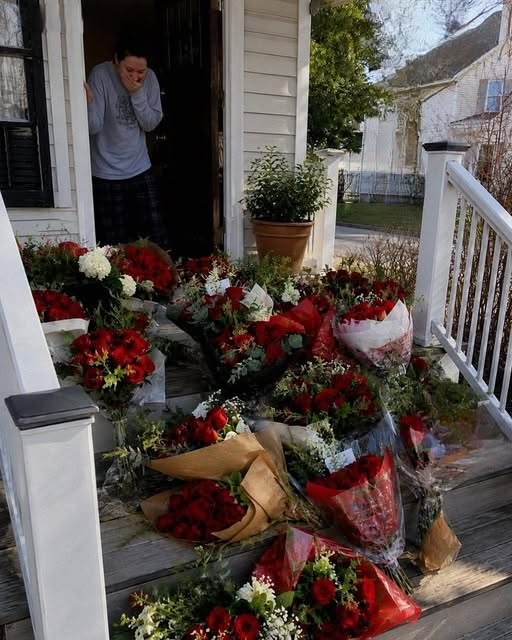
I sensed something was off before I even killed the engine. For seven years my wife Jane had stood on the porch the moment I pulled into the driveway after a trip. This time, the house was unnervingly quiet. Then I saw them: a hundred roses flooding the porch like a floral tide. My stomach dropped. Someone was trying to sweep her away, and the enormity of the gesture felt like a provocation. My hands trembled as I grabbed the small note tucked into one bouquet, bracing for the worst.
The perfume of a hundred roses hit me like a physical blow as I stepped out onto the porch. Red, pink, yellow, white—they smothered the front door in a suffocating splash of color. The door creaked open and Jane appeared, worn and drawn, pale in the porch light. She froze at the sight, eyes wide with stunned confusion that poked at me in the wrong way. When I asked who had sent them, the silence between us was heavy with unspoken suspicion.
Jealousy landed like a cold stone in my gut. Had someone been courting her while I was gone for five days? I searched her face for deception and found only a fragile woman near collapse. Then I noticed a little white envelope tucked near the swing, a crooked heart drawn in blue marker on the front. My pulse hammered as I tore it open. The handwriting was childish—big, uneven letters that trembled across the paper. I read aloud, my voice breaking with every line.
“Please don’t quit,” it began. Jane gasped, clutching her mouth, shoulders tightening. I continued, vision blurring as the next lines struck me. “We love you so much. We are so sorry.”
The silence that followed was loud. Jane didn’t so much cry as shatter—an ugly, raw sound that released months of bottled‑up hurt. Holding her, I realized the porch wasn’t an ambush; it was a message. Each bouquet, every card, had come from her students.
For months I had watched my wife erode. As a teacher, Jane gave everything—buying supplies from her own pocket, grading until dawn, remembering tiny facts about each child. But gratitude had been scarce. She came home in tears, exhausted by constant disruptions and the bruising sense of invisibility. She felt like she was failing and had even posted, in a desperate note to the parents’ group chat, that she might not come back.
She thought she’d been screaming into silence. But those parents had been listening. Surrounded by a mountain of bouquets, we began opening cards. They were from kids, from parents, from families: “Thank you for helping Ethan believe in himself,” read one. “School is better when you’re there,” said another. A glitter‑covered note in messy print made us laugh through tears: “Dear Mrs. Jane, please don’t quit because you make math less scary and your jokes are funny even if no one laughs.”
The deeper we dug, the clearer it became that appreciation hadn’t been missing—just quiet, waiting for the right moment. My wife, who had felt invisible, was suddenly buried in proof that she mattered and was loved.
By evening we had carried roses indoors, turning our living room into a garden. She stood in the center, a real smile lighting her face—one I hadn’t seen in years. It wasn’t exhaustion pretending to be joy; it was recognition. We found a huge card signed by dozens; at the bottom someone had written in thick ink: “The world needs teachers like you. Please don’t give up on us because we haven’t given up on you.”
Jane pressed the card to her chest and the tears shifted from despair to relief. I realized teachers plant seeds and seldom see which ones grow. She had been ready to walk away from her calling, yet those she’d taught returned that labor of care exactly when she needed it most.
That night, the house smelled like a greenhouse. She told me she would be back in class on Monday. The roses were more than flowers—they were a lifeline, evidence that kindness can tug someone back from the edge. We spent the night surrounded by notes and bouquets, the proof that she had mattered all along—even on the darkest days. In the end, she hadn’t just taught students to learn; she’d taught them to care, and that lesson came home to save her when she needed it most.