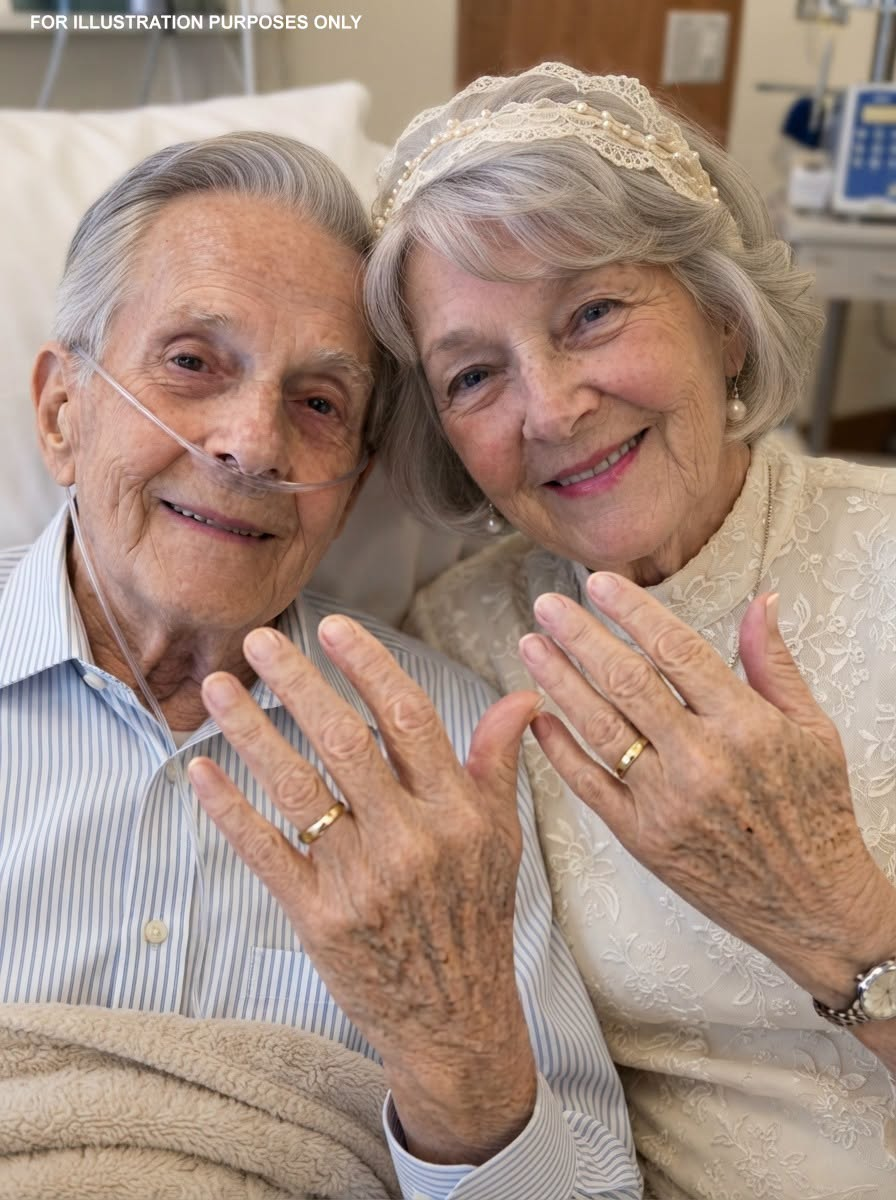
I thought saying goodbye to the love of my life would be the hardest thing I’d ever have to do. I had no idea that the real reason he came back into my life wouldn’t be revealed until after he was already gone.
Coming Home to a Town That Remembered Me
Rain tapped softly against the living room window of my little rented apartment while I sat stirring a cup of instant coffee I couldn’t really afford. At seventy-three years old, I had come back to the town I’d left when I was seventeen, and somehow the streets outside still seemed to know my footsteps better than I did myself.
My pension hadn’t stretched far enough to cover much of anything, so I’d pinned my old nursing badge onto a fresh uniform and gone right back to work at the local hospital, doing the same job I’d done for decades before retiring. Funny thing about coming home after fifty-some years away. Nothing looked exactly the same. And yet somehow, everything still felt the same.
I had never married. Never had children. There had been dates over the years, a handful of kind, decent men, but none of them had ever managed to become Thomas.
Thomas. I hadn’t said his name out loud in over fifty years.
He was my first love, back when we were both seventeen and still believed forever was a promise you could simply make and keep. I chose a college in another city. He chose to stay behind and work in his father’s business. I remember the bus station like it happened yesterday.
“Please don’t go, Nancy,” Thomas had begged me, standing on the platform with his hands shoved in his pockets.
“I have to, babe. I’ve worked too hard for this.”
“Then you’re breaking my heart.”
That was the last time I ever saw him. Or so I believed, for fifty-six years.
The Cousin Who Called Too Often
The phone rang, pulling me back into the present. I already knew who it was before I even picked up.
“Nancy, honey, it’s Raymond. Just checking in on my favorite cousin.”
Favorite cousin. We’d barely spoken in thirty years, but ever since I moved back to town, Raymond called almost every single week, always cheerful, always circling back to the same handful of questions.
“How’s the apartment treating you? Rent’s a killer at our age, isn’t it?” he said.
“I’m managing, Raymond.”
“You got everything squared away? Paperwork, will, that sort of thing? A woman living alone needs to be careful.”
I forced a smile into my voice, the way I always did with him. “I’m fine, dear. Really.”
“You know, I used to visit Aunt Margaret every week before she passed. Helped her with all her affairs. Family should look after each other, don’t you think?”
Something about the way he said it made my coffee taste bitter in my mouth. I couldn’t put my finger on exactly why, not yet.
“That’s kind of you, Raymond. I have to run. My shift starts soon.”
I hung up before he could stretch the call out any longer than he already had.

Room 220
The hospital hallway smelled the way hospital hallways always smell — disinfectant layered over quiet human worry. I pushed my cart down the corridor, checking room numbers, already tired, and it wasn’t even ten in the morning yet.
Room 220. New admission. Long-term care.
I pushed the door open, stepped inside, and opened the chart the way I always did on autopilot. My eyes skimmed the top line, then stopped cold.
Thomas.
I stared at the last name printed beneath it. My mouth went dry. It couldn’t be. There had to be a thousand men with that name in this state alone, I told myself, even as my pulse started climbing.
Then I lifted my eyes to the man in the bed, and I knew him instantly.
Fifty-six years hadn’t erased that face. Thomas was thinner now, paler, hollowed out by whatever illness was eating him from the inside, but those were the same eyes that had once begged a seventeen-year-old girl to stay. He smiled at me like he’d been waiting there the whole time.
“Hello, Nancy,” he said, soft as a Sunday morning.
I couldn’t speak for a long moment. I just stood there with the blood pressure cuff still in my hand, feeling my entire life catch up with me all at once, right there in a hospital room that smelled like antiseptic and old memory.
“Thomas,” I finally managed. “My goodness. Thomas!”
Coffee, Black, No Sugar
After that morning, I found reasons to check on him every single shift. My high school sweetheart told me he’d never married either. We laughed about our gray hair and our bad knees, and sometimes we didn’t talk at all — we just sat together in a comfortable silence I hadn’t felt with another human being in longer than I wanted to admit.
“You still take your coffee black?” he asked me one afternoon.
“Still do.”
“I knew it.”
There was something odd, though, about how calm he seemed through all of it. Most patients in his condition were angry, or frightened, or numb to everything around them. Thomas seemed almost peaceful instead, like a man who’d been holding his breath for a very long time and had finally been given permission to let it out.
One morning, he asked me, as carefully as a man stepping onto thin ice, “Do you have family nearby, Nancy? Anyone looking in on you?”
“Just a distant cousin. Raymond. He’s been calling more lately.”
Thomas’s jaw tightened for just a second. Then it relaxed, and he changed the subject to the weather outside his window. I didn’t think much of it at the time. I should have.
The Calls Got Stranger
Raymond’s calls kept getting stranger that same week.
“Are you seeing anyone, Nancy? At your age, you shouldn’t be alone. Family should have each other’s backs.”
“I’m fine, Raymond.”
“Have you thought about a will? God forbid, but you know. Somebody responsible ought to be listed.”
“I said I’m fine.”
He asked about my bank accounts. He asked about the apartment lease. He brought up Aunt Margaret again, how he’d “helped her with everything” toward the end of her life. I remembered Margaret dying alone in a rented room, and I couldn’t quite figure out why that memory suddenly sat so wrong in my stomach.
I brushed it off, the way I always brushed things off. That was practically my whole life story in one sentence.
The Question I Never Let Myself Imagine
Then came the afternoon everything changed. Thomas asked me to sit down. His hand found mine on top of the blanket, cold and light as a bird.
“Sweetheart,” he said, “I feel terrible asking you this.”
“Ask,” I said.
“I’ve loved you my entire life. I know I’m going to die soon. But I’ve always dreamed of marrying you. Will you marry me? It’s my last wish.”
I could barely breathe. I couldn’t even blink. Fifty-six years of what if, and here it finally was, thin and dying in a hospital bed, asking me the one question I had never let myself imagine hearing.
A voice in my head that sounded exactly like Raymond hissed, Foolish old woman, don’t you dare.
Another voice, one I’d silenced back when I was seventeen years old, said, Say yes. For once in your life, say yes.
Thomas had stage four cancer. There wasn’t much time left to overthink anything. I decided I would grant him his final wish.
“Yes,” I whispered. “Thomas, yes.”
His eyes filled with tears. So did mine.
“You won’t regret it,” he said. “I promise you that, Nancy. On my life, you won’t regret it.”
I didn’t understand, in that moment, why he said it quite like that — like a vow that carried more weight than the wedding vows themselves. I only understood that I had just agreed to marry a dying man, that my hands wouldn’t stop shaking, and that somewhere across town, Raymond was probably already dialing my number again.

A Wedding in Room 220
The wedding took place three days later, right there in Thomas’s hospital room. A nurse stood as our witness, and beside her stood a quiet man in a gray suit who introduced himself as Walter, Thomas’s attorney.
I thought it was a little odd to have a lawyer present at a bedside wedding. But my high school sweetheart squeezed my hand, and I let the thought slip away as quickly as it had come. His eyes shone when he said his vows. Mine did too.
After the small ceremony, Walter pulled a folder from his briefcase and set it down on the rolling tray table beside the bed.“Just a few papers, Nancy,” he said kindly. “Standard things. Take your time.”
I didn’t take my time. I signed each page right where he pointed, trusting Thomas the way you trust the sun to rise the next morning.
“You’re Being Manipulated”
That evening, my phone rang. Raymond again.
“Have you lost your mind?” he snapped, the moment I told him about the marriage. “Marrying a dying man you barely know?”
“I’ve known him longer than I’ve known you,” I said quietly.
“Nancy, listen to me. You’re being manipulated. Some stranger sees an old nurse with a pension and dangles a sob story in front of her, and you just fall for it? Annul it. Today.”
“No. I won’t.”
“You foolish woman. You don’t understand what you’re doing.”
I hung up on him.
The Funeral
A month later, Thomas was gone. He passed in the early morning, peaceful, with my hand still in his. The grief hit me harder than I ever expected it to, given that we’d only had a handful of weeks together. But sometimes a handful of weeks can carry almost six decades folded inside of them.
The funeral was small. I stood by the grave and let myself cry without holding anything back.
Raymond showed up, of course. He waited until the other mourners had drifted back toward their cars before he finally approached me.
“You know I’m your only living relative,” he said, adjusting his tie like it was a business meeting. “Family should handle family. Foolish old women shouldn’t sign papers they don’t understand, Nancy.”
“I understood every word Thomas said to me.”
He gave me a thin, humorless smile. “I helped Aunt Margaret with everything at the end. Everything. She was grateful for it.”
Something cold moved through me right then. I remembered the way Thomas’s jaw had tightened, every single time, whenever Raymond’s name came up in conversation.
“I need to go home, Raymond.”
“We’ll talk soon,” he said. “About your affairs.”
I walked to my car without answering him.
Walter Returns
The following morning, someone knocked on my apartment door. I opened it to find Walter standing there, holding a small wooden box under one arm, wearing the same quiet smile he’d worn at the wedding.
“May I come in?”
I stepped aside and let him in. He set the box down on my living room table and folded his hands in front of him.
“Thomas asked me to deliver this the day after his funeral. Not before. I’ve also sent Raymond a formal letter this morning, notifying him, as your next of kin, that your affairs are now under a trust. He’ll have it by noon.”
“What?” I asked, my heart suddenly loud in my chest.
Walter smiled gently. “Thomas was right. You finally walked right into his trap.”
I sat down slowly. My hands wouldn’t stop shaking. Walter drew a folded page from his jacket pocket.
“Thomas left instructions I’m to read exactly as he wrote them.”
He smoothed the page carefully and read it aloud in a voice that didn’t quite sound like his own anymore.
“My darling Nancy, forgive me, but I set a trap, and you were never meant to be the one caught in it.”
My breath caught in my throat. I gripped the edge of the table to steady myself.
What Was Really in the Papers
Walter looked up at me. “Those papers you signed at the wedding did more than accept what Thomas left you. One was a new will, naming a discretionary trust that I administer, funded entirely by Thomas’s estate for your support. Another was a durable power of attorney. You named me, Nancy. Not Raymond. To speak for your affairs, if you were ever unable to do so yourself.”
He cleared his throat before continuing. “And the third was your acceptance of the trust’s terms. Raymond cannot pressure you into signing anything binding, ever again. Any document touching your money or your care runs through me first, at your request. That was Thomas’s trap. A ring of lawyers built around you, so no one like Raymond can ever slide a page under your hand again without you understanding exactly what it says.”
The wood of the box was smooth beneath my fingertips. There was a small brass latch holding it shut. I thought of Raymond’s cold smile at the graveside. I thought of Thomas’s shining eyes on our wedding day. I lifted the lid.
And what I found inside made me gasp out loud.
I pressed my hand to my mouth and started sobbing right there at my kitchen table.
Inside sat a folded deed to Thomas’s family home, trust documents already drawn up in my name, and a thick stack of letters tied together with a length of twine. Fifty-five letters. One for every single year he hadn’t written, every year until the one that finally brought me back into his hospital room.
On top of the stack lay a handwritten note in his careful, familiar script. I looked up at Walter, my throat tight, tears sliding freely down my cheeks now.
“I don’t understand,” I whispered.
“Read it, Nancy. He wanted you to hear it in his own words.”

Thomas’s Explanation
Thomas had written that Aunt Margaret had been a loyal customer at his father’s hardware store for forty years, and a genuine friend besides. He’d tried, once, to warn her about Raymond siphoning money quietly out of her accounts, after he’d overheard something he wasn’t supposed to hear. But she wouldn’t listen to a single word spoken against her nephew. When she passed away, and Raymond walked away noticeably richer than he should have been, Thomas had kept a quiet, careful eye on him ever since.
So when he learned that I’d moved back to town and taken a nursing job, with Raymond suddenly hovering close by again, he’d requested a transfer onto my ward.
“He knew,” I whispered. “He knew what Raymond was planning to do to me.”
“He did,” Walter said gently. “That’s why the wedding happened when it did. That’s why I was there. And that’s exactly why he asked you to sign those papers.”
I pressed the note against my chest, my hands still trembling. I hadn’t said his name out loud in over fifty years, and now it was the only name in the entire world that mattered to me.
“The trap wasn’t for me.”
“No, Nancy. It was for Raymond. Thomas made you his legal wife so that no one could ever touch what he left behind for you. It’s ironclad.”
The Last Word
Raymond came pounding on my door three days later, red-faced, waving threats about lawyers and undue influence like a man swatting at smoke. Walter, who had taken to visiting often, happened to be sitting at my kitchen table with a cup of tea when it happened.
“Every document is airtight,” my lawyer told Raymond calmly, without even standing up from his chair. “Contest it if you’d like. You’ll lose, and you’ll pay the legal fees for the privilege.”
My cousin stared at me like he was looking at a total stranger. “You foolish old woman!”
“No, Raymond,” I said. “I’m a woman who was loved. There’s a difference.”
He left without another word, and this time, I knew he wouldn’t be calling again.
What Waited Fifty-Six Years
I moved into Thomas’s old house that following spring. Every Sunday morning, I open one letter from that stack and read it slowly over my coffee, black, no sugar, just the way he remembered.
Love hadn’t passed me by after all. It had simply waited fifty-six years for the right moment, and even in leaving this world, it had found a way to wrap its arms around me one very last time.