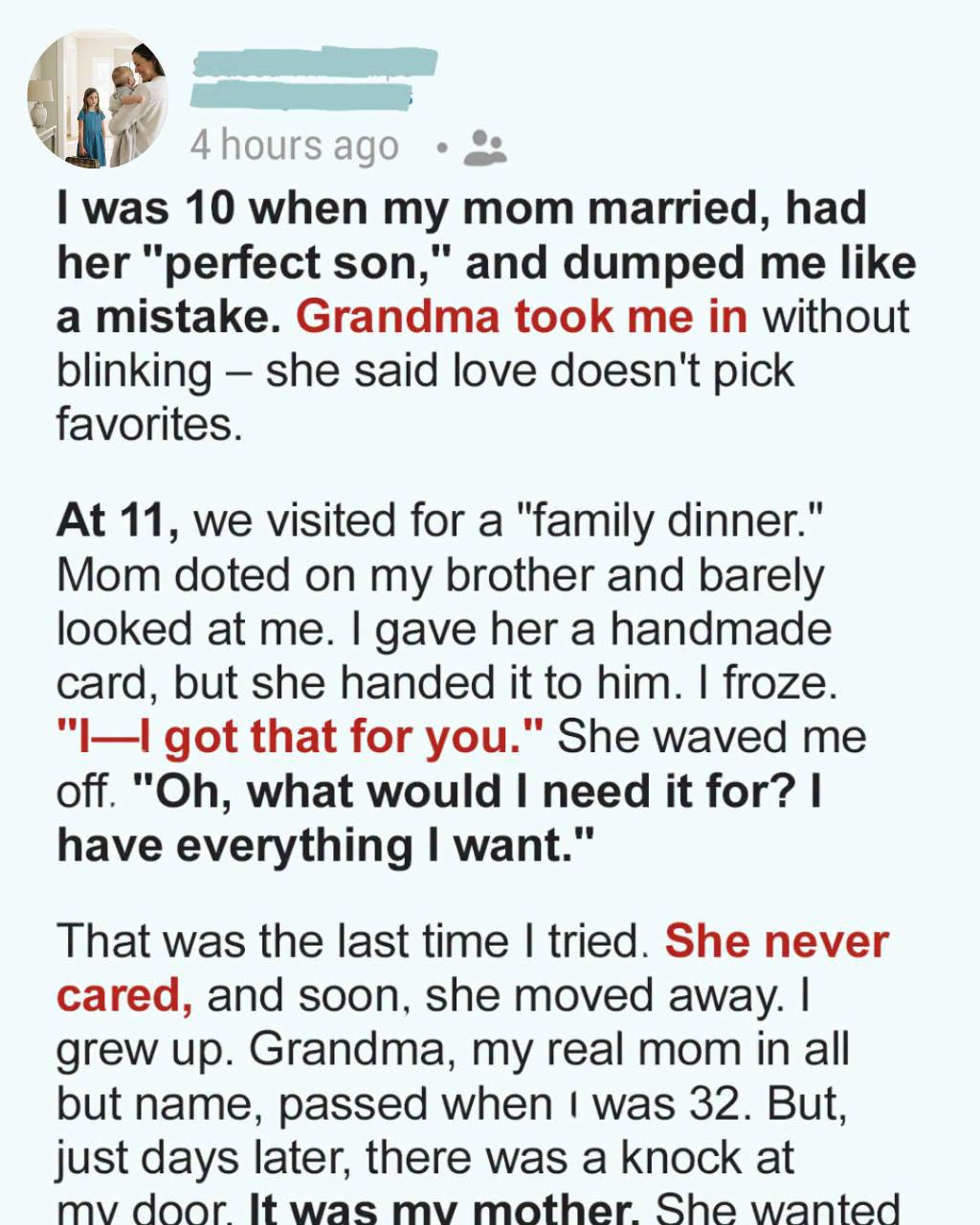
I was ten years old when my mother remarried, and overnight, I stopped being her child in any way that mattered.
She called it a fresh start. A new husband. A new house with a front door I didn’t recognize the smell of yet. And not long after, a new baby boy — her perfect son, the one she’d apparently been waiting for her whole life without knowing it. I remember standing in the doorway of that bright, unfamiliar house with my small suitcase gripped in one hand, watching her cradle him against her chest like the world had finally handed her everything she’d ever wanted. She barely looked in my direction the entire afternoon.
Grandma’s Sewing Room
A week later, she told me it would be “better” if I stayed with Grandma for a while. She said it lightly, like she was suggesting a sleepover instead of rearranging the entire shape of my childhood.
Grandma didn’t hesitate for even a second. She opened her arms wide, cleared out her sewing room to make space for a bed, and tucked me in at night beneath blankets that smelled like lavender and something I can only describe now as safety. When I cried into her shoulder those first few weeks, she wiped my tears with the pad of her thumb and said something I would carry with me for the rest of my life.
“Love doesn’t pick favorites,” she told me.
I didn’t fully understand it yet at eleven. I would understand it completely, years later, standing in a doorway of my own.

The Card With Glitter Hearts
At eleven years old, we were invited to what my mother called a “family dinner.” I wore my best dress that night. Grandma helped me braid my hair at the kitchen table, humming under her breath the whole time. In the days leading up to it, I spent hours making a handmade card, gluing on glitter hearts one at a time and writing I love you, Mom in my most careful, best-behaved handwriting. I pictured her face lighting up. I pictured her hugging me tight, maybe even realizing, all at once, exactly how much she’d missed me.
The moment we walked through the door, she rushed straight past me to scoop my baby brother up into her arms instead. She laughed, kissed his round cheeks over and over, called him her miracle in a voice I hadn’t heard her use with me in over a year. I stood there in my best dress, completely invisible in a room full of people who were supposed to love me.
During dessert, I finally gathered up enough courage to hand her the card. My hands were shaking so badly the glitter hearts caught the light unevenly.
“I—I got that for you,” I said.
She barely glanced down at it. Instead, she passed it straight to my brother, like it was one of his toys to play with. “Oh,” she said, waving me off — not cruelly, exactly, just completely, hollowly empty. “What would I need it for? I already have everything I want.”
Something inside me went very quiet after that. Not loud, not dramatic. Just quiet, the way a light goes out in a room you’ve already decided to stop entering.
That was the last time I ever tried.

What Grandma Taught Me Instead
After that dinner, there were no more handmade cards. No more visits arranged around holidays that never quite happened. Eventually my mother moved away entirely, and I grew up in the meantime, mostly without her.
Grandma became everything for me during those years. My protector. My loudest cheerleader at every school event nobody else showed up for. My home, in every sense of the word that actually counted. She taught me how to cook a full dinner from almost nothing in the pantry. She taught me how to save money in an old coffee can before I ever opened a real bank account. She taught me, patiently and without ever once making me feel pitiful for it, how to survive disappointment without letting it curdle into bitterness.
When people asked about my mother over the years, I learned to just say, “I live with my grandma.” It was easier than explaining the rest. It was also, somehow, the truest sentence I could offer anyone.
The Knock
Grandma passed away when I was thirty-two years old. Losing her felt like losing the ground out from under my own feet, the kind of grief that doesn’t announce itself gently but simply arrives and rearranges the furniture of your entire life. I buried the woman who had actually raised me — who had chosen me, without hesitation, at the exact moment my own mother hadn’t. After the funeral, I went back to a quiet house full of echoes and unfinished conversations, the kind of silence that presses against your ears.
Three days later, there was a knock at my door.
When I opened it, my chest tightened before my mind had even fully registered who was standing on the other side of the threshold.
It was my mother.
She looked older than I remembered. Smaller, somehow, in a way that had nothing to do with actual height. Uncertain, standing there with her hands clasped in front of her like she wasn’t sure they belonged to her anymore. She didn’t smile.
“I heard about your grandmother,” she said softly. “I’m sorry.”
Silence stretched out between us on that porch, long enough that I could hear a lawnmower running somewhere down the street. Then she said the real reason she’d come.
“I need to talk to you about the house.”
Of course she did.

Everything, Left to Me
She explained, awkwardly, standing there on my own front step, that Grandma had left everything to me. The house. The savings. Every last thing she owned. My mother’s voice cracked as she said it — not with grief, I noticed immediately, but with something closer to panic. She said it wasn’t fair. That she was Grandma’s actual daughter. That family was supposed to come first, always, no matter what.
I listened to all of it. Calm. Still. Twenty-two years of quiet had given me plenty of practice standing exactly where I was without flinching.
When she finally finished talking, I looked at her steadily and said the words I had apparently been waiting my entire adult life to say out loud.
“She did choose family,” I told her. “She chose the one who stayed.”
For the first time in my life, my mother had absolutely nothing left to say back to me. Not an excuse. Not a defense. Nothing at all.
I closed the door gently, without slamming it, without needing to. And for the first time in as long as I could remember, standing alone in that quiet, grief-filled house, I didn’t feel like the mistake anymore.