# A Father Dug a Grave for His 2-Year-Old Daughter — Nine Years Later, Her Story Took an Incredible Turn
In June 2017, a photograph from a small village in China left people around the world struggling to understand what they were seeing.
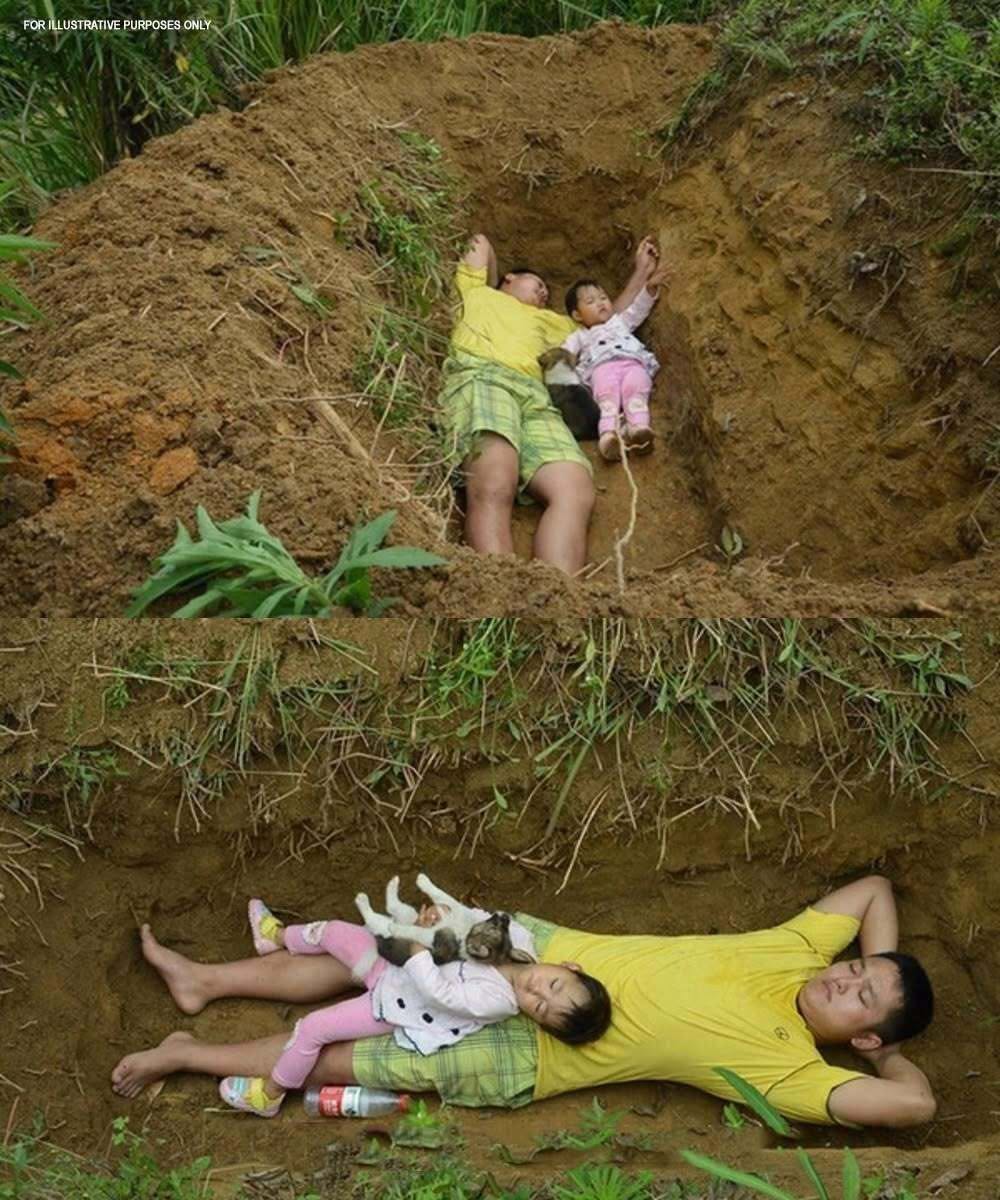
A young father was lying inside a shallow grave he had dug with his own hands.
Beside him was his two-year-old daughter.
The little girl was alive.
She was not attending a funeral, and her father was not burying her.
Instead, he was trying to prepare for the possibility that she might not survive a serious illness.
His name was Zhang Liyong, and his daughter, Zhang Xinlei, had a severe inherited blood disorder.
For nearly two years, the family had spent everything they could afford on medical treatment.
By the summer of 2017, their money was running out.
The father feared he might have to watch his daughter die because he could no longer pay for the care she needed.
His decision to dig a grave sparked widespread heartbreak, controversy, and disbelief.
But the story did not end with that photograph.
Years later, the grave would no longer be a place associated with an expected death.
It would become something entirely different.
And the little girl whose future once seemed uncertain would have a chance to grow up.
## A Little Girl Fighting for Her Life
Zhang Xinlei was born in 2015 in Sichuan province, southwestern China.
She lived with her parents in a rural community near Neijiang.
When she was approximately two months old, doctors diagnosed her with severe thalassemia.
Thalassemia is an inherited blood disorder that affects the body’s ability to produce healthy hemoglobin.
Hemoglobin is the protein inside red blood cells that helps carry oxygen throughout the body.
In severe forms of the condition, patients may develop life-threatening anemia and require regular blood transfusions.
For Xinlei, hospital visits became part of life at an age when most children were just beginning to explore the world.
Reports from 2017 described how she needed repeated transfusions to survive.
Her illness also left her vulnerable to infections and other medical complications.
While other children spent their days playing together, Xinlei’s childhood was frequently interrupted by treatment.
Her parents wanted to give her the care she needed.
But the cost was overwhelming.
## A Father’s Desperate Effort to Save His Daughter
At the time, Zhang Liyong was a young factory worker.
He worked at a glass factory and earned approximately 2,500 yuan a month, equivalent to roughly $370 at the exchange rates reported in 2017.
It was a modest income for a family facing major medical expenses.
According to contemporary reports, Xinlei’s treatment had already cost about 140,000 yuan, approximately $20,000 to $21,000.
The family had exhausted its savings.
They had borrowed money and received help from neighbors.
Yet the medical bills continued.
Every transfusion was essential, but the family’s financial resources were limited.
Zhang and his wife, Deng Min, faced an impossible-feeling situation.
They knew their daughter needed treatment.
They also knew that they could not simply create the money required to pay for it.
The struggle was not a lack of love or willingness to help.
It was a lack of financial resources.
And as their daughter’s condition remained serious, their options appeared increasingly limited.
## The Hope of a Stem Cell Transplant
For some people with severe thalassemia, a successful hematopoietic stem cell transplant can offer the possibility of a cure.
The treatment involves replacing the patient’s diseased blood-forming stem cells with healthy ones from a suitable donor.
However, the procedure is complex.
It requires specialist medical care, careful assessment, and appropriate donor compatibility.
Not every patient is eligible, and transplantation carries significant risks.
For Xinlei, doctors and her family considered transplantation as a possible way forward.
But her parents were not suitable donor matches.
The family eventually considered using stem cells from the umbilical cord blood of a younger sibling.
Deng Min became pregnant with their second child.
That pregnancy brought hope.
If the younger baby’s cord blood proved suitable, it might provide the opportunity Xinlei desperately needed.
But another obstacle remained.
Even if the medical team could proceed, the family still needed money for the treatment and associated care.
Their financial situation continued to deteriorate.
The possibility of saving their daughter’s life seemed close enough to imagine but difficult to reach.
## The Grave That Broke People’s Hearts
In June 2017, Zhang made a decision that would bring worldwide attention to his family.
He dug a grave on a piece of land belonging to them.
Then he brought his daughter to the site.
Photographs and footage recorded on June 23 showed him lying beside Xinlei inside the excavation.
The little girl was only two years old.
Reports described Zhang’s explanation: he feared that his daughter might die because he could no longer afford the medical treatment she needed.
He said he wanted her to become familiar with the place where she might eventually be buried.
It was an extraordinary and painful gesture.
To many viewers, the image appeared almost impossible to comprehend.
Here was a father who desperately wanted to protect his child but believed he was running out of ways to do so.
Some people interpreted his actions as an expression of helplessness.
Others questioned whether placing a living child inside a grave was appropriate.
The photograph provoked conflicting reactions.
But regardless of how people understood Zhang’s decision, the family’s medical and financial crisis was real.
And the images ensured that their situation could no longer be ignored.
## A Photograph That Reached Far Beyond the Village
As photographs and videos spread through Chinese media, the family’s circumstances attracted national attention.
Viewers learned that Xinlei was seriously ill.
They learned how much the treatment had cost.
And they learned that her father was struggling to afford further care.
Public reactions were mixed.
Some commenters criticized the decision to dig a grave while the child was still alive.
Others expressed sympathy and argued that the father was responding to unbearable circumstances.
Many people focused on the family’s immediate need for medical assistance.
The story reached charitable supporters, journalists, and members of the wider public.
What began as a heartbreaking scene in one village became a widely discussed account of the financial pressures facing families with severely ill children.
And that attention eventually produced a change.
## Strangers Stepped Forward to Help
As public awareness grew, people began offering assistance.
A crowdfunding effort helped raise money for Xinlei’s treatment.
Local government support also became part of the family’s medical funding.
According to later reporting, the attention generated by the family’s story helped make it possible to pursue the stem cell treatment that had previously seemed financially out of reach.
It was a significant turning point.
For months, the family had been struggling to pay for continuing care.
Now they had support from people far beyond their community.
The donations did not automatically guarantee a successful medical outcome.
Xinlei still faced a serious illness.
Doctors still needed to determine the most appropriate treatment.
But the family no longer faced every obstacle alone.
The possibility of a different future had begun to emerge.
## A Younger Sister Brought New Hope
In August 2017, Deng Min gave birth to the family’s second daughter.
The baby’s umbilical cord blood was collected and preserved for potential medical use.
The family had hoped that a younger sibling could provide stem cells suitable for treating Xinlei.
According to subsequent Chinese reports, doctors proceeded with a cord blood stem cell transplant.
The procedure reportedly lasted approximately eight hours.
Such treatment is medically complex, and a successful transplant requires careful monitoring afterward.
Patients may need continued specialist care because of risks including infection, graft-related complications, and other serious side effects.
For Xinlei, the recovery period was an essential part of the process.
But the family’s situation had changed dramatically.
Instead of preparing for what her father feared would be an early death, the family was now helping her recover from a potentially life-changing medical procedure.
## The Recovery That Changed Everything
Later reports described a remarkable improvement in Xinlei’s condition.
Her blood test results reportedly returned to normal ranges after the transplant and recovery period.
She no longer needed the monthly blood transfusions that had previously been necessary to sustain her life.
Her family continued focusing on her medical follow-up and rehabilitation.
A local businessperson was reported to have helped cover some of those continuing costs.
Meanwhile, the public interest that had initially surrounded the grave photographs did not completely disappear.
People who remembered the story continued wondering what had happened to the little girl.
For years, the original images circulated online without everyone knowing the outcome.
Some posts continued describing the grave without explaining that the child had survived.
That omission created a misleading impression.
The story was not simply about a father preparing to lose his daughter.
It was also about what happened after strangers responded to his family’s desperation.
## Where Is Zhang Xinlei Today?
In October 2025, a Chinese retrospective described Xinlei’s life several years after the original photographs.
She had grown into a school-age child.
The report described her as attending elementary school, enjoying drawing and dancing, and doing well academically.
Her mother said that medical checkups indicated she was in good health.
A further report by the *South China Morning Post* in August 2026 revisited the family’s story and confirmed the remarkable change in their circumstances.
The little girl who had once needed regular transfusions was no longer living the same life she had known at age two.
She was growing up.
She had interests, school activities, and ordinary childhood experiences.
The significance of that outcome is difficult to overstate.
In 2017, her father had feared he might not be able to keep her alive.
By 2026, reports were describing a child with the opportunity to enjoy the everyday experiences her parents had once feared she would never have.
## What Happened to the Grave?
Perhaps the most memorable part of the later reports concerns the place Zhang had dug in 2017.
The family did not leave it as a grave.
Instead, they filled it in and transformed the area into a flower garden.
Reports described sunflowers growing where the shallow excavation had once been.
According to the 2025 retrospective, Xinlei’s mother referred to it as her daughter’s magical garden.
The transformation carried a meaning that was immediately understandable.
A place created during a period of despair had become somewhere associated with life and growth.
The original photograph showed a father lying inside a grave with his daughter because he feared she would die.
Years later, the same family could look at a garden rather than an empty burial place.
It did not erase what they had endured.
It did not make the years of illness or financial hardship disappear.
But it became a powerful reminder of how dramatically their circumstances had changed.
## Why the Original Story Still Matters
There is a reason the 2017 photographs continue to affect people.
The images confront viewers with a parent’s fear of losing a child.
They also expose the devastating decisions families can face when medical care becomes financially inaccessible.
For Zhang and Deng, the challenge was not simply emotional.
It involved essential treatment, donor compatibility, household income, and the difficulty of finding sufficient resources.
Their story illustrates how the burden of serious illness can extend throughout an entire family.
Parents may have to change their work schedules.
Savings can disappear.
Daily routines become organized around hospital visits and medical appointments.
Even when a treatment exists, access may depend on circumstances beyond the family’s control.
The public reaction to Xinlei’s situation helped provide resources that made further treatment possible.
That does not mean every family receives the same help or experiences the same outcome.
But it shows why access to medical care and practical community support can matter enormously.
## Understanding the Illness Behind the Story
Severe thalassemia is not the same as ordinary iron-deficiency anemia.
It is a genetic condition that affects hemoglobin production.
Some people with thalassemia have mild symptoms and do not require intensive treatment.
Others have severe forms that can cause life-threatening complications without ongoing care.
Regular transfusions may help manage severe anemia, but long-term treatment can also create additional medical needs.
Stem cell transplantation offers a potentially curative option for certain patients.
However, it is not appropriate or successful in every case.
Doctors must consider donor suitability, the patient’s health, available medical resources, and the potential risks.
Newer treatment approaches have also expanded options for selected patients in some countries.
For Xinlei, the later reports attribute her recovery to a successful stem cell transplant using cord blood from her younger sibling.
Her reported outcome is extraordinary for the family, but it should not be interpreted as a guarantee that another child with thalassemia will experience the same recovery.
Every patient’s medical circumstances are different.
## The Detail Missing From So Many Viral Posts
Many people encounter this story through a single photograph or a short emotional headline.
They see the father.
They see the little girl.
They read that he dug a grave because he could not afford her medical care.
Then the post ends.
Without the later developments, readers may conclude that the child died.
But that is not what the updated reporting shows.
The original crisis occurred in 2017.
The family subsequently obtained assistance.
Xinlei received treatment and recovered.
And by 2025 and 2026, news reports described her as alive and in good health.
These details are essential.
Leaving out the ending turns a story of hardship, medical treatment, and survival into an incomplete tragedy.
The fuller account remains heartbreaking, but it also contains hope.
It demonstrates why older stories should be revisited before they are republished as though nothing happened afterward.
## A Father’s Fear and a Daughter’s Second Chance
It is impossible to know every private emotion Zhang experienced during those difficult years.
The public photographs and interviews provide only part of his family’s experience.
But the facts establish the seriousness of what they faced.
His daughter was critically ill.
The family could not afford the treatment she needed.
He dug a grave because he feared she might die.
And the public attention surrounding his actions helped bring assistance.
Nine years after the original photographs, the story had acquired a remarkably different ending.
Xinlei was no longer the two-year-old lying beside her father in a shallow grave.
She had grown into a school-age girl whose family reported that she was healthy and enjoying childhood.
The grave itself had been replaced by flowers.
**A father once dug that patch of earth because he feared he would have to bury his little girl. Years later, sunflowers grew there instead — and his daughter was alive to see them.**
That is the part of the story every reader deserves to know.