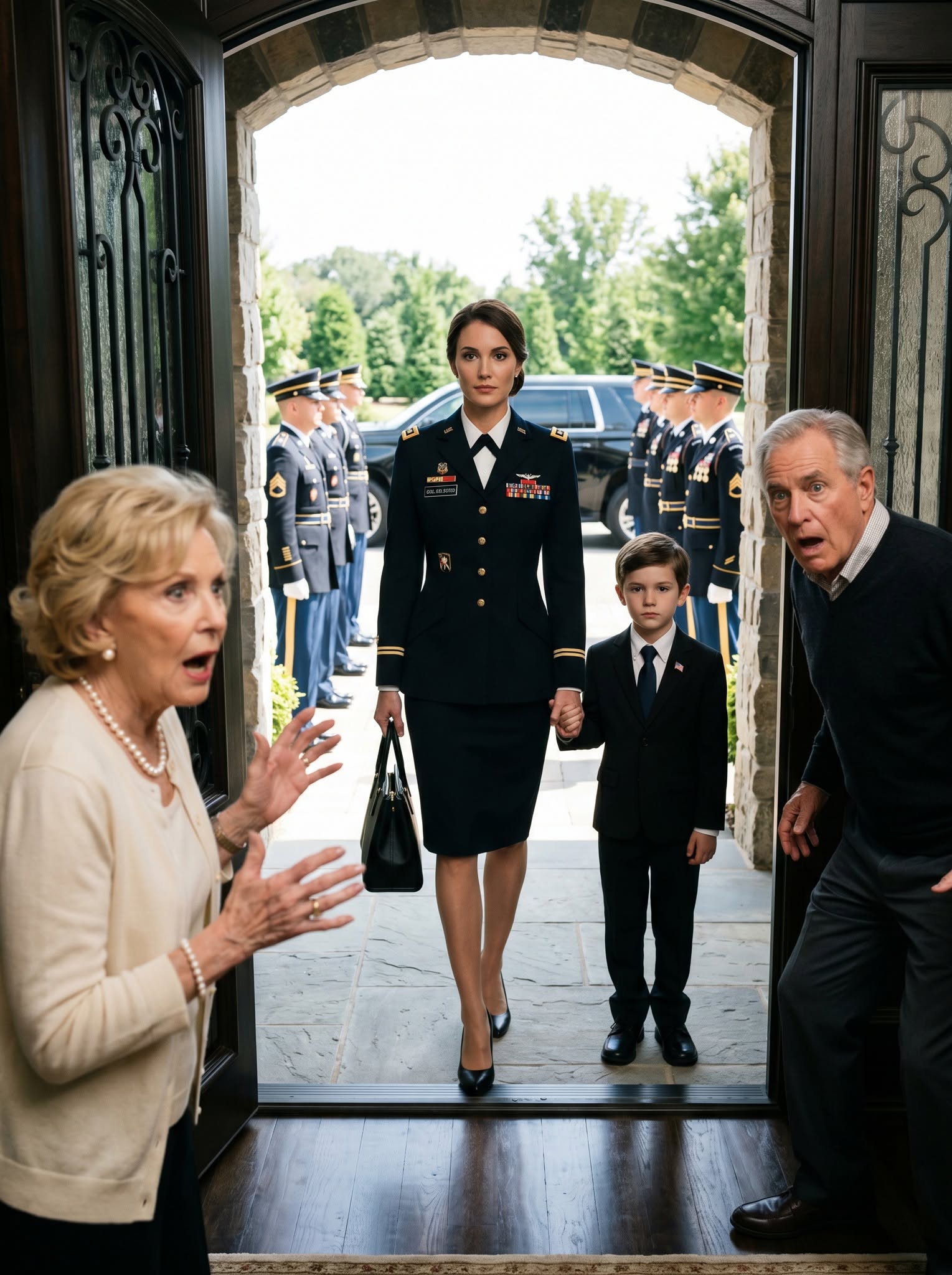
At exactly 2:13 a.m., my parents abandoned my six-year-old son and me on a freezing desert highway, convinced they’d gotten rid of us for good. My mother actually smiled as their car pulled away, and my father didn’t even look back. What they completely forgot was who they were messing with. The daughter they threw away had spent years as a senior military officer trained to survive the impossible—and by the time the sun came up, their perfect little plan was already self-destructing.
The Night They Left Us on Highway 95
The tires shrieked against the pavement when my father slammed the brakes on Highway 95 outside Beatty, Nevada. My son, Noah, lurched forward in the back seat and bumped his forehead against the seat in front of him.
For one terrified second, I thought we had hit something.
Then my father turned toward me with eyes colder than the desert night.
“Get out.”
I stared at him.
“What?”
“I said get out.”
Outside, darkness stretched for miles. The only light came from the headlights cutting across the empty highway. Less than twenty minutes earlier, we had passed a roadside sign showing 29°F.
“Dad,” I whispered. “Noah is still in the car.”
My mother turned slowly from the passenger seat.
Her makeup was perfect.
Her hair had not moved.
She looked at me as if I were a stranger asking for a favor.
“So?” she said.
Noah rubbed his sleepy eyes.
“Mom… what’s happening?”
Before I could answer, my father got out, yanked open my door, grabbed my backpack, and threw it onto the asphalt.
The zipper burst.
Clothes scattered across the road.
Noah’s asthma inhaler rolled underneath the truck.
“His inhaler!” I shouted.
My mother glanced at it for half a second.
Then she looked away.
That was when I understood.
This was not anger.
This was planned.
Earlier that evening, my father had insisted on holding my apartment keys so I “wouldn’t lose them.” My mother had slipped my wallet into her purse during a gas stop, promising to keep it safe. My phone battery had died because my father unplugged my charger hours before and laughed when I asked for it back.
They had not forgotten.
They had prepared.
My father tossed Noah’s dinosaur blanket into the dirt beside us and climbed back into the driver’s seat.
“Grandpa!” Noah cried. “Please don’t leave us!”
Neither of them answered.
The taillights disappeared into the dark.

The Camera in the Desert
For a few seconds, I wanted to collapse.
Instead, years of military training took over.
Control your breathing.
Protect the child.
Assess the environment.
Find resources.
I had survived survival school, brutal field exercises, and missions where every decision mattered. But none of that had prepared me for betrayal by my own parents.
I wrapped Noah inside my coat and checked him carefully. His forehead was bruised but not bleeding. His breathing was still steady, even without the inhaler.
Then I saw it.
About fifty yards behind us stood a state highway traffic camera mounted on a steel pole.
I remembered passing it seconds before my father stopped.
The lens pointed directly at the road.
It had seen everything.
The truck.
The license plate.
My father throwing our belongings onto the highway.
My mother’s silence.
Every second had been recorded.
I carried Noah to the shoulder and waited.
Ten long minutes later, headlights appeared in the distance.
A semi-truck.
I stepped forward, keeping Noah safely behind me, and waved both arms.
The truck slowed.
Then stopped.
The driver climbed down, looked at my shivering little boy, and immediately understood that something terrible had happened.
“Ma’am,” he asked quietly, “are you okay?”
For the first time that night, I told the truth.
“No.”
Within minutes, he wrapped Noah in warm blankets, gave me a phone charger, and called 911.
By sunrise, Nevada State Police had already secured the traffic camera footage.
The evidence was undeniable.
My parents thought abandoning us in the desert would erase us from their lives forever.
Instead, they abandoned the wrong daughter.
As I held Noah close and watched investigators review the footage, I realized this was not the end of our nightmare.
It was the beginning of theirs.

Part 2: The Clinic After the Highway
At the Tonopah emergency clinic, pale morning light slipped through the blinds while Leo sat on the exam table with a blanket around his shoulders and a paper cup of apple juice in his hands. The mark on his forehead had darkened, but the doctor said he was lucky: no concussion, no fracture, and his breathing was clear.
I stood beside him with one hand on his back, trying not to look like a woman whose own parents had left her child beside a desert highway before dawn.
“Mom?” he whispered. “Are Grandma and Grandpa mad at me?”
The question hurt worse than the cold ever had.
I knelt in front of him. “No, sweetheart. This was not because of you.”
“But Grandpa threw my blanket.”
“I know. That was wrong. But when grown-ups do wrong things, it does not mean children caused them.”
He studied my face, trying to decide whether he could believe me.
“Are we going home?”
I thought about my apartment keys in my father’s pocket, my wallet in my mother’s purse, and my dead phone charging across the room.
“Not yet,” I said. “But we’re safe.”

Part 3: The Officer and the Footage
A knock came at the door before a woman in a navy jacket stepped inside. Her badge read Sergeant Isabel Cruz, Nevada State Police. She had kind eyes, but her posture belonged to someone who did not waste time.
“Colonel Hayes?”
Hearing my rank in that clinic felt strange. I had not worn a uniform in months. To Leo, I was just Mom. To my parents, I had apparently become disposable. But to Sergeant Cruz, I was someone with a record and a name that could not be quietly erased.
“Retired,” I said automatically.
“Still earned.” She nodded. “May I speak with you outside?”
Leo looked up quickly.
“I’ll be right outside the door,” I told him. “Ms. Rosa will stay with you.”
In the hallway, Sergeant Cruz lowered her voice.
“We recovered the traffic camera footage. It shows the stop, your father removing your belongings, and the vehicle leaving. The plate is clear. The truck is registered to Robert and Elaine Hayes of Henderson.”
Their full names sounded like strangers’ names.
“Have they been contacted?”
“Yes,” she said. “They claimed you got out voluntarily during an argument and refused to get back in.”
I almost laughed. Not because it was funny, but because the lie was so neat and familiar. My father had always believed the first confident story became the official one.
“There’s footage,” I said.
“There is. That is why their statement is already a problem.”
Then she added that my parents claimed they believed Leo was staying with a neighbor.
I stared at her.
“They said that even after the camera showed him in the back seat?”
“Yes.”
A lifetime of excuses collapsed into something colder.

Part 4: Aunt Helen Was Not Dead
Sergeant Cruz handed me an evidence bag containing my apartment keys, my military ID, and my charger. My wallet was missing.
“My mother had it,” I said.
“They denied that.”
“Of course they did.”
Then Cruz told me my father had claimed he was driving us north so I could meet a friend.
“That’s not true,” I said. “We were going to visit my aunt.”
“Which aunt?”
“My mother’s sister, Helen Foster, near Carson City.”
Sergeant Cruz’s expression sharpened.
“Colonel, your parents told us Helen Foster died last year.”
The hallway went silent.
“My aunt called me three days ago,” I said slowly. “She sounded scared. She said she had something that belonged to me—something my mother should have given me years ago.”