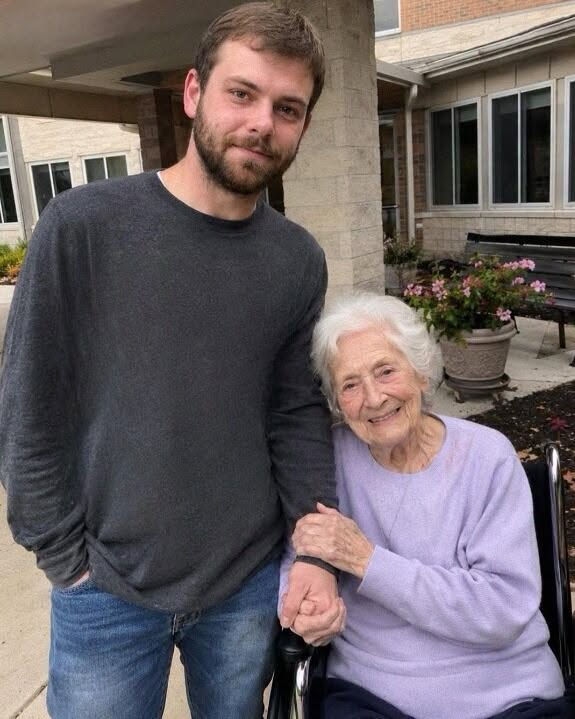
I never thought I would end up as a paid imposter, employed to take the place of a son who couldn’t bother to visit his own mother. My life was crumbling; I was overwhelmed with medical expenses for my ill mother, and my bank account was constantly screaming at me. Then, an unknown person handed me an envelope filled with cash to play a role: visit a woman named Rosie, who was suffering from dementia, call her Mama, and act like I was her family. It felt like a twisted game, but desperation has a way of silencing your morals. I accepted the job, believing it was merely business. I was mistaken.
Every weekend, I entered room 214 of the nursing home, my heart racing with the guilt of a criminal. The air was filled with the scent of antiseptic and wilted flowers, a harsh reminder of the fragile life I was pretending to inhabit. Rosie would sit by the window, a small, lonely figure yearning for a connection that had long since vanished. The first time I softly said, Mama, it’s me, she didn’t appear confused. Her face lit up with a warmth that felt like sunlight, and she reached for my hand with a grip that held more honesty than I deserved. I anticipated the emptiness of acting, but instead, I was met with an overwhelming sense of belonging.
She didn’t inquire about the world beyond; she wanted to know if I was eating, if I was sleeping, and if I was taking care of my heart. These were the questions no one had posed to me since my father disappeared and my mother’s health began its gradual decline. What started as a business arrangement quickly evolved into a real bond. I found myself visiting during my lunch breaks, bringing tulips on Wednesdays and chocolates on Thursdays, simply because I longed for the comfort of her presence. I wasn’t merely playing a role; I was healing.
Then, the inevitable occurred. The phone call from the nursing home came, and my world tilted on its axis. Rosie had passed away in her sleep. The director, her voice heavy with sympathy, informed me that she had left something for me. When I sat in that office three days later, holding a heavy, sealed envelope, the director looked at me with eyes that held more understanding than she revealed. She shared the truth: Rosie had known from the very first visit that I wasn’t her real son. She had realized it immediately, yet she chose to keep me in her life. She understood I was a fraud, but she valued my presence more than the biological son who had forsaken her.
Inside the envelope was a letter written in a shaky, beautiful hand. It was addressed to the boy who was not her boy. She explained that while her memory had been clouded by the fog of dementia, her heart remained crystal clear. She didn’t desire the man who shared her blood; she wanted the man who had the decency to remain. Also included in the envelope was a small brass key to a safety deposit box. The only stipulation she attached was that half of whatever I discovered inside had to be shared with the other residents of the nursing home—the forgotten souls who, like her, spent their days gazing at doorways that never opened.
The peace of her passing was fleeting. A few days later, her real son, Tim, pounded on my door, his face contorted with a mix of entitlement and buried guilt. He accused me of being a con artist and a predator, threatening me with lawsuits and destruction. He hadn’t visited her in years because he couldn’t bear to watch her fade, yet he was the first to arrive when there was a chance of a payout. The legal battle that ensued was excruciating. Tim’s lawyers portrayed me as a monster, but when the truth emerged—that he had been the one to hire me, that he had effectively outsourced his duty as a son—the judge saw right through his act.
During the hearing, Tim’s facade crumbled. When the judge inquired about his last visit, he broke down, confessing she no longer resembled his mother. He was a man fleeing from his own grief, but his sorrow did not excuse his abandonment. Margaret, a friend of Rosie’s from the home, testified how Rosie had referred to me as the boy who chose to stay. That phrase lingered in the courtroom like a verdict. The judge ruled in my favor, upholding the bequest and affirming the choice Rosie had made with her final act of agency.
When I finally opened the safety deposit box, it contained more than just money and bonds; it held a photograph of a young, vibrant Rosie cradling her infant son. It was a relic of a time before the bitterness, before the neglect, and before the long silence. I followed her instructions meticulously, dividing the assets to provide better care, special outings, and genuine comfort for the other residents. I watched as the funds transformed the lives of individuals who had been waiting for a reason to smile.
I still visit the nursing home every Saturday. I sit in the same chair where I once pretended to be Tim, but now, the pretense is long gone. I spend time with Margaret, we discuss the weather, we reminisce about Rosie, and sometimes we simply sit in the silence that is no longer lonely. I brought a bouquet of fresh tulips to the room last week and placed them in the sunlight. Gazing at that empty chair, I finally grasped the profound lesson Rosie had imparted to me. She taught me that life isn’t defined by those who share your blood, but by those who have the courage to show up. She had compensated me to act, but she ultimately taught me how to live. Her gift wasn’t the money in the vault; it was the quiet, enduring strength of choosing to stay.