Grief is a quiet companion that never leaves. For a year, it had been just my nine-year-old daughter, Ashley, and me, navigating the empty echoes of our two-bedroom apartment after my wife, Hannah, passed away. We were getting by, connected to the world through small routines and the memory of a woman who never encountered a stranger she didn’t wish to assist. I still find myself brewing coffee for two in the stillness of the morning, listening for the faint echo of Hannah’s voice amidst the ticking of the radiator. Money felt like a phantom, always disappearing before the month concluded, drained by the overwhelming medical expenses we had amassed in trying to keep Hannah with us.
Ashley inherited more than just her mother’s bright eyes and strong will; she also gained a heart that seemed too big for her petite frame. As Easter neared, she dropped her backpack by the door and made a proclamation that caught me off guard. She wanted to bake 300 cookies for the local homeless shelter, using every penny of her allowance and birthday money. When I questioned the enormity of the task, she gazed at me with a seriousness beyond her years and said, “I want to do it for people like Mom used to be.”
That statement lingered in the air like a tangible weight. I watched her retrieve Hannah’s old, batter-streaked recipe book from the top shelf. Hannah had spent time in that very shelter years before I met her, a secret she carried with dignity. She always told Ashley that you never truly understand what someone has been through until you sit with them. “Let’s sit with them, Dad,” Ashley implored. In that moment, the resilience and tenderness of my late wife were reflected perfectly in our daughter.
The kitchen soon transformed into a battlefield of flour and sugar. For three days, we toiled in a cloud of white powder. Ashley was the commanding officer, and I was her clumsy private, cracking eggs and sliding hefty bags of sugar across the counter. She used Hannah’s old heart-shaped cookie cutter, twisting her wrist with the precise technique her mother had taught her to prevent the edges from breaking. As we worked, she posed the questions I had been avoiding. She wanted to know why her mother had ended up in a shelter at nineteen. I had to share the truth: that her grandparents had been ashamed of her pregnancy and had cast her out into the cold with nothing. Ashley’s expression tightened with a mix of sadness and determination. She couldn’t comprehend turning away from family. She simply wanted the people at the shelter to feel a sense of belonging.
On Easter morning, we delivered the pink boxes. I watched from the lobby as my daughter moved among the residents, offering cookies and hugs. She whispered to a weeping woman that she wasn’t alone, her small voice carrying a strength that flour and sugar alone couldn’t provide. I felt Hannah’s presence in that space, a warmth that transcended the sterile atmosphere. It was the proudest moment of my life, a beautiful conclusion to a challenging chapter. Or so I believed.
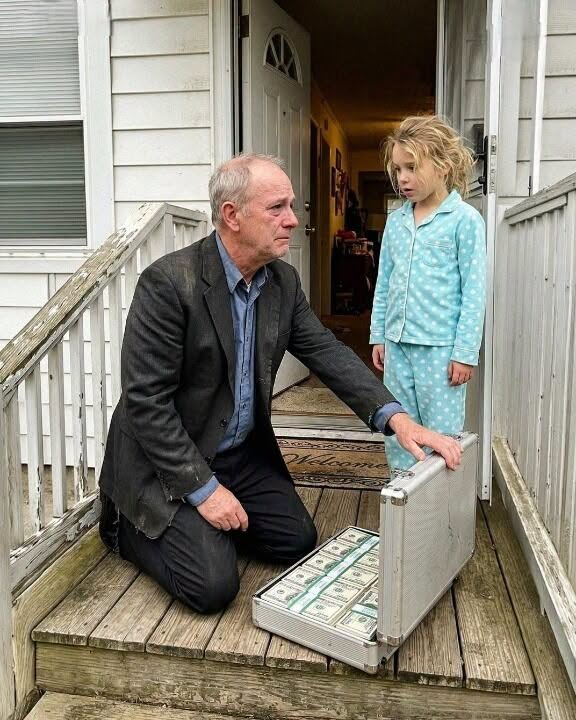
The next morning, the illusion of tranquility was disrupted by a knock at the door. I found a man standing on our porch, looking like a tattered shadow of a person. He wore a faded suit and clutched a scratched aluminum briefcase. He didn’t look at me; his gaze was fixed on Ashley, who was napping on the sofa. Without introducing himself, he placed the briefcase on our hallway table and flicked the latches. Inside were neat, thick stacks of hundred-dollar bills—more money than I had ever seen in my life.
My instinct was defensive. I asked who he was and why he was presenting us with a fortune. His voice was a gravelly rasp as he explained the condition: if I accepted the money, Ashley could never know who provided it. He revealed that he was the man who had ensured her mother had nowhere to go. The room felt like it was tilting. This was Richard, Hannah’s father. The man who had abandoned her when she needed him most was now standing in my hallway with a briefcase full of blood money.
I told him he couldn’t buy his way back or use my daughter as a vessel for his late-onset guilt. But Richard wasn’t seeking forgiveness; he seemed to be sinking under his own shame. He explained that he had been at the shelter the previous day. He had seen Ashley, recognized Hannah’s face in hers, and when he tasted the cookie she gave him, he recalled his own mother’s recipe. He had spent years saving that money, trying to locate Hannah only to discover he was too late for every significant moment. He wanted to give his granddaughter the future he had stolen from his daughter, as long as he remained a ghost.
As we argued in hushed, jagged whispers, Ashley woke up and wandered into the hall. Richard went pale, seeing the living image of the child he had abandoned. I quickly ushered her back to her room, my mind racing. Richard handed me a yellowed envelope before leaving the briefcase behind. It contained a letter from Hannah, written years ago but never opened by the man too cowardly to face his own reflection.
That night, after the house fell silent, I opened the letter. Hannah’s flowing handwriting jumped off the page. She had seen her mother’s funeral notice and had written to her father, offering a chance for redemption. She expressed that she had forgiven him long ago and didn’t want the past to bind her daughter to pain. She told him that if he ever returned “different,” he should give the love to her daughter that he couldn’t provide to her.
The words acted as a key, unlocking the anger I had harbored on Hannah’s behalf. I realized that keeping the secret wasn’t about protecting Richard; it was about honoring Hannah’s capacity for grace. I called Richard the following morning. We established a silent trust for Ashley—nothing extravagant, just a safety net for her future. There would be no visits and no sudden revelations. He would be a silent benefactor in her life, a shadow of support.
A month later, Ashley and I returned to the shelter to distribute muffins. As she laughed with the other children, her joy unburdened by the complexities of the adults around her, I realized that love is the ultimate heirloom. It gets passed down, sometimes bruised and altered, but it never truly loses its essence. Ashley would learn the truth one day, when she was mature enough to carry it. Until then, she would live the life her mother hoped for her—free from the chains of old ghosts, supported by a legacy of kindness that had finally, painfully, found its way home.