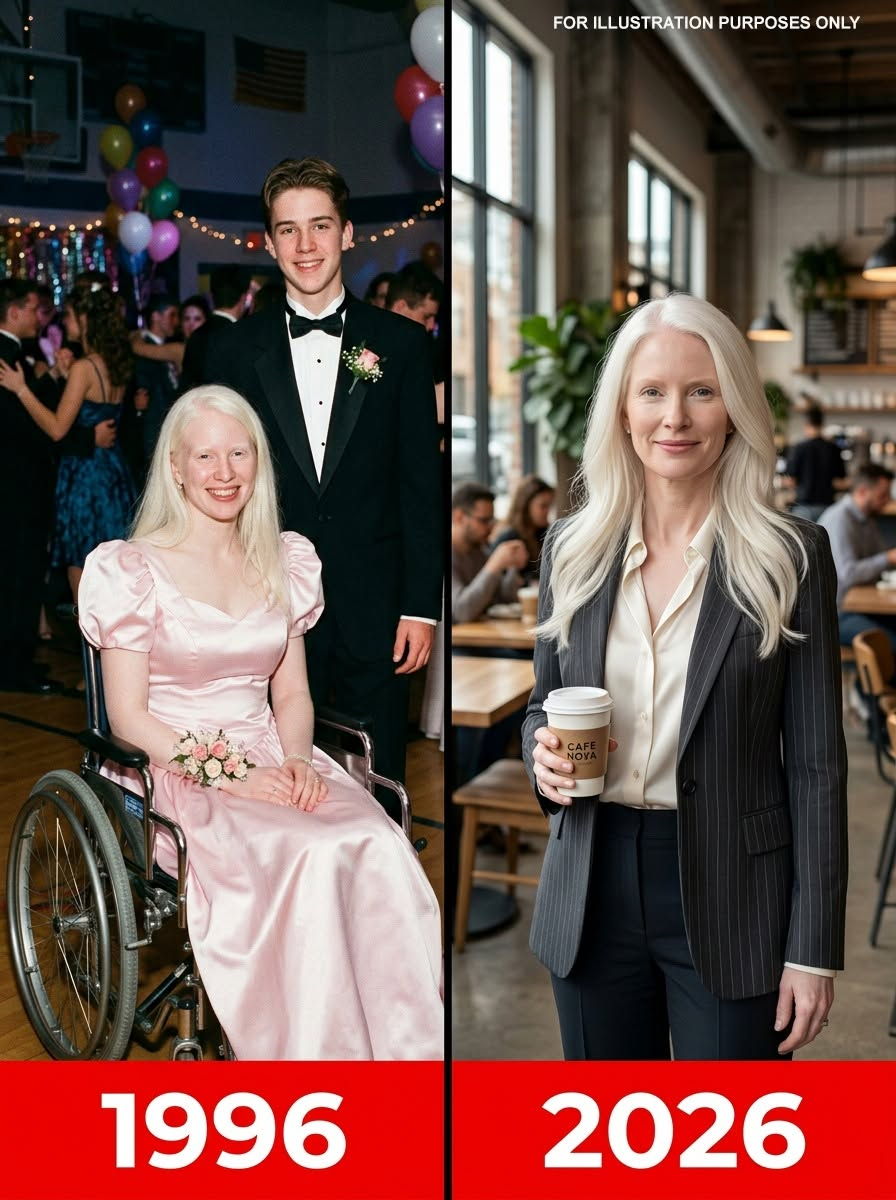
I never thought I would see Marcus again.
When I was seventeen, a drunk driver ran a red light and changed everything in an instant. One moment I was worrying about exams, dresses, and prom pictures. The next, I was waking up in a hospital bed while doctors spoke in careful, uncertain words around me.
My legs were broken in multiple places. My spine had been damaged. There were phrases like rehabilitation, uncertain recovery, and possibility that no teenager should ever have to hear about herself.
By the time prom came, I had already decided I wouldn’t go.
There was nothing left for me there—at least that’s what I believed.
But my mother wouldn’t let me disappear quietly.
“You deserve one night,” she said, standing in my doorway with my dress in her hands.
“I don’t want to be stared at,” I whispered.
“Then stare back,” she replied.
So I went.

She helped me dress, helped me into my chair, and brought me into a gym full of music, laughter, and movement that felt like it belonged to another world.
For the first hour, I stayed near the wall, watching everyone else live the version of life I thought I had lost.
People came and went. Smiling. Dancing. Forgetting I was there.
Then Marcus walked over.
At first, I thought he was talking to someone behind me. I actually turned to check.
He stopped in front of me and smiled.
“Hey,” he said.
I hesitated. “You’re in the wrong place.”
He laughed softly. “No, I think I found exactly where I’m supposed to be.”
Then he looked at me more seriously.
“Is it hiding if everyone can see you?”
Before I could respond, he held out his hand.
“Would you like to dance?”
My chest tightened. “Marcus… I can’t.”
He nodded once, like that was an answer he had already prepared for.
“Okay,” he said. “Then we’ll figure out what dancing looks like.”
And before I could protest, he pushed my wheelchair gently onto the dance floor.
The moment we entered, I felt every gaze in the room land on me.
“They’re staring,” I whispered.
“They were already staring,” he said. “This just makes it honest.”
That made me laugh despite myself.
He didn’t dance around me.
He danced with me.
He spun my chair slowly. Moved with the rhythm. Let the moment feel like something shared instead of something separated. For the first time in months, I wasn’t just something to be looked at—I was part of the room.
When the song ended, he rolled me back to my table and sat down beside me.
“For the record,” I said, still trying to breathe normally, “this is completely insane.”
“For the record,” he replied, smiling, “you’re smiling.”
After that night, he disappeared when my family moved for medical care.
Life became surgeries, rehabilitation, and long years of learning how to live inside a changed body. I learned how to transfer myself, how to move with braces, how to rebuild independence in pieces. I also learned something else: how quickly people move on when your life becomes inconvenient to understand.
College took longer. Everything did.
But anger stayed with me, and I turned it into architecture—into designing spaces that didn’t quietly exclude people like me. Buildings that didn’t assume everyone moved the same way through the world.
By the time I was fifty, I had built a career, a company, and a reputation for accessibility work that actually respected the people it claimed to serve.
And I thought that chapter of my life—the one with Marcus—was gone forever.
Until the day I walked into a café.
It was supposed to be a normal stop. I spilled coffee everywhere. Someone rushed over with napkins and a mop.
He was limping.
Wearing scrubs under a café apron.
Something about him felt familiar before I even understood why.
He looked up at me for a brief second and said, “Sorry… you look familiar.”
But he didn’t remember.
Not yet.
I came back the next day.
And the day after that.
Finally, I said it.

“Thirty years ago, you asked a girl in a wheelchair to dance at prom.”
His hand froze mid-motion.
Slowly, he looked up.
“Emily?” he said.
And just like that, time collapsed.
We talked.
He told me what happened after prom—how his life unraveled into survival. His mother became sick. Money became tight. Football stopped mattering. Everything stopped mattering except staying afloat.
“I kept thinking it was temporary,” he said. “And then one day I looked up and I was fifty.”
He wasn’t bitter.
Just tired.
But still kind.
Still him.
Over the following weeks, we kept meeting. Talking. Relearning each other in fragments.
I offered help. He refused it at first.
“That’s charity,” he said.
“It’s not,” I replied. “It’s opportunity.”
Eventually, he accepted a consulting role in an adaptive design project at my firm. Not because he trusted the offer—but because something in him trusted me.
His input changed everything.
He didn’t speak in theory. He spoke in lived experience. He challenged designs that looked perfect on paper but failed in real life. He reminded us that accessibility isn’t about compliance—it’s about dignity.
And slowly, something in him began to shift too.
He sought medical care he had ignored for years. His knee was treated properly for the first time in decades. The constant pain didn’t disappear, but it stopped defining every step he took.
One afternoon, he sat on the curb outside a clinic and said quietly, “I thought this was just my life now.”
I sat beside him. “It was your life. It doesn’t have to be the whole story.”
That was the turning point.
Not dramatic.
Just real.
From there, he began rebuilding—not just physically, but socially. He mentored younger people with injuries. He helped train staff. He became the kind of voice he once needed when he was younger.
And somewhere in all of that, we found each other again.
Not as teenagers.
Not as memory.

But as two adults shaped by time, loss, and survival.
One night, I found an old photo of us from prom and brought it to work without thinking.
He saw it and went quiet.
“You kept that?” he asked.
“Of course I did.”
Then, after a long pause, he said something I didn’t expect.
“I tried to find you after high school.”
My breath caught. “You did?”
“Yeah,” he said. “But life got small fast. My mom got sick. Everything else followed.”
I stared at him. “I thought you forgot me.”
He looked genuinely confused by that.
“Emily,” he said softly, “you were the only girl I ever tried to find.”
And something inside me finally loosened after thirty years of holding on without realizing it.
Now, we don’t rush anything.
We don’t try to rewrite the past.

We just live in the present—carefully, honestly, without pretending life was ever simple.
At the opening of our community center, music played in the main hall.
He walked up to me, just like he did all those years ago, and held out his hand.
“Would you like to dance?” he asked.
I smiled.
This time, there was no hesitation.
“We already know how,” I said.
And we did.