By the time prom came into my daughter’s life, our days had already shrunk into medication schedules, quiet mornings, and fragile hope we tried not to lose. I thought the hardest part would be watching her long for a teenage experience she might never fully have. I was wrong about that.
The steady hum of the oxygen machine had become the background of our home. Constant. Soft. Like a metronome marking time I didn’t want to count.
“I still want to go, Mom,” she said one day, running her fingers gently over the dress in a photo. “Even if it’s something close to it.”
“Do you think we can find one like that?”
“We’ll find something,” I told her.
After Brittany’s first hospital visit, everything began to shift.
Her phone vibrated under the blanket. She glanced at it, then quickly flipped it over.
“Brittany?” I asked.
Nora shrugged slightly. “Prom group chat.”
“What are they saying?”
“Shopping plans.”
She paused.
“They didn’t include me,” she said quietly, keeping her eyes on the photo. “It’s okay. I haven’t really been included in things lately.”
“I just wish I could at least see prom,” she added after a moment. “Just once. The lights, the music… I don’t even need to stay long.”
That wish stayed with me.
When I came back into her room, she was still holding the picture close.
I brushed her hair back gently. “Do you want to go?”
Before I could second-guess myself, I picked up the phone and called the school. I asked for the principal, Mr. Green. He listened without rushing me.
When I returned, she was still clutching the photo.
“What did he say?” she asked softly.
“He said yes.”
Her eyes widened. “Mom…”
“I mean it.”
“What if people stare?”
“Then they stare,” I said, sitting beside her and holding her hand. “We’ll make it a night worth remembering.”
The next evening, I was on her bedroom floor smoothing her dress over her knees.
She wiped her face, then hesitated. “Can I tell Jude?”
I looked up. “The boy from Wednesday?”
“He’s not just a boy,” she said softly. “He’s Jude.”
“Yes,” I said. “Tell him.”
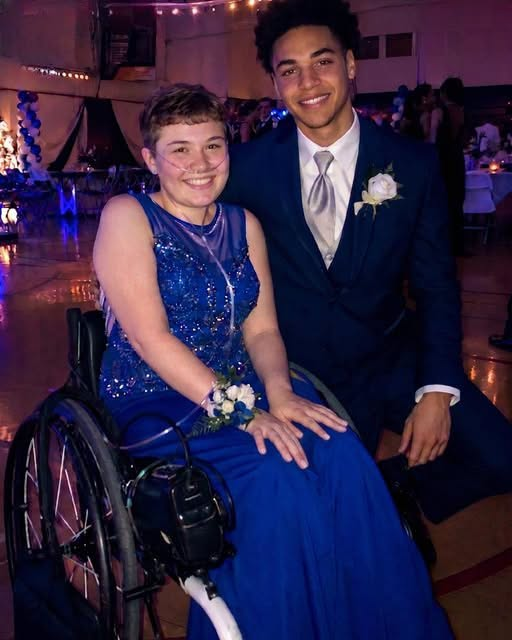
It wasn’t the exact dress from the picture, but it came close enough to make her smile. Soft blue fabric, a faint shimmer at the waist, oxygen tubing resting quietly against her skin.
In the car, she tapped along to the radio, trying to look calm.
“Do I look okay?” she asked.
“You look beautiful,” I said, fastening her bracelet.
I checked everything again—oxygen tank, backup tube, medication pouch clipped under her chair.
“Just in case,” I said.
“I know,” she replied gently.
When we arrived, the gym was glowing with lights and decorations that tried to feel like normal teenage life.
I lifted her chair from the trunk and helped her settle. The second we entered, conversations began to slow.
Whispers followed almost immediately.
Brittany stood with a group near the photos. For a brief moment, I saw something flicker across her face, then vanish.
Nora kept her chin raised.
She rolled forward slightly, watching everything with an expression I can still see clearly when I close my eyes.
I asked if she wanted punch. She shook her head.
Then the music shifted into a slow song. Couples drifted onto the floor. Nora stayed still, watching them, something quiet and heavy in her expression—less jealousy, more awareness of everything she’d been forced to miss.
Then I saw Jude.
He walked in through the crowd, nervous but determined, like someone who had already decided what mattered more than fear.
He stopped in front of her and smiled.
“You came,” he said.
“Of course I did,” she whispered.
He gently took the chair handles and guided her onto the floor.
Her eyes widened. “You really came.”
“I said I would,” he replied, offering his hand. “Dance with me?”
“With me?” she asked.
“With you.”
Something in her face changed completely.
“Okay,” she said softly.
He moved in front of her, took her hand, and they swayed slowly to the music. His other hand rested lightly over hers in her lap, steady and careful.
For a moment, she wasn’t a patient, wasn’t defined by illness—just a girl at prom.
Then someone’s voice cut through the room.
“Oh my God… Brittany, he actually did it.”
A phone lifted into the air. Recording.
Another comment followed, sharp and unnecessary.
Nora’s expression faltered slightly. Her fingers tightened around his.
Jude leaned in and said something quietly to her, never stopping the rhythm, refusing to let the moment be taken from her.
I started moving before I even realized it.
“Brittany,” I said.
The girl lowered the phone halfway.
“This is weird,” someone muttered.
Brittany stood stiff, caught between embarrassment and attention.
“Put the phone down,” I said firmly.
The girl hesitated.
Nora flinched slightly behind me. I saw it immediately. The shift in her smile. The way she tried to hold herself together.
That was enough.
I turned back toward her, but before I could reach her fully, Mr. Green stepped forward.
“Give me a moment,” he said.
“No,” I replied instantly.
He looked at Nora, then at me. “Just one minute.”
Before I could stop him, he took the microphone. The music stopped.
Silence spread across the gym.
“I need everyone’s attention,” he said.
Nobody spoke.
“Nora belongs here tonight. This is her prom too. That was never in question.”
The room stayed frozen.
Phones lowered. Eyes dropped.
“There will be consequences for what just happened,” he added calmly. “This isn’t something we ignore.”
Then he continued.
“A student came to me weeks ago asking how to make sure Nora had a real prom experience—not out of pity, but out of respect.”
His gaze briefly landed on Jude.
Jude returned to Nora’s side without ceremony.
“That’s what character looks like,” he said quietly.
Then he stepped away.
The DJ eventually restarted the music, softer this time.
Jude returned and crouched beside her.
“Still want to dance?” he asked.
She nodded through tears.
“Okay.”
I watched as he guided her again, slower this time, more intentional. A few students began returning to the floor. Not all at once. Hesitantly. Some avoided eye contact. Others looked ashamed.
No one interrupted again.
On the ride home, the lights of the gym faded behind us.
She leaned back, exhausted but peaceful.
“When he asked me to dance,” she said softly, “I forgot everything else.”
A pause.
“He told me about his sister,” she added. “That’s why he understood.”
I squeezed her hand.
“He’s a good one,” I said.
“He is.”
She looked out the window.
“For a little while… I felt normal again.”
At home, I carried her inside, settled her into bed, and turned down the light.
Before I left, I looked back.
Her dress lay across the blanket like a piece of sky. The oxygen tube rested against her shoulder, almost forgotten in the softness of the moment.
“Mom?” she whispered.
“I’m glad I went,” she said sleepily.
I stood there a moment longer than I should have.
“So am I,” I said.