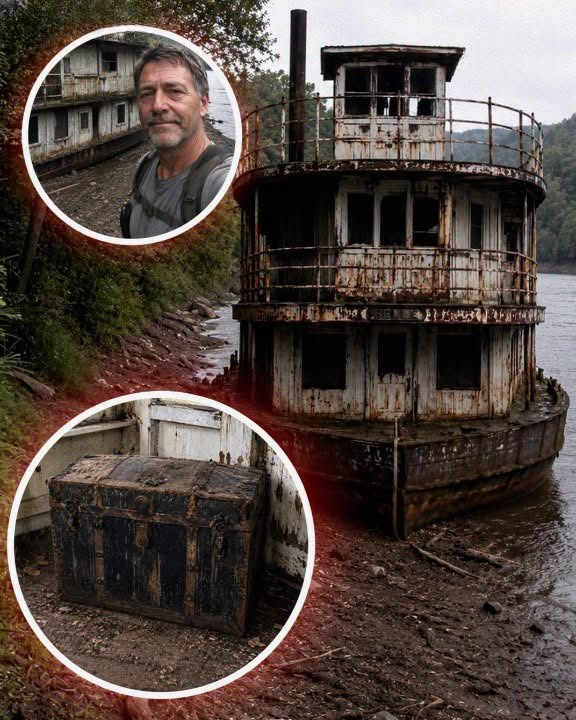
Michael headed into the forest hoping to find mushrooms and earn a bit of extra money. While walking along the riverbank, he noticed an old rusted boat. Something about it caught his attention, compelling him to stop and climb aboard.
I am forty eight years old, and for many years my life felt like something that had been broken repeatedly and patched back together in all the wrong ways.
My name is Michael. Three years ago, social services took custody of my youngest daughter. Before that happened, I lost my oldest child.
Before that, I lost my wife.
If you had met me recently, the first thing you probably would have noticed was my boots. They were worn, cracked, and always covered in mud. After that, you might have noticed the scent of dish soap from my evening job or the smell of motor oil from the repair work I did for cash.
I spent my days working construction. Three nights a week I washed dishes. On weekends, I wandered through the woods collecting mushrooms to sell to neighbors and to a man at the local market who consistently paid less than they were worth.
That was the routine of my life. Work. Debt. Endless paperwork. Supervised visits with my daughter Rosie under harsh fluorescent lights. Promises I continued making because I had nothing else left to offer.
My wife Sarah died twelve years ago.
She was seven months pregnant when a truck ignored a red light and crashed into her vehicle from the side. I was at home packing lunches when the police arrived at my door. I remember thinking they must have the wrong house. I remember one officer gripping his hat with both hands.
I remember hearing him say, “Mr. Turner, there’s been an accident,” and responding, “No, there hasn’t,” as though refusing to believe it could somehow change reality.
Sarah died that same day.
Our unborn son died with her.
Emily was ten years old at the time. Rosie was only five. During the first year after Sarah’s death, I learned how to braid hair poorly, fill out school paperwork in waiting rooms, cry silently in the shower, and stand in grocery store aisles calculating every dollar while pretending not to notice when my daughters quietly put items back on the shelf to help me save money.
Somehow we survived.
Not gracefully, but we survived.
Then Emily became ill.
At first there were bruises that appeared too easily and constant exhaustion. Then came the fevers. After that came blood tests. I still remember the doctor folding his hands together before speaking. That was the moment I knew something was terribly wrong. Nobody folds their hands before delivering good news.
Leukemia.
Emily was twelve when she received the diagnosis. She was fourteen when she passed away.
People often say things like, “She fought bravely.” And she did. But what I remember most is how conscious she became about money, as though she could see exactly what her illness was costing us.
One day during chemotherapy she tapped the pocket of my jacket and joked, “Did you really pay for parking again? Dad, that’s such a ripoff.”
I laughed because she wanted me to laugh.
Several months later she quietly whispered, “I’m sorry I cost so much.”
I stood so quickly that my chair scraped loudly across the floor.
“Don’t ever say that again.”
She flinched, not because she was frightened of me, but because she knew there was enough truth in the statement to hurt.
I sat back down and held her hand.
“Listen to me,” I told her. “I would sell the sky itself if I had to. You are not the problem.”
But love cannot defeat biology, and financial hardship cannot purchase miracles.
Emily died in March. The heating system rattled through the hospital vents while I sat beside her holding a cup of coffee that I never had the chance to drink.
After Emily passed away, everything that had been held together through determination and sheer willpower began to unravel.
I missed work.
Then I threw myself into work too much.
Bills started piling up faster than I could pay them. Rent fell behind. The electricity was eventually shut off, and Rosie missed a week of school after developing bronchitis while living in our cold apartment. Someone reported our situation.
Not long afterward, social services arrived.
The caseworker assigned to us was named Andrea. She was not cruel, which somehow made the entire situation hurt even more.
Standing in my kitchen with a clipboard in hand, she said, “Mr. Turner, this doesn’t have to be a permanent removal if you can stabilize your housing and income.”
“She has a bed,” I replied.
Andrea glanced toward the living room, where water stains marked the ceiling and plaster peeled away from one corner of the wall.
“She needs more than a bed.”
Rosie was standing in the hallway listening.
When the time came for her to leave, she wrapped her arms around me so tightly I nearly lost my footing.
“Daddy, please,” she cried. “I’ll be good. I promise I’ll be good.”
“It’s not because of that. Rosie, look at me.”
She was trembling too much to focus.
I held her face gently between my hands.
“I’m bringing you home. Do you hear me? This is not forever.”
She turned thirteen last month.
By then, the phrase “not forever” sounded like just another promise adults made when they did not know what else to say.
I rented a tiny room behind a mechanic’s garage and worked constantly.
Whenever weekends came around, I headed into the woods. Mushrooms were one of the few things nature still offered for free.
The Saturday I discovered the boat, I had just returned from a supervised visit with Rosie.
I brought her a used sketchbook along with a set of quality pencils that I could barely afford. She hugged them to her chest and smiled. For a brief moment, I saw the little girl she used to be.
Then she asked, “When do I get to come home for real?”
“Soon,” I answered.
She lowered her eyes toward the pencils.
“You always say that.”
I had no response that would not break both of our hearts.
The next morning, I wandered farther into the woods than usual. Part of me was searching for chanterelles. Another part was trying to escape my own thoughts.
Rain had fallen overnight. The ground was dark, wet, and slippery. Water dripped from the pine trees overhead.
I crossed the ridge where I normally turned back and kept walking until I heard the sound of a river.
I had never explored that section before.
The river was broad and calm, with thick reeds growing along its banks.
Half buried in the muddy shoreline sat a small rust-covered boat.
It looked ancient, as if it had been abandoned there for decades.
Corrosion had eaten away much of the hull. One of the windows was missing. The interior was covered with spray-painted names and faded dates left behind by visitors over the years.
Curiosity got the better of me.
I climbed aboard.
Part of me wanted answers.
Part of me simply wanted a distraction from everything else.
The boat groaned beneath my weight.
Inside, the air smelled of wet metal, rotting leaves, and years of neglect.
I checked beneath a bench and kicked aside scattered debris.
Nothing.
Just more signs that bored teenagers had explored the wreck before me.
I was preparing to leave when something caught my attention.
Near the back wall, hidden beneath layers of rust, was a square outline.
A hatch.
I pressed against it.
Nothing happened.
I planted my boot firmly, pushed with my shoulder, and suddenly the hatch burst open with a loud crack.
I cursed and stumbled backward.
Behind the hatch was a narrow compartment.
Inside sat a metal box wrapped in deteriorating oilcloth.
I froze.
My first thought was drugs.
My second thought was a weapon.
My third thought, embarrassingly enough, was that I had finally lost my mind and the forest had decided to start delivering mysterious prophecies.
The box was surprisingly heavy.
I carried it to a dry section of the floor and used my pocketknife to work on the rusted latch until it finally snapped apart.
When I opened the lid, I found several bundles wrapped carefully in wax paper.
Money.
Stacks of cash.
Beneath the cash sat a leather pouch filled with gold coins.
Under that was a metal tin containing documents protected inside old plastic sleeves.
I felt the blood drain from my face.
I looked over my shoulder even though nobody else was there.
“No,” I whispered. “No way.”
Inside the tin were faded letters, an old map, and a handwritten note.
The note read:
“If an honest person finds this, use it better than we did.”
Several names were signed at the bottom.
The letters suggested the money was connected to river smuggling operations from the 1960s. Two brothers had been involved. One was dead. The other may have ended up in prison. The cash had apparently been hidden after a deal went wrong.
You might think my first instinct was to take everything directly to the sheriff.
It wasn’t.
My first thought was Rosie.
I carried the box home and spread its contents across the table in my rented room.
I counted the money twice.
I will not reveal the amount because people tend to lose their minds whenever large sums are involved.
But it was enough to transform a life if used wisely.
Maybe several lives.
At the same time, I knew enough to understand that saying, “I discovered a fortune inside an abandoned boat,” sounded exactly like the kind of story that could land a poor man in serious trouble.
The only person I trusted was Walter, the owner of the pawn shop on Main Street.
Walter was the kind of man who insulted people using the same tone most people reserved for comforting friends.
I brought him one gold coin.
He examined it through a magnifying loupe, weighed it carefully, then looked directly at me.
“If you robbed a museum,” he said, “this would be a great time to tell me. I close at six.”
“I found it.”
“That somehow sounds worse.”
“In a boat.”
Walter stared at me.
“Did you hit your head?”
I told Walter everything.
He listened without interrupting.
When I finished, he walked to the front door, locked it, flipped the sign to CLOSED, and came back.
For a moment he simply rubbed his jaw.
Then he said, “Well, either God finally decided to throw you a lifeline, or trouble finally figured out where you live.”
“Very helpful.”
“I’m not trying to be helpful. I’m trying to be accurate.”
Walter gave me the name of an attorney in the neighboring county.
Denise Harper.
“She’s smart,” he said. “She’s also expensive and has all the warmth of a sharpened kitchen knife.”
As it turned out, he was absolutely right.
Denise listened to my story with the expression of someone trying very hard not to laugh at an obvious lie.
Then she examined the letters.
She checked dates.
She photographed everything.
Finally she leaned back in her chair.
“This is either a legitimate abandoned asset claim connected to a historical criminal matter,” she said, “or the most creative waste of my afternoon I’ve ever experienced.”
“Which one do you think it is?”
“I think that if you were capable of inventing something this elaborate, you wouldn’t be wearing boots held together with glue.”
That was our introduction.
The next three weeks became the most frightening and hopeful period of my life.
Denise filed reports.
She contacted government agencies.
She researched ownership claims.
She explained legal procedures in a way that somehow made me feel foolish every time I asked a question.
Meanwhile, Walter helped store the contents of the box inside a secure safe where nobody in town could stumble across it.
Then the first major obstacle appeared.
The riverbank where I found the boat belonged to a timber company.
Their attorney argued that anything discovered on that property might legally belong to them.
Denise responded so quickly that I was surprised the paperwork didn’t burst into flames.
Then another problem surfaced.
A man arrived claiming to be the grandson of one of the brothers mentioned in the letters.
He carried a dramatic story, questionable records from a family Bible, and far more confidence than actual evidence.
“Money has a funny way of creating relatives,” Walter muttered after I told him about the encounter.
For nearly a week, I barely slept.
Every time my phone rang, I expected Denise to tell me everything had been taken away.
At the same time, Andrea scheduled another review regarding Rosie’s case.
I arrived carrying proof of employment, records showing my savings, and documents demonstrating that I was actively securing better housing.
Andrea reviewed everything carefully.
“This is definitely progress,” she said. “But there are still concerns.”
“What concerns?”
She looked up from the paperwork.
“Your recent financial activity is unusual.”
My stomach sank.
Denise had warned me that disclosure would eventually become necessary, but timing mattered.
“It’s legal,” I replied.
“That remains to be determined.”
“I’m handling everything correctly.”
Andrea sighed.
“I’m not accusing you of wrongdoing. I’m simply telling you that the court will want certainty.”
Then she said something that nearly knocked the strength out of my legs.
“The foster family has requested consideration for long term guardianship if reunification continues to be delayed.”
For several seconds I could only stare at her.
Rosie’s foster mother, Janine, had always treated me respectfully.
She sent updates.
She made sure Rosie attended visits.
She genuinely cared.
I had been grateful for her kindness.
Now gratitude and panic collided inside me.
“Rosie wants to come home,” I said quietly.
Andrea’s expression softened.
“I know. But wanting something and being ready for it are two different things in family court.”
That night I sat alone in my room staring at the inventory list from the box.
For the first time, I wondered whether I had discovered a miracle too late to matter.
At nine thirty that evening, I called Denise.
She answered immediately.
“What?”
“They’re discussing long term guardianship.”
Silence.
Then her voice changed.
“Bring me every document from your case.”
“Now?”
“Yes. Tonight.”
I drove directly to her house.
When she opened the door, she was wearing sweatpants and an old college T shirt. Her hair was tied back. She wore glasses instead of her usual professional appearance.
For the first time, she looked less like a weapon and more like an exhausted human being.
She reviewed Andrea’s notes and muttered a curse beneath her breath.
“All right,” she finally said. “We stop waiting for perfect conditions. We prove stability immediately.”
“With what money? I can’t even touch it.”
“You can if a judge authorizes a managed advance against uncontested value.”
She rubbed her forehead.
“It’s messy. I hate this approach.”
“Then why do it?”
“Because I dislike family court even more.”
For the first time since meeting her, she smiled.
Only slightly.
But it was there.
The following week felt like a war.
Denise managed to secure temporary court approval for a limited release of funds while the larger ownership dispute remained unresolved.
Walter helped me locate a small two bedroom rental owned by one of his cousins.
I paid six months of rent in advance.
Walter’s cousin even replaced the broken stove, though I strongly suspect that happened only because Walter bullied him relentlessly.
Then disaster struck again.
Someone broke into my room behind the mechanic’s garage.
The mattress had been ripped apart.
Drawers were dumped onto the floor.
My cheap bedside lamp had been smashed.
The thieves never found the box because it remained secure in Walter’s safe.
But they stole my laptop.
They stole my cash.
Worst of all, they took the folder containing copies of Rosie’s drawings from school.
I stood in the wreckage and felt something dark rise inside me.
Walter came over shortly afterward.
He surveyed the damage.
“People found out,” he said.
“Who told them?”
He shrugged.
“This town leaks information like a cracked bucket.”
I leaned against the wall.
“I can’t keep doing this.”
“Yes, you can.”
“No. I mean I’m tired of surviving.”
Walter studied me quietly.
“Yeah,” he said. “That part I believe.”
Ironically, the break in ended up helping Denise’s case.
The police report strengthened her argument that I needed immediate access to safer housing and that delaying financial approval created unnecessary risk.
It was a terrible twist of fate.
But I accepted any advantage I could get.
Ten days later, Rosie’s hearing arrived.
I wore the only suit I owned.
It still fit as long as I remembered not to breathe too deeply.
Janine sat in the courtroom with Rosie.
Janine looked uncomfortable.
Later I learned that the guardianship request had been pushed primarily by the agency rather than by her personally.
Still, seeing her seated at the opposite table made my stomach twist.
The judge reviewed everything.
Housing.
Employment.
Counseling compliance.
The managed fund order.
The pending asset claim.
Debt repayment plans.
Then Andrea raised concerns regarding financial uncertainty tied to the unresolved asset proceedings.
For a moment, I genuinely thought I might pass out.
Before I could respond, Denise stood.
Before I could say a word, Denise rose from her seat.
“Your Honor,” she began, “my client has done everything this court asks of parents who are trying to rebuild their lives. He has maintained steady employment, secured appropriate housing, complied with every requirement placed before him, and acted lawfully by reporting an extraordinary discovery instead of hiding it. To punish him for being honest would be completely unreasonable.”
Denise could be cold when she wanted to be, but in that moment she sounded unstoppable.
Then something happened that none of us expected.
Janine spoke.
“Rosie loves her father,” she said quietly. “She talks about going home constantly. I care deeply about her, but I’m not here to replace him.”
The entire courtroom fell silent.
The judge turned toward Rosie.
“Where would you like to live?”
Rosie looked directly at me.
Her face tightened the way it always did when she was fighting back tears.
“With my dad,” she answered softly. “I’ve already lost enough people.”
I lowered my head because I could not let her see me breaking apart.
After reviewing everything, the judge ordered reunification with a two week transition period.
Not immediately.
Not perfectly.
But yes.
For me, those two weeks felt longer than the previous three years combined.
I painted Rosie’s bedroom myself.
Yellow.
When she was little, she always insisted yellow was the happiest color in the world.
Walter helped install shelves.
He complained during every second of it.
“I’m too old for this nonsense,” he grumbled while carrying lumber into the house.
“You said that three boards ago.”
“And I was correct three boards ago.”
Rosie started visiting more frequently.
Each visit lasted longer than the one before.
The first time she saw her room, she stood silently in the doorway.
She ran her fingers along the edge of the desk near the window.
“This is really mine?” she asked.
“If you want it to be.”
She turned toward me.
“You already put my sketchbooks on the shelf.”
“I figured that was a pretty safe guess.”
She nodded as though trying very hard to act older than she felt.
Then suddenly she rushed forward and hugged me so tightly that I almost dropped the lamp I was carrying.
The day she finally moved home for good, she arrived with one duffel bag, two milk crates full of books, and a small plant she claimed she was “fairly sure” she could keep alive.
That evening I cooked spaghetti.
Not because I was inspired, but because it was one of the few meals I could prepare without thinking about it.
Rosie sat at the table drawing while I stirred sauce on the stove.
After a while she looked up.
“So tell me the boat story again.”
“You still think I made it up.”
“I think it sounds completely fake,” she said. “But the fun kind of fake.”
For the first time in a very long while, I laughed.
Not the polite laugh I used when people expected it.
A real laugh.
The kind I had almost forgotten existed.
So I told her everything.
From finding the rusted boat to discovering the hidden compartment.
From opening the box to meeting Walter and Denise.
When I finally mentioned the handwritten note hidden inside the box, Rosie became quiet.
After a moment she said, “Maybe Mom and Emily convinced the universe to help you.”
I looked across the room at her through the steam rising from the pot.
“Maybe they did.”
After dinner, Rosie fell asleep on the couch.
A pencil was still resting loosely in her hand.
One sock had slipped halfway off her foot.
I covered her with a blanket and stepped outside.
The porch light cast a faint glow over the front steps.
Somewhere down the street, a dog barked twice before falling silent.
Through the front window I could see Rosie’s little plant sitting on the windowsill.
I could see the top of her head above the couch cushion.
And that was enough.
There was no dramatic revelation.
No perfect lesson.
No grand speech explaining the meaning of everything that had happened.
Just my daughter sleeping peacefully in our home.
A chipped yellow mug cooling in my hands.
And the memory of her laughter from earlier that evening lingering in the rooms as though it had been waiting years for the chance to return.
The legal process surrounding the money continued for several more months.
The timber company eventually withdrew its claim after Denise dismantled every argument their attorneys presented.
The man claiming to be the grandson of one of the brothers disappeared when asked to provide legitimate documentation.
Most of the cash was eventually released after the authorities concluded that no rightful owner could be established and no active criminal claim remained.
A portion of the money went toward taxes.
A large portion went toward debt.
Another portion was placed into savings for Rosie’s future.
For the first time in decades, I was able to breathe without constantly calculating what disaster might arrive next.
I reduced my construction hours.
I stopped washing dishes at night.
I started sleeping.
Really sleeping.
The kind of sleep that comes when your mind finally believes it can rest.
Rosie settled into her new school.
Her grades improved.
She filled sketchbook after sketchbook with drawings.
One afternoon she showed me a picture she had made of the boat.
The rusted hull.
The river.
The hidden compartment.
Everything.
At the bottom she had written:
“Sometimes lost things find people who need them.”
I framed it.
It still hangs in my living room today.
Every now and then people ask me whether I think finding that boat was luck.
Others call it fate.
Some insist it was divine intervention.
The truth is, I honestly don’t know.
What I do know is this:
A desperate man walked into the woods looking for mushrooms.
A father who felt like he had failed everyone he loved climbed into an abandoned boat.
And somehow, against every reasonable expectation, he found a second chance.
Not just for himself.
For his daughter too.
Maybe it was luck.
Maybe it was fate.
Or maybe life simply decided that after years of taking things away, it was finally time to give something back.