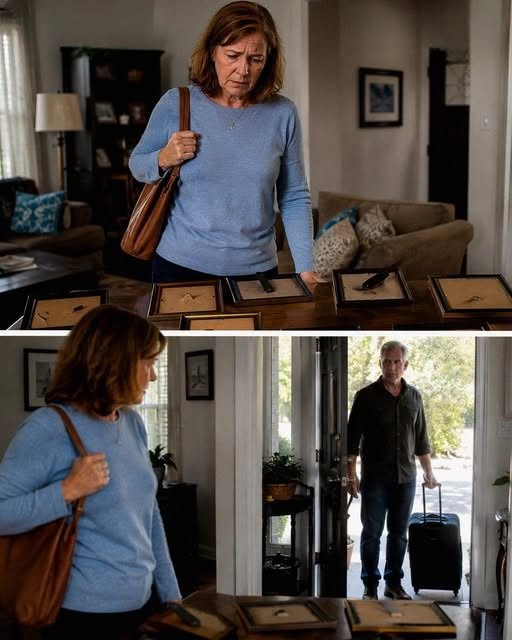
I was certain I was about to catch my husband in an affair. Every framed family photo in our home had been flipped face‑down, and when he finally arrived carrying a suitcase, he looked like a man hiding something. The real story was far from what I feared.
I noticed the moment I stepped through the front door. The house felt off in a way I couldn’t immediately name. I set the grocery bags down and my eye landed on the mantelpiece where a picture lay with its face to the wall.
I flipped it over. Our wedding portrait stared back at me.
A second later I found Melissa’s college graduation photo, also facedown. Then the next frame. Within minutes I moved through room after room and saw the same thing everywhere: vacation shots, the children’s portrait in the dining room, the picture by the sink Michael always joked was older than our marriage, even the collage above the staircase — every single frame turned over. Nothing else in the house had been touched.
I stood in the living room, trying to make sense of it. If someone had broken in, why only the photographs? If it was a prank, it wasn’t funny. If Michael had done this, I couldn’t guess why.
The sound of tires in the driveway pulled me to the window. A car door thudded, and moments later Michael came in carrying a dark leather suitcase. He froze at the sight of me, then glanced at the photos — or rather, at the empty spaces where their faces should have been.
“You turned them over,” I said, not really asking.
He tightened his hold on the suitcase. “I was going to explain.”
That bothered me. Most people lead with a reason. Michael simply confirmed it and moved on to say he’d explain. I looked properly at the case then — scuffed brown leather, brass clasps, a faded tag. I recognized it but couldn’t place it at first.
“What’s going on?” I demanded.
He looked away. “Can we sit down?”
“No.”
Something in his expression shifted, not to anger but to a kind of relief, as if he’d been bracing for this. That unsettled me more than anything.
“Why are all the pictures turned over?”
“I’ll tell you.”
“When?”
“Soon.”
“Soon?” I stared.
He set the suitcase down. “I just need a minute.”
A minute for what — to invent a cover, or to decide how much to admit? Lately I’d noticed Michael distracted and absent as if part of him had drifted elsewhere. Three weeks earlier he’d forgotten Melissa’s birthday dinner until we were on the way. A week later I found him sitting in his car out front for twenty minutes after work. When I asked, he said he’d been finishing a phone call though the radio was off and the engine cold. And then there’d been the sticky note tucked inside his wallet: two words, “Don’t forget.”
For twenty‑eight years we’d weathered job losses, miscarriages, debt, and the chaotic years when our kids tested every limit. Infidelity had never crossed my mind — until these small oddities. Now here we were, pictures face‑down and my husband dodging simple questions.
“You’ve been acting strange for weeks,” I said.
“I know.”
“Were you going to tell me why?”
“I was trying to.”
The answer landed badly, implying there was something to tell. I folded my arms. “Is there someone else?”
He closed his eyes, bracing. When he opened them he still didn’t answer. My stomach sank. I walked over and grabbed the suitcase.
“Please don’t,” he begged.
I ignored him. The case was heavier than I expected. Up close I saw the wear on the leather, the scratched brass, and my breath caught — I’d seen this suitcase years ago in Michael’s father’s garage. I knew it. I unlatched it.
Inside were stacks of paper: pamphlets, folders, brochures, some yellowed, some current. The top brochure read “Understanding Alzheimer’s Disease.” Another: “Memory Care Options for Families.” Another: “Support Resources for Caregivers.” I pulled out a rubber‑banded packet dated nearly twenty years back and recognized the name: Robert — Michael’s father. Diagnosis reports, medical notes, treatment suggestions — documents from the last years of his life.
Mixed in with the old papers were freshly printed brochures: a local memory‑care center, a neurology clinic, an assisted‑living facility. The pieces began to align.
“Why do you have these?” I asked, voice softer, baffled.
Michael sank into a chair and rubbed his hands as if trying to warm them. “Because I went looking for them,” he said at last.
“For what?”
“For answers.”
He picked up one of the folders. “After my father died I didn’t look at any of this. Not once. But a month ago I started noticing things.”
I catalogued the strange moments in my head — the missed dinner, the car outside our house, the sticky note. I had been searching for the wrong explanation.
“I forgot where I parked my car,” he said. “It took me forty minutes to find it.” He admitted he’d thought it was stress, then he forgot a client’s name. For Michael, a man who remembered old phone numbers and anniversaries without fail, these lapses were not trivial.
“I made appointments,” he said. “Then another. Then another.” He looked at the suitcase. “There was a diagnosis.”
The words landed, heavy and final. I stared at the papers and the brochures and everything looked different. The turned‑over photographs, the distracted silences, the sticky note — none of it pointed to another woman. The note had been meant for him.
“When?” I asked.
“A month ago.”
Four weeks of carrying this alone. I picked up an envelope near the bottom of the case with a neurology clinic return address and opened it. The letter inside was short, but the crucial line repeated in my head. I read it twice, then again until it stopped feeling like a foreign language.
“Why didn’t you tell me?” I asked.
He laughed softly. “I tried. About twenty times.” He’d rehearsed conversations that never happened, pictured my reaction, and stopped. “I thought you’d fall apart,” he said.
“I thought I would,” I admitted. The confession hurt because I understood it. His silence hadn’t been secrecy to shield someone else; it had been fear of exposing me to the future he dreaded.
He told me how he’d gone to his father’s storage unit that day to look through what Robert had kept after the diagnosis. Michael read his father’s old notes — questions, reminders, the shaky handwriting of someone losing ground. One line had been underlined: “Tell them while you still can.” Michael said he’d read it over and over.
Then he explained why he’d turned the photographs face‑down. That morning he’d stood where I was, picked up the wedding picture, and found he could no longer immediately recall the details. The image came back after five minutes. Then another photo, and another — delayed, uncertain memories slipping just out of reach. For someone whose mind had always been precise, every pause felt like failure. He’d been testing himself, measuring whether memory returned instantly. Every hesitation scared him.
“So why flip the pictures?” I asked.
“When I realized I was afraid of them,” he said simply. The honesty landed harder than any dramatic confession might have. For twenty‑eight years those photos had represented our shared life. For him they’d become exams he worried he would fail.
He’d spent hours reading his father’s notes, visiting facilities, comparing resources, trying to shape a plan for a future none of us knew how to predict. He hadn’t planned to move into one; he’d only needed to feel like he was doing something. The suitcase had become a timeline — his father’s final years and the possibility he might face something similar.
“I imagined scenarios,” he said. “What if it gets worse fast? What if I become a burden?” The last question hung between us.
“You are not a burden,” I said, and he looked up as if needing to hear it aloud.
We sat for a long time, going through the old notes and new brochures. When he finally handed me the little sticky note — “Don’t forget.” — and the hurried writing on its back: “Tell Kate tomorrow,” I realized he’d carried that instruction daily, deferring the moment of truth because “tomorrow” always seemed safer.
A real laugh surprised us both, a fragile thing after hours of fear. He reached for my hand. The future still frightened us: appointments, decisions, good days and hard ones. But the most terrifying thing hadn’t been the diagnosis itself. It had been the idea of facing it alone. For the first time in weeks, Michael wasn’t alone.
The next morning sunlight hit the wedding photo on the mantel. He looked up and smiled. “Hawaii,” he said.
“I know,” I answered.
He nodded, then added, quieter: “So do I.”
For the first time in a month, he wasn’t trying to carry that weight by himself. Somehow, that felt like a beginning.