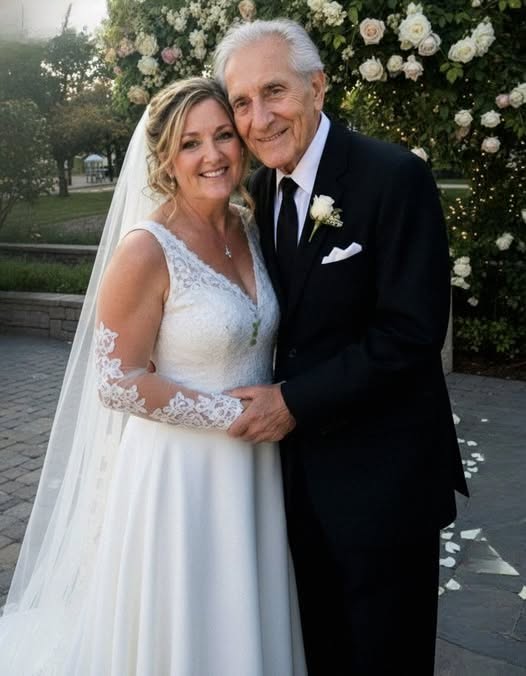
I believed my mother had dishonored my father when she married an 87-year-old wealthy man only a month after his funeral. I couldn’t stand seeing her smile again, or the way she moved forward, or the new ring on her finger. Then Harold appeared at my door with a letter from my father, and everything I thought I knew about love and loyalty collapsed.
My father had been gone for thirty-two days when my mother returned home with a faint smile.
After weeks of watching her drift through our small apartment like a shadow, even that expression felt like a betrayal.
I was sitting at the kitchen table surrounded by medical bills, my college withdrawal papers, and my father’s worn silver watch resting beside me.
Thirty-two days earlier, my father had died.
Cancer had taken him, then it took everything after him.
Our home, our savings, my mother’s wedding ring, and my future.
I had left college two weeks after the funeral and started working extra shifts at a diner, but it still wasn’t enough. The hospital didn’t care that he had been kind. The bank didn’t care about our grief.
Past due notices replaced everything else.
Cancer had taken him first.
My friend Parker sat across from me, nervously peeling the label off a bottle, a habit she had whenever she didn’t know what to say.
“You can’t stare those bills into disappearing,” she said quietly.
“And if I don’t look at them, they multiply,” I replied.
“Avery…”
“What?”
“You’re eighteen.”
“And the electric company knows that?”
Before she could respond, the door opened.
My mother stepped in carrying groceries, a faint smile on her face.
“Why are you smiling?” I asked immediately.
Her grip tightened on the bags. “I’m not.”
“Yes, you are.”
“It’s nothing.”
“Mom.”
She set the bags down slowly.
Parker spoke gently. “Aunt Rachel… what made you smile?”
My mother hesitated. “A man I met at the store. His name is Harold.”
The atmosphere in the room shifted instantly.
“A man?” I repeated.
“Avery, don’t—”
“After a month?”
Mom lowered her eyes. “Your father has been gone for a month.”
“I remember every moment he struggled,” she whispered.
That should have ended the conversation. It didn’t.
“So what, you meet someone near canned food and suddenly everything’s fine?”
“I’m not fine,” she said.
“You looked fine walking in.”
“For five minutes,” she replied. “Am I not allowed five minutes?”
She unpacked the groceries slowly. “I was putting back apples because we couldn’t afford them. He said his wife used to buy the same ones. That’s all.”
“Did he get your number?” I asked.
Silence.
My chest tightened. “Mom…”
“He asked me for coffee.”
“And you said yes?”
“Yes.”
“That’s a date.”
“It’s coffee,” she insisted.
“How old is he?”
“Eighty-seven.”
Parker blinked in shock.
I laughed bitterly. “You’re forty-six.”
“I know.”
“This is insane.”
My mother flinched slightly, but I couldn’t stop myself.
“What would Dad think?”
Her eyes filled with tears. “He would want me to keep living.”
“No,” I snapped. “He’d want you to remember him.”
She said nothing more and walked away quietly.
Parker stood up sharply. “That was too harsh.”
“She’s dating a stranger.”
“She’s grieving,” Parker replied. “So are you.”
I looked at my father’s old mug sitting on the table.
“I don’t want her to forget him,” I whispered.
“She hasn’t,” Parker said.
But I already knew she hadn’t forgotten. That somehow made everything harder.
Two weeks later, she called me into the kitchen.
Her hands were wrapped around a mug.
I noticed my father’s mug still on the counter.
“Harold asked me to marry him,” she said.
I froze. “Say that again.”
“He proposed.”
“You’ve met him three times.”
“Four,” she corrected.
“Even worse.”
“My father died a month ago,” I said.
“I know,” she replied softly.
“So how can you do this?”
“We have nothing left,” she said. “No home, no savings.”
“So this is about money.”
“It’s about survival.”
“You’re replacing him.”
“Nobody replaces your father,” she said firmly.
“Then don’t do this.”
Her voice broke. “I’m exhausted from pretending we can survive on pride.”
“I don’t want his money.”
“I know.”
“I want my dad.”
She covered her face. “So do I.”
The wedding happened that Friday.
A small courthouse room. Ten chairs. Silence everywhere.
My mother wore a simple dress. Harold leaned on a cane in a dark suit.
I wore black.
People whispered behind us. Judgment everywhere.
I said nothing.
After the ceremony, my mother approached me with tear-filled eyes.
“Can we take a photo?”
I looked at her ring. “I already have photos of you with my father.”
Her expression collapsed.
I left before the celebration ended.
That night, I sat alone in the dark wrapped in my father’s blanket, wanting answers I couldn’t find.
Then someone knocked.
It was Harold.
“I’m not in the mood,” I said.
“I didn’t come for your mother,” he replied.
He said he had something to give me.
An envelope from my father.
My hands shook as I opened it.
My father’s handwriting filled the page.
He told me not to hate my mother. To hate the situation. To hate what illness and debt had done to us.
I called my mother immediately. No answer.
I went straight to Harold’s house.
She opened the door.
“Did you know?” I asked.
“Yes,” she whispered.
“Why didn’t you tell me?”
“Your father asked me not to.”
“Why?”
“Because he knew you’d react like this.”
I turned to Harold. “Is this real?”
He nodded.
“I cared for her in hospice,” he said quietly.
The truth unfolded slowly. My father and Harold had known each other indirectly. My father had arranged everything before he died.
The marriage wasn’t betrayal. It was structure. Protection.
Even my education had been secured through a separate fund.
None of it was what I expected.
But it didn’t erase how I felt.
Later, I sat in a lawyer’s office. Everything was explained: protection clauses, financial separation, exit options.
Harold wasn’t taking anything. He was covering what we had lost.
It wasn’t manipulation. It was planning.
Still, shame lingered.
At a family lunch days later, insults came quickly. My mother was treated like an outsider.
I stayed quiet until I couldn’t anymore.
I spoke about bills, hospital debt, and sacrifices no one else had made.
Silence followed.
Then I apologized to my mother. For judging her without understanding.
She cried quietly.
“I didn’t know how to tell you,” she said.
I believed her.
Over time, everything settled into something new. Not perfect, not traditional, but stable.
Harold never replaced my father. He filled a gap my father had carefully prepared for.
And slowly, I realized the truth I had missed from the beginning:
My father hadn’t been taken from us completely.
He had been trying to make sure we survived after he was gone.