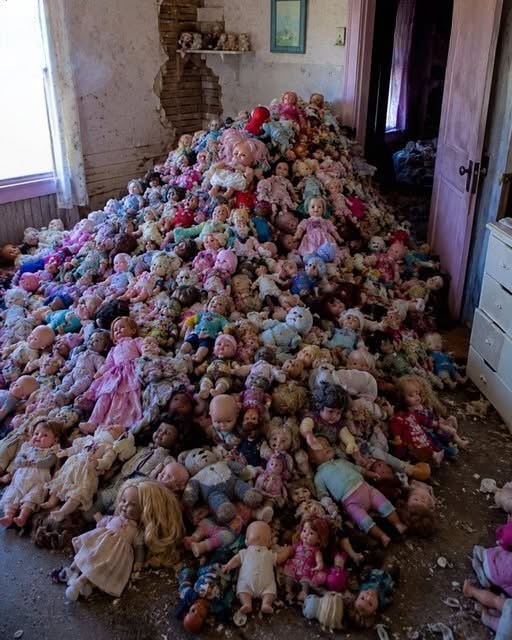
I only went out for a walk to clear my head, but I ended up inside a crumbling house where an upstairs room held hundreds of dolls and a story that felt like it was waiting just for me.
I’m thirty‑two, single, and my life is—by my usual description—quiet.
When people ask, that’s what I say. Quiet sounds intentional, not lonely. Quiet sounds like a choice, a crafted peace, rather than the result of years of small letdowns, missed chances, and friendships reduced to polite holiday messages.
My name is Maria, and for the past while I’ve taken long evening walks to untangle my thoughts.
I started wandering after my last relationship ended. At first I could barely stay inside my apartment; every corner reminded me of someone who no longer called, no longer left a toothbrush on the sink, no longer asked how my day went. One block became three; three became habit. By spring I knew which porches had wind chimes, which stoops smelled of cigarettes, and which dogs barked before I reached them.
That night the air bit colder than I expected. The sky was a deep blue, not quite black, and the streetlights were blinking on. I left after dinner in an old gray coat and sneakers that weren’t built for miles but had carried me far enough.
I passed the bakery wiping its window, the laundromat smelling of detergent and hot metal, then turned down a street I usually avoided—the older neighborhood with houses set back, tall trees, and long shadows.
Some were gracefully worn, porches bowed, cracked stone steps, stained glass that must have been lovely in sunlight. One house at the end of the road stopped me.
It squatted behind a rusted fence, half choked by weeds. Taller than the others, three stories high, its white paint peeled and windows dark like closed eyes. The porch sagged. The roofline dipped as if the house were tired of standing.
Something about it tugged at a childhood memory—the curiosity kids have about abandoned places. Back then we dared each other to peek into cracked garages and clamber over barn fences. We didn’t want to steal; we wanted to imagine who’d lived there and what they’d left behind.
At thirty‑two, curiosity usually wears caution and bills and common sense. I knew better than to go into a neglected house at night. Any sensible woman would keep walking, lock her door, make tea, and watch something safe. But I stood there as if the house had called my name.
“Don’t be ridiculous,” I told myself. My voice sounded too loud in the empty street. Still, I followed the overgrown path. Branches scratched my coat; dead leaves crunched beneath my feet. I kept looking back, half hoping someone would stop me and ask what I was doing so I could laugh it off.
No one did.
The front steps groaned. The door looked worse up close—swollen wood, cracked finish, a cold brass knob. I expected it locked. It wasn’t. It opened with a long, aching creak that made my heart leap. For a moment I waited, braced for an alarm or a raccoon or a shout. Nothing. The house smelled of dust and old wood and forgotten things. I stepped inside.
My sneakers left faint prints on dusty floorboards. The entry opened to a wide hall with a staircase and doorways into shadowed rooms. No furniture, no rugs—only faded rectangles on the walls where pictures once hung. Imagining the people who lived here nearly filled the empty rooms: a Christmas tree by the window, a long Sunday table, a woman at the sink with flour on her hands. In my mind the house breathed again.
I should have left after the first floor. Instead I climbed the wobbly staircase. The second floor was colder; doors stood open like waiting mouths. One room had faded blue wallpaper, another a cracked mirror reflecting only dark.
Stopping felt harder than moving. Then I opened a door near the back and froze.
The room’s center was a mountain of dolls—hundreds of them. Porcelain faces with painted cheeks, plastic baby dolls with cloudy eyes, worn rag dolls, some missing limbs, one bald, another in a tiny yellow dress thick with dust. No bed, no dresser—only that mound sitting like an offering.
My skin prickled. I stepped closer, telling myself they were just toys. Still, my mouth went dry. As I bent to look, a voice came behind me.
“I put them here.”
Every muscle tensed. I spun. An old woman stood in the doorway, hand on the frame as if to steady herself. Small, perhaps late seventies, pale blue cardigan buttoned to the throat, silver hair in a loose bun. Her eyes were bright and very tired. For a beat neither of us spoke. I stumbled backward, almost into the dolls.
“I’m sorry,” I blurted. “I didn’t know anyone lived here.”
“No one does,” she said.
That didn’t comfort me. I eyed the dark hallway, plotting escape speed. “I shouldn’t be here. I’ll go.”
“You found them,” she said softly.
She approached the pile and knelt, picking up a small doll in a red dress, brushing dust from its cheek. “My name is Soraya,” she said. “This was my house.”
“You lived here?” I asked, taking in the emptiness.
“For forty‑one years,” she replied with a faint smile. “My husband hated the peeling paint, but I loved every crack.”
“And the dolls?” I asked.
“They belonged to the children who passed through,” she said, voice folding into the dust. Her fingers tightened on the doll. “We were foster parents. The county brought kids here—some for a night, some for years, some with nothing but the clothes on their backs. I gave each child a doll on their first night. Not always pretty, not always new, but something that belonged to them.”
The room chilled. I sank to the floor, the dust climbing my jeans. “How many?” I whispered.
“Two hundred and seventeen.” She smiled sadly. “My husband used to say this house never slept. There was always somebody crying, laughing, breaking a plate, asking for pancakes, refusing to brush their teeth.”
I nearly smiled with her, but the ache in her voice held me still. “Why leave them here?” I asked.
Soraya looked down. “Some took their dolls when they left. Some didn’t. The ones left behind weren’t trash; they meant a child had been here. Each one had a name.”
She lifted a doll with one missing eye. “This belonged to Stacy. She was four and screamed when doors closed because it reminded her of being locked away.” She found a soft brown bear. “This was Devon’s. He pretended he was too old, but he slept with it under his shirt.”
I listened as the room transformed from eerie to sacred. “You remembered them all?” I asked.
“I tried,” she said. “Foster kids are easy to forget. They move through files and homes. I couldn’t control where they went, but I could remember that they were loved here.”
I asked why she’d left. Her answer was simple: her husband died, she fell ill, and her daughter moved her into assisted living. “She said I was too old to keep this place,” Soraya said with a small laugh. “Maybe she was right.”
She reached into her cardigan and produced a folded note. “They’re tearing the house down next week. I came tonight to say goodbye.”
“You came alone?” I asked.
“I had to,” she said, and her voice broke.
Without quite thinking, I touched her hand. “You shouldn’t have to do that alone.”
She looked at me fully then, tears coming to her eyes. “A house is wood and nails until children fill it,” she whispered. “Then it becomes arms.”
I asked what would happen to the dolls. Her lips trembled. “I couldn’t choose which to take.”
“We don’t have to choose,” I said. “I work at the community center on Oak. We can clean them, photograph each one, attach a note about the child they belonged to. Some can go to kids who need comfort now.”
Soraya’s hand flew to her mouth. “And the broken ones?”
“We keep them,” I said. “They mattered.”
Her smile came, full and relieved. Over the next two days I returned with boxes, masks, cloths, and volunteers from the center. Soraya sat in a folding chair and told stories: Stacy, Devon, Maribel, Jonah, Nina—children who arrived frightened and left with a small piece of belonging. We cleaned, mended, and recorded every doll.
By the time the city crews arrived, the room was empty—not abandoned, but emptied by care. A month later we opened “The Room That Remembered” at the community center. Restored dolls sat in baskets for children entering foster care, each tagged: “You are not forgotten.”
Soraya came to the opening in her pale blue cardigan and held my hand through it. “You gave them a future,” she whispered.
“No,” I told her, watching a little girl pick the red‑dressed doll. “You did that first.”
That night I didn’t walk to escape my life. I walked because for the first time in a long while I wanted to go somewhere. The real question I kept with me was this: when you find something unsettling in a forgotten place, do you turn away, or do you stay long enough to learn the story, honor the lives behind it, and be part of remembering?