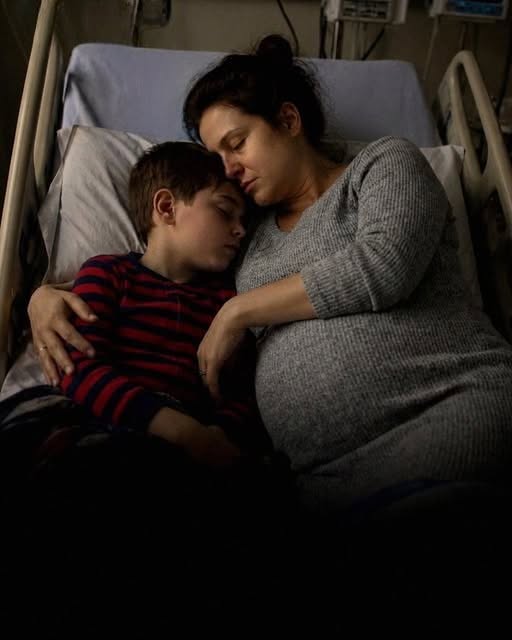
People assume that when confronted with an impossible decision, they’ll somehow instinctively know the right path. I believed that too—until one night I sat surrounded by doctors while both my children’s lives trembled in the balance.
I never imagined at 41 I’d be forced to choose between my unborn baby and my eight-year-old son.
When I look back, I can pinpoint the exact instant everything shifted.
Not the sterile room, the clinician’s clinical lines, or the consent forms stacked for my signature. It was a single syllable.
Her.
One tiny word that changed the fetus inside me from being Micah’s last hope into my daughter. Suddenly, the already unbearable choice grew even crueller.
Two years earlier, our world looked entirely different.
Micah was six when leukemia entered our lives.
Before illness, he was a perpetual motion machine. He built elaborate blanket forts in the living room, hoarded curious rocks, and asked more questions in an hour than many adults do in a week.
“Why don’t woodpeckers get headaches?”
“Can fish feel thirsty?”
“If astronauts sneeze in space, where does it go?”
His curiosity filled every corner of our home.
The diagnosis arrived on a wet Tuesday afternoon. At first, we thought it was just the flu. Then bruises surfaced, then blood tests, scans, and a specialist appointment. Every test tightened the knot in my chest as we edged closer to a truth I wasn’t ready to accept.
I recall the doctor’s face as she sat across from my husband, Caleb, and me. Her look said more than words would.
No one is prepared to hear:
“Your son has leukemia.”
The next two years blurred into an endless cycle of hospitals, treatments, and alternating hope and heartbreak.
Chemotherapy first.
Then stronger chemo.
Then experimental treatments.
Each time a therapy raised our hopes, we dared to believe; each time it failed, we picked up the pieces and tried again.
Through it all, Micah showed an astonishing courage.
Once, while an IV dripped into his arm, he glanced up and asked, “Do you think cancer ever gets tired of losing?”
I blinked. “What do you mean?”
He shrugged. “Because I keep fighting it every day.”
I turned away so he wouldn’t see me weep.
At eight, the doctors called us back to that dreaded conference room.
By then, we knew that room intimately. It was where lives changed and where parents brace for the worst.
They told us a bone marrow transplant was Micah’s best shot.
Relief lasted about five minutes.
Then the obstacle appeared.
Neither Caleb nor I matched.
No relatives matched.
No registry matches.
Weeks melted into months with no luck. One afternoon, Micah’s specialist raised another option.
A future sibling. Sometimes a newborn sibling could provide a suitable donor. I stared at the doctor, then at Caleb.
We drove home in a silence heavy with meaning.
Both of us understood what had been proposed.
Months of painful conversations and guilt followed before we decided to try. We did want another child, and after all we’d endured, it felt wrong to shut that possibility down.
If that child could save their brother, how could we ignore it?
I became pregnant soon after turning 40, and hope crept back into our house.
The pregnancy went well. Each appointment offered cautious optimism; every healthy scan felt like a little miracle. Meanwhile, Micah kept fighting.
By month seven, we had a fragile routine: hospital stays, school when Micah could manage, doctor visits, prenatal checkups, and the daily work of holding on.
Then one night, everything unraveled.
I woke with a searing pain twisting through my belly.
At first, I blamed an awkward turn in bed.
Another wave hit.
Stronger.
By the time Caleb switched on the lamp, I could barely breathe through it.
Within an hour, we were in the emergency department.
Doctors moved fast around me, nurses hurried, machines beeped, voices meshed into white noise. The room felt wrong.
Every concerned look exchanged among the staff tightened the knot of dread.
A maternal-fetal specialist sat by my bed, her face familiar from other hard conversations.
“You’ve developed severe complications,” she said softly.
My chest dropped.
“What does that mean?”
“It means there’s a high risk of premature labor.”
I laid a shaky hand over my belly.
“And the baby?”
Her pause was its own terror.
“If labor begins now, survival would be unlikely.”
I closed my eyes.
Seven months.
So close, but not yet there.
Before I could absorb that, the door flew open.
Micah’s oncologist rushed in; doctors don’t sprint unless something dire is happening.
His face was ashen.
“Micah’s condition has worsened quickly.”
My heart pounded.
“How bad?”
He and the specialist exchanged a look.
Silence answered first.
“Very bad.”
Caleb gripped my hand. “Tell us.”
The doctor swallowed. “We’re seeing signs of organ involvement.”
The room spun. I whispered, “Then save him.”
No one replied.
The silence widened until the doctor spoke words I will never forget.
“Not without the transplant.”
I looked everywhere but at the truth in front of me.
“How long?” Caleb asked.
His voice broke. “Maybe days.”
My breath left me.
Days? After two years of fighting, this could come down to days.
The specialist leaned closer.
“There is one option.”
I already knew what she meant.
Even before she finished.
“If we induce labor, we might be able to harvest the stem cells Micah needs.”
My stomach tightened.
“And the baby?”
No one answered.
“TELL ME.”
The senior doctor lowered his gaze.
“The baby might not survive.”
The room dropped into stunned silence.
A nurse burst in and whispered into Micah’s doctor’s ear. His face shifted; the monitor data she carried was not good.
He faced us. “You have to decide now.”
“Her or him.”
I froze.
Her?
The word landed like a blow.
“Her?”
The doctor blinked, surprised. “We… thought you knew.”
Knew what?
They had determined the baby’s sex during emergency scans; they simply hadn’t told us.
“You’re having a daughter.”
Not an abstract donor, not a possibility—the baby was suddenly a little person. That made the choice excruciating. I clutched my belly and broke down.
For months, every appointment, every prayer, every fear had revolved around Micah. Even this pregnancy had been entangled with his survival.
Not that we didn’t love the unborn child already, but survival had consumed our lives.
Somewhere along the way, I had stopped letting myself picture her: whether she’d have Caleb’s eyes, laugh like Micah, hate vegetables, adore cartoons, or leave crayons everywhere.
Now, in one small revelation, she became real—and I was being told to risk losing her.
Caleb hid his face in his hands.
In our marriage, I’d seen him cry a few times: the day of Micah’s diagnosis, the day chemo failed, and now.
Words failed us. What could be said in a moment like that?
The doctors left us alone for a few minutes.
The room became unbearably quiet: the steady beeps of machines, distant footsteps, the hum of vents—mundane noises inside a nightmare.
Finally, Caleb looked up. His eyes were raw. “I can’t do this.”
Neither could I.
But disease doesn’t pause. Time doesn’t pause. Somewhere else, our son was running out of both.
The door opened again. This time a different doctor entered.
For a heartbeat, I thought we were expected to answer. Instead he said something we didn’t dare expect.
“Wait.”
The room snapped taut.
“What?” Micah’s doctor demanded.
The new doctor, breathing hard as if he’d run from another floor, said, “We just received a call from the national donor registry.”
No one moved; we barely let ourselves hope.
“There may be a match.”
For a second, I thought I’d imagined it.
A match. After two years of dead ends and tireless searching, someone might finally match.
“Are you sure?” Caleb asked.
“A preliminary match,” the doctor replied. “We need confirmatory testing, but the markers look promising.”
Hope surged like pain.
That crushing choice we’d been suffocating under seemed, for a moment, avoidable. Maybe this could end without us being forced to sacrifice one child for another.
The doctor went on. “The donor is a 23-year-old man from Colorado.”
I laughed, then sobbed, then laughed again—the emotional flip-flop nearly unhinged me.
For the first time that night, the room relaxed.
Then his face fell.
My stomach dropped.
“What now?”
“We can’t reach him.”
The hope evaporated.
“He isn’t answering calls. We think he’s traveling overseas.”
Not now, not after everything.
“We’re trying every number.”
The specialist scanned his notes. “If we reach him quickly, there’s still a chance.”
If we don’t—no one said it aloud, but we all knew.
Later they wheeled me up to Micah’s room.
He looked impossibly small amid the machines that seemed designed for larger bodies.
When he saw me, he smiled. “Did the baby kick today?”
“A few times,” I said, voice tight.
“I think she’s excited to meet me.”
I turned my face away so he wouldn’t notice my tears. He was speaking of a future we couldn’t guarantee.
The next 24 hours stretched forever. Doctors checked us both again and again. No contact. Still trying. No response. Still searching. The phrases became a cruel loop.
By the next afternoon, Micah worsened.
His kidneys faltered, his blood counts plummeted.
Each report was bleaker than the last.
That evening the doctors assembled in my room again.
I recognized the expressions.
The specialist set a folder on the bedside table. My chest constricted.
Inside: consent forms.
I stared at them until the paper blurred.
They looked like ordinary pages—white, black text, signatures—yet they carried unbearable weight.
Caleb sat silent beside me, grasping my hand.
“What are the chances?” I asked.
“If we induce now, we may be able to collect what Micah needs,” the doctor said.
“And our daughter?”
Silence answered.
I closed my eyes and imagined both children: Micah and the little girl I had never met.
I pictured first birthdays, school photos, bedtime stories, Christmas mornings—moments yet to come.
Then I picked up the pen.
My hand trembled so badly I could hardly steady it.
Tears blurred the ink.
Instincts screamed not to sign. Instincts screamed to save my son. I felt torn into pieces.
Caleb sobbed beside me, helpless in a way I had rarely seen.
I signed.
Everything blurred around me as the doctors began quietly preparing the paperwork.
The procedure was scheduled for early morning.
For the first time since Micah’s diagnosis, I felt shattered.
Not terrified or hopeful—broken.
I barely slept. When I closed my eyes, I saw my children: one in a pediatric oncology room, the other shifting beneath my ribs.
My love for them was a physical ache.
Before dawn, a hard knock broke the night.
At first, no one stirred—hospitals are noisy places.
Then the door flew open.
Micah’s doctor stood there, smiling.
Actually smiling.
For a moment I thought I was dreaming.
“We found him.”
I sat up. “What?”
“The donor.”
The room froze. “He was at the airport,” the doctor said, breathless. “He saw 27 missed calls and turned around before boarding.”
I could not absorb it.
“He agreed?”
“Immediately.”
Tears spilled uncontrollably.
“He said if someone needed him, he wasn’t getting on that plane.”
Caleb hid his face. For several long seconds, we couldn’t speak. The impossible decision that had consumed us for 48 hours evaporated.
Not because it hadn’t been real, but because it no longer had to be made.
I allowed myself, finally, to hope.
The transplant followed the next day, and then another precarious stretch. Transplants are not guaranteed miracles—they are opportunities, and opportunities can still fail.
But slowly, miraculously, Micah improved. His counts steadied, energy returned, and doctors used words we’d not heard for years: encouraging, promising, responding.
My own complications stabilized. The pregnancy continued. Days became weeks. The danger receded.
I could again picture bringing both children home.
Two months later, our daughter arrived, wailing loud and perfect. It was the most gorgeous sound.
Caleb wept before the nurse passed her to him.
Micah met her the following day. He sat carefully by my bed and stared for nearly a minute.
Then he smiled. “She’s tiny.”
I laughed through tears. “She is.”
He watched her from a safe distance, and for the first time in months I saw something other than exhaustion in his face.
No one in the room spoke—no words were necessary.
Years later, I return to that moment often, not because of what occurred but because of what nearly did.
Years have passed.
Micah is well now.
Our daughter, Ava, is six.
They spend their days bickering about trivial things: who picks the movie, who ate the last cookie, who gets the front seat—ordinary sibling battles that both exasperate and delight parents.
One night I stood in the kitchen as they argued over a board game.
Micah grinned at his sister. “You know you saved my life before you were born, right?”
Ava scooted closer. “Good. I like having you here.”
We all laughed.
Then both turned to me.
I wiped a tear and said softly, “No. You saved each other.”
They didn’t understand my tears. I hope they never fully do—because for two days I believed I might lose one child to save the other.
Instead, I watched them grow up side by side.
And that will always feel like a miracle.