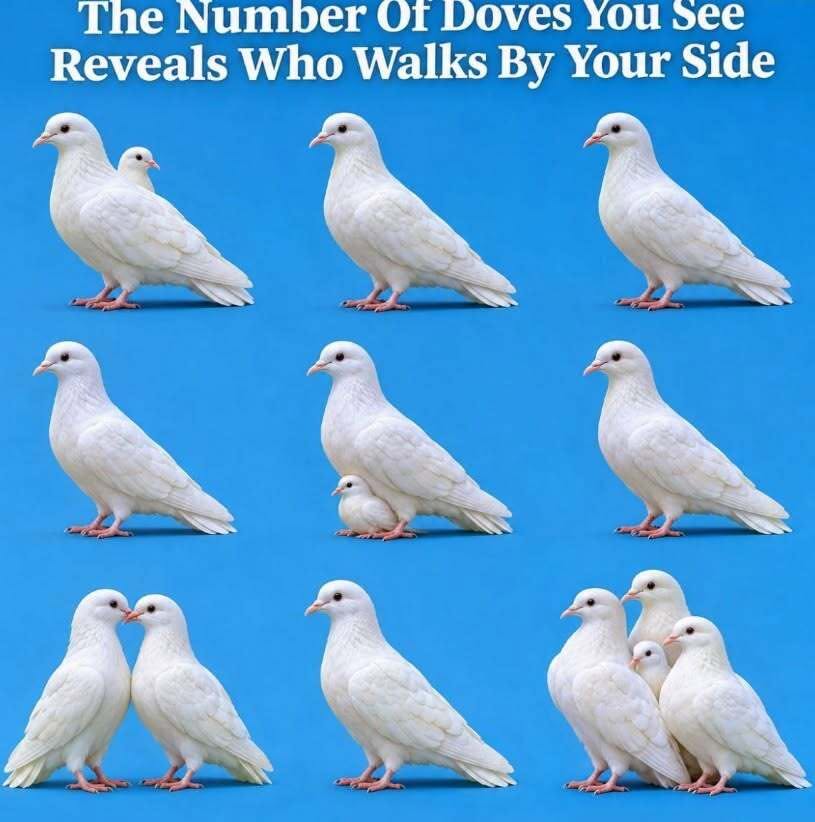
At first glance, this picture seems incredibly simple.
There are nine squares arranged in a three-by-three grid, and each one appears to contain a white dove.
So the obvious answer seems to be nine.
But look again.
There are actually **15 doves** hidden in the image.
The trick works because several of the birds overlap. In some squares, one dove partially covers another, making two or even more birds appear to be a single shapeOur brains naturally recognize the first few doves and then assume the rest of the pattern continues in the same way.
That is exactly why the hidden birds are so easy to miss.
Start with the top row.
There are actually four doves there.
The upper-left square contains two birds. One is easy to see, while another is partially hidden behind it, with only part of its head and body visible.
The other two squares in the top row each contain one dove.
That brings the first row’s total to four.
Now move to the middle row.
Again, there are four doves.
The left square contains one bird.
The right square contains one bird.
But the center square is the tricky one.
A smaller dove is hidden near the feet of the larger bird, making it easy to overlook unless you examine the image carefully.
So far, the total has reached eight.
Then comes the bottom row.
This is where the puzzle becomes much more difficult.
There are seven doves hidden across those three squares.
On the left, two birds face one another.
The middle square contains one dove.
And the bottom-right square hides the biggest surprise of all.
There are four doves crowded together in that single space.
Their bodies overlap so closely that the group can easily look like only one or two birds.
The easiest way to count them is to focus on the heads rather than the bodies.
One bird stands in front.
Another is positioned behind it.
A third appears on the right.
And a smaller dove is tucked between them.
Once you identify all four, the final count becomes clear.
The correct answer is **15 doves**.
That breaks down to four in the top row, four in the middle row, and seven in the bottom row.
This puzzle is a great example of how easily our brains can be fooled by familiar patterns.
Once we decide that each square contains one bird, we often stop examining the smaller details carefully.
The picture itself never changes.
Only the way we look at it does.
So if you originally counted nine, ten, or even twelve doves, take another look.
Examine each square separately.
You may be surprised by how many hidden birds suddenly appear once you know where to look.