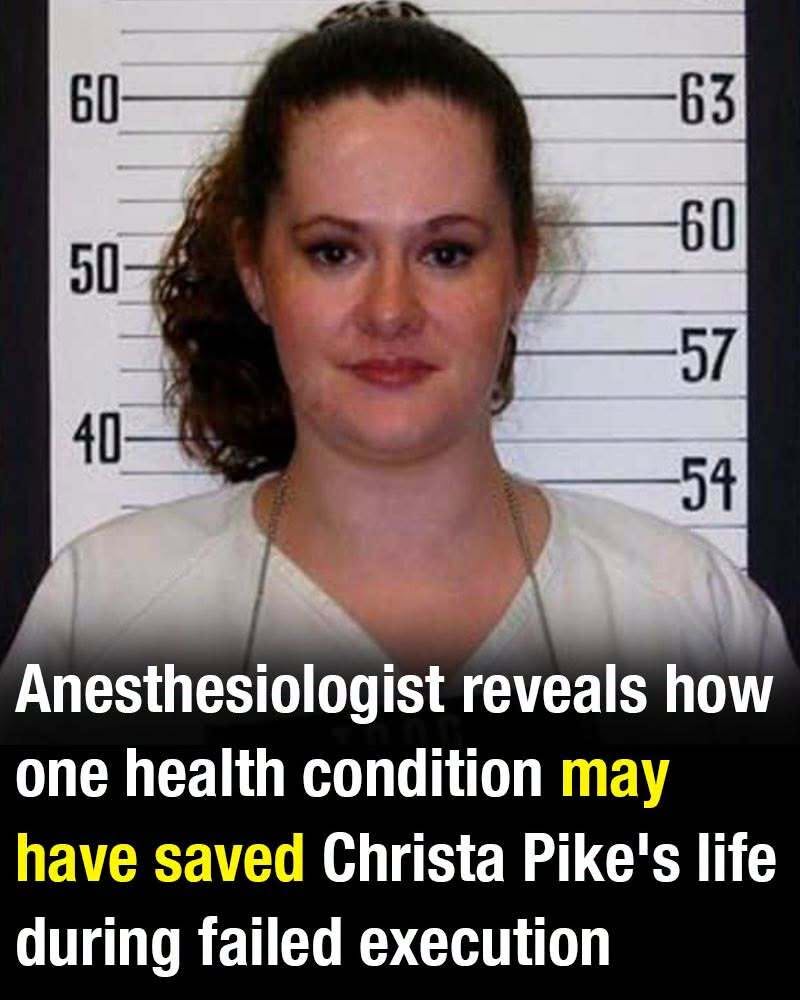
Doctor Explains Medical Condition That May Have Helped Christa Pike Survive Failed Execution
A doctor who previously examined Christa Gail Pike says one of her medical conditions may help explain why she survived Tennessee’s failed attempt to execute her by lethal injection on September 30.
Pike, 50, was sentenced to death for the 1995 torture and murder of 19-year-old Colleen Slemmer. After spending roughly three decades on death row, she was scheduled to be executed at Riverbend Maximum Security Institution.
But the procedure did not go as planned.
Pike received two doses of pentobarbital, the drug Tennessee uses for lethal injection, yet she remained alive and was ultimately transported to an outside hospital. Reuters reported that she survived the execution attempt after receiving two syringes of the drug.
Her attorneys later alleged that problems with the IV lines caused pentobarbital to enter surrounding tissue rather than properly circulating through her bloodstream.
Pike has remained unconscious and on a ventilator while doctors continue treating her. Her attorney, Stephen Ferrell, told CNN on October 4 that her condition was still critical and that her long-term prognosis remained unclear.
Attorney Gives Update on Pike’s ConditionSpeaking on CNN’s State of the Union, Ferrell said:
“It remains the same. She’s still in the hospital on a ventilator, critically ill.”
He added:
“We don’t really know the prognosis yet, and may not know for several days.”
Pike’s legal team has also raised concerns about possible long-term injuries resulting from the failed execution.
The Washington Post reported that she remains unconscious following the procedure, while attorneys have alleged serious swelling, burns, and blistering to her arms.
Doctor Points to Pike’s Blood Disorder
Dr. Joel Zivot, an anesthesiologist who has worked with Pike’s defense team and opposes the death penalty, believes a medical condition known as thrombocytosis may have played a role in what happened.
Thrombocytosis involves an unusually high platelet count.
Platelets help the blood clot when a blood vessel is injured. According to Zivot’s explanation, inserting an IV needle into Pike’s vein may have triggered excessive clotting around the catheter.
That clotting, he suggested, could have partially or completely blocked the vein.
If that happened, pentobarbital injected through the IV might not have entered the bloodstream in the way execution officials intended.
Instead, pressure inside the vein may have caused it to rupture, allowing the drug to leak into surrounding tissue.
Zivot stressed that the explanation remains his medical assessment of what may have occurred, rather than a final official finding.
Pentobarbital May Have Entered Her Tissue
Zivot has said the damage visible on Pike’s arms could be consistent with pentobarbital leaking outside the vein.
“She very likely has a significant burn on one or both arms from the pentobarbital that I expect went into the tissues.”
Pike’s attorneys have similarly claimed that her arms became severely swollen, burned, and blistered following the procedure.
People reported that Zivot believes a failed intravenous catheter could have caused the lethal drug to leak into surrounding tissue, producing chemical burns while preventing enough of the drug from entering Pike’s circulation to kill her.
The theory may help explain how Pike could receive two intended lethal doses yet survive the procedure.
Doctor Says Problems Were ‘Predictable’
Zivot has also argued that the difficulties encountered during Pike’s execution should not have come as a surprise.
Speaking after the failed procedure, he said:
“These things were predictable. I knew that they would happen. I called that they would happen and they happened.”
He continued:
“I can tell you that all the things that I warn about – that I’ve written in the past – have all come to fruition in the case of Christa Pike.”
Before the execution, Pike’s attorneys had already warned that her medical conditions and small veins could make IV access especially difficult.
The Guardian reported that her lawyers had argued before the execution that gaining reliable access to her veins could prove dangerous and potentially painful.
Why IV Placement Matters During Lethal Injection
For lethal injection to work as intended, execution personnel must successfully place an intravenous catheter into a vein.
The drug then has to enter the bloodstream at the intended concentration.
Zivot says this is where executions can encounter a major practical problem.
“Placing an intravenous catheter is a specific technical skill that is practised by people in healthcare. It’s not something that translates into the execution chamber.”
Doctors and nurses are generally constrained by professional ethics from participating directly in executions. Zivot argues that this can leave technically complicated IV placement to personnel with different levels of medical training and experience.
In Pike’s case, her attorneys say execution personnel repeatedly struggled to establish working IV access before administering the drugs.
What Happens Next?
Pike’s medical future remains uncertain.
She is still being treated in hospital, and her lawyers say it is not yet clear whether she will regain consciousness or what long-term neurological or organ damage she may have suffered.
Zivot also raised questions about whether Pike could ever face another execution if the failed procedure leaves her permanently medically impaired.
“So if Christa Pike’s health should be such a thing that it can never be restored to some degree… then she may not face [execution] again.”
He also argued that once an execution attempt fails and a prisoner remains alive, the state has a responsibility to provide medical treatment.
“If the death penalty goes wrong, which it has done in this case, it becomes the duty of the state to restore the prisoner to health. So they’re bound to do it.”
For now, the exact medical reason Pike survived has not been conclusively established.
But Zivot’s explanation involving thrombocytosis, possible clotting around the IV site, and pentobarbital leaking into surrounding tissue offers one medical theory investigators are likely to examine closely as Tennessee reviews what went wrong during the September 30 execution attempt.