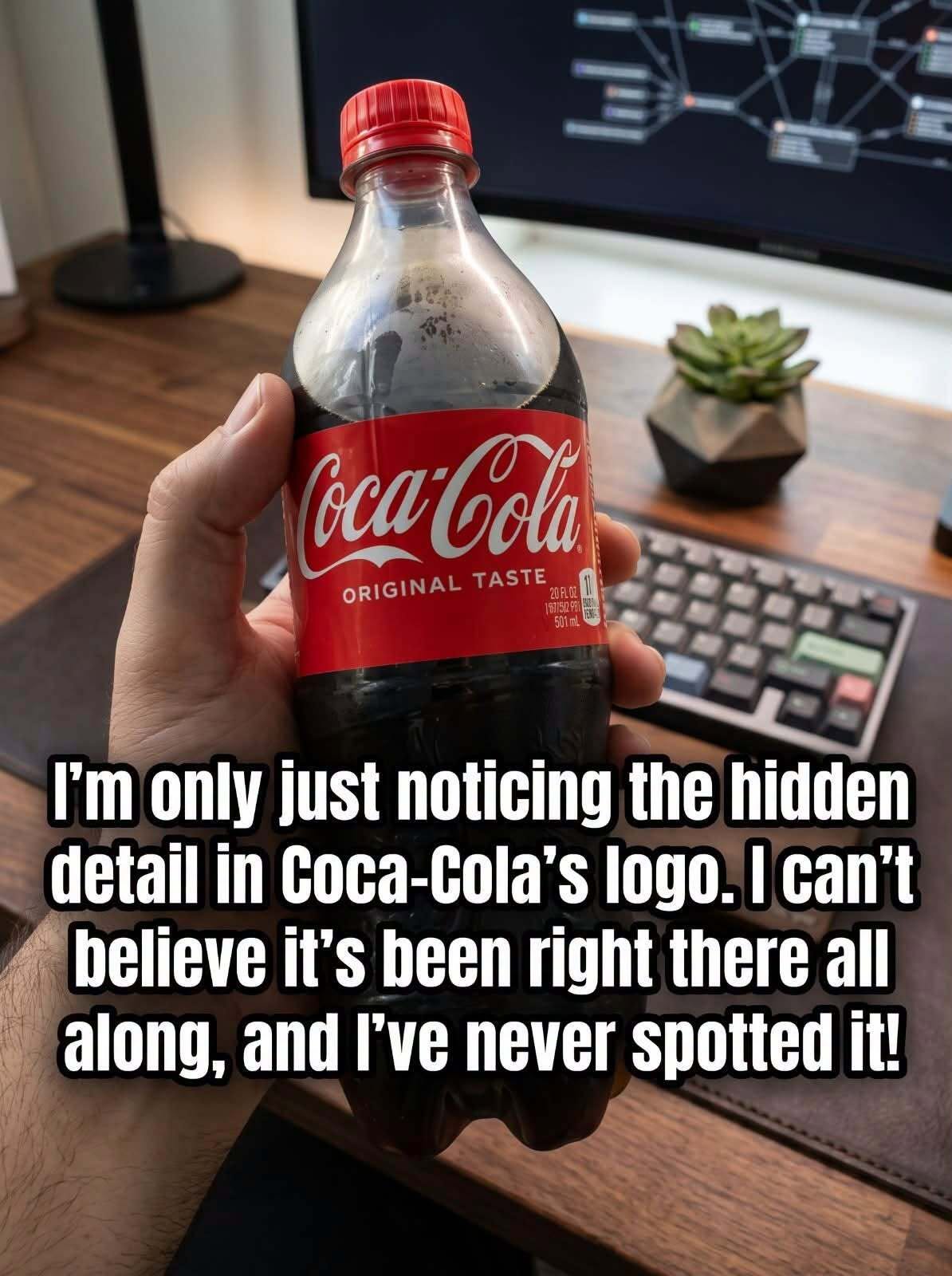
How many times have you seen the Coca-Cola logo?
Probably more times than you can count.
It appears on bottles, cans, signs, refrigerators, vending machines, and advertisements around the world. Most of us recognize it instantly without really examining it.
But look closely and you may notice something curious.
Inside portions of the flowing white lettering, some people see a small shape resembling the Danish flag: a white cross against Coca-Cola’s familiar red backgroundOnce pointed out, it can be surprisingly difficult not to see.
So is Denmark’s flag actually hidden inside the Coca-Cola logo?
Probably not intentionally.
There is no well-established evidence showing that Coca-Cola deliberately incorporated the Danish flag into its famous script. The resemblance is better understood as an interesting visual coincidence created by curves, spacing, negative space, and the brand’s red-and-white color scheme.
The Danish flag, known as the Dannebrog, features a white Scandinavian cross on a red field. Because Coca-Cola uses those same two dominant colors, even an approximate cross-like shape can feel immediately familiar.
Our brains are also naturally skilled at finding recognizable patterns.
This tendency is often called pareidolia: seeing familiar images or forms in shapes that may not have been intentionally designed that way.
It is why people notice faces in clouds, animals in rocks, or figures in shadows.
Logos are especially good at producing this effect because we normally recognize them as a whole. We rarely stop to inspect every curve, gap, and intersection.
Once someone tells us what to look for, our attention changes.
Suddenly the familiar logo becomes a collection of separate shapes, and one of those shapes may begin to resemble a flag.
That does not make the observation meaningless.
It simply means there is an important difference between noticing a resemblance and claiming intentional symbolism.
A deliberate hidden message would require stronger evidence—such as design records, statements from the creators, or historical documentation.
Without that, the most reasonable conclusion is straightforward:
Some people can see a shape resembling the Danish flag inside the Coca-Cola logo, but there is no solid basis for saying it was deliberately placed there.
And perhaps that is enough.
The interesting part is not necessarily that a secret was hidden in plain sight.
It may simply be that something we have looked at thousands of times can still surprise us when we slow down and pay closer attention.
Recognition is not always the same thing as observation.