“Mom, don’t.”
Marcus said it almost under his breath.
Lauren was standing on my front porch, staring at the bank statement I had placed on the small table beside the door.
For several seconds, neither of them moved.
The porch light illuminated the paper between us.
Somewhere down the street, a sprinkler clicked rhythmically.
Behind me, I could hear the refrigerator humming inside the little house I had purchased with my own money.
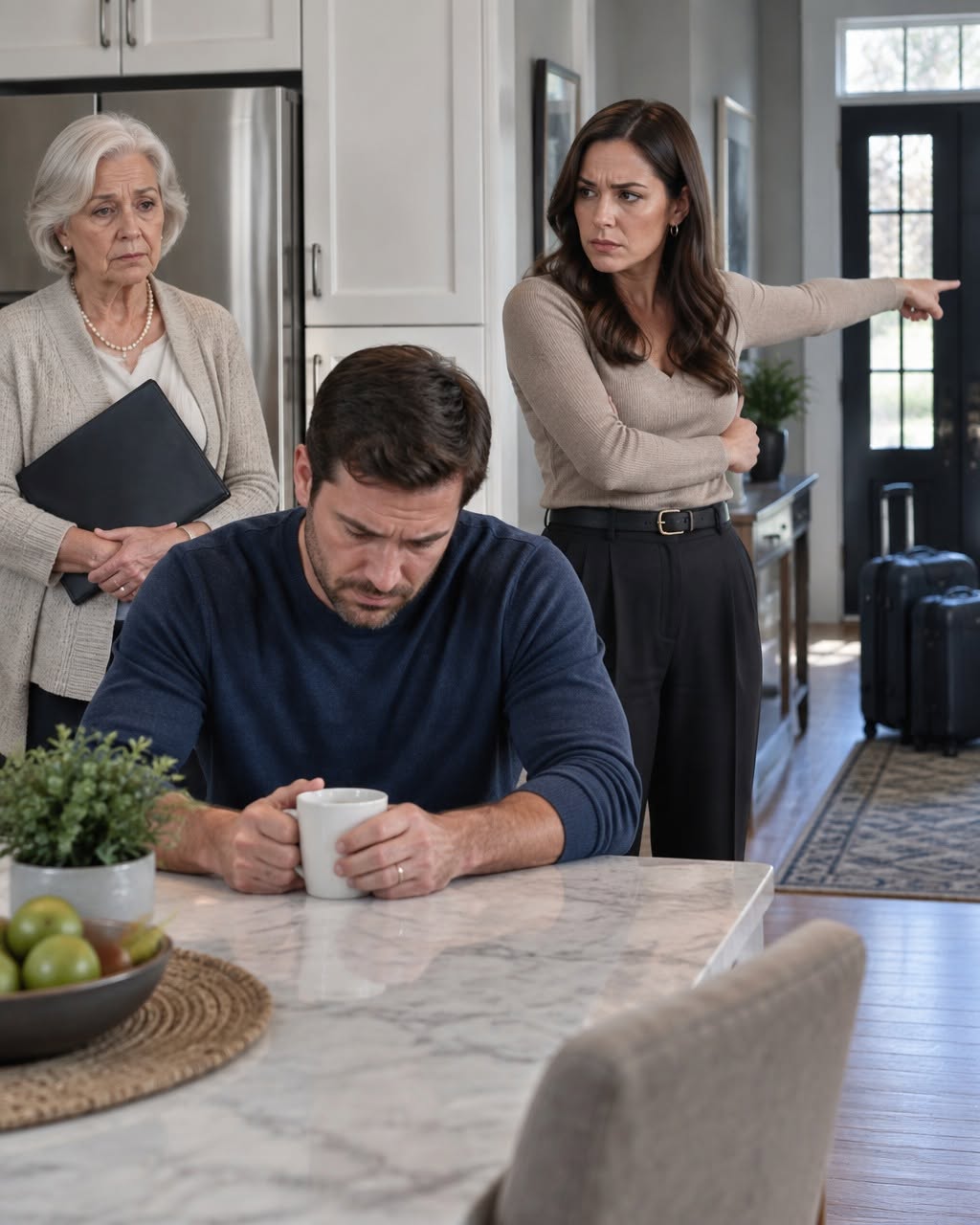
Three weeks earlier, Lauren had stood in her kitchen and told me I had two choices:
Hand over my savings.
Or move out.
Now she stood outside my home holding a bank envelope, looking at evidence that the financial disaster she had blamed on me had actually started long before her ultimatum.
“What is this?” she asked.
I looked at my son.
“You want to explain it?”
Marcus dragged one hand across his face.
Lauren turned toward him.
“Marcus?”
He said nothing.
I knew that silence.
It was the same silence he had used while his wife called me a freeloader.
The same silence he had hidden behind when she demanded the retirement money my husband and I had spent forty-two years saving.
Only this time, the silence was working against him.
Lauren grabbed the statement.
It showed a payment I had made for Marcus several months earlier.
At the time, he had called me privately and said an unexpected truck repair had left him short.
He told me everything else was fine.
I believed him.
So I transferred the money.
But the date on the statement told a different story.
It proved that their financial trouble had begun long before Lauren claimed the mortgage problems were recent.
Lauren looked up.
“You told me that money was for the truck.”
Marcus stared at the floor.
“Some of it was.”
Her expression changed.
“Some?”
“We were behind on other bills too.”
“How far behind?”
I opened the front door wider.
“You should probably come inside. The neighbors don’t need to hear this.”
Oddly, that seemed to embarrass Lauren more than anything else.
She stepped into my home for the first time.
Her eyes moved around the living room.
A blue sofa beneath the front window.
Family photos on a shelf.
My late husband’s reading chair angled toward the garden.
A lamp I had owned for thirty years.
Fresh flowers on the table.
Nothing luxurious.
Nothing borrowed.
And nothing Lauren could threaten to take from me.
Marcus noticed the chair.
“Dad’s chair.”
“Yes.”
He swallowed.
I led them to the dining table.
Lauren placed the bank envelope beside the folder I had prepared.
“We don’t have time for a lecture,” she said. “The mortgage company wants payment.”
There it was again.
That sharp tone.
That belief that urgency gave her permission to command me.
I stayed calm.
“How much?”
Marcus told me.
The amount was much larger than I expected.
It wasn’t one missed payment.
There were several.
Late fees had piled on too.
“How many months?”
He hesitated.
Lauren answered.
“Four.”
“Five,” Marcus said quietly.
She turned toward him so quickly the chair scraped the floor.
“Five?”
He nodded.
For once, all the anger in the room was directed somewhere other than at me.
Marcus started explaining.
His work hours had been cut earlier in the year.
Then an old credit-card balance became harder to manage.
The truck needed repairs.
They used one card to cover another bill.
Then they started delaying payments from one week to the next.
Each month, Marcus convinced himself the next month would be better.
It never was.
Lauren stared at him.
“Why didn’t you tell me?”
Marcus looked exhausted.
“Every time I said we needed to cut back, you said we’d figure something out.”
“So you lied to me?”
“I was scared.”
“And hiding bills was your solution?”
Marcus glanced toward me.
“I thought Mom could help until my hours went back up.”
I sat very still.
That sentence explained more than he understood.
“So when Lauren demanded my savings,” I said, “you already knew how serious the situation was.”
His face tightened.
“Yes.”
“And when she said I had been living in your house for free, you knew that wasn’t true.”
He closed his eyes.
“Yes.”
That word hurt.
But not the way it would have hurt three weeks earlier.
Here, sitting in my own house, I could finally hear it clearly.
It was a confession.
Not proof that I was worthless.
Lauren pushed the folder toward me.
“Fine. Marcus handled things badly. I handled things badly too. But that doesn’t change what happens now. If we can’t pay this, we might lose the house.”
“What exactly do you want from me?”
She looked at me as if the answer were obvious.
“Come back. Help us get things under control.”
“With my savings.”
She didn’t answer.
Marcus did.
“We need money, Mom.”
I nodded.
“That is not the same thing as needing me to move back in.”
Silence.
Marcus looked down.
And that distinction mattered more than anything.
They had not come because they missed me.
They had not come because the house felt empty.
They had not come because they had suddenly realized how cruelly they had treated me.
They came because their money had run out.
Lauren tried another tactic.
“You obviously have enough to help. You bought this place with cash.”
I almost smiled.
“Three weeks ago, you told me what I owned should belong to you because I was sleeping in your guest room.”
“I was angry.”
“No.”
I looked directly at her.
“You were confident.”
Her jaw tightened.
I opened the folder.
Then I started laying documents across the table.
Electric bills.
Grocery receipts.
Money transferred to Marcus.
The insurance payment that had kept his truck covered.
A veterinarian bill I paid when one of their dogs became ill while they were traveling.
I had never saved those things because I intended to demand repayment.
Most of them existed automatically in online statements and receipts.
But after Lauren called me a freeloader, I needed to make sure grief hadn’t distorted my memory.
It hadn’t.
Even I was surprised by the total.
During the months I lived with them, I had contributed thousands of dollars.
That didn’t include the cooking.
Errands.
Dog care.
Cleaning.
Or the countless daily things that never appeared on a bank statement.
Lauren stared at the figures.
“I didn’t know about all this.”
“You knew about the groceries.”
She said nothing.
“You knew I paid the electricity.”
“I didn’t know about the other payments.”
I looked at Marcus.
He remained silent.
Lauren understood immediately.
“You’ve been giving him money behind my back.”
“When your husband asked me for help, I helped him.”
She shoved her chair backward.
“So both of you were lying to me.”
“Don’t do that.”
My voice wasn’t loud.
But she stopped.
“Do what?”
“Turn your marriage problems into something I caused.”
I pointed toward the papers.
“I didn’t create your debt. I didn’t hide your mortgage notices. And I certainly didn’t stand in your kitchen and demand another woman’s retirement savings.”
Lauren’s eyes flashed.
“We’re talking about losing our home.”
“I know exactly what losing a home feels like.”
That stopped her.
After my husband died, selling our old townhouse had felt like dismantling our marriage room by room.
Marcus had been the one who convinced me I shouldn’t live alone.
For a while, I believed moving in with him meant I still had a family home.
Lauren destroyed that illusion in less than a minute when she told me to surrender my savings or leave.
Now, strangely, I was almost grateful.
At least I knew the truth.
Marcus leaned forward.
“Mom, I failed you.”
Lauren glanced at him.
He kept going.
“I should have stopped her the second she told you to leave.”
I waited.
“Why didn’t you?”
His answer came slowly.
“Because part of me was hoping you’d give us the money.”
There it was.
No excuse.
No polished version.
Just the truth.
My son had watched his mother be humiliated because desperation had made my bank account seem more important than my dignity.
My throat tightened.
“Thank you for finally admitting that.”
Lauren stared at him.
“You’re making it sound like I did everything.”
“You said the words,” Marcus replied. “I stood there and let you. That isn’t much better.”
Lauren got up and paced toward the window.
“So what happens now? We lose the house while everyone sits around having some emotional revelation?”
I closed the folder.
“No.”
She turned.
“Then what?”
“You deal with the actual problem.”
“What problem?”
“You cannot afford your house.”
She reacted as if I had insulted her.
But the numbers didn’t care about pride.
I asked them what the property was worth.
What they still owed.
Whether foreclosure had formally begun.
This time, Marcus answered honestly.
The situation was serious, but it wasn’t beyond repair yet.
The lender had sent multiple notices.
They owed several missed payments.
But they still had equity.
If they sold voluntarily, they could probably walk away with something.
If they waited until everything collapsed, they might lose far more.
Lauren shook her head.
“We are not selling.”
“What is your alternative?”
“Catch up.”
“With whose money?”
Her eyes moved toward me.
That answered the question.
I leaned back.
“My savings are not your financial plan.”
Her face hardened.
“So you’re just going to watch your own son lose his house?”
Marcus whispered her name.
I raised one hand.
“My husband worked through illness, holidays, and years when we barely took vacations because we wanted security when we got older.”
I looked at Marcus.
“I worked too.”
Then at Lauren.
“We saved so that if one of us died, the other would never become financially dependent on our child.”
I tapped the folder.
“That money has a purpose. It is not a reward for whoever applies the most pressure.”
Lauren looked away.
Marcus’s eyes were wet.
“I understand,” he said.
For once, I believed he might.
I did offer to help.
But not with a bailout.
The next morning, I would sit beside Marcus while he called the mortgage lender.
We would ask about hardship options.
Payment plans.
Possible restructuring.
I would help them make a complete list of their debts.
And if keeping the house was unrealistic, I would help them find an agent and sell it before the situation became worse.
But I would not pay the overdue mortgage.
I would not move back.
And I would not hand over my savings.
Lauren stared at me.
“You’ll make phone calls with us, but you won’t give us the money?”
“Correct.”
“That is unbelievable.”
Marcus surprised us both.
“No, Lauren.”
She turned toward him.
“What?”
“What’s unbelievable is that we threw Mom out and then showed up here expecting her to write a check.”
Lauren’s face changed.
She grabbed the bank envelope from the table.
“Fine. You two can figure it out.”
She headed toward the door.
Before leaving, she looked around my living room again.
I couldn’t tell whether she was angry.
Embarrassed.
Afraid.
Probably all three.
Marcus stayed.
For several minutes, we sat without speaking.
Then he looked toward his father’s chair.
“Dad would’ve been disgusted with me.”
“Don’t use your father to punish yourself.”
He looked at me.
“You are responsible for what you do next. Not for imagining what a dead man might say.”
Marcus nodded.
It was the first honest conversation we had had in months.
The next morning, he returned alone.
We called the lender.
There was no miracle.
The missed payments still existed.
His reduced income still existed.
But the situation wasn’t quite as hopeless as panic had made it feel.
Over the following week, Marcus and Lauren finally went through every expense.
The truth was brutal.
The house had always been too expensive for them.
When Marcus’s income dropped, they continued spending as though nothing had changed.
Credit cards covered the difference.
Until they couldn’t.
Eventually Marcus called me.
“We’re listing the house.”
Lauren hated the decision.
But she agreed.
Several weeks later, the house sold.
They cleared the mortgage and a large portion of the other debt.
Then they moved into a smaller rental across town.
Marcus sold the pickup truck too.
When he told me, he gave an embarrassed laugh.
“Turns out I didn’t need a giant truck payment to prove I was doing well.”
“That was an expensive lesson.”
“You’re telling me.”
Things between Lauren and me didn’t suddenly become perfect.
Life rarely works that neatly.
For months, our conversations remained short and polite.
Then one Sunday afternoon, she appeared at my front door.
Alone.
It was the same porch where she had once arrived carrying a bank envelope and expecting money.
This time, her hands were empty.
“Can I come in?”
I stepped aside.
She sat at the kitchen table and looked through the window toward the garden.
“I keep thinking about what I said to you,” she began.
I waited.
“About you living with us for free.”
I didn’t interrupt.
“It was cruel.”
She swallowed.
“And it wasn’t true.”
That mattered more to me than some dramatic speech.
Lauren admitted she had been terrified about the mortgage.
She was furious that Marcus had hidden the truth.
But instead of facing the fact that they couldn’t afford their lifestyle, she looked at my savings and convinced herself I should solve everything.
“I turned your money into the answer because that was easier than admitting we couldn’t afford our own life.”
I nodded.
“Yes.”
Her eyes filled with tears.
“I’m sorry.”
I accepted the apology.
But accepting it didn’t mean pretending nothing had happened.
Lauren would never again have access to my financial information.
And I would never again live under their roof.
Those weren’t punishments.
They were boundaries built from experience.
Marcus and I repaired our relationship slowly too.
He started calling without asking for anything.
Sometimes he came over to fix a cabinet hinge.
Sometimes he helped move something in the garden.
Sometimes we just sat with coffee.
Months later, on what would have been my husband’s birthday, Marcus showed up carrying his father’s favorite pie.
We sat near the old reading chair and talked about him until the sun went down.
Before Marcus left, he stopped by the front door.
“Mom?”
“Yes?”
“I’m glad you bought this place.”
I looked around.
So was I.
The day Lauren told me to hand over my savings or move out felt, at the time, like one of the worst humiliations of my life.
But it forced me to understand something grief had blurred.
A home isn’t simply a place where someone gives you permission to sleep.
It isn’t a room you earn by being useful.
Quiet.
Helpful.
Or financially convenient.
A real home is somewhere your dignity isn’t being held as collateral.
My husband and I had spent decades saving so that neither of us would ever have to sacrifice that dignity for security.
In the end, the most important thing those savings bought me wasn’t the small house.
It wasn’t the garden.
Or the blue sofa.
Or even the front door that opened with my own key.
It bought me something far more valuable.
The ability to say no.
And still have somewhere safe to go.