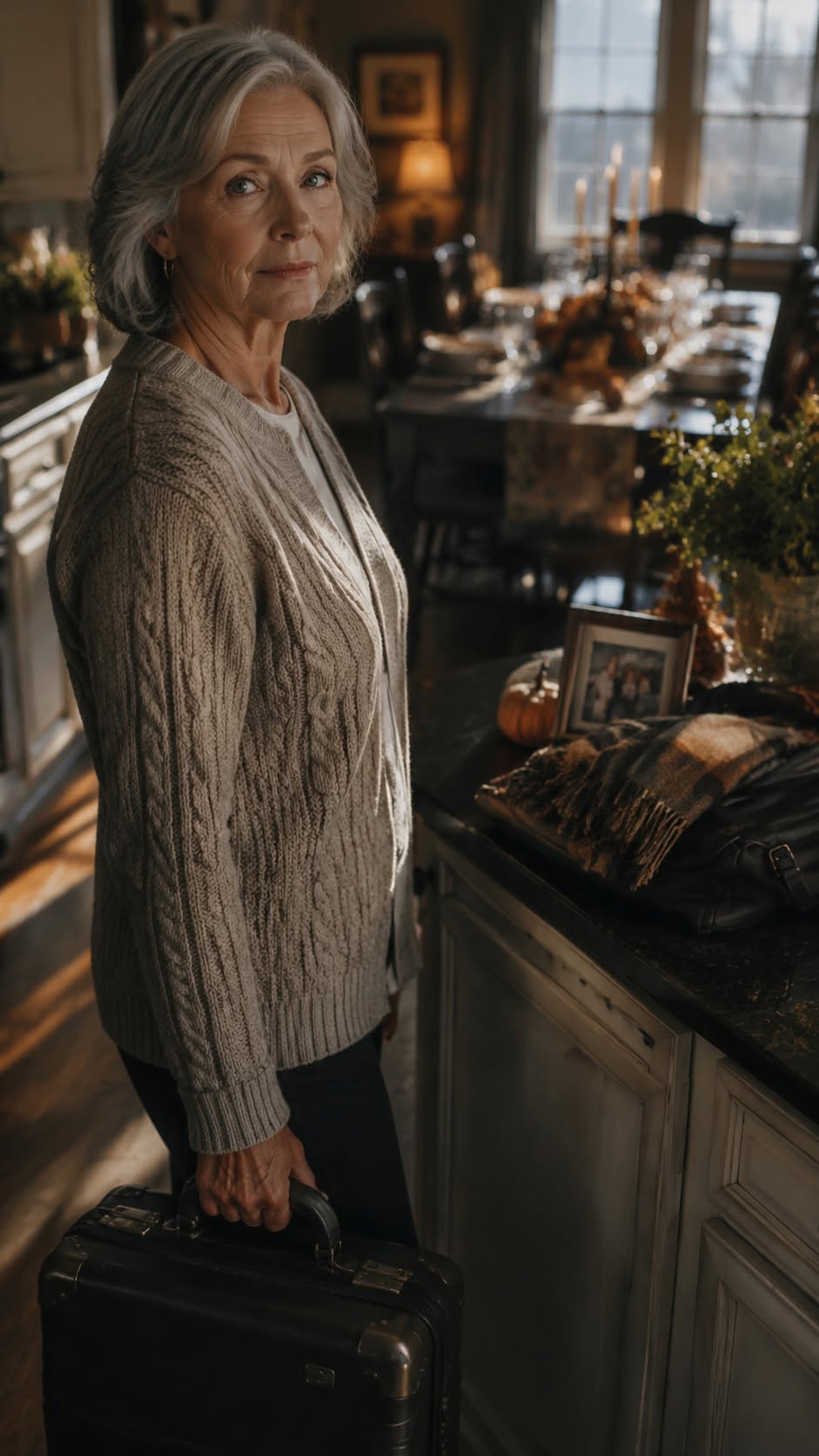
No one in the room understood how quickly everything was about to change.
My daughter-in-law Rachel did not walk into my kitchen that morning like a guest entering someone else’s home.
She walked in like an executive arriving to inspect a property she had already purchased.
She stood beside my counter, stared at her phone, and scrolled through a list without even taking off her coat. The winter sunlight came through the window behind her, landing on the Thanksgiving decorations I had carefully stored and brought out every year since Daniel was a boy.
Not once did she look at them.
“Eighteen people will be here for Thanksgiving,” she announced. “We’ll arrive Wednesday afternoon to start setting up. The boys can sleep in the basement, but my brother’s family will need the upstairs bedrooms.”
She tapped her screen.
“My brother doesn’t do air mattresses.”
The knife in my hand stopped above the pear I was slicing. My kitchen. My bedrooms. My basement. My Thanksgiving.
Yet somehow, I was the only person who had not been included in the decision. Rachel continued as if my silence meant approval.
“We’ll need two turkeys this year. Last time, everyone wanted seconds before the children had even eaten. And I’ll need you to make those rolls your neighbor always talks about.”
Then she finally looked up and smiled.
“You’re just so good at this, Margaret. Nobody makes Thanksgiving like you.”
For years, those words would have made me smile. Years ago, they would have meant something different. When Daniel first married Rachel, she called me weeks before every holiday.
“Would it be okay if we came Thursday morning?”
“Can I bring anything?”
“I don’t want you doing everything alone.”
Back then, Daniel would walk through my front door carrying chairs from the basement while Rachel helped me arrange flowers on the dining table.
“Mom, this house smells like my whole childhood,” he used to say.
I believed him.
I believed that the laughter around my table meant we were building something together. But over time, the questions changed. Not, “Can we come?” Instead, “What time should we arrive?” Not, “Can I help?” Instead, “What are you making?”
And eventually, the invitations disappeared completely because everyone simply assumed my house would always be available. I set the knife down carefully.
“Rachel.”
She looked up.
“I will not be hosting Thanksgiving this year.”
For a moment, she just stared at me. Then she laughed. Not because something was funny. Because she thought I was making a strange joke.
“Okay,” she said. “Very funny. What are you actually making?”
“I’m not making anything.”
Her smile faded slightly.
“I don’t understand.”
“I won’t be here.”
The room became quiet except for the refrigerator humming behind us. Rachel lowered her phone.
“Where are you going?”
“Somewhere else.”
“On Thanksgiving?”
“Yes.”
She blinked.
“But Daniel already told everyone we were coming here.”
I looked at her.
“Then Daniel should have asked me before making plans for my home.”
That was when her expression changed. Not sadness. Not embarrassment. Anger.
“You’re serious.”
“Yes.”
“Margaret, this affects eighteen people.”
“No,” I said quietly. “It affects the person who owns the house and was never asked.”
She opened her mouth, but no words came out. For the first time in years, Rachel had no immediate answer.
When Daniel came home that evening, he found her waiting for him in the living room.
I heard the front door close. I heard their voices before I walked downstairs.
“She’s refusing,” Rachel said.
Daniel sounded confused.
“Refusing what?”
“Thanksgiving.”
A pause.
“What do you mean?”
“She said she’s leaving.”
Another silence. Then Daniel lowered his voice.
“Mom wouldn’t do that.”
I stepped into the doorway.
“I already did.”
Both of them turned. Daniel looked at me as if I had announced something impossible.
“Mom.”
“I meant what I said.”
His face tightened.
“Why would you do this now?”
I almost smiled at the question. Not because it hurt. Because it told me everything. He did not ask why I was tired. He did not ask why I felt taken for granted. He asked why I chose this moment to inconvenience everyone else.
“I have spent years making sure everyone else had a perfect holiday,” I said. “This year, I’m spending it somewhere I’m actually wanted.”
Rachel crossed her arms.
“That’s dramatic.”
I looked at her.
“No. Dramatic would be expecting someone to spend three days cooking, cleaning, and preparing for eighteen people without even asking if she wanted to do it.”
Daniel rubbed his forehead.
“Mom, Rachel didn’t mean it like that.”
I looked at my son.
“Did she ask me?”
He didn’t answer. That silence hurt more than anything Rachel had said. The next morning, I packed a suitcase.
I placed my favorite sweater inside. I packed the book I had been trying to finish for months. I watered my plants and checked the locks twice before leaving. On the kitchen counter, I left one note. Not a speech. Not an angry message. Just four words.
“The kitchen is yours.”
I drove three hours south to a small cabin near the lake, where the only sounds were the wind through the trees and the crackle of the fireplace. For the first few hours, I waited for guilt to arrive. It did not. Instead, I felt something unfamiliar.
Peace. Then my phone started buzzing. First it was Daniel.
“Mom, where are you?”
Then another message.
“Everyone is asking what’s happening.”
Then Rachel.
“This is incredibly selfish. You’re really doing this to the kids?”
I stared at the screen for a long time. Years ago, I would have driven home immediately. Years ago, I would have apologized for something I had not done. Instead, I turned my phone face down beside the fireplace. Thanksgiving morning arrived quietly.
I made coffee. I watched the sunrise over the lake. I ate a piece of toast without rushing to prepare twenty other plates. Then my phone lit up again. This time, the message was from my fifteen-year-old granddaughter, Hazel.
“Grandma, are you okay?”
I picked up the phone. Another message appeared before I could reply.
“Mom and Dad are acting weird. We’re at Uncle’s apartment because nobody knew what to do.”
I stared at the words. Then the final message appeared.
“Also… Grandma? I think they finally understand what you used to do.”
The fire cracked beside me. Because for the first time, they were not missing Thanksgiving. They were missing me. And then my phone began ringing again. This time, it was Daniel.
“Mom?”
I let the phone ring twice before answering.
“I’m here.”
For a moment, neither of us spoke. I could hear voices in the background, dishes being moved, someone laughing awkwardly, and a television playing too loudly in whatever apartment they had ended up gathering in. Then Daniel exhaled.
“I don’t know what to say.”
I looked out at the lake, where the morning fog was slowly lifting from the water.
“That makes two of us.”
“Mom, everyone is upset.”
“I imagine they are.”
“Rachel says you embarrassed her.”
I closed my eyes. There it was. Not an apology. Not an understanding. Still the same question: how had my choice affected them?
“Daniel, did Rachel tell you she made the plans without asking me?”
Silence.
“Did she tell you she assigned bedrooms in my house?”
More silence.
“Did she tell you she told eighteen people they were coming before she ever spoke to me?”
“She thought you would say yes.”
I stared at the phone.
“Exactly.”
My son’s voice softened.
“Mom…”
“No, Daniel. I need you to hear this. She didn’t misunderstand. She assumed. And you did too.”
He did not argue. That told me more than an argument would have.
“Are you coming home today?” he finally asked.
“No.”
“Mom, please.”
“Daniel, I have spent years saying yes before anyone even finished asking. One no should not destroy the family.”
The line went quiet. Then he said something I did not expect.
“I didn’t realize how much you did.”
I looked down at my hands.
Those hands had made thousands of meals. Wrapped hundreds of gifts. Folded countless towels after guests stayed in rooms that were supposed to be mine.
“That’s the problem,” I said. “Nobody did.”
After we hung up, I stayed at the cabin another two days.
I did not answer every message. I did not defend myself to relatives who had heard only Rachel’s version of events. I let the silence exist.
For once, I was not rushing to repair something I had not broken.
When I drove home Sunday afternoon, I expected the house to feel different.
I did not expect to feel like a stranger walking into my own driveway. The front door was unlocked. That bothered me more than I wanted to admit. I stepped inside and immediately noticed the evidence of Thanksgiving chaos.
Extra chairs were still stacked near the dining room. A blanket I did not recognize was thrown over the sofa. There were children’s drawings on my coffee table and empty boxes beside the kitchen door.
It looked like someone had borrowed my life for a weekend and returned it slightly damaged. Then I saw the folder. It was sitting on the counter. A plain white folder with my name written across the front. I picked it up. Inside were printed emails.
At first, I thought they were mine. Then I saw Rachel’s name. The first message was from months earlier. Rachel had sent it to Daniel. I read the opening line twice.
“Your mom will eventually understand that keeping that big house makes no sense.”
My fingers tightened around the paper. I kept reading.
“The taxes are expensive, and she’s not using half the rooms. We could help her make a decision that benefits everyone.”
I turned the page. Another message.
“If we could get her to transfer ownership, we wouldn’t have to worry about rent anymore. The house is sitting there doing nothing.”
I stopped. The room suddenly felt colder. I had known Rachel was entitled. I had known she had stopped seeing my home as my home.
But I had not known she had been planning for it to become hers. I read the rest slowly. There were conversations about repairs. Taxes. Investments. Money. My money.
Rachel had written that my savings could “help the family get ahead” and that Daniel was “too emotional to bring it up.” The last message was the one that made me sit down.
“Thanksgiving is the perfect time to talk to her. Everyone will be there, and she won’t want to disappoint people.”
I placed the papers on the table. For several minutes, I just listened to the quiet house. The strange thing was, I was not shocked by Rachel anymore. I was thinking about Daniel. Because he had known enough to be silent. And silence, I had learned, could be its own kind of decision.
The garage door opened. I looked up. A few seconds later, Daniel walked into the kitchen. He froze when he saw me.
“Mom.”
His eyes moved to the papers on the table. He knew immediately.
“Where did you get those?”
I looked at him carefully.
“They were left on my counter.”
His face changed. Not confusion. Fear.
“Mom, I can explain.”
“Can you?”
He opened his mouth. Nothing came out. I picked up the first page.
“Did you know Rachel wanted this house?”
Daniel looked away. That was my answer.
“Daniel.”
“I knew she was frustrated.”
“Frustrated?”
He swallowed.
“She thought things were unfair.”
I almost laughed.
“Unfair?”
I held up the page.
“I gave you a place to stay when you needed one. I paid for your wedding reception when you were short on money. I watched Hazel when you worked late. I opened my home every holiday. And Rachel thinks it’s unfair because I still live here?”
“Mom, that’s not what she meant.”
“Then what did she mean?”
He had no answer. The silence stretched between us. Finally, Daniel sat down.
“She was worried about money.”
“So she decided my house was the solution?”
“I told her we couldn’t just take it.”
I looked at him.
“But you didn’t tell me.”
His shoulders dropped.
“No.”
“Why?”
He stared at the floor.
“Because I knew you would be hurt.”
I nodded slowly.
“You knew.”
Those two words seemed to hit him harder than anything else.
“Mom…”
“You knew I would be hurt, and you let it continue anyway.”
Daniel rubbed his hands over his face.
“I thought it would go away.”
“Things don’t go away when people avoid them. They grow.”
He looked at the documents again.
“I never agreed to transfer the house.”
“No,” I said. “You didn’t.”
I walked to the cabinet near the hallway and pulled out a small locked box. Daniel watched me.
“What’s that?”
I placed it on the table.
“The reason I never worried about losing this house.”
His expression changed.
“Mom… what is inside?”
I opened the box. Inside were years of paperwork Rachel and Daniel had never seen. Property records. Financial statements. A letter from my attorney. I placed the documents beside Rachel’s emails.
“Before anyone decided what would happen to my home,” I said, “I made sure I knew exactly who had a right to decide.”
Daniel looked at the papers.
And for the first time since he walked through the door, he looked less like my son defending his wife.
He looked like a man realizing he had never understood the situation at all.
He reached for the top document but stopped before touching it.
“What did you do?” he asked quietly.
I pulled the chair across from him and sat down.
“I protected myself.”
Daniel looked confused.
“From us?”
The question came out before he could soften it. I looked at my son for a long moment.
“From anyone who forgot that kindness does not mean ownership.”
He looked away. I opened the first document.
“This house has always been mine. My name is the only name on the deed. There is no joint ownership. No promise that it would become yours. No agreement that you or Rachel would inherit it while I am alive.”
Daniel nodded slowly.
“I know you bought it after Dad died.”
“Yes.”
“But Rachel thought…”
“Rachel thought a lot of things.”
The words were sharper than I intended, but I did not take them back. Daniel picked up the email again.
“I didn’t know she wrote all this.”
“But you knew she wanted the house.”
He closed his eyes.
“Yes.”
“How long?”
He hesitated. That hesitation told me there was more.
“Daniel. How long?”
He swallowed.
“Almost a year.”
The room went silent. A year.
For almost a year, my son had sat across from me at dinner. He had hugged me when he visited. He had told me he loved me.
And somewhere underneath all of that, he and his wife were discussing how to convince me to give up my home.
“When were you planning to tell me?” I asked.
“I wasn’t.”
His honesty hurt more than a lie would have.
“Why?”
Daniel stared at the table.
“Because every time I thought about bringing it up, I remembered everything you’ve done for me. And then I felt guilty.”
“Guilt did not stop you.”
“No.”
“Fear did not stop you.”
“No.”
“So what stopped you?”
He had no answer. I looked at the papers again.
“Did Rachel ask you to talk to me about selling?”
He nodded.
“Yes.”
“Did she ask you to suggest moving me somewhere smaller?”
Another nod.
“Yes.”
“Did she ask you about my savings?”
This time, he looked up quickly.
“Mom…”
“Answer me.”
His face tightened.
“Yes.”
The word landed heavily between us. I leaned back.
“How much did she know?”
Daniel rubbed his forehead.
“I don’t know.”
“That’s not an answer.”
“She knew you had savings. She knew Dad left you the insurance money. She knew you helped me pay off my student loans.”
“And she thought that meant it was available?”
“She thought we were family.”
I stared at him.
“Family asks. Family does not plan.”
Daniel lowered his head.
For years, I had defended him. I had told people Daniel was thoughtful. Daniel was kind. Daniel had a good heart. And maybe he did. But a good heart could still make cowardly choices. The back door opened. Neither of us moved. Then Rachel’s voice came from the kitchen.
“I knew this would happen.”
I turned. She stood in the doorway holding her purse, her expression carefully controlled. Daniel immediately stood.
“Rachel.”
“No, it’s fine.”
She looked at the documents on the table.
“Apparently my private conversations are more important than Thanksgiving now.”
I looked at her.
“Private conversations about taking my house?”
Her jaw tightened.
“That’s not what we were doing.”
“Then tell me what you were doing.”
Rachel stepped farther into the room.
“We were trying to help you.”
I almost smiled.
“Help me?”
“Yes. You live in a five-bedroom house by yourself. You have stairs. Maintenance. Expenses. We were thinking about the future.”
“Whose future?”
She did not answer immediately. That pause was enough.
“Rachel, this is my home.”
“I know that.”
“Do you?”
Her expression hardened.
“Margaret, nobody is trying to steal anything from you.”
I tapped the email sitting on the table.
“You wrote that my house was sitting there doing nothing.”
“Because it is too big for one person.”
“That does not make it yours.”
“I never said it was mine.”
“You planned Thanksgiving guests for bedrooms you don’t own.”
She looked away.
“That’s different.”
“Why?”
“Because that’s family.”
I nodded slowly.
“Exactly. Family. The people who should have asked first.”
Rachel crossed her arms.
“You are making this much bigger than it needs to be.”
Daniel looked at her.
“Rachel…”
She turned toward him.
“What? You’re taking her side now?”
“This isn’t about sides.”
“It feels like it is.”
“Because I didn’t know everything.”
That made her expression change. For the first time, Rachel looked uncertain.
“What do you mean?”
Daniel picked up the emails.
“I didn’t know you wrote that Thanksgiving was the perfect time to pressure her.”
Rachel went still.
“You weren’t supposed to see that.”
The sentence left her mouth before she could stop it. No one spoke. I watched Daniel’s face. He heard it too.
“You weren’t supposed to see it?” he repeated.
Rachel looked uncomfortable.
“I meant it wasn’t meant to be taken out of context.”
“What context makes that okay?” Daniel asked.
She looked at him.
“Daniel, we were struggling.”
“So you thought my mother was the answer?”
“I thought your mother would want to help.”
I looked at her.
“I have helped you for years.”
Rachel’s voice softened.
“And we appreciate that.”
“Do you?”
She looked away. The answer was written all over her face. I closed the folder.
“There is something else you both need to understand.”
Daniel looked at me.
“What?”
I placed the attorney’s letter on top of the documents.
“When your father died, I made one decision that neither of you knew about.”
Rachel’s eyes narrowed.
“What decision?”
I looked at both of them.
“I created a legal plan for this house and my finances.”
Daniel frowned.
“Why?”
“Because your father spent his whole life making sure I was protected. And after he was gone, I promised myself I would never become dependent on anyone else.”
Rachel stared at the letter.
“So what does that mean?”
I opened the envelope.
“It means nobody can pressure me into giving away what belongs to me.”
Daniel looked at the papers. Then he noticed the date. His expression changed.
“Mom… this was done eight years ago.”
“Yes.”
“Before Rachel and I even had Hazel.”
“Yes.”
He looked at me.
“You knew something like this might happen?”
I shook my head.
“No. I knew something like this could happen.”
Rachel stepped closer.
“You planned for us to betray you?”
I looked directly at her.
“No. I planned for the possibility that someone might confuse my generosity with permission.”
The room went quiet. Then Daniel noticed another document beneath the letter. A handwritten note. His name was on it. He looked at me.
“What’s that?”
I hesitated before answering.
“Something your father wrote before he died.”
Daniel reached toward it.
And for the first time that day, I saw fear on Rachel’s face. Not anger. Not frustration. Fear.
Because whatever was in that letter was something she had never expected to exist. slowly. He unfolded the paper with both hands. The handwriting was familiar to him. His father’s.
Daniel read the first few lines silently. His eyes moved across the page, then stopped. I watched the color leave his face.
“What does it say?” Rachel asked.
Daniel did not answer.
“Daniel?”
He looked up at me.
“Dad knew.”
The room became still.
“Knew what?” Rachel asked.
Daniel looked back at the letter.
“He knew Mom would need to protect herself someday.”
Rachel shook her head.
“That doesn’t make sense.”
Daniel continued reading.
“Your father wanted me to have a place that was mine,” I said quietly. “He wanted me to always have a home where nobody could make decisions for me.”
Daniel swallowed.
“He wrote that he hoped I would never need this letter.”
He looked at Rachel.
“But he said if anyone ever made me feel like I owed them my own security, I should remember that love and ownership are not the same thing.”
Rachel’s face hardened.
“So now I’m the villain?”
I looked at her.
“I didn’t say that.”
“Everyone is acting like I came here with a plan to hurt you.”
Daniel looked at the emails.
“Rachel, you did have a plan.”
She turned toward him.
“A plan to help our family.”
“A plan you didn’t tell me everything about.”
“Because you would have stopped me.”
The words hung in the air. Daniel stared at her.
“You just admitted that.”
Rachel looked away. For once, she had no explanation ready. I gathered the papers and placed them neatly back on the table.
“This ends today.”
Rachel looked at me.
“What does that mean?”
“It means there will be no more conversations about my house without me. No more plans involving my money. No more assumptions about what I will give because I have always been generous.”
She laughed quietly.
“You really think I was trying to take everything from you?”
“I think you convinced yourself you deserved something that was never yours.”
Her eyes flashed.
“That’s not fair.”
“Fair?”
I leaned forward.
“You want to talk about fair? Fair would have been asking me if I was tired. Fair would have been noticing that every holiday you enjoyed was built on someone else’s work. Fair would have been treating me like a person instead of a resource.”
Rachel opened her mouth. Nothing came out. Daniel sat quietly beside her. That was when I realized something important.
The person I had been waiting to defend me was not Rachel’s husband. He was my son. And he was finally seeing the difference.
“Mom,” Daniel said softly.
I looked at him.
“I’m sorry.”
The apology was simple. Too simple to fix everything. But it was the first honest thing he had said all day. I nodded.
“I believe you are sorry.”
His eyes dropped.
“I should have told you.”
“Yes.”
“I should have stopped it.”
“Yes.”
He took a breath.
“I thought keeping peace meant avoiding conflict.”
“Sometimes avoiding conflict just means choosing who has to suffer quietly.”
Daniel closed his eyes. He knew. Rachel stood and grabbed her purse.
“I can’t do this right now.”
Daniel looked up.
“Rachel.”
“No.”
Her voice shook slightly.
“I came here thinking we were family.”
I looked at her.
“So did I.”
That stopped her. For a moment, her expression changed. Not anger. Something closer to shame. Then it disappeared.
“I’m going home.”
Daniel stood.
“I’ll come with you.”
Rachel looked at him.
“Are you taking her side?”
Daniel shook his head.
“I’m taking the truth’s side.”
She stared at him as if she had never heard him speak that way before. Then she walked out. The door closed behind her. For several minutes, neither of us spoke. Finally, Daniel sat back down.
“She really thought she would get the house.”
I did not answer immediately.
“Yes.”
“Even though I never promised it.”
“Promises are not always spoken, Daniel. Sometimes people create them because they benefit from believing they exist.”
He nodded slowly.
“What happens now?”
I looked around my kitchen. The place where so many conversations had happened. The place where I had celebrated birthdays, graduations, and holidays. The place Rachel had looked at and seen opportunity.
“Now,” I said, “everyone learns what happens when they confuse love with entitlement.”
Daniel stayed for another hour. Before leaving, he stopped at the door.
“Mom?”
I looked up.
“Thank you for not changing the locks.”
I almost smiled.
“I never wanted to lock you out.”
His face fell slightly.
“I know.”
“I wanted you to understand that having a key doesn’t mean you own the house.”
He nodded.
“I understand now.”
After he left, I returned to the table. The documents were still there. The emails. The legal papers. The letter from my husband. I placed everything back into the box except one page. My husband’s handwritten note. I read the final sentence again.
“A home is not measured by who enters the door. It is measured by whether the person inside feels safe.”
I folded the letter carefully. Then I put it away.
But the next morning, when I opened my front door, I found something unexpected waiting on the porch. A small envelope. My name was written on it. This time, the handwriting was not my husband’s. It was Hazel’s.
I carried the envelope into the kitchen and sat down before opening it.
For some reason, I was more nervous about Hazel’s letter than I had been about any of the documents I had read the day before. Adults could hurt you with decisions. Children often hurt you with the truth. I carefully opened the envelope.
Inside was a folded piece of notebook paper covered in my granddaughter’s handwriting.
“Grandma,” it began, “I don’t know if I should tell you this, but I think you deserve to know.”
I kept reading.
Hazel wrote that on Thanksgiving morning, she had watched her mother and father argue in Uncle Mark’s apartment kitchen.
She had heard Rachel say, “If your grandmother cared about us, she would understand this is what families do.”
She had heard Daniel say, “Maybe we should have asked her before making plans.” And she had heard Rachel answer, “She always says yes eventually.” I stopped reading. Those words were worse than the emails. Because they explained everything. Rachel had not seen my kindness as kindness.
She had seen it as a pattern. Something predictable. Something she could use. I continued reading.
Hazel wrote about the moment everyone realized Thanksgiving was not happening the way they expected.
“Mom kept looking at her phone,” Hazel wrote. “She was waiting for Grandma to call and apologize.”
I lowered the paper slightly. Then I read the next line.
“But I told Dad he should call you first.”
A small smile crossed my face. That sounded like Hazel. Honest even when honesty was uncomfortable. The final paragraph was shorter.
“Grandma, I don’t think Mom is a bad person. But I think she forgot that you are a person too.”
I read that sentence twice. Then I folded the letter and held it against my chest. An hour later, there was another knock at the door. This time, I already knew who it was. Daniel stood on the porch. He looked tired. Not angry. Not defensive.
Just tired.
“Can I come in?”
I stepped aside. He entered quietly and looked around the house.
For the first time in a long time, he looked at it differently. Not as the place where he grew up. Not as a place waiting for him. As my home.
“I read Hazel’s message,” he said.
I looked at him.
“She sent one to you too?”
He nodded.
“She said she was sorry she got involved.”
“She wasn’t involved. She was honest.”
Daniel sat down at the kitchen table. The same table where he had eaten dinner as a child.
The same table where he had sat yesterday and realized how much he had ignored.
“Mom, I need to tell you something.”
I waited.
“Rachel and I are having problems.”
I did not interrupt.
“Not because of the house. Not only because of the house.”
He looked down.
“I let things happen because it was easier than admitting they were wrong.”
“What things?”
He took a breath.
“The holidays. The expectations. The way Rachel talked about you. I always told myself she didn’t mean anything by it.”
“And did you believe that?”
He was quiet.
“No.”
That answer mattered. More than an excuse would have.
“I should have protected you,” he said.
I looked at him.
“No, Daniel. You should have respected me. Those are different things.”
He nodded.
“You’re right.”
For a moment, he looked like the little boy who used to sit at that table waiting for me to cut his pancakes. Then he looked like the man he had become. A man finally accepting responsibility.
“Rachel wants to come talk to you.”
I was quiet.
“Do you want her to?” he asked.
I thought about the answer. Months ago, I would have said yes immediately. Not because I wanted to. Because I was afraid of disappointing someone.
“She can come,” I said. “But not to explain why she was right.”
Daniel nodded.
“What should she come for?”
“To listen.”
That afternoon, Rachel arrived. She did not walk in confidently this time. She stood at the doorway until I invited her inside. Daniel stayed in the living room, giving us space. Rachel looked around the kitchen.
“I know you’re angry.”
I said nothing.
“And I know I handled things badly.”
I waited. She folded her hands together.
“I was scared.”
That was the first thing she had said that sounded real.
“About money?”
She nodded.
“About failing. About not being able to give Daniel and Hazel the life I thought we should have.”
I looked at her.
“So you decided my life was the solution.”
Her eyes dropped.
“Yes.”
The honesty surprised me.
“I convinced myself that because you loved us, you would understand.”
“And if I didn’t?”
Rachel swallowed.
“I guess I didn’t want to think about that.”
I nodded slowly.
“That’s the part you need to understand. Love does not erase boundaries.”
She wiped her eyes quickly.
“I know that now.”
“Do you?”
She looked at me.
“Yes. Because I saw what happened when you stopped doing everything. Nobody knew how to cook. Nobody knew where things were. Nobody knew how much work you did.”
Her voice became quieter.
“We thought Thanksgiving happened because you loved us. We didn’t realize it happened because you sacrificed for us.”
I looked toward the window. The words were not enough to erase what happened. But they were a beginning.
“There will be changes,” I said.
Rachel nodded.
“I know.”
“You will not have access to my finances.”
“I understand.”
“You will not make plans for this house without asking me.”
“I understand.”
“And if you want to be part of this family, you need to stop seeing me as someone who provides things and start seeing me as someone who deserves respect.”
Rachel closed her eyes for a moment. Then she nodded.
“I want that.”
From the living room, Daniel looked toward us. Not with relief. With understanding. Because forgiveness was not the same as pretending nothing happened. And trust was not something anyone could demand. It was something they would have to rebuild.