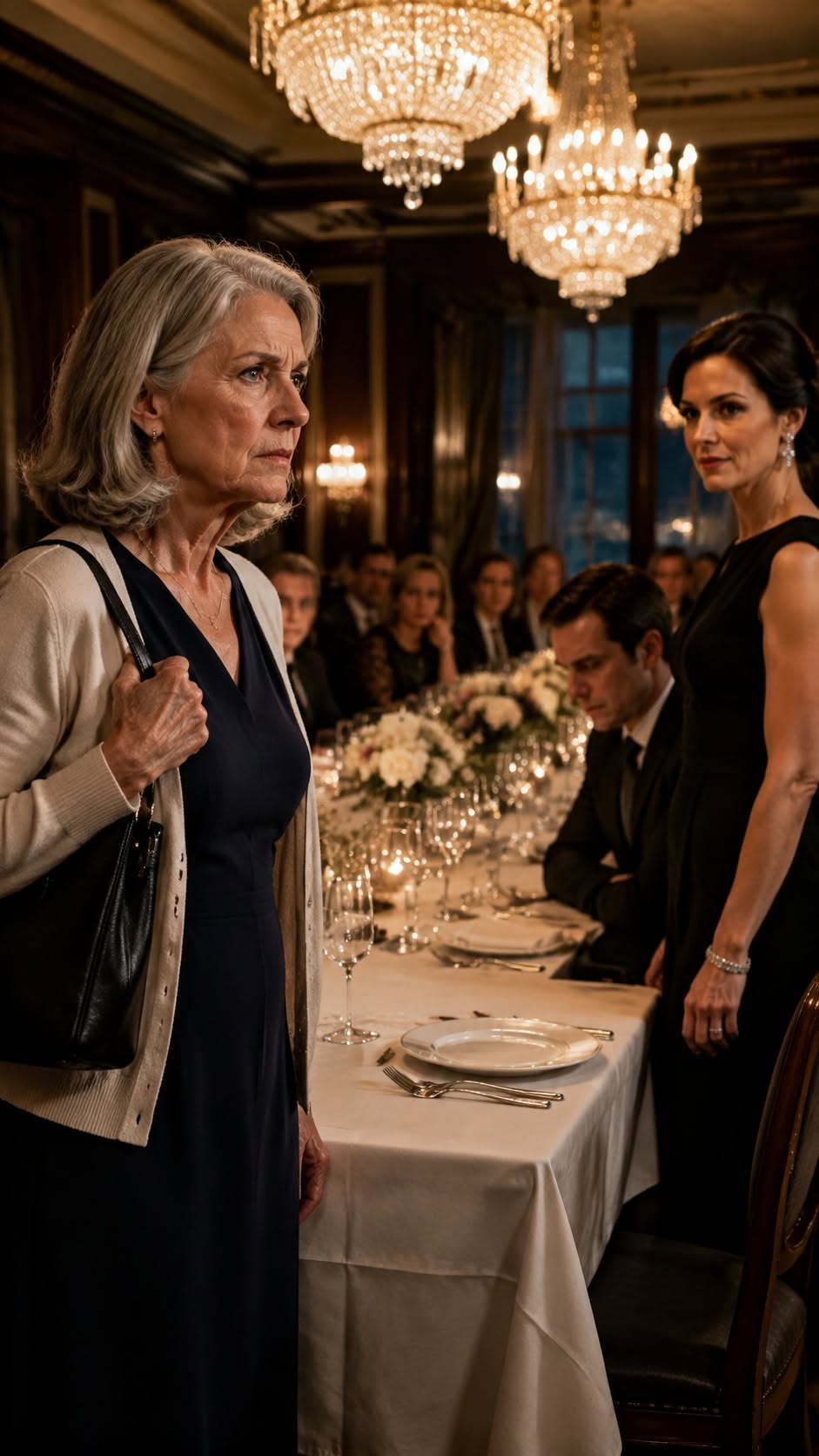
I kept telling myself there had to be a reasonable explanation. Then one look, one sentence, and one terrible detail proved there wasn’t.
“There’s no chair for you, Wilma. Go eat in the restroom. You’re used to it.”
For one breathless second, I wondered if I had misunderstood. Tessa stood beside the only empty chair at the long dining table, one hand resting possessively on its back, her diamond bracelet catching the chandelier light as she smiled at me. I hadn’t misunderstood.
My daughter-in-law had just told me, in front of twenty-four people, that I should eat my dinner in a restroom.
The private dining room seemed to shrink around me. Conversations stopped. Crystal glasses hovered halfway to mouths. Someone at the far end of the table gave a little nervous laugh, then immediately looked down at his plate when he realized Tessa wasn’t joking. Nobody defended me.
That hurt more than her words.
The room shimmered beneath three enormous golden chandeliers. White linen covered the table. Silverware lay in perfect rows, and every place setting carried a handwritten menu embossed with Reid’s name and the title he had finally earned after six years of promotions, late nights, and office politics.
Senior vice president. That was what everyone had come to celebrate. And I had quietly paid for all of it.
The room. The catering. The champagne. The wine. The flowers. The musicians playing softly near the windows. Every single dollar. Nobody knew because I had never wanted them to know. I looked at my son.
“Reid?”
His jaw tightened. He glanced at Tessa, then at the empty chair, then at me.
“Mom, maybe just—”
“Just what?” I asked.
He swallowed. Tessa answered for him.
“Don’t make a scene.”
I almost laughed.
She had humiliated me in front of his boss, his colleagues, their spouses, and several people I had known longer than she had been married to my son. Yet somehow I was the one threatening to make a scene. I looked around the table again.
A woman named Claire, who had spent the first half of the evening telling me how wonderful Reid was, suddenly became fascinated by her napkin. His boss, Martin, stared at his wineglass. Two younger executives whispered to each other and stopped when I turned my head.
Then I noticed something that made the whole thing worse. There was a chair behind Tessa.
Not another chair for a guest. A chair someone had pulled away from the table and left near the wall. She had moved it. She had known exactly what she was doing.
“Tessa,” I said quietly, “did you move that chair?”
Her smile flickered.
“Honestly, Wilma, we’re not doing this.”
“Did you?”
She lifted one shoulder.
“You weren’t supposed to be sitting with everyone tonight.”
Reid closed his eyes for a second. I stared at him.
“Were you aware of that?”
He didn’t answer. That was my answer. I nodded once.
“All right.”
Tessa gave a small, satisfied breath, as if she had won an argument. I picked up my handbag.
“I’m leaving.”
“Mom,” Reid said.
I stopped.
He looked miserable now, but misery was not the same thing as courage.
“Please don’t leave like this.”
I turned back.
“How should I leave?”
He opened his mouth. Nothing came out. I waited three seconds. Then I walked out. Nobody followed me.
Outside, the night air was cooler than I expected. I stood beneath the restaurant’s awning while a valet hurried past with someone else’s keys, and for a moment I could still hear the muffled music through the doors. My phone was already in my hand. I called the restaurant manager.
“This is Mrs. Tate.”
His voice changed immediately.
“Good evening, Mrs. Tate.”
“Please remove my payment method from tonight’s reservation.”
There was a short silence.
“Understood.”
He knew exactly what I meant. I had booked private dinners there before. I had paid for anniversary parties, charity luncheons, and once, quietly, a memorial dinner for a woman whose family couldn’t afford one. He had never asked why.
“Should we inform the party now?” he asked.
“No.”
“Then when?”
I looked through the glass doors at the room where my son was still sitting beside his wife.
“Wait until they request the check.”
“Of course.”
I hung up. Then I walked to my car. I did not cry.
Not in the car. Not at the traffic light. Not when I pulled onto Sycamore Street and saw the narrow brick building where I had lived for the last three years.
My apartment was small enough that I could stand in the kitchen and see the front door. There was no marble foyer, no landscaped driveway, no heated garage. The living room held a secondhand sofa, two bookshelves, and a round wooden table I had bought for eighty dollars at an estate sale.
It was quiet. I liked quiet.
I had learned to like it after discovering how loudly people spoke when they thought you had money. I had barely taken off my coat when my phone rang. Once. Twice. Three times. I ignored every call. On the fourth, I answered.
“Mom?”
Reid sounded frightened. I sat at the little kitchen table.
“There’s a problem.”
I said nothing.
“The restaurant says the payment method was removed.”
I looked at the clock. Nine seventeen.
“The bill is almost four thousand dollars,” he continued. “Everyone is waiting.”
“How unfortunate,” I said.
His breathing sharpened.
“Can you fix this?”
I closed my eyes. There it was. Not *Mom, are you all right?* Not *I’m sorry.* Not even *Tessa went too far.* Can you fix this? I opened my eyes.
“Do you remember what your wife said to me tonight?”
Silence.
“And do you remember what you did when she said it?”
Another silence. In the background, I heard Tessa’s voice.
“Tell her the restaurant made the mistake. Why is she acting like this is some huge thing?”
I smiled without humor.
“Put me on speaker.”
Reid hesitated.
“Now.”
A click sounded.
Then the restaurant noise became faintly audible through the phone. Twenty-four people were suddenly listening. I imagined their faces. The same people who had watched me leave without saying a word. I took one slow breath.
“Tessa.”
“What?”
“You told me there was no chair for me.”
“I was joking.”
“No, you weren’t.”
“I was trying to keep the dinner organized.”
“By telling me to eat in the restroom?”
Her voice sharpened.
“You’re taking one sentence and turning it into some enormous betrayal.”
I heard a chair scrape against the floor. Perhaps someone had finally stood up. I said, “Do you know who paid for tonight?” Tessa didn’t answer. Reid did.
“You did.”
“No,” I said. “You knew I arranged it. That’s different.”
“You paid for it,” he said quietly.
“Yes.”
A silence followed. Then Tessa said, “So what? You’re his mother. You offered.” I looked at the little wooden table in front of me.
There was a scratch along its edge from when I had moved it into the apartment myself.
“I offered to celebrate my son,” I said. “I did not offer to finance my own humiliation.”
“Wilma,” Tessa snapped, “if you’re angry, fine. But don’t punish Reid because you don’t like me.”
I heard Reid inhale. He knew that wasn’t what I was doing. I said, “I’m not punishing Reid.”
“Then pay the bill.”
Someone at the restaurant audibly gasped. Tessa continued before anyone could stop her.
“You made the reservation. You invited everyone. You can’t suddenly decide you’re offended and leave twenty-four people sitting here.”
I almost admired the confidence. She still believed the money was the point. She still believed I was bluffing. I leaned back in my chair.
“Reid.”
“Yes?”
“Do you remember the conversation we had this afternoon?”
He went very still. Tessa said, “What conversation?” Reid didn’t answer. I continued.
“The one about the offer.”
Tessa’s voice changed immediately.
“What offer?”
I heard Reid say her name under his breath.
“Tessa.”
“No. What offer?”
I could almost see her turning toward him. I said, “One hundred sixty-five million dollars.” The restaurant went silent. Even through the phone, I could feel it. Tessa spoke first.
“Wilma, what are you talking about?”
I looked toward the dark window over my sink.
For years, I had believed silence protected the people I loved. I had believed that if I kept certain numbers, names, signatures, and ownership records away from Reid, he could build a life without constantly wondering what would be his one day. I had been wrong.
Silence had not protected my son. It had protected the version of me his wife had invented. The harmless widow in the small apartment. The mother who could be insulted because she would forgive. The woman who would always pay. That woman had just disappeared.
“Mom,” Reid whispered, “please don’t do this tonight.”
“I’ve already done it.”
Tessa laughed nervously.
“You’re seriously threatening us over a dinner bill?”
“No.”
I stood and walked to the kitchen cabinet above the refrigerator. Inside was a blue folder I had not touched in six months. I took it down. The weight of it felt strangely reassuring in my hands.
“No one at that table needs to pay tonight,” I said.
Tessa exhaled in relief.
Then I added, “Because I already arranged for the bill to be settled.” Reid said nothing. Tessa said, “See? I knew you wouldn’t actually—”
“The restaurant will be paid from the account I opened for the event,” I said. “Not the account you expected to use.”
Her breathing stopped. Reid spoke slowly.
“What account?”
I opened the blue folder.
The first page was a copy of a corporate resolution bearing my late husband’s signature from twenty-two years earlier. The second was a current ownership statement.
And beneath it was the number I had spent years keeping out of my son’s life. I said, “The same account that received the proceeds from Tate Meridian.” Reid’s voice became barely audible.
“Mom…”
Tessa asked, “What is Tate Meridian?” I looked at the papers.
Then I said the words I had promised myself I would never have to say to my own son.
“Reid, you need to come home.”
He was silent.
“Tonight.”
“Why?”
“Because tomorrow morning, the lawyers will make this official.”
Tessa’s voice rose.
“Make what official?”
I closed the folder.
“The sale.”
Reid whispered, “You accepted it?”
“Yes.”
“The offer?”
“Yes.”
“For one hundred sixty-five million?”
“Yes.”
Tessa suddenly shouted, “You can’t sell it!” I froze. Not because of the volume. Because of the certainty in her voice. She had not asked what *it* was. She knew. I slowly sat back down.
“Interesting,” I said.
There was a long silence on the phone.
Then Tessa said, much more quietly, “I mean… whatever you’re talking about, you can’t make decisions that affect Reid without telling him.” I stared at the folder. There it was. The terrible detail I had been too blind to see. My daughter-in-law had not been surprised by the number.
She had been afraid of losing whatever that number represented. I said, “Come to my apartment.” Reid asked, “Now?”
“Yes.”
Tessa immediately said, “I’m coming too.” I looked at the folder again.
“All right.”
I paused.
“Bring the house keys.”
Neither of them spoke. I hung up. For the first time that night, my hands began to shake. Not from fear.
From the knowledge that by sunrise, my family would finally know who I had been all along.
The knock came twenty-three minutes later.