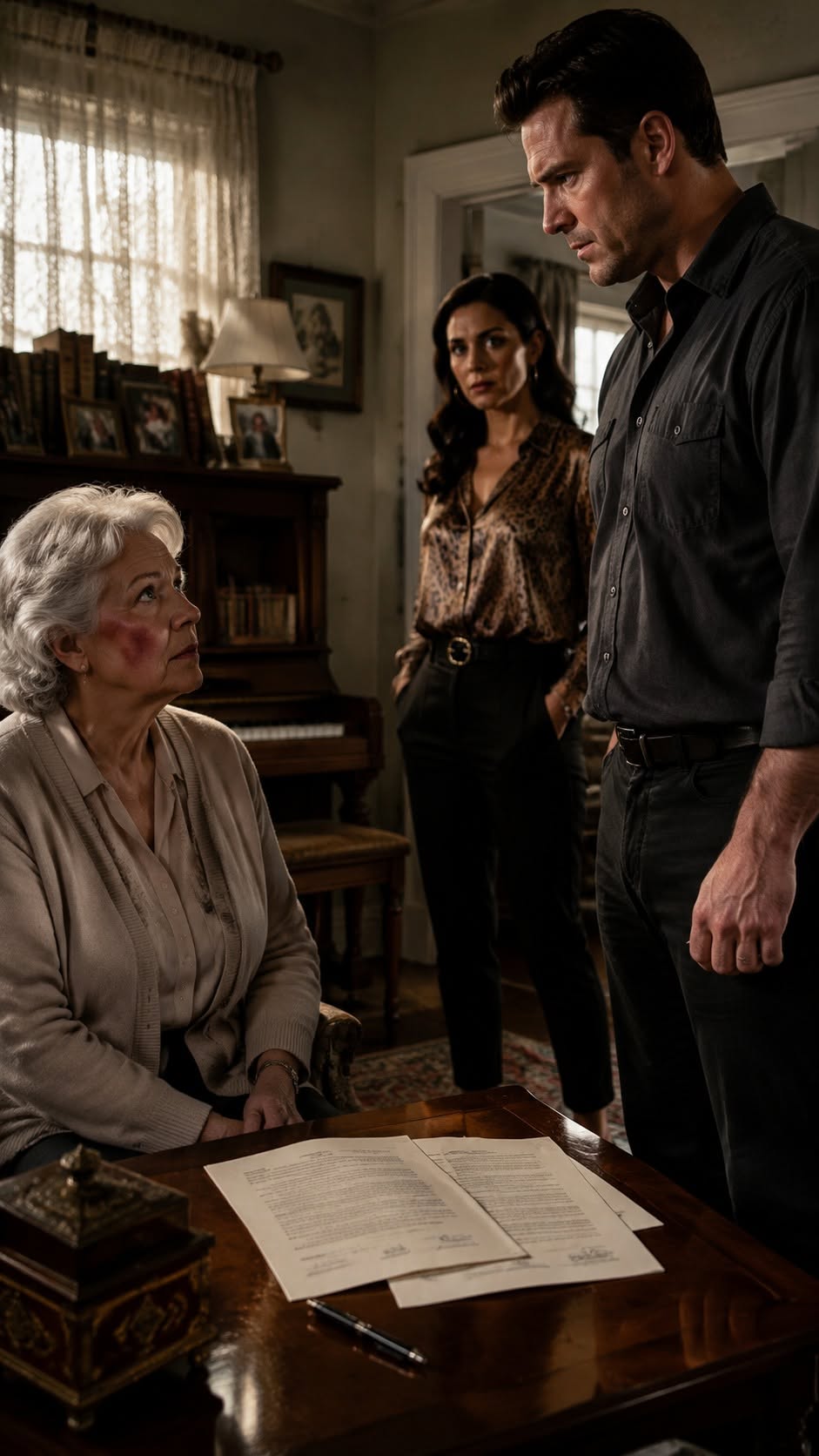
I thought the confrontation would last a few uncomfortable minutes. Instead, my son raised his hand, struck me across the face, and changed what the word family meant to me forever.
Daniel’s palm caught my cheek with such force that my head snapped sideways. For one stunned second, I saw nothing but the lace curtains trembling in the afternoon light, and then the room came back—the polished piano, Robert’s old books, the framed photograph of Daniel at twelve, grinning beside the magnolia tree.
I did not scream. I did not cry. I turned my face back toward my son and looked at him.
The little boy who had once crawled into my bed during thunderstorms was gone. In his place stood a thirty-nine-year-old man with a red mark across his knuckles and the expression of someone who had just crossed a line he had never believed would exist.
Marissa stood behind him in the doorway, one hand pressed dramatically to her chest. But she was not looking at me. She was looking at the deed.
Daniel followed her eyes to the papers on the coffee table. Then he picked them up, smoothed the top page, and pushed them toward me again.
“Sign it, Mom.”
My cheek burned.
“No.”
His jaw tightened.
“You don’t understand what you’re doing.”
“I understand perfectly.”
“This house is worth more than a million dollars. You’re living here alone. I’m your son. Why are you making this difficult?”
I looked at the deed.
“Because you are asking me to give you my home.”
“I’m asking you to transfer it to family.”
“You slapped me.”
His eyes flickered toward Marissa.
“That was a mistake.”
“No,” I said quietly. “It was a decision.”
Marissa stepped forward.
“Linda, please don’t turn one bad moment into something it doesn’t have to be. Daniel is under pressure. You know that.”
I looked at her.
“Pressure doesn’t make a man’s hand move by itself.”
Daniel’s face hardened.
“Enough. Sign the paper.”
“No.”
He leaned toward me.
“Then you’re going to regret this.”
I held his stare until he finally looked away.
That was when I understood something I had refused to understand for years: Daniel was no longer asking me for help. He believed he was collecting what belonged to him.
And he believed I was the only thing standing between him and everything he wanted.
For thirty-eight years, I had lived in that house with Robert. We had raised Daniel there, measured his height against the pantry door, wrapped presents beneath the staircase, and buried two beloved dogs beneath the magnolia trees. After Robert died, I had stayed because every room still carried pieces of the life we had built.
Daniel knew that. He also knew exactly how much the house was worth.
For years, I had paid his tuition, bought his first car, covered the losses from three businesses he promised would succeed, and made one “temporary” mortgage payment that somehow lasted fourteen months. When Robert died, Daniel said he needed somewhere to stay while he got himself back on his feet.
I gave him the guesthouse. Then Marissa moved in. The requests changed first. Then the tone.
The guesthouse became “our side of the property.” My driveway became “shared access.” My kitchen became a place where Marissa complained that the appliances were outdated. Daniel began talking about renovations, resale values, and what the property would look like if someone “modernized” it.
Last night, all of that had become a deed on my coffee table. And a bruise beneath my eye. Daniel gathered the papers.
“I’ll give you until morning.”
“You won’t get an answer different from the one I gave you tonight.”
He smiled without warmth.
“We’ll see.”
He and Marissa went upstairs. I remained where I was until I heard the bedroom door close. Only then did I touch my cheek. My fingers came away trembling. I looked at the framed photograph of Robert on the mantel.
“What did you know?” I whispered.
The photograph gave me no answer. By sunrise, the swelling beneath my eye had turned dark purple. I stood in the kitchen ironing my best lace tablecloth. Not because I had surrendered. Because I wanted breakfast.
If Daniel expected tears, pleading, or an old woman begging her son not to abandon her, he was going to be disappointed.
I set out the good china. Eggs. Biscuits. Bacon. Fresh fruit. Coffee. I polished Robert’s silver creamer until I could see my reflection in it. Then I placed a fourth plate at the table. I did not know whether anyone would sit there. But I knew someone was coming.
At eight fifteen, footsteps sounded on the back stairs.
Daniel entered first, wearing wrinkled sweatpants and a shirt he had slept in. Marissa followed in a silk robe, her hair pinned loosely on top of her head. Daniel stopped when he saw the table.
His eyes moved over the food, the polished silver, the china, and finally the lace tablecloth. A satisfied smile appeared.
“So,” he said. “You finally learned.”
I lifted my coffee cup.
“Learned what?”
“That fighting me isn’t going to help.”
Marissa sat down without being invited.
“This could have been so much easier, Linda.”
I buttered a biscuit.
“I’m sure it could have.”
Daniel pulled out a chair. Then he noticed the fourth place setting. His hand stopped halfway to the chair.
“Who’s coming?”
I took a sip of coffee.
“Someone who has something to say.”
Marissa laughed softly.
“Oh, Linda. Don’t start with the games.”
Daniel did not laugh. He was staring at the empty chair. Then the kitchen door opened. An older man stepped inside carrying a worn leather folder.
He had silver hair, a dark suit, and a narrow face I remembered from another lifetime. Daniel went completely still. Marissa looked from him to Daniel.
“Who is that?”
The man set the folder on the table.
“Martin Hale.”
Daniel’s face lost all color. I knew the name too. Martin had been Robert’s attorney for more than twenty years.
He had handled the purchase of the house. He had prepared Robert’s first will. He had stood beside us when Robert signed the papers that divided his business interests after retirement. And he had not spoken to Daniel since Robert’s funeral. Daniel took one step backward.
“You weren’t supposed to be here.”
Martin looked at him calmly.
“No. I was supposed to be here three years ago. Your father asked me to wait.”
Marissa frowned.
“Wait for what?”
Martin looked at me.
“For Linda to refuse.”
The room went silent. Daniel’s voice dropped.
“Refuse what?”
Martin opened the folder. Inside was a small digital recorder, a notarized document, and several photographs. Daniel stared at the recorder as if it were a weapon.
“Where did you get that?”
Martin did not answer him immediately. He turned the recorder toward me.
“Robert left instructions that I was not to give you anything until your son tried to take this house from you.”
My breath caught. Daniel’s chair scraped backward.
“That’s impossible.”
“Is it?”
“My father never—”
“Your father knew exactly who you were becoming.”
Daniel slammed his palm against the table.
“Don’t talk about my father like you knew him.”
Martin’s expression did not change.
“I knew him well enough to know he was afraid of what you would do after he died.”
Marissa stood.
“This is ridiculous. We should leave.”
Martin finally looked at her.
“You can leave if you want. But if you do, you’ll miss the part where your name appears in the evidence.”
Marissa froze. Daniel turned toward her.
“What does he mean?”
She stared at Martin.
For the first time since she had moved into my guesthouse, she looked frightened. Martin reached for the recorder.
“There is something you both need to hear.”
Daniel shook his head.
“No.”
Martin pressed a button. Static crackled through the kitchen. Then Robert’s voice filled the room. Older. Tired. Unmistakable.
“Linda, if you’re hearing this, Martin finally decided the time had come.”
My hand tightened around the coffee cup. Daniel whispered my husband’s name.
“Dad…”
Robert’s recorded voice continued.
“I hope I’m wrong about why you’re listening. I hope Daniel never asks you for this house. I hope he proves me wrong before you ever hear these words. But if he has put a deed in front of you and told you that you owe him the property, then he has done exactly what I feared.”
Daniel moved toward the recorder. Martin stood.
“Don’t touch it.”
“Turn it off.”
“No.”
“Turn it off!”
Martin did not move. Robert’s voice continued.
“Linda, the deed Daniel is showing you is not the deed that controls this property.”
My heart began pounding. Daniel stared at Martin.
“What did he do?”
Martin opened the second compartment of the folder.
He removed a thick original document bearing Robert’s signature, a county seal, and a date from six months before Robert died. He placed it beside Daniel’s deed. The two documents looked nothing alike. Martin tapped the original with one finger.
“Your father transferred the house into a protected family trust before his death.”
Daniel stared at the page.
“That’s not possible.”
“It is.”
“I would have known.”
Martin gave him a cold look.
“That was the point.”
Marissa stepped closer.
“What does the trust say?”
Martin turned the page toward her.
“It says Linda owns the right to live here for the rest of her life. It also says the property cannot be sold, mortgaged, transferred, or pledged by Daniel under any circumstances.”
Daniel’s breathing changed.
“I’m his son.”
“Yes.”
“I’m the beneficiary.”
Martin nodded.
“You were.”
The kitchen seemed to shrink around us. Daniel looked at the document again.
“Were?”
Martin closed the folder.
“That’s the part your father wanted me to explain after you heard the recording.”
He reached for the final document. Daniel suddenly lunged across the table. Martin caught his wrist.
“Don’t.”
Daniel pulled free.
“What did my father change?”
Martin looked at me. Then he slid the document across the table.
At the bottom, beneath Robert’s signature, was a clause I had never seen before. Daniel read it once. Then again. His mouth opened, but no words came. Marissa leaned over his shoulder. Her face changed too. I looked down at the final paragraph. And finally understood why Robert had told Martin to wait.
He had not merely protected my home.
He had prepared for the exact moment my son tried to steal it. the clause again. The words blurred for a moment. Then they sharpened.
If Daniel attempted to sell, transfer, mortgage, encumber, or obtain possession of the property through coercion, deception, or fraud, his beneficial interest in the trust would terminate immediately. I looked at Martin.
“He put that in there?”
Martin nodded.
“Six months before he died.”
Daniel’s face had gone rigid.
“That’s not what that means.”
“It means exactly what it says.”
“No. My father wouldn’t cut me out.”
Martin’s eyes remained on him.
“Your father spent thirty-two years loving you. That doesn’t mean he was willing to let you destroy your mother.”
Daniel pushed the document away.
“This is forged.”
Martin almost smiled.
“You just accused the attorney who prepared the document, the notary who witnessed it, and the county recorder who accepted it of participating in a forgery. You may want to choose your next words carefully.”
Marissa grabbed Daniel’s arm.
“Let’s go.”
He shook her off.
“I’m not leaving.”
“Daniel.”
“I said I’m not leaving.”
He pointed at the papers.
“This is my father’s house.”
I heard my own voice before I realized I was going to speak.
“No.”
Daniel turned toward me. I put my hand flat on the table.
“It was our house. Robert’s and mine. And when he died, he made certain it would remain my home.”
Daniel stared at me.
“He didn’t trust me.”
“Apparently not with this.”
His nostrils flared.
“You think this makes you better than me?”
“No.”
I looked at his red knuckles.
“I think what you did last night makes you responsible for what happens next.”
For several seconds nobody moved. Then Martin reached into the folder again. He removed a sheet of paper and placed it beside the trust.
“There is another reason your father wanted me to wait.”
Daniel’s eyes narrowed.
“What now?”
“The deed you brought Linda yesterday.”
Daniel looked at it.
“What about it?”
Martin turned the first page toward me.
“Linda, did you sign this?”
I looked at the signature. It was mine. Or it looked like mine. The same looping L. The same long stroke beneath my name. But I shook my head.
“No.”
Daniel immediately spoke.
“She signed it.”
I looked at him.
“I did not.”
“Mom—”
“I did not sign that document.”
Martin tapped the signature.
“Good. Because this is where things become considerably worse for your son.”
Marissa stepped closer.
“You’re making a mistake.”
Martin looked at her.
“Am I?”
“Daniel told me she signed it.”
The words came out before Marissa seemed to realize she had said them. Daniel turned sharply.
“Marissa.”
She blinked.
“What?”
“What did you just say?”
“I said you told me she signed it.”
Daniel’s mouth tightened. Martin calmly lifted another page.
“The signature was copied from an older document in Linda’s records. The notary stamp is genuine, but the notary has already confirmed that Linda was not present when this was supposedly executed.”
My stomach dropped.
“How do you know?”
“Because Robert anticipated that someone might try this.”
Daniel laughed once, harshly.
“My father was paranoid.”
“Your father was careful.”
“You’re lying.”
Martin reached into his jacket and produced a business card.
“Then you will have no objection to speaking with the notary yourself. Her name is Denise Porter. She has already agreed to give a sworn statement.”
Daniel stared at the card. His confidence was beginning to crack. Marissa noticed it too.
“Daniel, maybe we should—”
“Stop telling me what to do.”
She recoiled. Martin folded his hands.
“There is more.”
Daniel closed his eyes briefly.
“Of course there is.”
Martin picked up the small digital recorder.
“Your father left two recordings. One for Linda. One for me. The first explains why he created the trust. The second explains what he believed you might eventually do.”
I stared at the recorder.
“He knew?”
“He suspected.”
“About Daniel?”
“About the possibility that money would become more important to Daniel than his relationship with you.”
Daniel stepped forward.
“You’re enjoying this.”
Martin’s expression hardened.
“No. I am trying to finish the job your father entrusted to me.”
He pressed the button again. Robert’s voice filled the kitchen.
“Martin, if Daniel ever tries to force Linda to sign anything, do not warn him first. Do not negotiate with him. Give Linda the documents and let the evidence speak.”
Daniel looked toward the ceiling as if he could somehow escape the sound. Robert continued.
“And if he has someone helping him, preserve everything. Don’t assume the person beside him will stay loyal once the truth comes out.”
Marissa’s face went pale. Daniel looked at her.
“What does he mean by that?”
She said nothing. The recording clicked off. Martin placed both hands on the folder.
“Your father also left instructions concerning the financial records connected to the property.”
Daniel’s voice was barely controlled.
“What financial records?”
Martin looked directly at him.
“The mortgage application.”
Silence. I frowned.
“What mortgage application?”
Daniel’s eyes closed. Martin slid a copy across the table.
“Three weeks ago, someone applied for a six-hundred-thousand-dollar loan using this property as collateral.”
My fingers went cold.
“What?”
“The application listed Linda as the owner and borrower.”
I looked at Daniel. He said nothing.
“I never applied for a loan.”
“I know.”
Martin pointed to the signature.
“This is the same copied signature.”
I looked at the page. The room seemed to tilt.
“Why would anyone need six hundred thousand dollars?”
Daniel finally spoke.
“I was going to refinance it.”
“You said you were transferring the house to yourself.”
“It was temporary.”
“Six hundred thousand dollars is temporary?”
“I could have paid it back.”
“With what?”
He didn’t answer. Martin did.
“With the proceeds from selling the property.”
Daniel slammed his fist against the counter.
“I wasn’t going to throw her out!”
I flinched at the sudden movement, but I did not step away.
“Then why did the application list a projected sale value of one million four hundred thousand dollars?”
His face tightened.
“Because that’s what it’s worth.”
“And what was I supposed to do?”
He looked at me. For a moment, he seemed almost like the boy I remembered. Then the moment disappeared.
“You could have lived somewhere smaller.”
The words landed harder than his hand had. Marissa whispered, “Daniel.” He looked at her.
“What? It’s true. She doesn’t need all this space.”
I stared at him.
“You were going to sell my home and put me somewhere smaller.”
“I was going to take care of you.”
“By taking my house?”
“By making sure you had money.”
Martin shook his head.
“You weren’t going to give Linda the money.”
Daniel turned on him.
“You don’t know that.”
Martin opened another file.
“The bank records say otherwise.”
He removed a printed statement.
“The mortgage application was connected to three outstanding business debts, two personal credit accounts, and a private lender demanding repayment.”
Daniel’s face changed. I looked at him.
“How much do you owe?”
He said nothing.
“Daniel.”
“It doesn’t matter.”
“It matters to me.”
“You wouldn’t understand.”
“Then explain it.”
He dragged a hand through his hair.
“I made some mistakes.”
Martin’s voice was quiet.
“Three hundred and eighty-seven thousand dollars’ worth of mistakes.”
Marissa suddenly stepped away from Daniel. He noticed.
“Why are you backing up?”
“I’m not.”
“You are.”
“Daniel, this is getting out of control.”
“You knew about the debt.”
She folded her arms.
“I knew you had problems.”
“You knew about the house.”
“You said it would be ours.”
The words hung in the air. Daniel stared at her. I looked from one to the other. Martin quietly opened the folder again.
“There is something else you should hear.”
Daniel shook his head.
“No.”
“This recording was made before the deed was prepared.”
My heart began beating faster.
“What recording?”
Martin removed a small memory card sealed in a plastic evidence sleeve.
“A video.”
Daniel went completely still. Marissa whispered, “Where did you get that?” Martin looked at her.
“From Robert.”
“Robert died three years ago.”
“Yes.”
“Then how—”
Martin interrupted her.
“Your husband had security cameras installed in the study after his first fall. One of them recorded sound as well. Robert’s system backed up automatically to a remote server. He never told Daniel about it.”
Daniel’s eyes widened.
“You have my father’s security footage?”
“The relevant portion.”
Martin took out a tablet. He placed it on the table.
“I watched it yesterday. I recommend that everyone in this room watch it now.”
Daniel shook his head.
“You can’t use that.”
“Why not?”
“Because it’s private.”
Martin looked at him.
“You were discussing a fraudulent transfer of property you did not own.”
Daniel’s lips parted. No answer came. Martin pressed play. The screen showed Robert’s study. I recognized the room immediately.
Robert’s desk stood beneath the window. His leather chair was turned slightly toward the bookshelves. The grandfather clock in the corner showed 9:42 p.m. Then Daniel walked into the frame. My stomach tightened. He looked younger. Angrier.
He was standing exactly where he had stood dozens of times when arguing with his father. Then Marissa appeared behind him. The recording was dated eleven months before Robert died. Daniel’s recorded voice filled the kitchen.
“If he doesn’t change the will, we’re finished.”
Marissa answered, “He won’t change it for you.”
“Then I’ll make him.”
I closed my eyes. Robert’s study disappeared behind my eyelids. I heard Marissa laugh softly.
“How?”
“Mom.”
“She’ll never agree.”
“She doesn’t have to agree if Dad leaves it to me first.”
“And if he doesn’t?”
Daniel leaned against the desk.
“Then we wait.”
Marissa folded her arms.
“You said the house would be ours.”
“It will be.”
“I want that in writing.”
Daniel laughed.
“You think my mother is going to live forever?”
My hand went to my mouth. Martin paused the video. Nobody spoke. I could hear the refrigerator humming behind me. Daniel stared at the frozen image of himself.
“That’s taken out of context.”
Martin didn’t respond.
“Play it.”
I said it. Martin looked at me.
“Are you sure?”
I nodded.
“Play it.”
The video continued. Marissa’s voice came next.
“What if Robert changes everything?”
Daniel answered immediately.
“He won’t. He thinks I’m still the kid who needs saving.”
“And Linda?”
“Mom will do whatever I tell her once Dad is gone.”
Marissa laughed.
“You really believe that?”
“I know her.”
Daniel leaned toward her.
“She can’t stand the idea of losing me. That’s the weakness.”
The recording ended. Martin turned the screen off. Daniel stood motionless. I looked at him.
“You knew exactly how to hurt me.”
His eyes met mine.
“Mom—”
“Don’t.”
He stopped.
“Don’t call me Mom as if that word can undo what you just said.”
His shoulders dropped. For the first time, he looked tired instead of angry. But Marissa was staring at him with something different in her eyes. Fear.
“You told me Robert was going to leave you the house.”
Daniel looked at her.
“I thought he would.”
“You told me the trust didn’t exist.”
“I didn’t know about it.”
“You told me your mother had already agreed.”
Daniel looked away. Marissa’s voice rose.
“You told me this was done.”
“I said I was handling it.”
“You said we would have the house.”
“We still might.”
Martin gave a short, humorless laugh.
“No, Daniel. You won’t.”
Daniel turned.
“You don’t get to decide that.”
“Your father did.”
Martin pointed to the clause.
“And then you made the mistake of triggering it.”
Daniel stared at the page.
“What happens now?”
Martin’s answer was immediate.
“Your beneficial interest ends.”
Daniel swallowed.
“And the house?”
“Remains in the trust. Linda remains the life tenant.”
“After she dies?”
Martin closed the folder.
“We can discuss the remainder beneficiaries after we deal with the fraud you attempted today.”
Daniel’s face hardened.
“You’re going to report me.”
“Yes.”
“You’re my father’s friend.”
“I was your father’s attorney.”
“And I’m his son.”
Martin looked at him for a long moment.
“That is precisely why your father gave you so many chances.”
Daniel’s eyes dropped. Martin gathered the documents.
“I am taking these to counsel this afternoon. The bank will be notified that the loan application is fraudulent. The county recorder will be notified that the deed is fraudulent. And the notary will provide her statement.”
Daniel moved toward him.
“Wait.”
Martin stopped.
“Please.”
It was the first time I had heard Daniel say that word that morning. He looked at me.
“Mom, I can fix this.”
I stared at the bruise reflected faintly in the silver creamer.
“You had years to fix it.”
“I was scared.”
“So you hit me?”
His eyes filled.
“I don’t know why I did that.”
“I do.”
He waited.
“Because you thought I would forgive you.”
His mouth trembled. Marissa suddenly grabbed her purse.
“I’m leaving.”
Daniel turned toward her.
“What?”
“I can’t be part of this.”
“You are part of this.”
She shook her head.
“No. You did it.”
Martin watched her carefully.
“That isn’t what the video shows.”
Marissa froze. Martin opened the folder one last time.
“There are three more minutes after the portion I just played.”
Her face went white. Daniel stared at her.
“Three more minutes?”
Martin nodded.
“Your conversation continues.”
Marissa whispered, “No.”
“You discuss the deed. You discuss the loan. And you discuss what will happen to Linda after the sale.”
Daniel slowly turned toward Marissa.
“What did you say?”
She backed toward the kitchen door.
“Nothing.”
Martin looked at me.
“Do you want to hear it?”
I looked at Daniel. Then Marissa. Then the tablet. My fingers closed around the edge of the table.
“Yes.”
Martin pressed play. The frozen image returned. Daniel’s recorded voice came first.
“Once the loan clears, we sell.”
Marissa answered, “And Linda?” Daniel laughed.
“She’ll have to move.”
“Where?”
“Somewhere cheap.”
There was a pause. Then Marissa asked the question that made my blood run cold.
“What if she refuses?”
Daniel’s recorded voice became quiet.
“Then we’ll make her choose between losing me and losing the house.”
The video continued. Marissa asked, “And if she still refuses?” Daniel answered without hesitation.
“Then we make sure she can’t stop us.”
The screen went black. Nobody breathed. Then Marissa whispered, “Daniel, that isn’t what you meant.” He looked at her.
“What did I mean?”
“You were angry.”
“What did I mean?”
She had no answer. Daniel looked at me.
I saw the exact moment he realized there was nothing left for him to say that could put the family back the way it had been. Martin closed the tablet.
“I have one final item.”
Daniel’s eyes narrowed.
“What?”
Martin removed a sealed envelope from the bottom of the folder. It had Robert’s handwriting on the front. Linda. My hands began to shake. Martin held it out.
“Your husband instructed me to give this to you only after Daniel’s attempt was documented.”
I reached for it. Daniel stepped forward.
“Mom, don’t open that.”
I stopped. I looked at him.
“Why?”
He couldn’t answer. Martin’s voice was quiet.
“Because whatever Robert wrote in that letter, Daniel already knows he cannot change it.”
I broke the seal. Inside was a single handwritten page. The first line made my breath catch.
“My darling Linda, if you are reading this, then our son has finally forced you to see what I could not make you believe while I was alive.”
I looked up. Daniel was crying. Not loudly. Not theatrically.
Two tears slid down his face, and he wiped them away with the heel of his hand. But I kept reading.
And when I reached the final paragraph, I understood that the trust was not the greatest thing Robert had left me.
The greatest thing was the truth he had been waiting for me to discover myself.
I read the next lines slowly.
“Do not mistake my silence for blindness. I knew Daniel had debts. I knew about the money he borrowed from you, the businesses that failed, and the promises he made each time he came asking for another rescue. What I did not know, until shortly before my illness worsened, was how far he was willing to go.”
My eyes lifted. Daniel stared at the floor. Martin said nothing. I kept reading.
“I found the first forged signature in our bank records. I did not confront him because I wanted to know whether it was desperation or character. Then I found the second. After that, I knew.”
The paper trembled in my hands.
“You will be tempted to ask why I did not tell you. I was afraid you would protect him from the consequences again. I was afraid that if I told you, you would spend the rest of my life defending our son from the truth instead of letting him face it.”
A tear landed on the page. I wiped it away.
“Linda, I have loved Daniel every day of his life. But love is not the same as permission. If he ever tries to take the house, the trust will stop him. If he ever uses your name without your consent, the evidence will stop him. And if he ever raises a hand to you, I want you to understand something I should have told you years ago: you owe him nothing.”
I could not read for a moment. Then I reached the final paragraph.
“One more thing. I did not leave the remainder of the trust to Daniel automatically. I left him a chance to earn it. The house was to remain yours for life, and after you, the property was to pass according to the family trust only if Daniel proved that he could protect you rather than profit from you. If he failed that test, the remainder would pass to the children’s charity we supported together. I made that choice because I wanted our son to inherit our values, not simply our assets.”
The final line was written larger than the others.
“Do not give Daniel what I gave you because you feel sorry for him. If he ever comes back, let him come back as your son—not as the owner of your home.”
I lowered the letter. Daniel was still crying.
For a few seconds, the only sound was the clock on the wall. Then he whispered, “I didn’t know.” I looked at him.
“You knew enough.”
“No. I didn’t know Dad changed the trust.”
“You knew you were trying to take my house.”
His face crumpled.
“I thought I could fix everything.”
“With my life?”
He looked away. Marissa gave a short, bitter laugh.
“This is unbelievable.”
Martin turned toward her.
“Which part?”
She looked at him.
“All of it. Robert set a trap for his own son.”
“No,” Martin said. “Robert set a boundary. Daniel walked into it.”
Daniel turned on her.
“Stop.”
She folded her arms.
“You can’t blame me for this.”
“I didn’t say I was.”
“You told me your father would leave you the house.”
“I believed he would.”
“You told me Linda would sign.”
“I thought she would.”
“You told me the loan was already approved.”
Daniel went silent. Marissa’s eyes narrowed.
“Daniel?”
“The bank had given me conditional approval.”
“Conditional on what?”
He swallowed.
“The deed.”
Marissa stared at him.
“You told me the money was coming.”
“I said it might.”
“You said we could pay off everything.”
“I was trying to make it happen.”
Marissa stepped back.
“You knew the loan depended on a forged transfer.”
Daniel’s voice dropped.
“I knew I needed the house first.”
I watched her face change. It was not grief. It was calculation. She picked up her purse.
“I’m done.”
Daniel stared at her.
“You’re leaving?”
“Yes.”
“Now?”
“Yes, now.”
“After everything?”
She looked at the folder.
“There’s nothing left here for me.”
Daniel laughed once, almost in disbelief.
“So that’s what this was?”
Marissa’s eyes hardened.
“What did you think it was?”
He looked at her for a long moment. Then he nodded.
“Nothing.”
She turned toward the door. Martin’s voice stopped her.
“Before you leave, Marissa, you should know that your name appears on the loan correspondence.”
She froze.
“What correspondence?”
“The emails arranging the appraisal.”
Her face drained.
“I never signed anything.”
“I didn’t say you signed anything.”
“You said my name was there.”
“It is.”
“Then Daniel put it there.”
Daniel stared at her.
“Don’t do this.”
“I’m not doing anything.”
“You knew about the appraisal.”
“I knew you were getting an appraisal.”
“You knew why.”
“I thought you were buying the property.”
Martin interrupted.
“You discussed the sale price with the appraiser before the fraudulent deed was submitted.”
Marissa’s mouth opened. No sound came out. Martin placed a copy of an email on the table. Her own name appeared in the sender line. She read it. Then looked at Daniel.
“You said you handled everything.”
“I was trying to.”
“By using my name too?”
“I didn’t use your name.”
“Then why is it here?”
Daniel had no answer. Marissa snatched her purse from the chair.
“I am leaving.”
Daniel stepped toward her.
“You can’t just walk away.”
She looked at him.
“Watch me.”
The kitchen door slammed behind her. Daniel stood motionless. I looked at Martin.
“Is that the end of it?”
“No.”
He gathered the papers.
“Not legally.”
Daniel looked at me.
“Mom, please.”
I folded Robert’s letter and placed it back inside the envelope.
“Go home.”
“This is my home.”
“No.”
He flinched. I pointed toward the door.
“Your home is the guesthouse. For now.”
He looked at me.
“You’ll let me stay?”
“I’m not making that decision because I forgive you. I’m making it because I don’t want you on the street.”
His eyes filled again.
“Why?”
“Because I’m still your mother.”
I held his gaze.
“But that does not mean I am still your safety net.”
He nodded slowly. Martin picked up his briefcase.
“We need to move quickly.”
Daniel frowned.
“Where?”
“To the attorney handling the trust dispute.”
Daniel’s shoulders tightened.
“Already?”
“Your father instructed me not to delay once the trigger occurred.”
I looked at Martin.
“What trigger?”
He held my gaze.
“The attempted transfer.”
I understood.
The moment Daniel had put the deed in front of me, Robert’s final protection had become active. Martin continued.
“The bank has been notified. The county recorder will be notified. And we will file the trust documents today.”
Daniel looked at me.
“Can I come?”
I almost said no. Then I remembered Robert’s letter.
Let him come back as your son—not as the owner of your home. I nodded.
“You can come.”
The drive to the law office was silent. Martin drove. I sat beside him. Daniel followed in his car. I watched the city pass through the window.
Three years earlier, I had driven the same road beside Robert on the way to his last doctor’s appointment. He had held my hand at every red light.
“Don’t worry,” he had said.
I had laughed.
“You always say that when I should worry.”
He had smiled.
“Then worry about me. Not about the house.”
At the time, I thought he was joking. Now I knew he wasn’t. The attorney waiting for us was a woman named Evelyn Shaw. She read the trust amendment twice. Then she read the forged deed. Then she looked at me.
“Did you sign this?”
“No.”
“Did anyone have permission to sign on your behalf?”
“No.”
“Did you authorize the mortgage application?”
“No.”
She turned to Daniel.
“Did you prepare these documents?”
Daniel sat stiffly in the chair.
“I didn’t prepare them myself.”
“That wasn’t my question.”
He looked at Martin. Martin said nothing. Daniel rubbed his palms together.
“I gave the information to someone.”
“Who?”
He hesitated.
“An independent loan broker.”
“Name?”
He gave it. Evelyn wrote it down.
“Did you know the deed contained a forged signature?”
Daniel looked at the floor.
“I knew the signature wasn’t obtained normally.”
Evelyn stopped writing.
“That’s not an answer.”
“I knew.”
The room went quiet. I closed my eyes. There it was. Not an excuse. Not a story. The truth. Evelyn turned to me.
“Linda, I need you to understand what happens next. The trust is strong. The fraudulent transfer is likely void. But because there was an attempted loan secured against the property, we will have to formally unwind it and preserve all evidence.”
“Will Daniel go to jail?”
She looked at him.
“That depends on what the authorities determine.”
Daniel’s face went pale. I expected to feel satisfaction. I didn’t. I felt tired. Evelyn turned to him.
“If you want any chance of reducing the damage, you need to stop lying.”
Daniel swallowed.
“I’ll tell you everything.”
And for the first time since the slap, he did.
He told us about the debts. About the private lender. About the broker. About the appraisal. About the conversations with Marissa. About the forged signature. He admitted he had copied my name from an old mortgage document. He admitted he had used my identification information without permission.
And finally, he admitted something that made me grip the edge of the chair.
“I took money from Mom’s account.”
I looked at him.
“How much?”
He stared at the floor.
“Twenty-eight thousand.”
The room seemed to stop.
“Daniel.”
“I was going to put it back.”
“When?”
“When the business turned around.”
“The business was already closed.”
“I know.”
Evelyn’s voice was firm.
“Where did the money go?”
Daniel closed his eyes.
“Into the debt.”
I nodded once. Not because I accepted it.
Because now I understood why Robert had said he found the first forged signature. The house had never been the beginning. It had been the last attempt. The next morning, the bank representative met us at the office. She brought the original loan file.
The signature pages were examined. The application history was printed. The electronic records showed that the same device had accessed my personal information several times from the guesthouse. Daniel did not deny it. The bank representative looked at him.
“Did you know this was unauthorized?”
“Yes.”
“Did you submit the documents?”
“Yes.”
“And did you intend for the loan to be repaid through the sale of the property?”
“Yes.”
She closed the file.
“Thank you.”
Daniel looked at her.
“That’s it?”
“For today.”
Her voice was cold.
“You should speak to your attorney.”
By late afternoon, the county had placed a fraud alert against the attempted transfer. The property could not be sold. The mortgage could not be funded. The forged deed could not be recorded. But there was still the trust hearing.
Evelyn explained that the trust itself had to be formally recognized and Daniel’s beneficial interest challenged under the clause Robert had written.
“What happens to the house?” I asked.
“You keep your life interest.”
“And after me?”
She looked at the trust.
“The remainder goes to the Magnolia Children’s Foundation if Daniel’s interest is terminated.”
I looked at Martin.
“The charity Robert supported?”
He nodded.
I thought of Robert standing beneath the magnolia trees with Daniel on his shoulders. Then I looked at my son sitting across from me. He had his father’s eyes.
But he had made choices his father had spent years trying to prevent. The hearing was scheduled for the following week. That night, Daniel came to my kitchen door. He did not enter. He stood outside with his hands in his pockets.
“Can I talk to you?”
I looked at him.
“About what?”
“I don’t know.”
“Then maybe you shouldn’t.”
He nodded.
“I wanted to say I’m sorry.”
I said nothing.
“I know that doesn’t fix it.”
“No.”
“I know I don’t deserve the house.”
“No.”
He swallowed.
“I don’t even know why I thought I deserved it.”
“Because I spent your whole life rescuing you.”
He nodded.
“Yes.”
“And I taught you that love meant there would never be a consequence.”
His eyes filled.
“I thought you would always save me.”
“I did too.”
He looked down.
“I hurt you.”
“Yes.”
“I scared you.”
“Yes.”
He took a breath.
“Can I come inside?”
I looked at the doorway. Then at him.
“Not tonight.”
He nodded.
“Okay.”
He turned away.
“Daniel.”
He stopped. I did not invite him in. I only said, “Tomorrow, tell the truth again.” He nodded.
“I will.”
The hearing began at nine the following morning. Daniel sat beside his attorney. I sat beside Evelyn and Martin. Marissa was not there.
Her attorney had informed the court that she would cooperate with the investigation, and the emails she had provided had become part of the evidence. The judge reviewed the trust. Then the deed. Then the mortgage application. Finally, Evelyn submitted Robert’s amendment and the recorded video.
Daniel’s attorney tried to argue that Robert’s clause was punitive and ambiguous. Evelyn stood.
“Your Honor, the language is explicit. The beneficiary’s interest terminates upon an attempt to obtain the property through fraud, coercion, or unauthorized transfer.”
The judge looked at Daniel.
“Did you attempt to obtain the property?”
Daniel stood. His attorney touched his arm. Daniel gently moved it away.
“Yes.”
The courtroom became silent. The judge looked at him.
“Did you submit a document bearing a signature you knew the owner had not authorized?”
Daniel swallowed.
“Yes.”
“Did you attempt to secure financing using that property?”
“Yes.”
“Did you intend to sell the property to repay your debts?”
“Yes.”
His attorney closed her eyes. The judge looked down at the trust. Then she said the words I had been waiting to hear.
“Mr. Hale’s beneficiary interest is terminated pursuant to the trust instrument.”
Daniel closed his eyes. The judge continued.
“The property remains subject to Linda Hale’s lifetime right of occupancy and control as provided by the trust. The attempted mortgage is void as to the property. The fraudulent deed has no legal effect.”
I let out a breath I hadn’t realized I was holding. Then the judge addressed Daniel.
“Mr. Hale, there are separate matters concerning the alleged unauthorized use of financial information and forged documents. Those matters are not resolved by this ruling.”
Daniel nodded.
“I understand.”
“And you will be required to cooperate with the investigation.”
“Yes.”
The judge signed the order. It was over. Not emotionally. Not financially. But legally, the house was mine to live in. Daniel had lost the inheritance he had believed was already his.
And he had lost it because he had tried to take from the person his father had spent years protecting. Outside the courtroom, Daniel stood beneath the courthouse steps. I approached him. He looked at me.
“Mom.”
I stopped. He took a long breath.
“I know you don’t owe me anything.”
I said nothing.
“But I’m going to pay back the twenty-eight thousand.”
“You will.”
“And the other money.”
“Yes.”
He nodded.
“I’ll sell my car.”
“That’s your choice.”
“I’ll take whatever work I can get.”
“That’s your choice too.”
He looked at me.
“Will you ever forgive me?”
I thought about the letter in my purse. Then I answered honestly.
“I don’t know.”
His face fell. I continued.
“But I know what you can do.”
“What?”
“Earn the right to ask me again someday.”
He nodded.
“Okay.”
He turned to leave. Then stopped.
“Mom?”
“Yes?”
“I don’t expect you to say it.”
I waited.
“I love you.”
My throat tightened. I did not say it back. Not yet. He walked down the steps alone. Martin came to stand beside me.
“You did the right thing.”
I looked at him.
“I don’t know.”
He smiled faintly.
“Neither did Robert, sometimes.”
I turned toward him.
“What do you mean?”
Martin reached into his briefcase. He handed me the old digital recorder.
“There is one more recording.”
I stared at it.
“You said there were two.”
“There were two that concerned the trust.”
He smiled.
“This one was for you.”
I pressed the button. Robert’s voice came through, softer than before.
“Linda, if Daniel has reached this point, then I am sorry. Not because you failed him. Because I did not tell you soon enough that being his mother does not mean being his shield.”
I closed my eyes. Robert continued.
“If he loses the inheritance, let him lose it. If he has to rebuild his life, let him rebuild it. And if one day he becomes the man I always hoped he would be, you can decide whether there is a place for him beside you.”
There was a pause. Then I heard him laugh softly.
“And Linda, if you’re angry with me for arranging all of this, you can tell me so when we meet again.”
A faint click sounded. Then his voice returned.
“Until then, keep the magnolia tree. Daniel used to climb it when he was seven. I remember you yelling from the porch that he would break his neck.”
Despite everything, I laughed. The recording ended. I stood beneath the courthouse steps holding the recorder against my chest. Martin waited. I wiped my face.
“That man always had to have the last word.”
Martin smiled.
“Yes, he did.”
Three months later, Daniel came back to the house. He did not arrive in a new car. He did not carry paperwork. He did not bring flowers or a lawyer. He carried a cardboard box. I opened the door. He stood on the porch.
“Can I come in?”
I looked at the box.
“What’s in it?”
He lifted the lid.
Inside were the things he had taken from Robert’s study: an old fountain pen, two photographs, a brass paperweight, and the small wooden model sailboat Robert had built with him when he was ten.
“I took these when I thought the house was going to be mine.”
He swallowed.
“I should have asked.”
I stepped aside. He entered. He walked slowly through the hall. Nothing had changed. The same grandfather clock. The same piano. The same photograph of Robert beneath the magnolia blossoms. Daniel stopped beneath it.
“I don’t remember him being that young.”
“He was forty-six.”
Daniel smiled sadly.
“He looked happy.”
“He was.”
Daniel put the box down.
“Mom?”
I looked at him.
“I’ve been going to counseling.”
I said nothing.
“I know that’s not enough.”
“No.”
“I’ve also started paying back the money.”
“I know.”
He looked surprised.
“How?”
“The bank sends me copies of the repayment records because of the settlement.”
He nodded.
“I wanted you to know.”
“I do.”
He stood there awkwardly. Then he looked toward the kitchen.
“Can I sit down?”
I almost laughed.
“Why?”
He pointed toward the doorway.
“Because Dad’s chair is there.”
The old wooden chair sat beside the kitchen table. Robert had used it every morning for twenty-nine years. Daniel approached it. His hand rested on the back. Then he stopped.
“I don’t think I should.”
I watched him. He looked at me.
“Should I?”
I thought about Robert’s letter. Not the house. Not the trust. Not the money. Just the last line.
Let him come back as your son—not as the owner of your home. I pulled out the chair.
“Sit.”
Daniel lowered himself into it. For a moment, neither of us spoke. Then he looked at the table.
“Do you remember the Christmas when Dad burned the turkey?”
I smiled.
“He blamed the oven.”
“He always blamed the oven.”
We both laughed. It was small. Fragile. Not forgiveness. Not yet. But it was something. Daniel reached into his pocket. He placed a folded paper on the table.
“What’s that?”
“The repayment agreement.”
I looked at him.
“You don’t have to show me.”
“I want you to see it.”
I unfolded it. Every debt was listed. Every payment. Every obligation. At the bottom was a handwritten note. I read it.
“I took what wasn’t mine. I am returning what I can.”
I looked up. Daniel’s eyes were wet.
“I know I can’t buy back what I did.”
“No.”
“But I can stop making it worse.”
I folded the paper.
“That’s a good place to start.”
He nodded. Then his gaze moved to the empty chair beside me.
“Can I come for dinner Sunday?”
I looked at him.
“Sunday?”
“Yes.”
“You’ll have to bring something.”
He smiled.
“What?”
“Pie.”
He laughed.
“Apple?”
“Your father’s favorite.”
His smile faded for a second. Then returned.
“I’ll bring two.”
I nodded. He stood. At the door, he stopped.
“Mom?”
“Yes?”
“Thank you for not throwing me away.”
I looked at him.
“I didn’t save you, Daniel.”
He nodded.
“I know.”
“I gave you the chance to save yourself.”
He opened the door.
“I’ll try.”
“I know.”
He stepped onto the porch. Then he turned back.
“I love you.”
This time, I answered.
“I love you too.”
He nodded once and walked away. I closed the door. Not because I was shutting him out.
Because for the first time in years, I knew he could walk away without needing me to carry him. That evening, I went into the kitchen. I took Robert’s letter from the drawer. I read the final line one more time.
Then I folded it carefully and placed it beneath the old silver creamer. The next morning, I opened the curtains. The magnolia tree was blooming.
And on the kitchen table, beside Robert’s chair, sat a handwritten note in Daniel’s familiar crooked handwriting. I picked it up. It said only three words.
“Pie. Sunday. Promise.”
I smiled. Then I set the note beneath Robert’s old fountain pen.