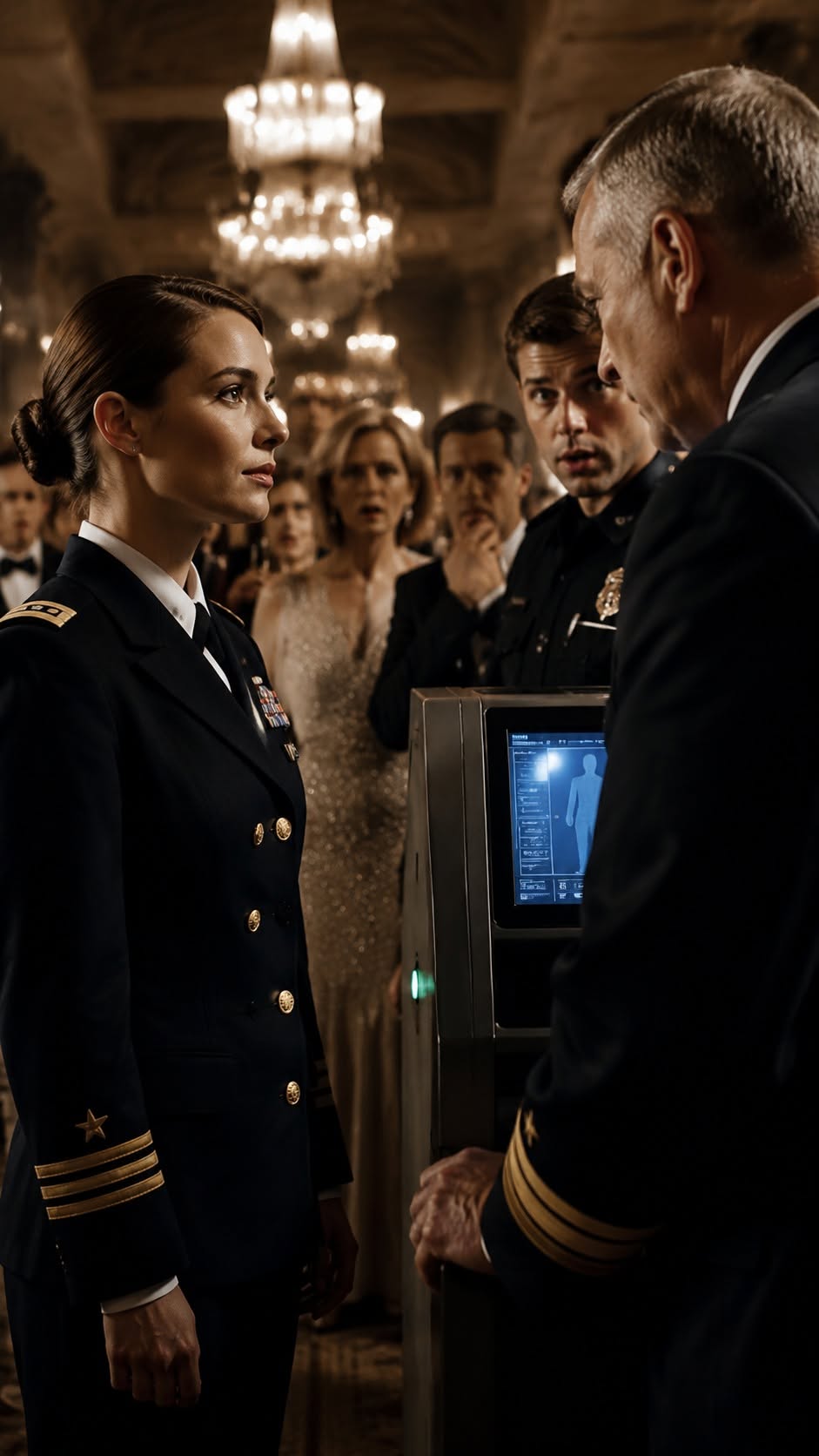
“She stole that uniform!” Sybil shouted, gripping the arm of a military police officer as though she had just exposed a dangerous criminal. “Get her out of here immediately!”
The orchestra was still playing, but no one was listening to it anymore. Hundreds of heads turned across the ballroom, glasses hovering halfway to mouths, conversations collapsing into whispers as Sybil pointed at me from beneath the chandeliers. My husband, Preston, stood three steps behind her with his face gone pale.
Sybil had wanted this moment for years. I could see it in the rigid satisfaction of her smile, in the way she held herself as if the room had finally been arranged to give her a stage. For seven years she had introduced me as Preston’s wife, never as an officer, never by my professional title, and never without adding the little phrase that made her feel superior.
“This is Preston’s wife,” she would say. “She works some little administrative job in the Navy.”
The first few times, I corrected her gently. After that, I stopped. There are insults that become so predictable they stop hurting and start teaching you something about the person delivering them. Sybil had never understood that my silence was not agreement.
Tonight, I had arrived in full dress uniform because I was one of the officers responsible for running the event. The ballroom belonged to the joint military installation hosting the annual service recognition gala, and every detail from the seating chart to the security perimeter had passed through my office. I had spent three months making sure visiting commanders, veterans, families, and civilian guests could move through the evening without a single avoidable problem.
Sybil had spent less than ten minutes trying to create one. The MP beside her looked uncomfortable.
“Ma’am, please lower your voice.”
“I will not lower my voice while someone is impersonating an officer in a restricted military event.” Sybil pointed at my shoulder boards. “Look at her. Does she look like an officer to you?”
The young officer glanced at me, then at Sybil.
“I’m going to need to verify her credentials.”
Sybil smiled.
“Exactly.”
Preston finally stepped forward.
“Mom, stop.”
She turned on him so quickly that several people nearby flinched.
“Stop what? Protecting you?”
“You know she belongs here.”
“No, Preston. I know what she tells you.”
I watched my husband close his eyes for half a second. It was a tiny movement, almost invisible, but I knew it. He had been doing that for years whenever Sybil pushed too far—a private blink that meant he wanted the argument to end without him having to choose a side.
Tonight, there would be nowhere for him to stand in the middle. Sybil looked at me again.
“You have embarrassed this family enough,” she said. “You walk around pretending this little office job makes you important, and now you have the nerve to dress up like a real officer?”
A woman at the nearest table lowered her fork.
I could have answered. I could have listed my assignments, my qualifications, the years I had spent earning every stripe and insignia on my uniform. I could have told Sybil exactly how many people had trusted me with responsibilities she dismissed as paperwork. Instead, I said nothing.
Years in uniform had taught me that composure often spoke louder than anger. The MP extended his hand.
“Ma’am, may I see your military identification?”
I reached inside my jacket and removed my ID card. For the first time all evening, Sybil’s smile widened. She folded her arms.
“Thank you,” she said to the officer. “I’m sure you’ll find this is exactly what I said it was.”
The officer took the card carefully and walked toward the security scanner positioned beside the ballroom entrance. The screen was visible from where we stood. Sybil watched it as though she were waiting for a verdict she had already written. Preston came closer to me.
“I’m sorry.”
I kept my eyes on the scanner.
“For what?”
“For this.”
“That isn’t an apology.”
His jaw tightened.
“I know.”
The scanner chimed. The officer looked down at the screen. Then he stopped. His shoulders straightened.
His eyes moved across the display once, then again, more slowly. The confident expression he had worn when he approached me disappeared completely. Behind him, Sybil gave a small, satisfied laugh.
“Well?” she demanded.
He did not answer. Sybil took one step forward.
“I told you.”
The officer looked at the screen again. Then at me.
Something in his face changed so completely that the room seemed to notice it before anyone understood why. He turned toward Sybil.
“Ma’am, I need you to step back.”
Her smile vanished.
“What?”
“Please step back.”
“You just said you needed to verify her credentials.”
“I did.”
“And?”
The officer swallowed.
He looked at me with a mixture of surprise and something much closer to respect.
Then he turned the screen slightly so the senior security officer standing behind him could see it. The senior officer leaned forward. His eyebrows rose. He said something too quietly for the crowd to hear. The younger officer nodded. Sybil’s voice sharpened.
“What does it say?”
No one answered her. She looked at Preston.
“Why is nobody answering me?”
Preston stared at the scanner. His face had changed too. I looked at him.
“What did you think it would say?”
He met my eyes.
“Nothing like this.”
The senior security officer finally approached us. He was older, broad-shouldered, and carried himself with the kind of calm that came from having seen enough emergencies to know which ones mattered. He stopped in front of me.
“Commander, I apologize for the interruption.”
The ballroom went silent. Sybil blinked.
“Commander?”
The officer continued as if she had not spoken.
“Your credentials are valid, current, and fully authorized for this event.”
A murmur moved through the room. Sybil stared at him.
“No.”
The officer glanced at her.
“Ma’am?”
“That’s impossible.”
I watched her face as the first crack appeared—not shame, not yet. Something more dangerous. Calculation.
She looked at my uniform again, but this time she was no longer seeing a costume.
She was seeing every person in the room who had heard her call it one. Preston moved beside her.
“I’ve been trying to tell you,” he said quietly. “This isn’t someone else’s event.”
He looked directly at me.
“She’s one of the officers running it.”
Sybil’s face tightened.
“No,” she snapped, loud enough for nearby guests to hear. “That’s impossible.”
She marched across the ballroom, grabbed the arm of the younger MP, and pointed directly at me.
“That woman doesn’t belong here! She’s wearing a uniform she hasn’t earned. Remove her immediately. Arrest her if you have to!”
The officer gently removed her hand from his sleeve.
“Ma’am, you need to step away.”
“You don’t understand.”
“I understand that her credentials are valid.”
“She lied to my son!”
Preston’s voice cut through the room.
“Mom.”
Sybil turned.
“What?”
“You need to stop.”
The words were quiet, but they landed harder than shouting would have. For a second, nobody moved. Then the senior security officer looked toward me.
“Commander, would you like me to have someone escort her outside?”
I looked at Sybil.
Her breathing had become shallow. Her fingers were clenched so tightly that her knuckles were white. She had spent years correcting me in front of strangers, interrupting me at family dinners, reducing my work to paperwork, and telling Preston that my career made me too ambitious to be trusted with a family.
Now, for the first time, she was the one standing in front of strangers with nothing left to hide behind. I could have had her removed. Instead, I shook my head.
“No.”
The officer waited.
“I want her to stay.”
Sybil stared at me. I could almost hear the room lean closer.
“Why?” she asked.
“Because you wanted everyone to see me exposed,” I said. “I think everyone deserves to see what you came here to do.”
Her expression changed. For one brief second, fear replaced anger. Then she recovered.
“You have no idea what you’re talking about.”
“Maybe not.”
I looked at Preston.
“But I think you do.”
He did not answer.
That silence was different from all the others I had heard from him over the years. This one was not an attempt to keep peace. It was the silence of a man who knew that something he had hidden was about to become impossible to hide.
The senior security officer touched his radio.
“Sir, I need the event operations file brought to the ballroom.”
Sybil’s eyes snapped toward him.
“What file?”
He looked at her.
“The one connected to the guest access request submitted earlier today.”
Preston’s head lifted. I felt the first cold thread of suspicion move through me.
“What guest access request?” I asked.
The officer looked from me to Sybil. Then he said something that made Sybil go completely still.
“Ma’am, the request was submitted under your name.” For a second, Sybil did not blink. Then she laughed.
“Of course it was submitted under my name. I’m his mother. I was asking for a guest pass.”
The senior security officer did not move.
“A guest pass for what area?”
Sybil opened her mouth. Nothing came out. He looked toward the younger MP.
“Bring the request.”
The officer disappeared through a side door. Around us, the whispers grew louder. Sybil glanced from face to face, searching for the old escape route—the moment when somebody would decide the family matter was too uncomfortable to watch. Nobody looked away. Preston spoke first.
“Mom, what did you request?”
“Nothing unusual.”
“That isn’t what he asked.”
She turned on him.
“I was trying to make sure I could find you.”
“You knew where I was.”
“I knew where you were supposed to be.”
Her eyes flicked toward me.
“And I knew she had arranged all of this.”
I felt my stomach tighten.
“All of what?”
Sybil gave a brittle smile.
“Don’t pretend you don’t know.”
“I really don’t.”
The senior officer’s radio crackled.
A moment later, the younger MP returned carrying a thin folder. He handed it over. The senior officer opened it, read the first page, then held it so I could see. At the top was Sybil’s full name.
Underneath it was a request for temporary access to the event operations corridor and credentialing office. The stated reason was: FAMILY VERIFICATION. The requested access window began forty minutes before the gala and ended after the ballroom opened. I looked at Sybil.
“You requested access to my credentialing office?”
“I requested access to the event.”
“No. You requested access to a restricted office.”
“I didn’t know it was restricted.”
The senior officer raised an eyebrow.
“It is marked restricted on the request form.”
Sybil’s lips parted. She looked at Preston. He looked back at her.
“Why?” he asked.
She straightened.
“Because I wanted to see whether she really belonged here.”
There it was.
Not an accident. Not confusion. Not some innocent misunderstanding that had somehow grown into a public accusation. She had come prepared to test me. The officer turned another page.
“You also listed the name of a second person who was supposed to accompany you.”
Sybil’s face changed. Preston noticed.
“Who?”
She didn’t answer. I looked down at the page. The second name was Preston. I looked at him. His eyebrows drew together.
“I didn’t agree to that.”
Sybil immediately spoke.
“You were going to.”
“No, I wasn’t.”
“You said you wanted to understand what she did all day.”
“I said I wanted you to stop insulting her.”
“That isn’t what you said.”
“It is exactly what I said.”
The senior officer closed the folder.
“Ma’am, did you enter the restricted corridor earlier this afternoon?”
“No.”
He looked at the younger officer.
“Badge log.”
The younger officer checked his tablet.
“Attempted entry at 16:47.”
Sybil went still. The officer continued.
“Credential rejected. Visitor pass was not authorized.”
Preston stared at his mother.
“You came here before the event?”
“I was trying to help.”
“By trying to get into a restricted area?”
“I wanted proof.”
“Proof of what?”
“That she was lying.”
I stepped closer.
“About my rank?”
Sybil’s chin lifted.
“Yes.”
“Then why didn’t you ask me?”
“Because you would have lied.”
I almost smiled, but there was nothing funny in it.
“You spent seven years calling my work insignificant. You could have asked me once.”
“I know women like you.”
The words came out so quickly that even she seemed surprised by them. I waited. She swallowed.
“What does that mean?”
She looked away.
The room had become so quiet that I could hear the faint hum of the ventilation system.
Sybil finally said, “It means you think a uniform makes you better than everyone else.”
“No,” I said. “It means I earned mine.”
Preston rubbed his forehead.
“Mom, enough.”
She turned toward him.
“You’re taking her side?”
“I am asking you to stop.”
“After everything I’ve done for you?”
His expression hardened.
“That’s exactly the problem.”
Sybil stared at him. He took a breath.
“You want me to say it here?”
She said nothing.
“You’ve been interfering with our finances for months.”
A murmur went through the nearest tables. Sybil’s face drained.
“Preston.”
“You called the bank.”
“I was trying to help.”
“You told our financial adviser that I was making reckless decisions.”
“Because you were.”
“You asked for copies of our account statements.”
“I’m your mother.”
“You tried to move money from the family investment account into an account you control.”
Sybil’s mouth fell open.
“I never—”
“You did.”
Preston reached into his jacket and pulled out his phone.
“I have the email.”
Sybil’s eyes locked on it.
“Put that away.”
“No.”
“Preston, don’t humiliate me.”
He gave a short, bitter laugh.
“You tried to humiliate my wife in front of half the base.”
“That is different.”
“How?”
She couldn’t answer. I looked at Preston.
“How much?”
He hesitated.
“That isn’t important right now.”
“It is to me.”
He looked down.
“Eighteen thousand.”
Sybil immediately stepped forward.
“That money was being wasted.”
“Eighteen thousand dollars?”
“It was sitting there.”
“It was ours.”
“It was family money.”
“Our family,” Preston said, “doesn’t mean you.”
Sybil recoiled as if he had slapped her. The senior security officer cleared his throat.
“Commander.”
I turned. He held out the folder.
“There is one more item.”
I took it.
A handwritten note had been attached to the request form. The handwriting was unmistakably Sybil’s.
I recognized it because I had seen it on birthday cards, grocery lists, and the notes she used to leave on Preston’s kitchen counter. The note said:
VERIFY HER RANK BEFORE SHE ENTERS THE BALLROOM. IF SHE IS LYING, HAVE SECURITY STOP HER AT THE DOOR. I looked at Sybil. She didn’t deny it. She didn’t apologize either. Instead, she whispered, “I knew something was wrong.”
“What did you think you would find?”
She stared at me for several seconds.
Then she said, “I thought you were pretending to be someone you weren’t.” I held up the credential request.
“And now?”
Her eyes moved to the rank displayed on my identification record.
“Now,” she said, “I know I was wrong.”
Preston exhaled. For one second, I thought that might be the end of it. Then the younger officer looked at his tablet.
“Commander, there’s something else.”
I turned. He looked uncomfortable.
“What?”
He glanced at Sybil.
“She also requested that security contact her if your credentials came back valid.”
Sybil’s face tightened. I looked at her.
“Why?”
She said nothing. The officer answered for her.
“Her note says she wanted to speak with you privately before the event began.”
“About what?”
Sybil finally looked at me. Her voice was suddenly much smaller.
“About Preston.”
I waited. She swallowed.
“About money.”
Preston stared at her.
“What money?”
Sybil looked down at the floor. The senior officer closed the folder.
“That,” he said quietly, “is no longer a security matter.”
He handed the folder back to me.
I looked at the words on the page one last time, then folded it shut. For seven years, Sybil had told people I was only Preston’s wife.
Tonight, in front of everyone, she had finally been forced to say my rank. But the eighteen thousand dollars had changed the shape of the evening. Because money was not an insult. Money left records.
Records. By the time we left the ballroom, the rain had started.
Preston drove without turning on the radio. The windshield wipers moved back and forth, clearing narrow windows through the water, while the folder from security lay unopened on my lap. Neither of us mentioned the eighteen thousand dollars again until we were three streets from home.
“There’s something else you need to know,” Preston said.
I looked at him.
“Tonight keeps getting better.”
He gave a humorless smile.
“My mother has been asking about the house.”
“What house?”
He glanced at me.
“The one my father left.”
I knew the house. Everyone in Preston’s family called it simply the house, as if no other name were necessary. It stood outside town on several acres of wooded land, had belonged to his grandfather before his father, and had been empty for years except for occasional visits. Preston had told me the property was tied up in his father’s estate and that one day we would decide what to do with it.
I had never imagined Sybil was making decisions about it without us.
“What has she been asking?”
“She wants me to transfer it.”
“To her?”
He nodded.
“Why?”
“I don’t know.”
I watched his hands tighten around the steering wheel.
“You’ve known she wanted it.”
“I knew she wanted control of it.”
“That isn’t the same thing.”
“No.”
He was quiet for several seconds.
“It’s worse.”
When we reached the house, the porch light was already on. Preston slowed.
“There shouldn’t be anyone here.”
A second later, we saw Sybil’s car beside the driveway. I looked at him.
“She has a key?”
“She used to.”
“Used to?”
He didn’t answer. The front door opened before we reached it. Sybil stood inside.
She had changed out of her evening clothes and was wearing a dark cardigan, but the expression on her face was exactly the same one she had worn in the ballroom when she believed she had the upper hand.
“Where have you two been?”
Preston stopped on the threshold.
“Why are you here?”
“I came to talk.”
“You could have called.”
“You wouldn’t have answered.”
“I wouldn’t have.”
Her eyes moved past him to me.
“Then perhaps you’ll answer now.”
I stepped inside.
“About what?”
“The house.”
Preston shut the door.
“What about it?”
Sybil walked toward the dining table, where a thick envelope lay beside a leather folder.
“I have spent months trying to protect this family.”
Preston laughed once.
“By trying to take our money?”
“By making sure your father’s property doesn’t disappear.”
“It isn’t disappearing.”
“It will if she gets control of everything.”
I looked at the envelope.
“Why is my name on that?”
Sybil’s expression barely changed.
“Because you are part of the transfer.”
I picked up the envelope.
Inside was a copy of a property transfer agreement. The legal description was unmistakable. It was the house and the surrounding acreage. The proposed transferee was Sybil.
My name appeared beneath a statement declaring that I consented to the transfer. I read it twice. Then I looked at Preston.
“I never signed this.”
Sybil crossed her arms.
“You did.”
“No.”
“You signed the consent when Preston signed his portion.”
“I wasn’t there.”
“You were.”
I turned the page. There it was. A signature bearing my name. At first glance, it looked convincing. At second glance, it looked wrong.
My signature always finished with a long upward stroke. This one stopped abruptly. The first letter was too narrow, the final loop too round. I traced it with my eyes.
“Who witnessed this?”
Sybil didn’t answer.
“Who witnessed it?” I asked again.
She lifted her chin.
“The paperwork was handled properly.”
“That’s not what I asked.”
Preston took the document from my hand. His face changed.
“Mom.”
“What?”
“Why does this say I signed on Tuesday?”
“You did.”
“I was deployed at the base that day.”
“You signed the documents beforehand.”
“No, I didn’t.”
Sybil stepped closer.
“You signed several papers for me because you knew I was trying to help.”
Preston stared at her.
“I never signed a transfer.”
“I never said you signed a transfer.”
“You just did.”
She went silent. I turned another page. There was a notary stamp. The date was three months earlier. My pulse quickened.
“Who notarized this?”
Sybil reached for the folder.
“Give me that.”
I pulled it away.
“No.”
“You don’t understand what you’re looking at.”
“I understand enough.”
I looked at Preston.
“Did you know about this?”
“No.”
“Did you give her permission to transfer the house?”
“No.”
Sybil slammed her palm against the table.
“Because you two are being irresponsible!”
The folder jumped.
“You think that house belongs to you because you married my son,” she said. “It doesn’t.”
Preston stared at her.
“It was my father’s.”
“And he promised it to me.”
Silence. I looked up.
“He promised you the house?”
“Yes.”
“When?”
“Before he died.”
“Where is that promise?”
Sybil’s eyes hardened.
“You don’t get to interrogate me in my own family.”
“It isn’t your property.”
“It should be.”
Preston stepped between us.
“Mom, what are you doing?”
She looked at him.
“I am trying to stop you from destroying what your father built.”
“You mean the house.”
“I mean everything.”
“No,” Preston said. “You mean control.”
Sybil’s face twisted.
“You have no idea what I’ve sacrificed for you.”
“And you have no idea what you’ve taken from me.”
She stared at him. Then her eyes returned to the transfer papers.
“If you refuse to cooperate, the property will become a legal mess.”
“It already is,” I said.
She looked at me. I held up the page with my supposed signature.
“Because somebody forged this.”
For the first time that night, Sybil looked genuinely frightened. It lasted less than a second.
Then she reached across the table and snatched the folder from my hand.
“You don’t know that.”
“I know my own signature.”
She backed toward the door.
“Give me the documents.”
“No.”
“Preston.”
He didn’t move. She looked at him desperately.
“Tell her.”
“Tell her what?”
“That your father wanted me to have the house.”
Preston’s expression hardened.
“I’ve never heard him say that.”
Sybil’s mouth tightened.
“He told me privately.”
“Then why isn’t it in the estate documents?”
She said nothing. I took the folder back when she hesitated. Inside, beneath the transfer agreement, was another sheet I hadn’t noticed before. It was a copy of a letter addressed to an attorney. At the bottom was my name.
But beneath it was a sentence that made the room seem suddenly colder.
I, the undersigned spouse, acknowledge that I have no claim or objection to the transfer of the property to Sybil. I read it once. Then again. I had never written those words. I had never agreed to them.
And yet somebody had attached my name to them as if my consent had already been given. I looked at Sybil.
“Where did you get this?”
She stared back at me.
“From the attorney.”
“Which attorney?”
She didn’t answer. Preston reached for his phone.
“I’m calling him.”
Sybil’s composure broke.
“No.”
He stopped. She realized what she had just revealed. I watched her fingers tighten around the strap of her handbag.
“Why not?” Preston asked.
She looked toward the door. Then back at us.
“Because,” she whispered, “you don’t understand what happens if that house isn’t transferred.”
“What happens?”
She said nothing. Preston took one step toward her.
“Mom.”
Her eyes filled with something I had never seen there before. Not anger. Fear.
And suddenly the eighteen thousand dollars in the ballroom no longer felt like the beginning of the problem. It felt like the smallest piece of it. I lowered the papers.
“Sybil,” I said, “what did you do?”
She looked at the forged signature bearing my name. Then she looked at her son. And for several seconds, she could not make herself answer.
Preston’s phone remained in his hand.
“Mom.”
She closed her eyes.
“I made a mistake.”
“What mistake?”
“I thought I could fix it.”
“With my signature?” I asked.
She opened her eyes.
“I didn’t forge it.”
I held up the page.
“Then who did?”
“I don’t know.”
“You just told us the attorney had it.”
“I said I got it from the attorney.”
“Which attorney?” Preston demanded again.
She turned toward him.
“Your father’s attorney.”
“My father’s attorney retired three years ago.”
Sybil’s face tightened.
“His office didn’t.”
“That doesn’t answer the question.”
She looked at the papers.
“You two are making this into something it isn’t.”
I placed the transfer agreement on the table.
“My name is on a document I never signed.”
“I didn’t put it there.”
“Then you won’t mind if we have it examined.”
She went silent. Preston took the folder from me.
“We’re going to the county recorder tomorrow.”
“No.”
The answer came so quickly that he stopped.
“Why?”
“Because you don’t understand the consequences.”
“Then explain them.”
Sybil looked at the clock.
“It’s late.”
“Mom.”
“I’m tired.”
“You’ve been lying to me for months.”
Her mouth tightened.
“I have been trying to protect you.”
“From what?”
She looked at me.
“From her.”
I felt something inside me go completely still. Preston shook his head.
“You don’t get to keep saying that without telling me what she did.”
Sybil’s eyes hardened.
“She has access to everything.”
“To what?”
“Your accounts. Your career. Your insurance. Your benefits.”
“She is my wife.”
“And that gives her control.”
“No,” I said. “It gives me responsibility.”
Sybil gave a bitter laugh.
“You have no idea how easy it would be for her to walk away with everything.”
“Neither do you,” I said.
She looked at Preston.
“You’ll regret this.”
He opened the front door.
“Go home.”
She stood there for several seconds. Then she picked up her handbag. At the doorway, she turned back.
Preston said nothing.
“He knew you would let her take it from you.”
The door closed behind her. We listened to her car pull away.
Only when the sound disappeared did Preston lower himself into the nearest chair. He put both hands over his face.
“I should have known.”
I sat across from him.
“Known what?”
“That she was in trouble.”
I waited. He looked at the folder.
“She started asking me for money last year.”
“How much?”
“Small amounts at first.”
“Why?”
“She said there were expenses connected to my father’s estate.”
“Were there?”
“No.”
The answer came immediately. I leaned back.
“How much did you give her?”
He stared at the table.
“Twenty-four thousand.”
I felt the air leave my lungs.
“Twenty-four?”
“Over time.”
“You told me the eighteen thousand was the first time.”
“It was the first time I knew she had tried to move money without asking me.”
I looked at him.
“And the other twenty-four?”
“I thought I was helping her.”
“Helping her do what?”
He shook his head.
“I don’t know.”
That answer frightened me more than anything else he had said. I stood.
“Then tomorrow we find out.”
He looked up.
“How?”
“Bank records. Property records. Estate records. Every document you signed for your mother.”
He swallowed.
“There are a lot.”
“Then we start tonight.”
He opened the folder again. A few minutes later, we found the first blank page. It had been folded between two completed documents. At the top was a title: AUTHORIZATION FOR PROPERTY-RELATED REPRESENTATION. The signature line was filled in. Preston stared at it.
“I didn’t sign this.”
I looked at the signature.
It resembled his handwriting, but the pressure was wrong. The final stroke was heavier than the first part, as if someone had copied the shape rather than made the movement naturally.
“When did you last sign something for her?” I asked.
He thought.
“Six months ago.”
“What was it?”
“She said it was an authorization so she could request estate records.”
“Did you read it?”
“I read the first page.”
“And then?”
“She had several pages behind it.”
“Did you sign all of them?”
He looked at me.
“I signed where she pointed.”
I slowly turned the page. The document beneath it transferred authority over the property to Sybil. Preston’s face went white.
“She had blank pages behind the one I read.”
I looked at him.
“How many?”
“Four. Maybe five.”
“Did you sign them?”
“I thought they were copies.”
“You didn’t know what you were signing.”
“No.”
He stood abruptly.
“I trusted her.”
The sentence broke in the middle.
He walked toward the kitchen, then stopped with his hand against the counter. I followed him.
“She knew I’d sign them.”
“Yes.”
He turned.
“Why?”
“Because she knew you wanted to believe she was helping.”
His eyes closed.
“I gave her access.”
“To some documents.”
“To everything.”
“No.”
I touched the folder.
“Not everything.”
He looked at me.
“Then what is she trying to get?”
I looked down at the property transfer.
“The house.”
“And the trust.”
His face changed.
“What trust?”
I looked up.
“You didn’t know?”
“No.”
I pointed to a reference number printed near the bottom of the transfer agreement.
“That’s a trust number.”
He took the page from me.
“Where did that come from?”
“Your father’s estate.”
He stared at the number.
“I thought the trust was closed.”
“Apparently not.”
He sat down again. For several minutes, neither of us spoke. Then his phone buzzed. He looked at the screen. The message was from the bank. I watched his face change as he opened it.
“What?”
He handed me the phone.
There were three recent transfers from an investment account connected to the estate. All three had been authorized by a representative account. The recipient was Sybil. The total was $46,500. Preston stared at the number.
“I didn’t authorize these.”
“Neither did I.”
He scrolled. There were more. Smaller amounts. Then larger ones. Insurance payments. Wire transfers. A withdrawal from a brokerage account. I counted them twice. The total exceeded eighty thousand dollars. Preston sat completely still.
“What was she doing with it?”
I looked at the account descriptions. One transfer had a company name attached to it.
I recognized the word immediately because I had seen it in financial correspondence before.
“What’s Northstar?”
He looked at the screen.
“My mother’s investment company.”
“Her company?”
“She started it after my father died.”
“Is it still operating?”
He shook his head.
“Not that I know of.”
I scrolled through the records.
The transfers had continued even after the company stopped appearing in public filings. Then I found one dated only eleven days earlier. The description read: LOAN REPAYMENT. The amount was $12,000. Preston stared at it.
“She borrowed from the estate.”
“No,” I said. “Look at the direction.”
He did. His face went pale.
“The estate paid her.”
I nodded. Another message appeared. This one was from a number Preston didn’t recognize. PAYMENT DEMAND: NORTHSTAR INVESTMENTS. FINAL NOTICE BEFORE LEGAL ACTION. Preston read it twice. Then he whispered, “Oh God.” I looked at him.
“How much does she owe?”
He didn’t answer. He opened the attachment. The figure at the bottom was larger than anything I expected. $312,000. I sat down slowly.
“That’s why she wants the house.”
Preston shook his head.
“She can’t sell it.”
“She doesn’t need to sell it if she can make herself the legal owner.”
He looked at the forged transfer.
“She was going to use the house as collateral.”
“And the trust.”
He stared at me.
“For what?”
“To cover the debt.”
His phone slipped from his hand onto the table.
For several seconds, the only sound in the room was the refrigerator humming in the kitchen. Then he said, “She was never protecting me.”
“No.”
“She was protecting herself.”
I looked at the documents spread across the table. The forged signature. The blank pages. The transfers. The demand for payment. The request to enter my credentialing office. Suddenly they were no longer separate events. They were pieces of the same plan. Preston picked up the property authorization again.
“I signed the blank pages.”
I nodded.
“And she filled them in later.”
He looked at the forged transfer bearing my name.
“But you never signed anything.”
“No.”
He pushed the papers away.
“Then how did she get your signature?”
I thought of every form I had signed over the years. Tax documents. Insurance forms. Mortgage paperwork. Medical forms. Family documents Preston had asked me to review. Anything Sybil could have seen. I looked at him.
“She didn’t need to copy it from one place.”
“What do you mean?”
“She could have had access to it for years.”
His expression darkened.
“You think she took something from our files?”
“I think we need to find out.”
He stood.
“I’ll call the bank tomorrow.”
“Tonight.”
“It’s nearly midnight.”
“I know.”
He looked at the stack of papers. Then he picked up his phone.
“I’ll call the bank.”
I gathered every document into one pile.
At the bottom of the folder, hidden beneath the transfer agreement, was a small white envelope. There was no address on it. Only one handwritten word. PRESTON. I held it up. He stared at it.
“Did your mother give you this?”
“No.”
“Have you seen it before?”
He shook his head. I turned it over. The flap had already been opened. Inside was a photocopy of an old estate inventory. One item had been circled in blue ink.
ORIGINAL LETTER — TO BE DELIVERED TO PRESTON UPON FINAL DISTRIBUTION OF TRUST. Below it was a notation in a different hand. WITHHELD AT REQUEST OF BENEFICIARY. Preston stopped breathing for a second.
“Beneficiary?”
I looked at him.
“Who?”
He stared at the notation. Then he said the only name that made sense.
“My mother.”
My mother.
The next morning, we sat across from the attorney who had handled Preston’s father’s estate.
His name was Martin Hale, and the first thing he did when we placed the transfer papers on his desk was take off his glasses. He read the forged consent once, then turned to the second page and read it again.
“Where did you get these?”
“From my mother,” Preston said.
Martin looked at him.
“Did she give you the originals?”
“No. Copies.”
“That may be fortunate.”
I leaned forward.
“Why?”
“Because these documents are not what they appear to be.”
Preston’s hand tightened around the chair. Martin opened a drawer and removed a thick estate file.
“I kept the originals when the trust was established. Your father was very particular about documentation.”
He placed three sheets on the desk. The first was an authorization Preston recognized immediately.
“I signed that.”
Martin nodded.
“You did. But you signed it on a different date.”
He placed a timestamped scan beside it.
The date on Preston’s signature was six months earlier than the date printed on the completed document Sybil had produced. Preston stared at it.
“What happened?”
Martin looked at him.
“You signed a blank page.”
Preston closed his eyes.
“I thought it was part of the authorization.”
“It was.”
Martin tapped the document.
“Just not this authorization.”
He turned to me.
“And your signature isn’t genuine.”
I let out a breath I hadn’t realized I was holding.
“How can you tell?”
“Because I have your actual signature from the estate closing.”
He laid another page beside the forged consent.
The two signatures looked similar enough that a stranger might have missed the difference. Martin hadn’t.
“This one was reproduced,” he said. “The spacing is wrong. The pressure pattern is wrong. More importantly, the document was created after the estate file was closed.”
Preston looked up.
“So she altered the papers.”
Martin’s expression remained calm.
“Someone altered them.”
“You know who.”
“I know who had access.”
The office door opened. Sybil walked in. She stopped when she saw us. For several seconds, nobody spoke. Then Martin said, “You were not invited.”
“I knew you would be here.”
Preston turned toward her.
“How?”
“I know how these things work.”
Martin closed the file.
“Mrs. Mercer, you should leave.”
“No.”
She looked at Preston.
“You need to hear me.”
“I’ve been hearing you for years.”
She flinched.
“I was trying to protect you.”
“From my wife?”
“Yes.”
Martin sighed.
“Then explain why you submitted a transfer containing a forged spousal consent.”
Sybil looked at him.
“I didn’t forge anything.”
“You presented it.”
“I received it.”
“From whom?”
She hesitated.
“I don’t remember.”
Martin pushed the original documents toward her.
“You should remember. Your name appears on the authorization request attached to the file.”
Her face tightened.
“I was acting for Preston.”
“You had no authority to act for Preston.”
“I am his mother.”
“That is not a legal power of attorney.”
She looked at Preston.
“Tell him.”
“Tell him what?”
“That you asked me to handle your father’s property.”
“I asked you to help me find records.”
“I helped you.”
“You took my signature.”
“I did not.”
“You had blank pages.”
Sybil’s voice sharpened.
“You signed them willingly.”
Preston stared at her.
“You knew exactly what you were doing.”
“I knew you were too trusting.”
Martin stood.
“Enough.”
The room went quiet. He pointed to the transfer document.
“This document has no enforceable authority. The spousal consent is fraudulent, and the property authorization was completed after the signature was obtained. I will notify the recorder’s office that the transfer is disputed and prepare the necessary filings to preserve the property under the existing trust.”
Sybil’s face went white.
“You can’t do that.”
“I already can.”
“You don’t understand what you’re doing.”
“I understand exactly what I’m doing.”
She turned toward Preston.
“If that house stays in the trust, everything falls apart.”
He stared at her.
“What falls apart?”
She said nothing. Martin’s voice was quiet.
“Your debts?”
Sybil looked at him.
“You know?”
“I know enough.”
Preston stood.
“Mom, how much do you owe?”
She shook her head.
“It isn’t what you think.”
“Three hundred twelve thousand?”
Her eyes widened. He continued.
“Northstar is insolvent. You took money from the estate. You tried to move eighteen thousand from our account. You have been trying to put the house in your name so you can use it as collateral.”
“I was going to repay everything.”
“With what?”
She looked away.
“With the investment.”
“You don’t have an investment.”
“I was going to recover.”
“You’ve been saying that for two years.”
Her voice broke.
“Because I thought I could.”
Preston stared at her.
“And you were going to use my father’s house to buy yourself more time.”
Sybil’s eyes filled.
“I was trying to save what he left us.”
“No,” he said. “You were trying to save yourself.”
She sat down. For the first time since I had known her, Sybil looked old. Martin reopened the estate file.
“There is another matter.”
Sybil’s head lifted.
“No.”
Martin looked at her.
“You know what I’m about to ask.”
Preston turned.
“What?”
Martin’s eyes stayed on Sybil.
“The original letter.”
Silence. I looked at Sybil.
“What letter?”
She didn’t answer.
Martin reached into the file and removed the inventory page we had found.
“This item was never delivered.”
Preston stared at the notation.
“Why?”
Martin looked at Sybil.
“She instructed the trustee to withhold it.”
Sybil stood abruptly.
“I had a reason.”
“What reason?” Preston asked.
She looked at him.
“Your father wrote it when he was sick.”
“And?”
“He was confused.”
Martin’s expression hardened.
“He was lucid when he signed the trust amendment.”
Sybil’s face changed. Preston took one step toward her.
“What did Dad write?”
She shook her head.
“I can’t do this here.”
“You’ve already done it here.”
He held out his hand.
“Give me the letter.”
She stared at his hand.
“I don’t have it.”
Martin said nothing. Preston’s voice dropped.
“Mom.”
Her eyes filled with tears. Then she reached into her handbag. She took out a small, worn envelope. My name was not on it. Preston’s name was. The seal had been opened years ago. Sybil held it against her chest.
“I kept it because I knew this would happen.”
Preston looked at the envelope.
“What did he say?”
Sybil’s fingers tightened around it.
“I don’t know if you want to hear it.”
Preston held out his hand again.
“Yes.”
She looked at me. Then back at her son.
“I think,” she whispered, “you should hear it from him.”
And slowly, she placed the letter in Preston’s hand.
Preston took the letter and stared at the handwriting on the front. He recognized it immediately.
“That’s Dad’s.”
Sybil nodded.
He broke the remaining edge of the seal and unfolded the paper. It was only two pages, written in blue ink, with several lines crossed out and rewritten in the margins. Martin moved his chair closer, but he did not speak. Preston began reading.
“Preston, if you’re reading this, then the trust has reached the point where I can no longer explain these things to you myself.”
His voice faltered. He continued.
“I want you to understand one thing before anything else. The house is not your mother’s to control. It is not mine to give her, and it is not yours to give away simply because she asks.”
Sybil closed her eyes. Preston looked up at her. She whispered, “Keep reading.” He did.
“I know your mother will tell you she has sacrificed everything for this family. I know she will say she understands money better than you do and that she is protecting what I leave behind. Please remember that protecting you is not the same thing as controlling you.”
The room was silent. I watched Sybil’s face.
She had spent years speaking about Preston’s father as though every decision he had made belonged to her. Now his own words were taking that authority away from her one sentence at a time. Preston continued.
“The house and the trust are to remain protected from any one person’s control. When the trust distributes, the property is to pass to you and your spouse jointly. If you are married at the time of distribution, your spouse is to be named as co-beneficiary.”
His voice stopped. He looked at Martin.
“That’s what this means?”
Martin nodded.
“That is exactly what it means.”
Sybil shook her head.
“He didn’t understand what he was writing.”
Martin looked at her.
“He signed it in my office.”
“He was sick.”
“He was not incompetent.”
“He was taking medication.”
“And he had an independent witness.”
Sybil looked down. Preston returned to the letter.
“Most importantly, Preston, I am putting this in writing because I know you will feel pressure to change it later. Do not transfer the property to your mother. Do not allow anyone to persuade you that doing so is necessary to preserve family peace. If she asks you to sign documents you do not understand, stop and have them reviewed independently.”
Preston lowered the page. His eyes met his mother’s.
“You knew.”
Sybil said nothing.
“You knew exactly what Dad wanted.”
“I knew he was angry with me.”
“He wasn’t angry. He was protecting me from you.”
Her face crumpled.
“I was his wife.”
“And I’m his son.”
Martin reached for the trust amendment.
“There’s one more clause.”
He turned the document toward Preston.
“Your father added a specific restriction against unilateral transfer.”
Preston read it. His shoulders dropped.
“So she couldn’t transfer it.”
“No.”
“And neither could I.”
“Not without the co-beneficiary’s consent.”
I looked at Preston. He looked at me.
For years, Sybil had treated my marriage to her son as though I were standing outside the family, asking permission to enter. His father’s trust had done the opposite. It had placed my name beside Preston’s deliberately, not as an afterthought but as protection. Sybil suddenly stood.
“You don’t understand what you’re doing.”
Preston folded the letter.
“I understand exactly what I’m doing.”
“If you leave that property in the trust, the creditors will come.”
“They’re your creditors.”
“They’ll take everything.”
“Not Dad’s house.”
“You think she will protect you?”
Preston looked at me. Then he looked back at his mother.
“She already has.”
Sybil stared at him.
“What does that mean?”
“It means she was the one who told me to call the bank. She was the one who found the transfers. She was the one who said we needed to come here instead of letting you keep controlling the documents.”
His voice hardened.
“And she never once asked me for the house.”
Sybil’s lips trembled.
“I am your mother.”
“I know.”
“I gave you everything.”
“And now you’re asking me to give you everything back.”
She looked at the floor. Martin stood and gathered the original trust documents.
“I will file notice today that the attempted transfer is disputed. The property remains under the trust. Mrs. Mercer has no authority over it.”
Sybil looked at him.
“You can’t take it away from me.”
Martin’s voice remained calm.
“It was never yours.”
She turned toward Preston.
“Please.”
He did not move.
“Mom, give Martin every document you have.”
“What?”
“Every copy. Every authorization. Every account statement. Everything related to Dad’s estate.”
“You don’t trust me.”
“No.”
The word landed without anger. Just certainty. Sybil stared at him for a long time. Then she opened her handbag. One by one, she placed the documents on Martin’s desk. The transfer agreement. The property authorization. The account statements. The copies of the blank pages Preston had signed.
Finally, she placed a small key on the pile. Preston looked at it.
“What is that?”
“The lockbox.”
Martin’s expression changed.
“Your father’s?”
Sybil nodded.
“There’s another copy of the trust inside.”
“Anything else?”
She hesitated.
“Some correspondence.”
“From whom?”
Sybil looked at Preston.
“Your father.”
Preston stared at her.
“How long have you had it?”
She whispered the answer.
“Seven years.”
His face tightened.
“You’ve been hiding his letters for seven years?”
“I was afraid.”
“Of what?”
“That you would choose her.”
Preston looked at me. Then back at his mother.
“You were afraid I’d choose my wife because Dad told me to.”
Sybil began to cry.
“I was afraid I’d lose my family.”
Preston’s voice was quiet.
“You lost it when you decided owning it mattered more than being part of it.”
She covered her face. Martin picked up the key.
“The lockbox will be opened with both beneficiaries present.”
Sybil looked up.
“Both?”
Martin nodded toward me.
“Mr. Mercer and his spouse.”
For the first time, Sybil seemed to understand that there was nothing left for her to negotiate. The house was protected. The trust was protected. The forged transfer was dead.
And the letter she had hidden for seven years had finally reached the person it was written for. Preston stood beside me. His hand found mine. Then he looked at Martin.
“What happens now?”
Martin gathered the papers into a single file.
“Now we make the record reflect what your father actually intended.”
Sybil stared at the file.
“And me?”
Martin looked at her.
“That depends on what the financial records show.”
Her face went pale again. Preston did not look away.
For the first time, he wasn’t trying to rescue her from the consequences. He was letting them reach her.