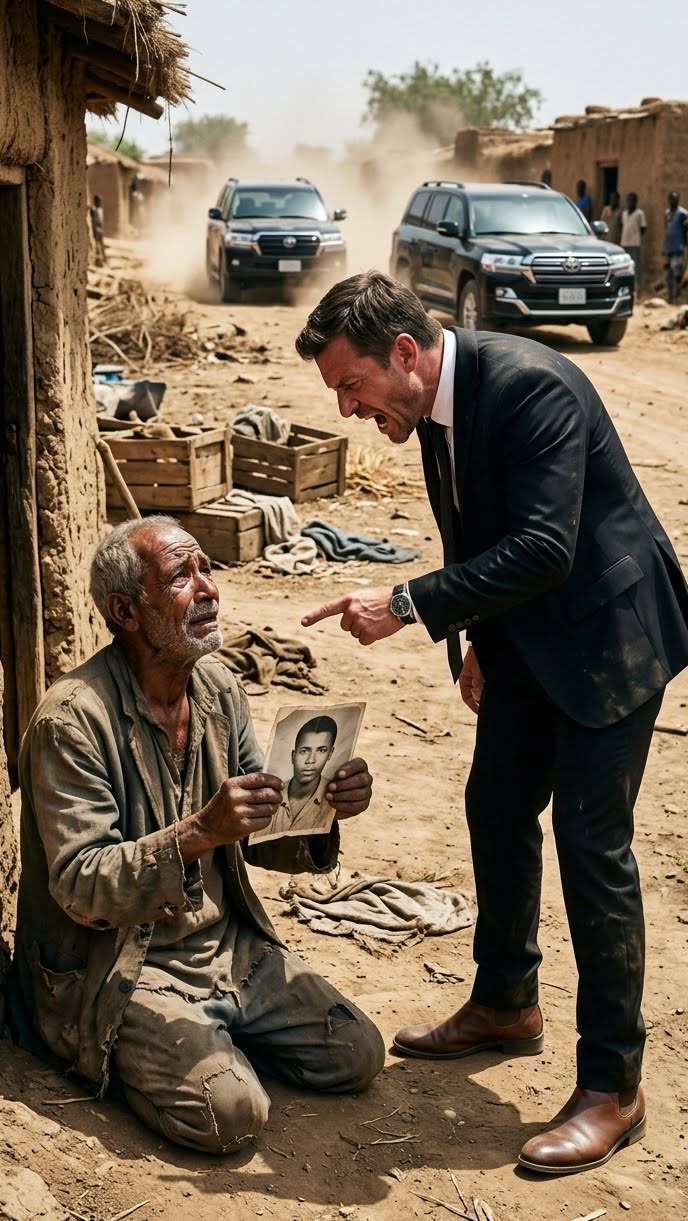
I stepped out of the black SUV, and the entire town of Oakhaven seemingly forgot how to breathe.
For a fraction of a second, all I could see was the swirling summer dust, the blinding mid-morning sunlight, and the old man on the ground. He was clutching a faded photograph of me like it was the only tether keeping him anchored to the earth. Thomas looked smaller than I remembered, his frame thinned out by the harsh years documented in the letters he used to send, but his eyes remained exactly the same. They were tired, profoundly kind, and carried that quiet, stubborn resilience—the exact kind of stubbornness required to pull a dying infant from a muddy creek bed when the rest of the world would have turned a blind eye.
I walked right past Sterling without granting him so much as a glance.
The wealthy patriarch’s arrogant, self-assured smile instantly collapsed.
“Dad,” I said.
That single, heavy word struck the gathered crowd harder than a crack of thunder.
Thomas lifted his weathered face, blinking rapidly through the dust as if he were staring at an apparition. His calloused hands began to violently shake. His mouth opened, closed, and opened again, but no sound materialized. Then, he whispered my name like a desperate prayer that had taken seven agonizing years to finally reach heaven.
“Matthew…”
I dropped to my knees in the dirt and wrapped my arms around him.
For twenty-five years, this man had carried the absolute weight of my existence. First, he carried me against his chest through a freezing rainstorm. Then, he carried me through grinding poverty, neighborhood mockery, crushing debt, and a suffocating loneliness. Now, it was my turn to hold him while the entire town watched.
Sterling’s voice, sharp and entitled, sliced through the stunned silence.
“What in the hell is this circus?”
I rose to my feet, slowly brushing the Oakhaven dirt from the knees of my tailored suit. Only then did I finally turn to look at him.
He was older now, but cruelty had preserved him far better than kindness had ever managed to preserve Thomas. Sterling’s Stetson hat was immaculate, his leather boots polished to a high sheen, and his crisp white shirt lay perfectly flat beneath a tailored vest that reeked of generational money and unchecked power. For decades, this man had ruled the valley by convincing the locals that he owned not only the surrounding orchards, but their very fear.
I turned slightly to the man standing rigidly beside my SUV. “Bring the documents.”
My lead attorney stepped forward, unfastening a thick, black leather folio.
Sterling let out a harsh bark of laughter, but I could already hear the microscopic fracture in his confidence. “Documents? Son, whoever you think you are dressing up like a city banker, that old beggar on the ground owes me thousands. His land is legally mine.”
I took the folio from my attorney and flipped it open.
“No,” I said, my voice echoing off the silent storefronts. “That is the first lie we are burying today.”
The armed private security men flanking Sterling shifted their weight uncomfortably. The gathered townsfolk exchanged panicked, nervous glances. Nobody had ever spoken to Sterling like that in public. Not in the town square, not in the orchards, not even in the pews of the local church where everyone pretended the Almighty listened to them all equally.
Sterling narrowed his cold, slate-gray eyes. “You think a fancy suit makes you someone important?”
I closed the distance between us, stopping just outside his personal space. “No. Evidence does.”
I handed the first crisp, watermarked page to the sweating local lawyer Sterling had brought with him to enforce the eviction. The man adjusted his glasses, scanned the text, and the color drained from his face so violently that even the crowd murmured.
“What does it say?” Sterling snapped, losing his patience.
My attorney answered on his behalf. “A federal injunction. Effective as of 8:00 AM this morning. Any eviction, asset seizure, sale, transfer, or destruction of property belonging to Thomas Miller is immediately suspended pending a federal investigation into predatory lending, gross coercion, wire fraud, and illegal land consolidation.”
The word federal rippled through the crowd like a lit match dropped into dry hay.
Sterling’s jaw locked. “This is absolute nonsense.”
“No,” I corrected him, my tone dead flat. “Nonsense is charging a starving orchard worker thirty-eight percent interest and hiding the clause deep inside a contract you knew damn well he couldn’t read.”
Thomas reached up, his trembling fingers grazing the cuff of my suit jacket. “Matt…”
I turned back to the man who raised me, and for a fleeting second, the cold rage evaporated from my features. “I’m here now, Dad. They are not taking your home.”
His lips trembled, tears finally spilling over his sun-damaged cheeks.
For seven years, guilt had lived inside my chest like a swallowed stone. Every letter Thomas had mailed me at college and later at my firm smelled faintly of dry soil and cheap coffee, and every single one ended the exact same way: Study hard. Eat well. Don’t worry about me. I believed him because my own survival required me to believe him.
But three months ago, a letter arrived bearing a distinctly different handwriting at the bottom.
It was from my old high school English teacher, Mrs. Gable. She wrote only one devastating sentence, and it completely derailed my life:
If you still have any love in your heart for the man who raised you, come home before Sterling buries him alive.
So, I came home. I brought ruthless corporate litigators, forensic auditors, private investigators, and every shred of truth that money could unearth.
But money wasn’t the real weapon I brought to Oakhaven today.
The real weapon was the blanket.
It was the exact same blanket Thomas had found wrapped tightly around my freezing body in the creek bed twenty-five years earlier. He had kept it meticulously folded inside a cedar box, right beside my first pair of shoes and every letter I had ever written him. It was incredibly fine woven cotton—far too expensive for a poor rural mother—and it was embroidered in the corner with three distinct initials in navy blue thread.
M.A.S.
For years, Thomas thought the letters meant nothing. Just a random hand-me-down from a charity bin.
But I had spent the last three months finding out they meant absolutely everything.
Sterling took a menacing step toward me, his fists clenched. “Get out of my way before I have my men throw you off my property.”
A dark, humorless smile touched my lips. “Your property?”
The villagers held their collective breath.
My attorney cleanly extracted a second document from the leather folio. “That,” I said softly, “is the second lie.”
Sterling’s face flushed a deep, dangerous crimson. “You better tread very carefully, boy.”
I looked right past him, aiming my gaze at The Sterling Estate perched high on the distant, rolling hill. Its massive white columns and manicured lawns glowed under the brutal midday sun. It looked majestic from a distance, like every powerful, well-funded lie. But up close, I now knew, its very foundation was sinking into a swamp of absolute silence.
I turned my back on Sterling and addressed the crowd.
“Twenty-five years ago, a newborn baby was found half-dead in the creek just below the north retaining wall of the Estate,” I projected my voice so the people in the back rows could hear. “Everyone in Oakhaven knew. Everyone whispered about it in the diner. But nobody ever dared to ask out loud why a discarded newborn was swaddled in a wealthy family’s custom-ordered blanket.”
A low, buzzing murmur spread through the onlookers.
Sterling barked, “That’s enough!”
I didn’t flinch. “That baby was me.”
The murmur swelled into a collective gasp.
Thomas attempted to push himself up from the dirt, but one of my security personnel gently supported him, helping him to his feet. My eyes snapped back to Sterling. He wasn’t laughing anymore. The arrogant sneer had melted into something rigid and defensive.
“I spent my entire childhood in this town being called a bastard,” I said, the old wounds bleeding into my words. “A burden. A tragic mistake. A piece of garbage thrown away. But three months ago, I took that blanket. I had it forensically tested, traced the manufacturer, and matched the purchase order to records from a private, off-the-books midwife who vanished the exact same week I was born.”
Sterling took one involuntary step backward.
It was a microscopic retreat. But the entire town of Oakhaven saw the king step back.
My attorney lifted a thick, sealed manila envelope above his head. “We have also obtained archived baptismal filings from out of state, sealed estate documents, sworn medical testimony, and a conclusive, court-admissible DNA confirmation.”
Sterling’s voice dropped an octave, the gravelly tone betraying his rising panic. “DNA confirmation with whom?”
I let the terrible silence stretch out, letting the anticipation suffocate him.
Then, I said the name that turned the entire valley to stone.
“Madeline Anne Sterling.”
Several older women in the front of the crowd gasped violently. One covered her mouth with both hands. Even Thomas stiffened beside me, leaning heavily on my guard.
Madeline.
The tragic, dead daughter of the great Sterling. The golden girl the town was told had run away to the city in shame and succumbed to addiction. The girl whose oil portrait had vanished from the Estate’s grand hallway overnight. The girl no one had spoken of above a terrified whisper in two and a half decades.
My voice hardened into steel. “My mother.”
Sterling’s face went ash-white beneath his deep tan.
For the very first time in my life, I watched the untouchable, terrifying Sterling look utterly terrified of a poor man’s son.
I didn’t stop. I couldn’t stop. “Madeline didn’t run away. She didn’t abandon her baby in a drug-induced haze. She didn’t disappear because she was ashamed of herself.”
I reached into my own jacket pocket and pulled out a faded, professionally restored photograph. It showed a young woman with bright, intelligent eyes, a gentle smile, and my exact jawline.
“She died in childbirth inside that massive house on the hill,” I said, pointing toward the Estate.
The town square froze.
“And you,” I said, pointing my finger directly at Sterling’s chest, “threw her child into the creek to drown.”
A woman screamed somewhere near the back of the crowd.
Sterling exploded, his composure shattering. “Lies! Slander and lies!”
His voice was booming, but the power had been stripped from it. It shook violently at the edges. His lie had been standing tall for too long, and now the blinding light of the truth had finally touched it.
My attorney checked his watch and turned toward the main highway leading into town.
Two unmarked white SUVs were cresting the hill, speeding toward the town square. They weren’t my private security. They had official government plates.
Sterling saw them, and the reality of the situation finally crashed over him. This wasn’t a family argument. It wasn’t a pathetic village rumor he could suppress with a few hundred-dollar bills and a veiled threat. This was a federal execution of his legacy.
I stepped closer, lowering my voice so only he could hear. “You should have just let him keep his little cabin.”
Sterling glared at me, his chest heaving.
“You should have let an old man die in peace,” I whispered. “But you got greedy.”
The government vehicles screeched to a halt behind my convoy. Men and women wearing official FBI windbreakers stepped out, flanked by two armed US Marshals. But it was the person who stepped out last that made my heart hammer in my throat.
An elderly woman in a heavy gray cardigan.
The moment Thomas saw her, his hand tightened around my arm like a vice. “Clara,” he breathed.
The crowd instinctively parted for her. She walked agonizingly slowly, leaning heavily on an aluminum cane, but her eyes were as sharp and unforgiving as broken glass. Twenty-five years ago, Clara had been the private nurse and midwife who worked exclusively for the Estate. Twenty-five years ago, she had vanished into thin air the day after Madeline’s reported “disappearance.” Everyone assumed Sterling had paid her off to retire in Florida.
Now, she stood in the Oakhaven dust, staring down the man who had ruined her life.
Sterling looked at her as if a corpse had just crawled out of the cemetery to testify against him. “You,” he choked out.
Clara lifted her chin, defiant and unbroken. “Yes. Me.”
I felt the adrenaline spiking in my blood. This was the moment I had funded, organized, and prayed for. Not the injunction. Not the money. Not the stunned faces of the people who used to mock me. This frail woman leaning on a cane carried the final, lethal truth.
My attorney spoke gently. “Nurse Clara, please tell the authorities and the people of Oakhaven exactly what happened the night Matthew was born.”
Sterling lunged forward, spittle flying from his lips. “She’s senile! She’s a goddamn extortionist!”
A US Marshal immediately stepped between them, resting his hand casually on his sidearm. Sterling froze.
Clara did not flinch.
“That night,” she began, her voice raspy but projecting clearly across the silent square, “Madeline was in agonizing labor for sixteen hours.”
The crowd was completely motionless.
“She begged for her father to come hold her hand,” Clara continued. “But Mr. Sterling wasn’t outside her door praying. He was locked in his study with his accountant and his lawyer, aggressively trying to figure out how to erase the ‘scandal’ before the sun came up.”
Sterling’s hands curled into trembling fists.
I felt physically sick, a wave of nausea washing over me, but I forced my eyes to stay locked on Sterling’s face.
“Madeline loved Robert Miller,” Clara said clearly.
Thomas let out a jagged gasp.
I turned toward him rapidly. His eyes were wide, wet, and utterly devastated. “My brother…”
The entire world tilted on its axis.
I had known the name Robert from the private investigator’s documents. I knew he was an orchard worker. I knew he had mysteriously disappeared the exact same month my mother died. But Thomas had never, ever known his vanished younger brother was connected to my mother, or to me.
Clara pointed a shaky finger at Thomas. “Robert was your brother, yes. And he was Matthew’s biological father.”
Thomas let out a broken, guttural sound and his knees buckled. I caught him, hauling him up and wrapping my arm tightly around his waist.
All my life, I thought Thomas had saved a random, discarded stranger. Now, staring at his weeping face, the devastating poetry of the universe became clear. He had saved his own blood without ever knowing it.
The town square erupted.
People were crying out. A few men cursed loudly. Others stared at Sterling with the absolute horror of people suddenly realizing the monster hadn’t been hiding in the woods; he had been giving them orders in broad daylight.
Sterling shook his head violently, denying reality. “Robert was a thief! A grifter who tried to steal from my house!”
“No,” Clara fired back, her voice gaining strength. “Robert loved your daughter. And she loved him deeply.”
My chest felt entirely too small to contain my heart.
Clara kept going, determined to finish it. “Madeline gave birth to a beautiful boy just before midnight. She was hemorrhaging. She was so weak, but she demanded to hold him. She kissed his little forehead. She looked at me and said his name was Matthew Robert.”
My breath hitched.
Thomas looked at me, touching my cheek, looking at me as if he were seeing the ghost of his brother superimposed over my features for the very first time.
“Then what happened?” the lead FBI agent asked, stepping forward with a digital recorder.
Clara’s voice trembled for the first time, tears tracking through the deep wrinkles of her face. “Sterling came into the bedroom. He looked at the baby. He looked at his dying daughter, and he said no filthy orchard-worker bastard was ever going to inherit his blood, his land, or his name.”
A woman in the crowd began to loudly sob.
“Madeline begged him,” Clara said, wiping her face. “She told him that if he dared touch her son, she would go to the state police and tell them exactly what he had done to Robert.”
I stepped forward, leaving Thomas with the guard. “What did he do to Robert?”
Clara looked at me. Her eyes were bottomless wells of grief.
“He had his security men drag Robert to the old cider mill on the edge of the property.”
Thomas covered his mouth with both hands, shaking his head. No, no, no.
Clara whispered, but the silence was so profound everyone heard it. “Robert never came out of that mill.”
The crowd roared. It was a terrifying, collective sound of betrayal and fury.
Sterling shouted over the din, “That is a goddamn lie!”
But this time, not a single soul believed him. Not the orchard workers. Not the sweating local lawyer he had brought. Not even his own private security men, who quietly holstered their weapons and took two distinct steps away from their employer.
My attorney raised a final, heavily redacted document. “Human remains were successfully recovered last month beneath the poured concrete floor of the old cider mill on the Sterling Estate property. Initial federal forensic analysis indicates male remains, approximately twenty-eight to thirty-five years of age, exhibiting severe skeletal injuries consistent with extreme blunt force trauma.”
Thomas made a sound that I knew would haunt my nightmares until the day I died. It was the sound of a man’s heart breaking in half. I gripped his shoulder, holding him together.
For twenty-five years, Thomas had mourned a missing brother without a grave to visit. For twenty-five years, he had raised Robert’s son in abject poverty without knowing it. For twenty-five years, the arrogant billionaire who mocked him in the street had been hiding both the murder and the child in his own backyard.
I turned my absolute focus onto Sterling.
“You killed my father.”
Sterling’s face twisted into a mask of pure, ugly hatred. “Your father was a parasite!”
“You killed my father,” I repeated, my voice devoid of emotion.
Clara’s aluminum cane trembled against the packed dirt. “After Madeline finally passed, he ordered me to take the baby away. He told me if I refused, I would disappear just like Robert did.”
I looked at the woman who had carried my secret. “What happened next?”
“I took you,” she wept. “But I couldn’t do it. I couldn’t kill a baby. I swaddled you in Madeline’s custom blanket because I desperately wanted one piece of her to stay with you. I left you down in the creek bed, close enough to the worker’s path where I prayed someone would hear you crying before the cold got you.”
Her wet eyes shifted to Thomas. “And God sent the right man.”
Thomas was weeping openly now.
I knelt right back down in the dirt beside him, no longer caring about my suit, or the FBI agents, or the fact that half the county was watching. He grabbed the sides of my face with both hands, his palms rough as sandpaper against my skin.
“Matt,” he sobbed. “I saved Robert’s boy.”
I wrapped my arms around his shaking shoulders, burying my face in his neck. “No,” I whispered fiercely. “You didn’t just save me. You raised me.”
There is a massive difference. Saving someone takes one night of bravery. Raising someone takes every hungry, exhausting, terrifying morning after.
The US Marshals stepped purposefully toward Sterling.
He whipped his head around, wildly expecting his usual wall of loyalty to rise up from the Oakhaven dust. But no one moved. Not one single person. The town he had ruled through financial terror and intimidation had finally seen the rotting bones buried beneath his kingdom.
“You cannot arrest me on the word of a crazy old woman!” Sterling demanded, backing away.
The Marshal’s voice was utterly calm. “We have a federal warrant for your arrest, Mr. Sterling. Turn around and place your hands behind your back.”
Sterling spun to his local lawyer. “Do something!”
The lawyer looked at the ground, then turned and walked rapidly toward his car.
That public betrayal finally broke something fundamental inside the old tyrant.
“You all ate because of me!” Sterling screamed at the crowd, the veins in his neck bulging. “You worked because of my orchards! You lived in this town because I allowed it!”
An old man near the front row—a mechanic who had fixed Sterling’s tractors for decades—answered him quietly. “No. We survived despite you.”
That was the exact moment the town of Oakhaven fundamentally changed. Not later during the trial. Not after the explosive newspaper headlines. Right there, in the dirt outside Thomas’s dilapidated cabin, with broken furniture scattered around and the richest man in the state surrounded by federal agents, the fear finally evaporated from the people’s faces.
Sterling pointed a shaking, manicured finger at me as the Marshals forcefully pulled his arms behind his back.
“You think this little stunt makes you one of us?” he spat, saliva flying from his lips. “You are still just trash pulled out of a ditch.”
I stepped into his space, close enough that only he could hear my first sentence.
“No,” I said, my voice ice cold. “I’m the monster you failed to bury.”
Then, I raised my voice for the entire square to hear. “And this ‘trash’ just legally inherited your name.”
The Marshals forced him into the back of the SUV and slammed the heavy door.
The silence that descended after the convoy pulled away felt impossible. For decades, every single sound in Oakhaven had bent around Sterling’s gravity. Trucks moved for him. Men lowered their eyes for him. Women crossed the street to avoid his temper. Now, all that remained of his empire was the swirling dust.
And Thomas’s little cabin, half-destroyed by the eviction crew, but still standing.
I turned to my security team. “Pick everything up. Put it all back inside.”
They moved instantly. The townsfolk watched in stunned silence as men in expensive tailored suits picked up Thomas’s broken rocking chair, his cracked ceramic plates, his patched quilts, and the old cedar box holding my childhood memories.
Then, something incredible happened.
A woman stepped forward from the crowd. Then a mechanic. Then a teenage boy holding a skateboard. Then, almost half the town.
Without anyone barking orders, the people of Oakhaven began gathering Thomas’s scattered belongings from the dirt. Someone brought a jug of fresh water. A carpenter found the front door Sterling’s men had kicked off its hinges and began re-screwing it into the frame. A young girl picked up the old photograph of me, carefully wiping the dust from the glass with the hem of her shirt.
I stood there, overwhelmed, watching a terrified village learn how to be brave, one small, defiant act at a time.
Thomas gripped my hand. “Why didn’t you tell me you were coming back, Matt?” he asked softly.
I looked at him, deeply ashamed of my silence. “Because I was terrified I wouldn’t find the proof, and I’d be too late.”
He smiled, a beautiful, broken expression. “You came. That’s all that matters.”
It was all he needed. But it wasn’t all I needed.
That evening, the Oakhaven town plaza filled with people without anyone organizing a meeting. They gathered under the bruised orange sky, whispering about Madeline, about Robert, about the baby in the creek, and the federal warrant. For the first time in memory, nobody nervously checked over their shoulder toward the Estate before speaking.
I stood beside Thomas near the old bronze fountain. He was wearing a clean, pressed shirt one of my men had brought from my luggage. It hung loose on his narrow shoulders. He kept smoothing the fabric, acting as if it were too expensive for him to wear.
I hated that. I hated every single year that had violently conditioned him to believe he deserved less.
The town mayor arrived late, sweating profusely through his collar. He had spent twenty years eating at Sterling’s table, and now he looked like a rat trapped in a maze.
“Matthew,” the mayor said nervously, wiping his forehead. “Perhaps we should all remain calm until the legal system sorts this out—”
I cut him off seamlessly. “The legal system is already here.”
He swallowed hard.
I lifted the black folio again. “And tomorrow morning, federal forensic auditors will begin reviewing every single land transfer, foreclosure, and deed assignment involving the Sterling Estate from the past thirty years.”
The plaza went dead silent. The mayor’s face turned the color of wet cement.
That was when the villagers finally understood that the secret was massive. It was bigger than one abandoned baby. Bigger than Robert. Bigger than Madeline. Sterling didn’t just steal my life. He built his empire by taking small, bloody pieces of everyone else’s.
A widow near the back began to cry. “He foreclosed on my husband’s farm a week after the drought hit.”
A man raised his calloused hand. “He made my father sign away our water rights while he was high on painkillers after a tractor accident.”
Another voice chimed in. “My older brother disappeared for a week when he refused to sell his orchard.”
The plaza transformed into a courtroom without walls.
I listened to every single story. I didn’t interrupt. I didn’t promise what my lawyers couldn’t legally deliver. But by the time the church bell struck eight, my legal team had documented twenty-three names, seventeen disputed land parcels, nine suspected forged contracts, and three ‘disappearances’ nobody had ever dared to connect to the Estate until tonight.
Thomas sat beside me on the fountain’s edge, quiet as stone.
When the last woman finished speaking, he stood up, his joints popping. Everyone turned to look at him. Crazy old Thomas, the town used to call him. He looked out at the faces of the people who had laughed when he brought a muddy baby into town. Faces that had watched him starve.
I wondered if he would condemn them all.
He didn’t.
“I was dirt poor,” Thomas said, his voice trembling but clear. “But I was never, not for one second, ashamed of raising my boy.”
The crowd collectively lowered their heads in shame.
“I was only ashamed once in my life,” he continued. “Today. When I realized how many of us suffered in total silence because we all thought we were completely alone.”
A deep, reverent quiet settled over the plaza.
Then, he reached out and took my hand. “This young man came back to give us the truth. But truth is a heavy damn thing to carry. No one should have to carry it by himself.”
That simple statement broke the dam.
People began stepping forward, one by one. They didn’t come to shake my hand, or praise my wealth. They came to stand shoulder-to-shoulder with Thomas. A human wall formed around the old man they had once mocked. The old man who saved the cursed baby. The man who, without ever knowing it, had preserved the sole heir to the very empire designed to crush him into dust.
That night, I didn’t sleep in the luxury hotel in the city. I slept on a thin, lumpy mattress on the floor of Thomas’s cabin.
The roof still leaked near the chimney. The air smelled of wet earth, wood smoke, and old coffee. Outside, coyotes howled in the distance. It wasn’t comfortable, but as I pulled the thin blanket over my shoulders, I realized it was the very first place in the world I had ever truly belonged.
Just before dawn, Thomas spoke into the pitch-black room.
“Did your mother suffer, Matt?”
I didn’t answer immediately. I heard the bottomless pain beneath the question. He wasn’t asking as my uncle, not yet. He was asking as the man who loved his brother Robert, and who now had to visualize his brother’s great love dying alone behind locked doors.
“Yes,” I said softly into the dark. “But Clara said she held me first. She said she named me.”
Thomas let out a shaky, rattling breath.
“She would have loved you so much,” he whispered.
I closed my eyes, letting the tears fall in the dark. All my life, being unwanted and abandoned was the opening sentence of my story. Now, that sentence had been violently crossed out. I wasn’t thrown away. I was stolen from a dying mother, ripped from a murdered father, and saved by an uncle whose love was stronger than blood—because he gave it freely before he even knew we shared it.
The next morning, Oakhaven transformed into a federal warzone. News vans choked the streets while FBI excavation teams breached the heavy iron gates of The Sterling Estate. By noon, agents were hauling out decades of buried sins in sterile cardboard boxes. Among the seized assets was a rusted metal lockbox, pried from beneath the floorboards of Madeline’s untouched bedroom.
Inside lay the final, devastating cornerstone of the truth: my mother’s diary.
I didn’t read it in a sterile conference room. I took it back to the cabin, sitting shoulder-to-shoulder with Thomas on the sagging porch. The pages were yellowed and fragile. Her elegant handwriting chronicled not a scandalous affair, but a consuming, epic love for Robert Miller. She wrote of his gentle hands, the apples he brought her, and their dream of a sunlit house by the river.
Then, my breath hitched at the final, tear-stained entry.
If my father takes this child from me, let whoever finds him know this: He was wanted. He was loved before he ever took a breath. He is my son.
I covered my mouth as a jagged sob tore from my throat. The gaping hole I had carried for twenty-five years suddenly filled with the blinding light of my mother’s love. Thomas reached out with trembling fingers, touching the fragile paper. “She was a brave woman, Matt,” he whispered.
But Madeline’s bravery didn’t end with love; it ended with an indictment. The final pages explicitly named the conspirators: the local priest who forged the burial record, the accountant who altered her inheritance, the foreman who dragged Robert to his death, and the corrupt doctor who signed a fake death certificate.
By sunset, the purge was absolute. Sirens wailed as the priest, the accountant, and the foreman were dragged from their homes in handcuffs. The town watched in breathless silence as the untouchable titans of Oakhaven were broken.
Meanwhile, Sterling sat in a federal holding cell, invoking his right to silence. But his silence was utterly useless. The expedited DNA results confirmed the undeniable truth. I was Madeline’s biological son. Robert’s son. Thomas’s nephew.
Later that evening, my lead attorney sat me down in the cabin. The documents he spread across the table shifted the axis of the entire valley. Madeline’s late mother had left her half the Estate—meaning the land Sterling ruled from legally belonged to the infant he had ordered to drown.
I looked out the window at Thomas, peacefully carving an apple with his pocket knife. “I don’t want his bloody throne, Dad,” I said. “I want to tear it down.”
My attorney hesitated, his face grim. “Tearing it down won’t be that simple, Matthew. We just intercepted a panicked phone call Sterling made from his holding cell ten minutes ago.” He slid a transcribed document toward me. “He didn’t call a lawyer. He called a private demolition crew to the old cider mill, intending to destroy whatever is buried beneath the secondary foundation before the feds can dig it up.”
Federal agents secured the old cider mill before Sterling’s desperate demolition crew even started their engines, preserving the final, damning evidence of my father’s murder. That panicked phone call was the dying gasp of a tyrant.
Within a year, the valley was reborn. Aggressive litigation dismantled the rotting core of the Sterling empire. Stolen lands were returned, and the heavily exploited orchards were converted into transparent, employee-owned cooperatives. The horrific mill was demolished, the earth purified, and transformed into a quiet memorial park where Robert’s remains were finally laid to rest beside Madeline.
At the funeral, Thomas placed a single white rose on the casket. “I brought your boy home, Robbie,” he whispered. I held him tight, sobbing not from grief, but from an overwhelming, profound peace.
I refused to bulldoze the old cabin. Instead, a sprawling modern farmhouse was built around it. We restored the original structure into a public library for the town’s children, proudly displaying Madeline’s diary behind museum glass. Above the door hung a heavy oak sign: The Miller House: No Child is Trash. I endowed a massive scholarship fund in Thomas’s name, guaranteeing that no child in Oakhaven would ever be denied a future because of their birthright.
When Sterling’s federal criminal trial finally commenced, the media dubbed it The Day the Dirt Spoke. Nurse Clara and Thomas delivered harrowing testimonies, but it was my moment on the stand that sealed the coffin. Sterling refused to look at me, his eyes hollow and dead.
“I was raised by a man who owned absolutely nothing,” I told the jury, my voice echoing in the cavernous courtroom. “But he gave me everything necessary to survive. A name. Half his meager dinner. A future. I am not here for your money, Sterling. I am here because my parents deserved the truth, and Thomas deserved to live without your boot on his neck.”
The guilty verdict on all counts echoed like a gunshot. Sterling was led away in heavy steel handcuffs, a broken, pathetic old man finally smaller than the truth. Outside the courthouse, reporters swarmed me, asking how it felt to win. I looked over the cameras at Thomas, waiting patiently in his stiff new shoes. “Justice is the community we build after the lie collapses,” I answered.
Years later, on Thomas’s seventieth birthday, the town threw a massive celebration, officially renaming the main road Thomas Miller Highway. That night, after the music faded, we sat together on the porch beneath a canopy of stars.
“When I pulled you out of that mud, I thought I was saving you from dying,” Thomas said, his voice raspy with age. He smiled, a soft, contented expression. “Turns out, you were saving me from living an empty life.”
I leaned my head against his shoulder. Twenty-five years ago, a cruel man threw away a baby to protect his power, and a poor man saved that baby with his last ounce of strength. The dirt had finally given back everything it was forced to hide, and the whole world learned which man had truly been rich all along.
If you want more stories like this, or if you’d like to share your thoughts about what you would have done in my situation, I’d love to hear from you. Your perspective helps these stories reach more people, so don’t be shy about commenting or sharing.