The Architecture of Sacrifice
Chapter 1: The Weight of Crimson
The air in the Harvard University library always smelled of privilege. It was a distinct blend of lemon oil, aging vellum, and the subtle, unspoken arrogance of centuries of unchallenged intellectual supremacy. For five years, I had breathed it in, letting it coat my lungs, trying to convince myself that I belonged in this cathedral of high expectations. I was Leo Vance, a Ph.D. candidate in Structural Engineering, and on paper, I was one of them.
In reality, I was a fraud waiting to be unmasked.
My dissertation defense was less than forty-eight hours away. This wasn’t just a graduation hurdle; it was a bloodsport. The prize was the Thurston Fellowship, a post-doctoral position so heavily endowed it practically guaranteed tenure at an Ivy League institution before the age of thirty-five. It meant an escape. It meant I would never have to smell the metallic tang of wet cement again.
“Still obsessing over Chapter Four, Leo?”
The voice belonged to Bradley Sterling. He slid into the oak chair across from me, his presence heralded by the sharp, expensive scent of cedar and bergamot. Bradley was third-generation Harvard. His father’s name was etched into the masonry of the very building we sat in. He was also my only real competition for the Thurston.
“Just refining the load-bearing calculations,” I muttered, not looking up from my laptop.
“Fascinating,” Bradley drawled, though his eyes were flat and bored. “I hear the committee is in a foul mood this week. Professor Harrison completely dismantled a candidate from MIT yesterday. Made the poor guy cry over a flaw in his methodology regarding tensile stress.”
A cold dread coiled in my gut. Professor Thomas Harrison was the undisputed titan of our department. He was brilliant, ruthless, and famously intolerant of mediocrity. He was also chairing my defense committee.
“I’ll be fine,” I lied, my voice remarkably steady.
“Of course you will,” Bradley smiled, a thin, predatory stretching of his lips. “You always work so incredibly… hard. It must be exhausting, having to claw your way up. Some of us just intuitively grasp the material, you know? But I admire your grit, Leo. Truly.”
He tapped his knuckles on the table and walked away, leaving a trail of superiority in his wake. I closed my eyes, the familiar weight of the Imposter Syndrome pressing down on my chest. I didn’t just feel like a fake because I had to study twice as hard as Bradley. I felt like a fake because of what I was hiding. To the faculty and my peers, I was a quiet, intensely focused scholar from a vague, respectable middle-class background in Ohio.
I had never told them about the rusted-out trailer park in Oakhaven. I had never mentioned the collection agencies that hounded us, or the winters we spent bundled in coats indoors because the heating bill went unpaid. And I certainly never talked about my stepfather, Arthur.
My phone vibrated against the mahogany table, jarring me from my thoughts. It was a text from a number I hadn’t seen in weeks.
Flight lands at Logan at 8 PM tomorrow. Got my suit ready. Can’t wait, son. – Dad
The blood drained from my face. My palms went slick with sudden, icy sweat. I had expressly told Arthur not to come. I had told him the defense was closed to the public, a bureaucratic formality, not a graduation. It was a lie born of pure, cowardly panic. The thought of Arthur—with his rough, calloused hands, his loud, booming voice, and his undeniable, inescapable working-class reality—walking into the hallowed halls of Harvard made my stomach turn.
If Bradley or Professor Harrison saw him, the illusion I had meticulously crafted for half a decade would shatter. They would see me for what I truly was: a boy forged in dirt, trying to wear a crown of glass.
I picked up the phone, my thumb hovering over the keypad, desperately trying to draft a message that would stop him without breaking his heart. But before I could type a single word, a follow-up message arrived.
Don’t try to talk me out of it, Leo. I wouldn’t miss this if the sky was falling.
I dropped the phone. The sky wasn’t falling, but my meticulously constructed world certainly was. He was coming. And there was absolutely nothing I could do to stop it.
Chapter 2: The Scars of Sacrifice
Sleep that night was a fractured, feverish thing. Every time I closed my eyes, I was pulled back to the crushing gray skies of Oakhaven, Ohio.
My biological father was a ghost, a man who had vanished when I was three, leaving behind nothing but debts and a hollow space in my mother’s chest. Life was a relentless cycle of survival until I was seven. That was the year Arthur walked in.
Arthur wasn’t a savior from a fairy tale. He was a construction worker. He smelled of diesel fuel, cheap tobacco, and mortar. He was a massive man, built like a brick wall, with hands that looked like they had been carved from oak. At first, I hated him. I hated his loud boots on our cheap linoleum floor. I hated how exhausted he was at the dinner table, too tired to speak, just staring into his plate of beans and cornbread.
But Arthur didn’t deal in words. His language was labor.
I remember the winter the roof gave way under the weight of the snow. It was three in the morning. Arthur didn’t wait for morning. He climbed up there in the freezing dark, slipping on the ice, hammering plywood and tarps to keep the elements away from my bedroom.
He noticed everything. He noticed when my shoes were too tight, taping up the soles so they’d last another month. He noticed when I started bringing home library books on physics and architecture. He didn’t understand a single equation, but he would sit in his battered recliner, nursing a beer, just watching me read with a quiet, fierce pride.
“Knowledge is weightless, Leo,” he told me once, his gravelly voice cutting through the hum of the space heater. “But it’s the heaviest weapon you can carry. You build your mind, and no one can ever tear it down. Not like the things I build.”
When the acceptance letter from Harvard arrived, the joy in our cramped living room was suffocating, quickly followed by the crushing gravity of the financial aid package. I had a partial scholarship, but the remaining tuition and the cost of living in Boston were astronomical. It was a sum that might as well have been a million dollars.
“I can’t go,” I had told him, staring at the numbers until they blurred. “I’ll go to the state college. It’s fine.”
Arthur hadn’t said a word. He just took the letter, folded it carefully, and put it in his pocket.
The next week, Arthur stopped coming home for dinner. He took a second job working the graveyard shift at a deep-foundation commercial site—the kind of job that paid double because the safety regulations were loosely enforced and the risks were terrifying. For two months, I barely saw him. He was a phantom, leaving a trail of dirty work clothes and exhausted sighs in his wake.
Then came the night the phone rang at 2:00 AM.
The hospital smelled of bleach and copper. I remember running down the glaring white hallways, my heart hammering against my ribs. When I found his room, my mother was weeping quietly in the corner. Arthur was in the bed, pale as ash, hooked up to a symphony of beeping machines.
A steel beam had slipped from a crane. Arthur had seen it swinging toward a group of younger workers. He had lunged, pushing them out of the way, but the beam had caught his right leg and his left hand.
They saved the leg, but the damage to the nerves and bones was catastrophic. He would walk with a heavy, agonizing limp for the rest of his life. As for his left hand, they had to amputate the ring and pinky fingers.
When he finally woke up, groggy from the morphine, I was sitting beside him, shaking with guilt. I knew why he was on that site. I knew whose tuition he was paying for with his blood.
“Dad, I’m so sorry,” I sobbed, the word ‘Dad’ slipping out for the very first time, anchored by a grief I couldn’t contain. “I’m not going. I’ll get a job. I’ll stay here.”
Arthur turned his head, his eyes struggling to focus on me. He reached out with his good hand, his rough thumb wiping a tear from my cheek.
“If you don’t go to that school,” he rasped, his voice weak but laced with steel, “then I broke my body for nothing. You go. You go and you build something that lasts.”
And so, I went. I took his sacrifice, packed it into a battered suitcase, and carried it to Massachusetts. But over the years, surrounded by the generational wealth and effortless grace of my peers, the memory of his sacrifice warped into a toxic shame. I didn’t want them to know what it cost for me to sit beside them.
Now, standing in the arrivals terminal of Logan Airport, watching the passengers stream out, that shame was a physical weight.
And then I saw him.
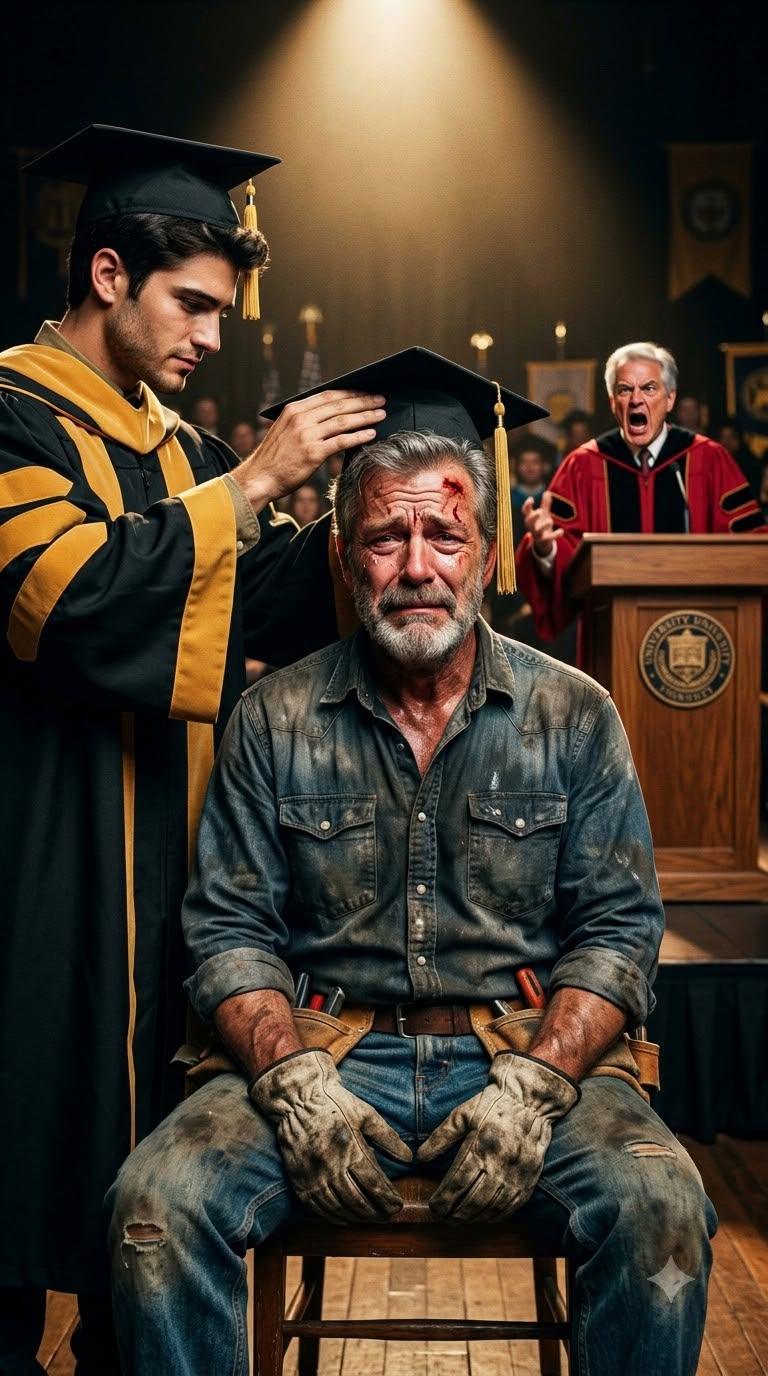
He was wearing a navy blue suit that he must have bought off the rack at a discount store. The shoulders were too wide, the sleeves too long, doing a poor job of hiding his missing fingers. He leaned heavily on a wooden cane, his bad leg dragging slightly with every step. He looked older, grayer, and entirely out of place in the sleek, modern terminal.
But his eyes found mine, and his face lit up with a smile so pure it made my chest ache.
“Leo!” he boomed, ignoring the sophisticated travelers side-eyeing him.
I walked toward him, forcing a smile, bracing myself for the collision of my two worlds. I hugged him, feeling the familiar, unyielding solidity of his chest.
“You made it,” I said, my voice tight.
“Told you I wouldn’t miss it,” he laughed, clapping me on the back. “Now, show me this fancy school of yours.”
I swallowed hard. Tomorrow was the defense. Tomorrow, I had to walk him through the campus. And I knew, with a sickening certainty, that keeping him hidden from the judging eyes of Harvard was going to be impossible.
The real test wasn’t the dissertation. The real test was whether my house of cards would survive the morning.
Chapter 3: The Collision of Worlds
The morning of the defense, the Boston sky was a crisp, unforgiving blue. The gothic spires of the engineering buildings looked sharper than usual, standing like silent sentinels ready to pass judgment.
I walked Arthur through the main courtyard. Every step he took was accompanied by the heavy thud-click of his cane. He was marveling at the architecture, pointing out the load-bearing arches and the masonry work with genuine, unpretentious awe.
“They built this to last a thousand years, Leo,” he said, running his rough hand over a stone pillar. “You can feel the pride in the mortar.”
I was hyper-aware of everything. I noticed the glances from passing undergraduates. I saw a group of professors in tweed jackets pause their conversation to look at the limping man in the ill-fitting suit. I felt my face burning. I wanted to usher him quickly into the building, into the safety of the back row of the auditorium, where the shadows could swallow him.
“It’s impressive, Dad,” I murmured, checking my watch for the fifth time. “We should get inside. The committee doesn’t tolerate tardiness.”
“Right, right. Don’t want to upset the big bosses,” he chuckled, adjusting his cheap tie.
We were fifty yards from the entrance of the auditorium when I heard it.
“Leo! Hold up a second.”
I froze. My blood turned to ice water.
Strolling down the manicured path, flanked by two other graduate students, was Bradley Sterling. He looked like he had stepped out of a catalog for Ivy League perfection—tailored charcoal suit, perfectly coiffed hair, a leather briefcase swinging casually from his hand.
“Morning, Bradley,” I managed to say, my throat suddenly dry.
Bradley’s eyes slid off me and landed squarely on Arthur. He took in the cheap suit, the cane, the awkward posture. A micro-expression of aristocratic amusement danced across his features before he smoothed it into a mask of polite curiosity.
“I don’t believe we’ve been introduced,” Bradley said, extending a hand toward Arthur. His tone was perfectly civil, but I could hear the subtle, patronizing edge beneath it. It was the tone one used when speaking to the help.
Arthur didn’t hesitate. He shifted his cane to his left hand—the hand missing two fingers—and reached out to shake Bradley’s hand with his right. I saw Bradley’s eyes flick down to the mangled left hand, a brief flash of disgust crossing his face.
“Arthur Vance,” my stepfather said, his grip firm. “Leo’s dad.”
“Fascinating,” Bradley murmured, retracting his hand perhaps a second too quickly. “I’m Bradley. A colleague of Leo’s. We’re both up for the Thurston today.” Bradley looked back at me, his eyes gleaming with malicious realization. He had found the crack in my armor. He had found the truth I had hidden so well.
“You must be very proud,” Bradley continued, turning back to Arthur. “It’s quite a leap, isn’t it? From… well, wherever you hail from, to the apex of academia. I imagine the culture shock is quite dizzying for you.”
The insult was wrapped in velvet, but it was a blade nonetheless. I felt a surge of hot, violent anger rise in my chest. I wanted to step between them. I wanted to tell Bradley to shut his mouth. But if I caused a scene now, right in front of the department, my chances at the fellowship would evaporate.
I remained silent. A coward’s silence.
Arthur, however, didn’t flinch. He looked at Bradley, his expression calm, his weathered face completely unbothered by the psychological games of a twenty-something heir.
“No shock at all, son,” Arthur said quietly, his voice carrying the deep, resonant gravity of a man who had faced worse things than a rich boy’s sneer. “Bricks are bricks, whether you lay them in Ohio or in Boston. The only difference is how much people pretend they didn’t get their hands dirty building it.”
Bradley’s smile stiffened. The velvet had been stripped away.
“Well,” Bradley clipped, checking his gold Rolex. “We should get inside. The Inquisition awaits.” He turned on his heel and walked away, his entourage trailing behind him.
I let out a breath I didn’t know I was holding. I looked at Arthur, shame burning a hole through my stomach.
“Dad, I’m sorry about him. He’s…”
“He’s a boy who’s never had to carry anything heavier than a textbook,” Arthur interrupted gently, patting my shoulder. “Don’t let him get in your head, Leo. You earned your place here. Now go prove it.”
We walked into the building. I led Arthur to the auditorium where the defenses were being held back-to-back. I found him a seat in the very last row, in the dim lighting beneath the mezzanine.
“I’ll be right here,” he whispered, squeezing my arm. “Deep breaths.”
I walked down the long, sloping aisle toward the stage. The room was cavernous, designed to make the speaker feel small. I arranged my notes on the podium, my hands trembling slightly.
I looked up at the long mahogany table where the committee would sit. The side doors opened, and the faculty filed in.
And then, walking at the front of the pack, came Professor Thomas Harrison.
He was a tall, imposing man in his late sixties, with sharp, hawkish features and silver hair pulled back tightly. He possessed an aura of absolute, terrifying authority. As he took his seat at the center of the table, he didn’t look at me. He opened my dissertation manuscript, uncapped a red fountain pen, and looked up, his eyes cold and calculating.
“Mr. Vance,” Professor Harrison’s voice echoed through the microphone, chilling the room. “Let us begin. And I assure you, we will not be gentle.”
Chapter 4: The Inquisition
The title of my dissertation was projected in stark black letters on the massive screen behind me: Structural Failure and Blue-Collar Casualties in Budget Construction: A Post-Mortem Analysis of Stress Tolerances.
It was a risky topic. Most of my peers, like Bradley, chose abstract, theoretical models. They designed impossible bridges for the future. I chose to look backward, into the dirt and the rubble, analyzing why cheap buildings collapsed and killed the people forced to build them. I had poured my soul into it, analyzing material degradation, corner-cutting in commercial contracts, and the exact mathematical point where a structure decides it can no longer hold the weight of human greed.
For the first twenty minutes, my presentation was flawless. I moved through the slides, my voice steadying as the data anchored me. I could see some of the junior faculty nodding in agreement.
Then, Professor Harrison raised his hand. The room instantly fell silent.
“Mr. Vance,” Harrison began, leaning back in his leather chair, tapping his red pen against his chin. “Your premise relies heavily on the assertion that catastrophic failure in these specific commercial frameworks is primarily due to material fatigue accelerated by improper load distribution. Specifically, your Chapter Four analysis of the ’93 Chicago collapse.”
“Yes, Professor,” I replied, gripping the edges of the podium.
“I find your mathematical models… quaint,” Harrison said, the word dropping like a stone. “You assert that a standard I-beam, under sudden dynamic loading caused by a secondary support failure, will buckle within 4.2 seconds. You’ve modeled this beautifully on a computer.”
He leaned forward, his eyes locking onto mine with predatory intensity.
“But you fail to account for the human element in emergency bracing. You treat the structure in a vacuum. If a secondary support fails, on-site crews often engage in immediate, improvised load transfer. Your math assumes they just stand there and watch it fall. Your conclusion that the collapse was mathematically inevitable is flawed because you lack an understanding of the practical, chaotic reality of a failing site.”
Panic flared in my chest. He was trapping me. He was shifting the debate from theoretical math to practical application—an area where he had decades of field experience, and I only had simulations.
“Professor,” I stammered slightly, “the improvised load transfer you refer to is highly unpredictable. My model focuses on the structural limits assuming standard safety protocols fail…”
“Standard protocols always fail in a collapse, Mr. Vance!” Harrison barked, his voice echoing off the high ceiling. “That is the nature of a disaster! You are sitting in an ivory tower, crunching numbers, completely disconnected from the visceral reality of a thousand tons of steel coming down. You claim to understand blue-collar casualties, but your math is sterile. It lacks blood.”
I saw Bradley Sterling in the front row, a smug, satisfied smirk playing on his lips. The Thurston Fellowship was slipping through my fingers like sand.
“I…” I swallowed hard, my mind racing. I needed to counter him. I needed to explain that I understood the human element better than anyone in this room, because I had seen its scars on my stepfather’s body. But the words wouldn’t come. The Imposter Syndrome clamped its jaws around my throat.
I don’t belong here, the voice in my head screamed. He knows. He sees right through you.
“If you cannot defend the practical application of your theory,” Harrison said coldly, preparing to write something damning in his notes, “then this dissertation is nothing more than an exercise in speculative fiction.”
He lowered his head to write.
I looked up, desperate, my eyes searching the vast, shadowy auditorium. I looked past Bradley’s smirk. I looked past the imposing faculty. My eyes found the back row.
Arthur was leaning forward in his seat. He wasn’t looking at the screen. He was looking directly at me. He didn’t offer a reassuring smile. He just gave me a slow, firm nod. You build your mind, and no one can ever tear it down.
I took a deep breath. The panic receded, replaced by a sudden, fierce clarity.
“Professor Harrison,” I said, my voice ringing out louder than before.
Harrison paused, his pen hovering over the paper. He looked up, irritated by the interruption.
“With respect, sir, you are incorrect,” I stated.
A collective gasp rippled through the graduate students in the room. You did not tell Thomas Harrison he was incorrect.
“My math is not sterile,” I continued, stepping away from the podium, leaving my notes behind. “I factored out improvised load transfer not because I don’t understand it, but because relying on human flesh to brace failing steel is not an architectural variable. It is a catastrophic failure of engineering.”
I locked eyes with Harrison, channeling every ounce of Arthur’s quiet strength.
“You say I don’t understand the visceral reality,” I said, my voice vibrating with controlled emotion. “But I know exactly what happens when an I-beam slips. I know that the human element you speak of means a worker throwing his own body against a structural flaw to buy time for others. I know it results in shattered femurs, amputated fingers, and a lifetime of chronic pain. My dissertation doesn’t ignore the blood, Professor. It demands that we stop relying on it to fix our bad math.”
The room was deathly quiet. Harrison stared at me, his jaw tight. He opened his mouth to deliver a crushing rebuttal.
But as he raised his head, his gaze drifted past me. He looked up toward the back of the auditorium, perhaps looking for the clock, or perhaps just reacting to the intensity of my statement.
Suddenly, Harrison froze.
The color vanished from his face. His hand, still holding the red pen, began to tremble violently. The pen slipped from his fingers, clattering loudly onto the mahogany table.
“Professor?” one of the junior committee members whispered, leaning over. “Are you alright?”
Harrison didn’t answer. He stood up slowly, pushing his chair back. His eyes were wide, fixed with terrifying intensity on the shadows beneath the mezzanine.
He wasn’t looking at the clock. He was looking at Arthur.
Chapter 5: The Architect of My Soul
The silence in the auditorium stretched until it felt like a physical weight. Every head in the room turned to follow Professor Harrison’s gaze, tracking it up the center aisle to the very last row.
Arthur sat there, frozen, his hands gripping the head of his wooden cane. He looked terrified, shrinking into the cheap fabric of his suit, clearly believing he had done something to ruin my defense.
Harrison stepped out from behind the long committee table. He bypassed the stairs, practically jumping down to the main floor. He began to walk up the center aisle. His usually impeccable posture was gone; he walked with a desperate, hurried stumble.
“Professor Harrison?” Bradley Sterling called out from the front row, sounding confused and annoyed that the spotlight had shifted.
Harrison ignored him. He didn’t stop until he reached the back row. He stood at the edge of the aisle, breathing heavily, staring down at my stepfather.
For a long moment, nobody moved. The great Thomas Harrison, the terror of the engineering department, looked as though he had seen a ghost.
“It’s you,” Harrison whispered. His voice was cracked, devoid of its usual booming authority. It carried through the silent room without a microphone.
Arthur looked up, swallowing hard. “I’m sorry, sir,” he said, his gravelly voice trembling. “I’m just here for Leo. I didn’t mean to disrupt the boy’s test.”
“Thirty-two years ago,” Harrison said, tears suddenly welling in his fierce eyes, “in the winter of ’94. The commercial high-rise project in downtown Columbus.”
Arthur’s eyes widened. He gripped his cane tighter. He recognized the man now.
Harrison turned his head slightly, addressing the dead-silent auditorium, but his eyes never left Arthur.
“I was a junior architect on that project,” Harrison said, his voice echoing off the walls, heavy with the weight of a decades-old confession. “I was twenty-five years old. Arrogant. Certain of my own genius. I signed off on a load-distribution modification for the central scaffolding to speed up the concrete pour. I bypassed the senior engineer.”
He looked back at Arthur, a single tear cutting a path down his weathered cheek.
“The structure failed,” Harrison continued, his voice breaking. “Five stories of steel and wet concrete began to collapse while thirty men were on the rig. I was trapped on the third level. A secondary beam gave way. It was going to crush me and two other men.”
Harrison dropped to his knees right there in the aisle, right beside Arthur’s chair. A collective shockwave rolled through the room. Bradley Sterling’s jaw actually dropped.
“But a foreman,” Harrison wept, looking at Arthur’s mangled left hand resting on the cane, “a man who was already safely on the fire escape… he ran back in. He wedged himself under that failing beam. He used his shoulder and his hands to hold thousands of pounds of collapsing steel just long enough for us to crawl out.”
Harrison reached out, his trembling hands gently hovering over Arthur’s ruined fingers, too reverent to actually touch them.
“The rig came down,” Harrison whispered. “They pulled him from the rubble hours later. He was rushed to the hospital. When I tried to find him days later to thank him… to beg for his forgiveness… the company had moved him. The contractors buried the incident. I never knew his name. I only remembered the man who gave up his body so I could live.”
Harrison looked up into Arthur’s face. “You are the man who saved my life. You are the reason I am here.”
Arthur looked down at the famous, powerful professor kneeling at his feet. The working-class man in the cheap suit didn’t gloat. He didn’t look vindicated. He just looked deeply, profoundly sad for the pain Harrison had carried.
With a groan of effort, Arthur forced himself to stand up. His bad leg wobbled, but he planted his cane and stood tall. He reached down with his right hand and gripped Harrison by the shoulder, hauling the professor back to his feet.
“You were a kid who made a mistake,” Arthur said softly, his voice echoing in the absolute silence. “I did what a man does when other men are in trouble. You don’t owe me a thing, Professor. You used your life to build good things. That’s enough.”
Harrison wiped his face with a trembling hand. He looked from Arthur, down to me, standing stunned on the stage. The realization clicked in his eyes.
“He is your father?” Harrison asked me.
“He’s my dad,” I said, my voice thick with emotion, the shame that had haunted me for years evaporating into thin air.
Harrison turned back to the committee table. He didn’t return to his seat. He stood at the front of the room, regaining a fraction of his composure, though his eyes were still red.
“The committee does not need to deliberate,” Harrison announced, his voice steadying, finding its authority once more. “Mr. Vance, your understanding of structural failure is not theoretical. It is born of a profound, practical reality that most of us will never truly comprehend.”
He looked at Bradley Sterling, whose face was pale and furious, realizing he had just lost the game.
“Your methodology is sound. Your defense is flawless,” Harrison declared. “Congratulations, Dr. Vance. And it will be my personal honor to recommend you for the Thurston Fellowship.”
The auditorium erupted. It wasn’t polite, academic applause. It was a roar. Students and faculty were on their feet.
But I wasn’t looking at them. I dropped my notes, walked off the stage, and ran up the center aisle. I bypassed the clapping professors. I bypassed Bradley. I practically tackled Arthur, burying my face in his cheap, ill-fitting suit, sobbing openly.
He wrapped his massive, scarred arms around me, holding me tight, his own tears soaking into my collar.
“You did it, Leo,” he whispered in my ear. “You built it.”
Three years later.
The air in my office at Harvard University smells of old books, fresh coffee, and the faint, earthy scent of the potted tomato plant sitting on my windowsill. I am Dr. Leo Vance. I have the fellowship, the tenure-track position, and the respect of my peers.
Professor Harrison retired last year, but not before dedicating his final textbook to a man from Oakhaven, Ohio. Bradley Sterling took a job at a corporate firm in New York; we do not speak.
As for Arthur, he finally retired. The money from my fellowship allowed me to buy him and my mother a small house with a garden, and a roof that will never leak. His back hurts, and his limp is worse, but he spends his days growing tomatoes and fixing up old bicycles for the neighborhood kids.
Every time I look at my diploma on the wall, I don’t see my name. I see a rusted trailer park. I see a man working a graveyard shift in the freezing rain. I see a scarred hand reaching out in the darkness.
I may hold the title of Doctor. I may teach the brightest minds in the world how to build skyscrapers that touch the clouds. But Arthur Vance is the true architect. He didn’t just construct walls; he took a broken boy and built a man. He is the foundation upon which my entire world stands, a structure of love and sacrifice that will never, ever fall.
If you want more stories like this, or if you’d like to share your thoughts about what you would have done in my situation, I’d love to hear from you. Your perspective helps these stories reach more people, so don’t be shy about commenting or sharing.